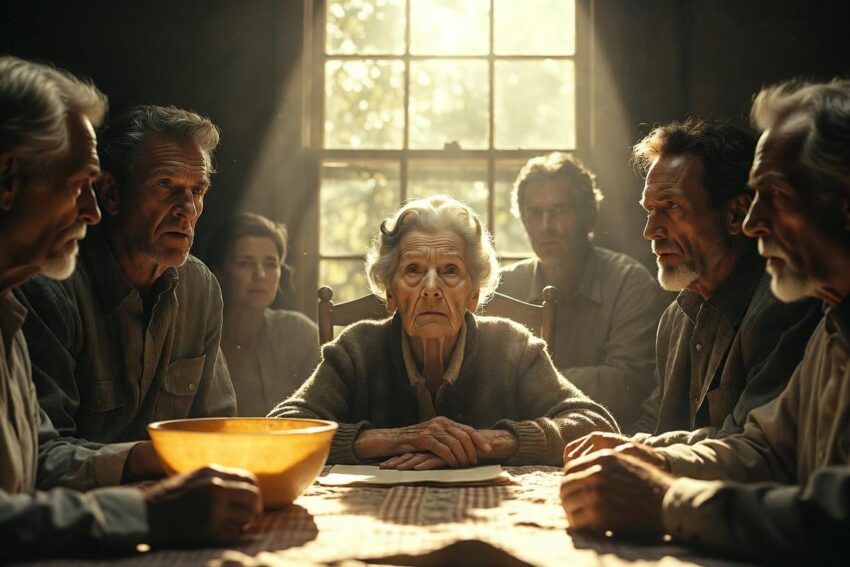
I had never once in my life heard my brother say anything so raw. My eyes welled up with tears, and I didn’t bother wiping them away.
Mama reached her left hand—the one that had healed—across the corner of the table, turning her palm upward. It took Ron a long moment to realize what she was offering. Then he let go of the table rim and rested his massive hand inside hers.
“I wasn’t crying out, Ronald,” she said gently.
He looked up at her.
“I called out twice. Then I knew full well nobody was within earshot, so I hushed up to keep my strength. Look at me, son. I wasn’t panicked the way you’ve built it up in your head. I was miserable cold, my wrist throbbed something terrible, and I was mad as hornets at myself for not watching that top tread. But I was lying where I could watch the swallows around the barn and look up at Harold’s pines. I talked to your father a little bit. I recited the Twenty-third Psalm, and whatever pieces of the hundred and twenty-first I could pull together. I thought to myself, well, Hazel, if your time has come, you’re on your own ground, and there are far worse places to leave this world.” She squeezed his thick fingers. “And then Dale came sputtering up on that noisy four-wheeler, and I thought, well, the Lord isn’t ready for you yet, Hazel, and now you have to ride into town looking like a fright in this housecoat.”
A ragged laugh broke out of Ron’s chest, cracking halfway through. Then his shoulders hitched, and that big, retired factory worker dropped his forehead down onto his mother’s hand and wept like a little boy.
Mama rested her right hand gently on the back of his grey head.
“There now,” she whispered softly. “There now. You’ve been dragging that around all summer.”
Paul looked straight up at the ceiling beams. Kevin pulled out a blue handkerchief and blew his nose with a loud honk. I sat there with cold potatoes on my plate and simply let the room breathe.
After a couple of minutes, Mama gave Ron’s shoulder two firm pats, the way she used to signal that recess was over, and he straightened up, wiping his face clean with his napkin.
“Now then,” Mama said, adjusting her sweater. “I am an old woman, but I’m not a fool. I took a bad fall, and I could easily take another. You’re dead right about those back steps, and you’re right that I shouldn’t be hauling laundry baskets up from the damp cellar. So here is how we’re going to handle this. You tell me what worries you, one item at a time, and we’ll fix the problem. We are not going to fix me.”
She turned her gaze straight down the table at me.
“And you took your sweet time speaking up, Cheryl.”
“I know, Mama.”
“Two whole years.”
“I know.” My throat felt tight. “I’m sorry. I started talking over you the morning we picked out the casket.”
“You did. And I let you do it. It was less fuss than speaking up, and I was bone-tired, and then it turned into a bad habit for both of us.” Her expression gentled. “Well. You found your voice. Now eat those potatoes before you hurt my feelings.”
I took a forkful of the potatoes. They were barely lukewarm and carried far too much pepper, but I wouldn’t have traded them for the finest meal on earth.
Kevin picked up the county tax bill. He pulled it out from beneath the gravy boat, wiped off a brown smear with the side of his thumb, and turned it over to the clean white backing. Right at the top, he wrote a neat number one.
“The back steps,” he announced. “That’s mine. That’s what keeps me up nights.”
“Paul?” Mama asked.
It was the first time anyone had asked Paul for his thoughts all afternoon. He leaned his forearms on the table.
“Sturdy handrails down both sides, bolted right into the foundation studs, not just tacked to the boards,” Paul said evenly. “Rubber traction strips glued across every tread. And I’ll put a grab bar in the shower while the drill is out. I can knock it out this coming Saturday. Lumber, lag bolts, and hardware—maybe a hundred and forty dollars.”
“I’ll cover the bill,” Ron offered immediately.
“I will cover it,” Mama corrected, “from my own bank account. Which brings us to number two.”
Kevin wrote down a two.
We spent the next hour working through that list. I cleared the meat platter and carried in fresh coffee and a warm apple pie, while they worked down the back of that envelope, untangling one fear after another.
The bank account was number two. Ron hesitated to hand the ledger back, until Mama pressed him and he admitted she had paid the propane company twice in January and forgot the fire insurance premium in May. She owned up to it without an argument. So they struck an agreement. The bills would arrive in her own metal box at the road, under her own name, and every Tuesday morning Ron would drive out from La Crosse so the two of them could sit together at the kitchen table with her checkbook and his reading glasses.
“You can check my math,” she warned him with a sharp look. “You will not write the checks for me.”
Number three was the washing machine. Paul and Kevin agreed to haul the washer and dryer up out of the dirt basement and install them on the enclosed back porch where there was already hot plumbing.
Number four was the forty minutes, though nobody used the phrase.
“They make a medical alert pendant,” Kevin said cautiously. “Hangs on a lanyard. Thirty dollars every month. You tap the center and it rings an operator.”
“I know what they are. Mrs. Gable wears one. She bumped it during the doxology in church and had three sirens in the parking lot.” Mama let out a small sigh. “I’ll wear the pendant.”
“And what about when you refuse to press it?” Ron pushed gently. “Because we know you, Mama. You’ll sit there on the floor thinking you don’t want to be a nuisance.”
She parted her lips, then closed them again. He had her cornered, and she knew it.
“The window shade,” I spoke up.
The whole table looked my way.
“The kitchen window shade. Mama pulls it open the minute she puts the coffee pot on the burner. Dale’s out checking his heifers by seven every morning along the fence line. If that shade isn’t pulled high by seven-thirty, Dale walks up and knocks. If she doesn’t open the door, he calls my cell.”
“That’s exactly how my mother and Lena Sorenson looked after each other for thirty years,” Mama murmured, her face lighting up. “A flour sack on the line meant stop by when you have a minute. No sack by midday meant drop everything and come running.” She gave a firm nod. “I can live with that. I’d be glad to do it.”
That brought us straight back to Dale, and the land itself.
“I won’t have this farm sold off,” Mama declared. “I’m not saying it won’t happen down the road. But not this fall, and not off some hasty scratchings on an envelope. But it makes no sense to let twenty-two acres of prime hay ground grow over with burdocks just because I’m too proud to let an engine on it. Dale needs grass for his stock. He can lease it.”
“What’s the going rate for pasture?” Ron inquired.
“Seventy-five dollars an acre is honest money for that ridge,” Kevin said, calculating on the paper. “Twenty-two acres comes to sixteen hundred and fifty dollars a year.”
“And the emergency button costs three hundred and sixty,” Mama noted, having worked out the figures before he even set his pencil down. “That leaves twelve hundred and ninety dollars. My real estate taxes were seventeen hundred and forty last winter. So the ridge ground pays for the alarm and covers three-quarters of the county tax, and I get a dependable neighbor driving through my pasture every morning for nothing.” She looked around the table, her eyes bright with satisfaction. “I’d say that beats twenty-eight thousand dollars and thirty-three cents any day of the week.”
“Twenty-eight thousand three hundred thirty-three,” Kevin corrected gently. “And thirty-three cents.”
“You can keep your thirty-three cents, Kevin.”
“Yes, Mama.”
“Now go dial Dale’s number. He’s sitting right by the kitchen phone. I told him Thursday he might be getting a ring once dinner was cleared.”