Those were honest worries. I had no simple solutions to give them. So I mostly kept quiet, nodding along, murmuring “I know” and “we’ll figure it out.”
That was my failure, and I won’t pretend otherwise.
My father, Harold, passed away two years before that Sunday dinner, slipping away peacefully in his sleep that October at eighty-eight. He and Mama had shared sixty-three years of marriage. And in the quiet aftermath of the service, without anyone ever saying a word out loud, the three of us simply took over speaking for Mama.
It started in small, harmless ways. Ron filled out the paperwork at the chapel because her hands shook too much to hold the pen. Kevin handled the insurance calls. I drove her in for checkups, and when the doctor asked how her nights were going, I’d jump in: “Not good, she’s awake by four in the morning,” while Mama sat silently on the crinkling exam table paper, clutching her handbag.
I ordered her prescriptions. I gave the updates in the church basement when neighbors inquired how she was holding up. At the supper club, I ordered her baked cod without ever asking what she had a taste for.
I convinced myself I was lightening her load. I thought taking every little burden made me a devoted daughter.
I run the lunchroom at the elementary school, and I’ve spent thirty years reminding little children to use their voices. Yet I never realized I had quietly taken away my own mother’s voice.
Paul saw it clearly. My husband has spent twenty-six years repairing school buses for the county fleet, and he’s the sort of man who sits quietly listening to an engine purr for ten minutes before he ever points to a part.
That morning, riding along the ridge road with the heavy roaster resting warm on my lap, I mentioned that Ron had called to say the boys had “figures to look over” after the blessing.
Paul kept his eyes on the asphalt for a good stretch.
“They ask Mama about any of this?” he asked softly.
“I doubt it.”
“You going to?”
I looked out at the rolling contour strips sliding past the glass—alternating rows of corn stubble and green hay wrapping the coulee ridges.
“They’re terrified, Cheryl,” he said gently. “Frightened men cling to hard figures. A number gives them something solid to lean on.” He slowed the truck at our turn. “Still, it’s her dining table.”
“I’m not trying to stir up an argument over pot roast.”
“Didn’t say to argue.”
He pulled up alongside the pump house, stepped out, and took the heavy roaster pan so I could turn the latch, saying not another word. That was Paul all over. He hands you the right tool and trusts you to turn the bolt.
Back at the table, Kevin had moved along to the furnishings.
“Dale doesn’t care for the household items,” he noted. “So we’ll call an estate auction. Or pick through what we want to keep and let the auctioneer take the rest.”
“The estate man out of Westby is solid,” Ron chimed in. “He handled the Miller place real smooth.”
“We can lot the heavier antiques separate. The cherry hutch. This walnut table. Dad’s oak chair ought to bring a fair dollar, it’s an authentic captain’s design.”
Mama’s fork clicked lightly against the edge of her porcelain plate. Just once. A quiet, dry ring.
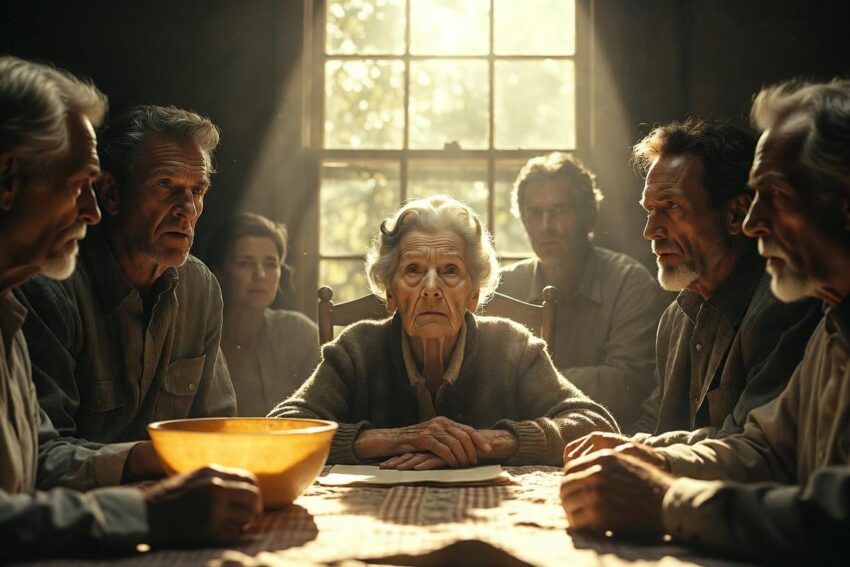
Daddy’s armchair stood tall at the far end of the table, facing her directly, right where it had sat for decades. Heavy quarter-sawn oak with curved armrests, older than me. The amber finish was rubbed down to bare wood in two smooth ovals right where his palms used to rest during the prayer. For two long years Mama had set a complete place setting right in front of that empty seat every single Sunday—plate, fork, folded napkin, and a water goblet. Not once had any of us asked why. We just passed the platters around it and kept right on chewing.
Under the tablecloth, Paul’s knee bumped gently against mine. He had set his silverware down. It wasn’t his family acreage and she wasn’t his mother; he knew better than to speak ahead of her own blood. But he was sitting beside me, letting me know he was there.
A dozen sharp words rose up to throw at my brothers, but every single one of them would just be another child talking over Mama in her own dining room.
Instead, I reached for the only words that mattered.
“Mama, would you pass those potatoes down this way?”
They rested right beside her left elbow in that old stoneware crock bowl. A heavy yellow dish, marked with a dark brown band around its middle and a nick on the rim from when I struck it with the masher back in 1977 and got sent to my room. She never let another living soul dish up those potatoes. They were her craft—whipped with sweet cream butter, whole milk, and far more black pepper than anyone ever expected.
Ron reached his arm across the table to grab the handles.
“She’s got it, Ron,” I said firmly.
He stopped short and stared at me.
Mama set down her fork. She wrapped both hands firmly around that heavy crock—the left wrist that had healed from the fall, and her right hand—and raised it up off the lace runner. It took effort. Her hands trembled slightly, and the silver spoon tapped against the stoneware rim—clink, clink—as a plume of buttery steam drifted past her bifocals.
She held it out toward me. I reached out and took the full weight of it, keeping my eyes locked straight onto hers.
“Mama,” I asked, clear and steady. “What is it you want to do?”
Kevin’s pencil froze right over the envelope.
“Cheryl,” Ron muttered under his breath, using the gentle tone he saves for nervous colts. “Don’t put her on the spot like that.”
“It’s her table, Ron.”
“We’re trying to carry the load so she doesn’t have to fret.”
“I know what you’re trying to do. I’m asking her anyway.” I set the warm bowl down squarely on my placemat without dishing a single spoonful. “Mama. The farm, the house, the fields. What do you want?”
Nobody took a bite. Nobody reached for a glass. Out through the kitchen archway, the old rooster wall clock ticked with a heavy, hollow thud I had never once noticed from the dining room before.
Then came the hardest part of all: staying completely quiet.
You’d think holding your tongue is simple. It isn’t. Ten agonizing seconds dragged by, and every fiber of me wanted to chatter just to break the silence. I wanted to tell her “You don’t have to answer right now,” or “I didn’t mean to upset things,” anything to smooth over the tension. Twenty seconds passed. Kevin shifted his weight, his oak chair groaning. Ron parted his lips to speak, but Paul—calm as ever—lifted two fingers an inch off the tablecloth, and Ron clamped his jaw shut.
Mama studied my face for a long, quiet moment. Then she turned her eyes on Ron. Then on Kevin. Then downward at the property tax assessment sitting under the gravy boat, where her legal name was printed in dark ink.
She reached up, slid off her glasses, and wiped both lenses along the hem of her knit sweater. Slow, steady circles. She held them up against the autumn window to check for spots, slipped them back over her ears, and folded her spotted hands together over the table.
“Well,” she spoke up, her voice clear as ice. “Seeing as somebody finally bothered to ask.”