You pour a fresh cup of coffee, sit down at the kitchen counter, and someone hits you with an addition problem so elementary that a fourth grader could solve it in under thirty seconds. You run the numbers in your head, completely confident. You blurt out your final total with a grin, only to have them shake their head and laugh. You fell right into the trap.
Do not feel bad. This specific mental math riddle has circulated across dinner tables, teacher lounges, and neighborhood group chats for years. It trips up engineers, accountants, and seasoned home planners alike. The beauty of this little puzzle is that it uses elementary school arithmetic to show off a fascinating blind spot in human cognition.

Morning coffee and a quiet five-minute brain exercise do wonders for mental clarity before the house wakes up.
Take the Mental Math Challenge: Count in Your Head
To experience the full effect, you must play by the house rules. Do not grab a scratch pad, do not open your phone calculator, and do not write digits on a napkin. Read through each line at a steady, rhythmic pace and keep the running tally strictly in your mind.
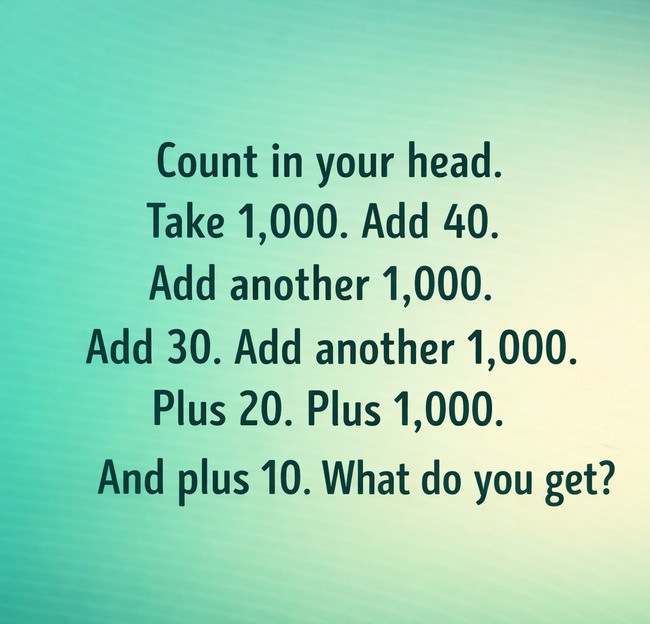
Start with 1,000.
Add 40.
Add another 1,000.
Now add 30.
Add another 1,000.
Plus 20.
Add 1,000 more.
And finally, add 10.What is your final total?
Did your mind land squarely on 5,000? If that was your immediate answer, take heart. Roughly nine out of ten people yell out five thousand without batting an eye. The real sum, however, is 4,100.
The Step-by-Step Breakdown: Where the Calculation Skips
When you see the actual math written out in clean columns, the arithmetic looks completely harmless. Let us walk down the list line by line:
- 1,000 (Starting point)
- 1,000 + 40 = 1,040
- 1,040 + 1,000 = 2,040
- 2,040 + 30 = 2,070
- 2,070 + 1,000 = 3,070
- 3,070 + 20 = 3,090
- 3,090 + 1,000 = 4,090
- 4,090 + 10 = 4,100
Every single step makes total sense on paper. Yet, when performed mentally, our working memory makes an unprompted leap at the very last second. Why does our inner calculator skip a beat right at the finish line?

Putting pencil to paper reveals exactly where our mental shortcuts skip ahead of our working memory.
The Cognitive Trap: Why Smart Brains Round Up to 5,000
Our brains are magnificent energy savers. They constantly look for patterns and predictable rhythms so they do not have to burn glucose recalculating standard formulas from scratch. In cognitive science, these mental shortcuts are called heuristics. Most of the time, heuristics help us pack school lunches, navigate morning traffic, and sort household laundry without mental exhaustion.
In this puzzle, the rhythm works against us. The alternating pattern sets up two parallel tracks of numbers: large base-ten units (1,000) and small descending decades (40, 30, 20, 10). Your brain splits the load, keeping track of the growing stack of thousands while tacking on the smaller double digits.
By the time you reach 4,090, your mental working memory is handling two pieces of data: four thousands and ninety tens. When the prompt asks you to add 10, your brain recognizes that 90 plus 10 reaches a clean century mark of 100. Because your tongue and mind are already primed by repeating “one thousand” four separate times, the brain takes the path of least resistance. It accidentally carries that newly formed 100 into the thousands column instead of the hundreds column, rounding 4,090 all the way to 5,000.
Phonetics and the Decade Roll-Over Error
There is also an auditory rhythm at play if you read the riddle aloud. The numbers sound heavy and rounded: one thousand forty, two thousand seventy, three thousand ninety, four thousand ninety. In casual English speech, moving from “ninety” to a round figure often feels like stepping into a whole new tier.
When you hear “four thousand ninety plus ten,” the mind rushes forward. The concept of “five thousand” sits right on the tip of your tongue because 4,000 was the last major milestone you registered. It takes active, conscious suppression to slam the brakes, hold the four thousand steady, and realize that 90 plus 10 simply gives you one hundred, landing neatly at 4,100.

Quick verbal riddles turn casual weeknight dinners into fun, unplugged challenges for everyone around the table.
How Mental Math Strengthens Everyday Focus
We live in an age where automated apps tally our grocery bills, split restaurant checks, and calculate hardware store measurements. Handing those tasks over to our phones is convenient, but our everyday mental sharpness pays a quiet price. Relying entirely on screens lets our raw numerical intuition grow rusty.
Working through quick puzzles like this is like doing a few morning stretches for your prefrontal cortex. It builds working memory capacity, which is the mental scratchpad you use to remember where you set your garden shears, how many cups of flour are already in the mixing bowl, or how much money remains in your monthly home improvement budget.
Try bringing this puzzle to your family table tonight. Dish up dinner, pour some sparkling water infused with fresh mint and crushed cucumber, and read the prompt out loud to the room. Watching family members furrow their brows and defend their answer of 5,000 before the penny drops is pure, unplugged entertainment.

Simple offline habits keep our thinking nimble and break our constant reliance on digital screens.
Four Quick Daily Habits to Keep Your Mind Sharp
If you want to keep your working memory active and resilient, you do not need complicated software subscriptions or hours of dry drills. Weave tiny cognitive challenges into your regular home routine instead:
- Tally the Grocery Cart: As you place produce, sourdough loaves, and pantry staples into your cart, round each item to the nearest dollar and maintain a running mental total. Check your mental sum against the register slip before you leave.
- Read Step-by-Step Instructions Once: When building flat-pack furniture or trying a fresh dinner recipe, read three steps ahead, put the paper down, and execute them from working memory rather than glancing back every three seconds.
- Play Offline Word and Number Games: Swap ten minutes of mindless social media scrolling for an old-fashioned paper crossword, a morning Sudoku over tea, or a card game with your kids.
- Practice Reverse Counting: Count backward from 100 by sevens while folding laundry or waiting for water to boil. It sounds simple, but subtracting sevens disrupts automatic rhythmic counting and forces your brain into full focus.
Our minds thrive when we nudge them out of auto-pilot mode. The next time a quick brain teaser catches you off guard, smile and take it as a friendly nudge from your brain to slow down, notice the fine details, and enjoy the process of thinking things through.