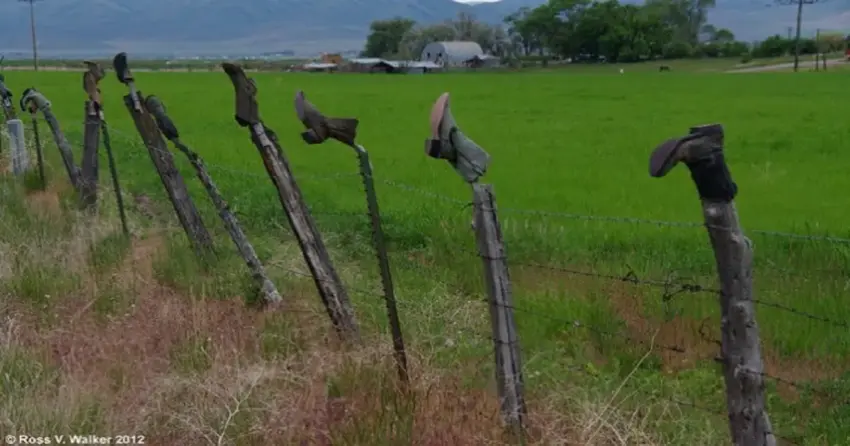
Drive down any two-lane county road across Texas, Montana, or Wyoming, and you will eventually spot it. Out past the cattle guards where the pavement gives way to crushed gravel, an old leather work boot sits upside down on top of a cedar post. Sun-bleached, stiffened by summer heat, and caked in dry clay, it rests there against a backdrop of open sky and barbed wire.
Most travelers glance at it through the windshield and chuckle, assuming it is just a bit of dry country humor. Others wonder if someone simply lost their footwear on a late-night walk home. But ask anyone who has spent their life mending wire, doctoring calves, or watching the sunrise from the seat of an old tractor, and they will tell you that boots on fence posts are rarely placed there by accident.
Sometimes the gesture is purely practical, born of thrift and hard-earned farm wisdom. Other times, it carries the weight of a quiet, pasture-side memorial. Here is the real story behind why those worn-out soles end up staring down at the dirt roads.
The Practical Farm Hack: Post Caps and Rust Prevention
Before diving into rural folklore, look at the unvarnished reality of maintaining boundary lines. Setting a fence is backbreaking labor. Digging post holes through rocky caliche or clay, tamping down dirt, and stretching high-tensile wire takes hours under a blistering sun. The last thing a rancher wants to do is replace those posts every few seasons.
Wooden fence posts rot from the inside out. When driving rain hits the flat, exposed top grain of a wooden post, water pools in the fibers. Frost gets in during the winter, cracking the wood wide open and giving fungus a permanent home. Capping that post with a thick rubber muck boot or an oiled leather work boot creates a durable umbrella. Rain rolls right off the heel instead of soaking the wood grain.
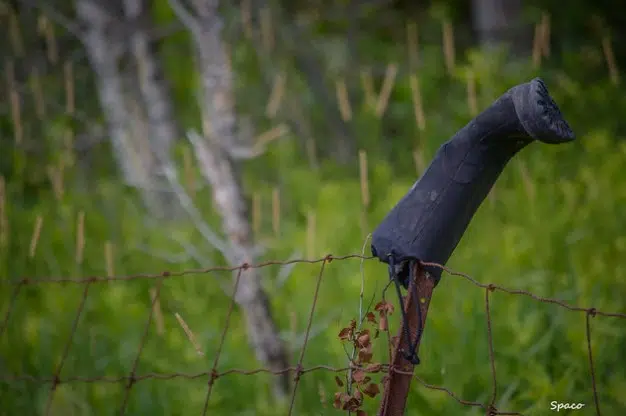
An inverted work boot caps a weathered steel post, shielding livestock from sharp edges while letting moisture run off harmlessly.
Steel T-posts carry their own set of hazards. The sheared top edges of modern metal posts are jagged and sharp. Curious horses leaning over the wire or steers crowding the fence line can easily slice their chests or necks open on an exposed corner. Sliding an upside-down boot over the steel tip acts as a soft bumper, protecting valuable animals from deep cuts and saving the rancher hefty vet bills.
Drying Out Leather and Evicting Ground Pests
There is also an everyday hygiene reason you might see boots on fence posts near a barn or pasture gate. Anyone who has spent twelve hours trudging through marshy creeks, irrigation ditches, or fresh spring mud knows what happens to heavy leather work footwear. It becomes soggy, heavy, and rank.
Leaving soaked leather boots sitting upright on a porch floor traps moisture inside the footbed, guaranteeing mold, mildew, and cracked leather by morning. Sticking them upside down on top of a post does two clever things at once:
- Maximum air circulation: The prairie breeze flows straight up into the shaft, drying the insole without baking the exterior leather against hot wood.
- Bug defense: Leaving boots sitting flat on the ground overnight turns them into prime real estate for brown recluse spiders, scorpions, and field mice looking for dark shelter. Raising them four feet off the dirt keeps unwelcome surprises out of your toe box when you pull them on at daybreak.
“A good pair of boots takes two years to break in and five minutes to ruin with damp rot. Putting them up where the wind can hit them is just common sense.”
The Cowboy Memorial: Honoring a Fallen Hand
Step away from the practical maintenance side, and you run directly into one of the most moving traditions in ranch country. Western life is traditionally reserved; folks rarely hold grand, noisy ceremonies or put up marble monuments across thousands of acres of private range. Instead, grief is handled quietly, within the rhythm of the land.
When a longtime ranch hand, family patriarch, or neighbor passes away, hanging their favorite work boots on the fence post outside the main gate serves as a heartfelt farewell. The symbolism is simple and profound: their daily chores are finished, their feet are finally resting, and their work on this earth is done.
In many regions, tradition dictates which way the toes point. Pointing the toes back toward the home ranch indicates that the person loved the spread and their spirit remains watching over the livestock. Pointing the toes toward the highway or the sunset suggests they have ridden on down the trail toward their final rest.
Remembering a Trusted Horse
It is not always a human being who receives this quiet tribute. In dedicated horse operations, a lone riding boot upside down on a pasture post often marks the loss of an exceptional gelding or mare. These were not just utility animals; they were partners who navigated treacherous rocky coulees, kept their heads during flash storms, and brought a rider safely home in pitch darkness.
When an animal like that reaches the end of the line, a rancher might take the single boot they wore during their best rides together and secure it over the pasture gate post where the horse used to wait for evening oats. It is an understated way of telling neighbors that an old companion has completed their final run.
Backroads Wayfinding: Country Mile Markers
Out where cellular signals flicker out and GPS maps display blank gray screens, navigation relies on memory, terrain, and odd markers. Directions in rural counties do not involve street lights or exit numbers. Instead, folks direct you by landmarks that have stood for decades.
You might be told to head three miles past the dry creek wash, watch for the old red barn, and take a sharp left right at the post with the scuffed roper boot. A distinctive boot works remarkably well as an informal highway marker. It catches the headlights of a pickup truck at night and stands out against miles of uniform green pasture or brown prairie grass.
Some landowners also use boots on fence posts to mark hidden hazards along their perimeter. A boot might flag a hidden irrigation culvert where a delivery truck could slide off the shoulder, or mark the boundary where one family’s grazing lease ends and another begins.
The Homestead Signal: “I Am Working on the Spread”
Long before two-way radios and smartphones, homesteaders developed visual shorthand to communicate with neighbors passing on horseback or in buckboards. An inverted boot on the post nearest the road was an easy signpost that saved people from wasting a trip down a half-mile gravel driveway.
If an extra pair of work boots was perched on the front fence, it signaled that the rancher was actively out on the property—tending the garden, turning irrigation water, or working in the machine shed. It told visitors to feel free to honk their horn or walk around back rather than knocking on a locked front door. Conversely, removing the boots showed that the hands had driven the team into town for supplies and would not be back until dusk.
Boot Retirement and Rural Whimsy
Not everything on a ranch comes wrapped in solemn tradition or clever mechanics. Sometimes, an old fence line is simply a showcase for dry country humor and frugal sentimentality. Ranchers hate throwing away items that have served them faithfully through years of sweat and grit.
When a pair of boots finally blows out its stitching, splits along the welt, and can no longer keep out morning dew, pitching them into a trash pile feels wrong. Mounting them on the fence line gives them an honorable retirement. Over time, neighbors add their own retired footwear, turning a half-mile stretch of cedar posts into an impromptu outdoor gallery of weathered cowhide, rubber chore boots, and tiny outgrown children’s boots.
It brings a smile to folks bumping down a lonely dirt road, reminding everyone that rural living is built on patience, hard work, and a healthy dose of humor.
What to Remember Next Time You Pass One
The next time you are traveling down an empty stretch of county highway and spot a lone, weather-worn boot perched atop a cedar post, take a second look. It might be shielding a good wooden post from rot, cushioning a steel edge against an inquisitive yearling, or marking a tricky turn for the mail carrier.
Or it might just be standing vigil for an old cowboy who spent fifty years walking that same dirt. Whatever the reason, that humble boot on a fence post is a quiet reminder of how much meaning, care, and practical grit can be tied to a simple stretch of barbed wire.