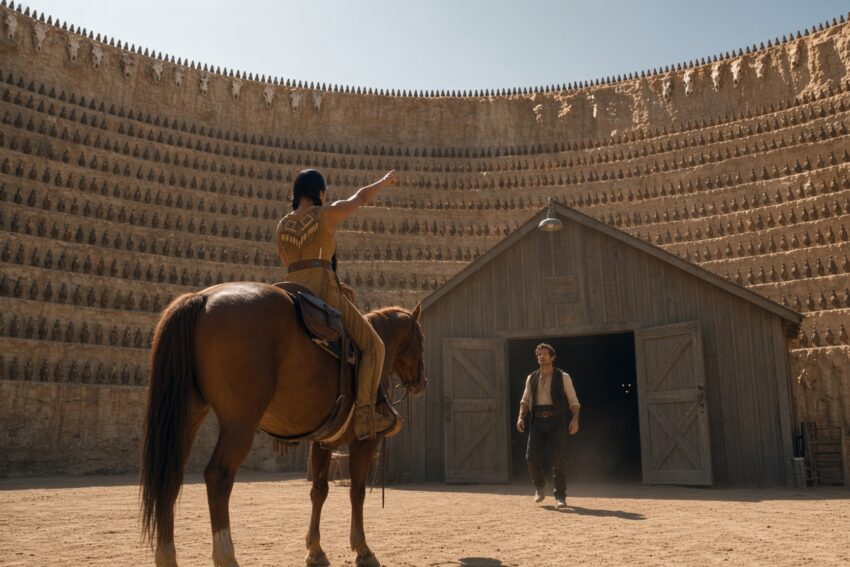
The Rancher Heard One Woman Call His Name—Then Five Hundred Apache Riders Appeared Above the Canyon Walls
PART ONE — THE NAME ABOVE THE CANYON
Silas Vance had spent fifteen years building a life around one simple certainty.
Nobody knew where to find him.
Then, on a hot September afternoon in 1883, a woman rode into his valley and called his name.
“Silas Vance.”
The hammer slipped in his hand.
He had been repairing the north door of the barn, where the summer wind had warped two planks apart. Behind him, three horses shifted beneath the shade roof. Beyond the corrals, Vance Valley lay silent between walls of red Arizona rock, narrow enough that every hoofbeat carried.
Silas stepped outside.
The woman waited fifty yards away on a chestnut mare.
She was perhaps thirty. Tall in the saddle. Dark hair braided behind her shoulders. Her buckskin clothing showed the dust of hard country, but neither she nor the horse looked exhausted.
She looked like someone who had arrived exactly where she intended to arrive.
Silas rested the hammer against his thigh.
“Do I know you?”
“No.”
“Then how do you know me?”
The woman lifted one hand and pointed toward the western wall of the canyon.
Silas followed her finger.
At first there was only stone, glare, and heat bending the air.
Then a horse stepped onto the rim.
Another appeared behind it.
Then six.
Twenty.
Silas stopped breathing.
Riders emerged along the high ridge in a long, deliberate line. Some wore broad hats traded from ranchers or soldiers. Others had cloth wrapped against the sun. Rifles rested across saddles, though no weapon was raised.
More riders appeared on the eastern rim.
Then above the narrow southern entrance.
Then on shelves of rock Silas had believed impossible to cross on horseback.
Fifty became a hundred.
A hundred became several hundred.
By the time the last column reached the upper ledges, the valley seemed ringed with mounted figures.
Nearly five hundred Apache riders watched from above.
Silas’s right hand drifted toward the revolver at his belt before he caught himself.
The woman noticed.
“If they meant to kill you,” she said, “you would not have heard your name first.”
It was not comforting.
“What do they want?”
“They are waiting.”
“For what?”
“For me.”
Silas looked back toward the ridges.
“To do what?”
The woman dismounted.
The chestnut mare stood without pulling at the reins.
“To decide whether you are the man my grandmother remembered.”
Something colder than fear moved through Silas then.
He had no wife. No children. No hired hands living on the property. The nearest settlement was Copper Mesa, thirteen miles east, and even there Silas rarely stayed long enough to be remembered.
He had chosen Vance Valley because it had one wagon road, one spring, poor grazing, and no reason for anyone ambitious to want it.
Now five hundred people had arrived for him.
The woman reached into a small leather pouch and removed an old brass key.
Its round bow was green with age.
“My name is Dyani.”
Silas did not take the key.
“My grandmother died twenty-one days ago.”
“I’m sorry.”
“She was eighty-two, or perhaps older. No one agreed.” Dyani looked toward the ranch house. “Before she died, she spoke one name.”
Silas already knew what name it had been.
He still said, “Whose?”
“Yours.”
He gave a dry laugh.
“You rode half an army into my canyon because an old woman said my name?”
“They came because of what she said after.”
Silas’s smile vanished.
Dyani held out the key.
He did not move.
“I never met your grandmother.”
“Yes, you did.”
“No.”
“You were seven.”
His stomach tightened.
Dyani saw it.
That bothered him more than the riders.
Silas had learned years ago to hide surprise because surprise invited questions. In Copper Mesa, people knew only that his father had died when Silas was young and that Silas had inherited enough money to buy poor land.
Both things were almost true.
Dyani turned toward the low adobe ranch house.
“The room beneath your kitchen.”
Silas stared at her.
“There is no room beneath my kitchen.”
“Then your father kept one promise.”
A rider began descending from the western wall.
Unlike the others, he came slowly, leading his horse down a steep trail Silas had never noticed. Age bent his shoulders but not his posture. Gray hair hung beneath a dark hat. A folded paper case lay across his saddle.
Dyani watched him approach.
“That is Tomas.”
“Your grandfather?”
“My grandmother’s younger brother.”
The old man dismounted and studied Silas without greeting him.
Silas suddenly understood why.
The man was comparing his face to another face.
His father’s.
Tomas opened the leather case.
Inside lay a yellowed sheet, creased into quarters.
A floor plan.
Silas recognized the handwriting before he read a single word.
Elias Vance.
His father.
His dead father.
The room dimensions had been written in pencil. Pantry. Kitchen. Stove. Interior wall.
And beneath the kitchen floor was a rectangle Silas had never seen.
CELLAR — EAST ACCESS.
A red X marked the center.
Silas took the paper.
For a moment the canyon disappeared.
He remembered his father at the kitchen table at night, writing by oil lamp.
He remembered being forbidden to enter the pantry after dark.
He remembered a sound beneath the floor once.
A thump.
Then voices.
His father had told him rats lived below the boards.
There had never been rats in Vance Valley.
Silas looked at Dyani.
“What was your grandmother’s name?”
“Isabel.”
The world tilted.
A child’s memory came back without permission.
Rain against the roof.
His father arguing with a woman.
A woman kneeling in front of Silas, pressing both hands around his seven-year-old fingers.
Dark eyes.
A scar near her mouth.
And a sentence he had forgotten for twenty-nine years.
If your father tells you to run, little hawk, you run toward the horses.
Silas whispered, “She called me little hawk.”
Dyani’s expression changed for the first time.
Not surprise.
Recognition.
“She said you might remember that.”
Silas walked away from them.
He reached the shade of the porch and stopped with one hand against a post.
His father had been dead twenty-eight years.
Silas had spent most of his life remembering Elias Vance as a hard, distant man who had moved from camp to camp, changed their surname twice, and taught his son never to answer questions about the past.
At twelve, Silas had buried him beneath a cottonwood after fever took him.
At twenty-one, Silas had found enough hidden money in his father’s saddlebag to buy this valley.
He had believed the hiding ended there.
Dyani approached but did not come onto the porch.
“My grandmother left instructions.”
Silas turned.
“What instructions?”
“That you open the room only after we returned.”
“You keep saying returned.”
She looked toward the riders.
“This valley was not always called Vance Valley.”
Silas’s grip tightened on the post.
“What was it called?”
“Home.”
A horse whinnied on the ridge.
Dyani continued quietly.
“Not to five hundred people. To families. To children. To my grandmother. To Tomas. To others who were forced away before I was born.”
Silas looked at the spring glinting beyond his corral.
He suddenly remembered stones he had dug up while building the barn foundation.
Worked stones.
Too square to be natural.
He had used them for the wall around his garden.
“What does that have to do with my father?”
“That,” Dyani said, “is why we need the room.”
They entered the ranch house together.
Tomas followed.
The riders remained above.
Silas pulled up the kitchen table. Dyani moved two chairs. Tomas stood in the doorway, his face unreadable.
There was no obvious hatch.
Silas dropped to one knee and examined the boards.
Nothing.
Then Dyani pointed.
“One board is shorter.”
Silas ran his fingers along the seam.
She was right.
The board beside the stove ended where all the others continued.
He brought in a pry bar.
The first plank rose with a squeal of old nails.
Then another.
Beneath them lay compacted earth.
Silas almost laughed from relief.
“No room.”
Tomas spoke for the first time.
“Dig.”
His English was quiet and exact.
Silas fetched a shovel.
Six inches down, the blade struck wood.
They uncovered a square trapdoor sealed with pitch.
At its center waited an iron lock.
Dyani placed the brass key in Silas’s palm.
“You open it.”
“Why me?”
“My grandmother insisted.”
“Why?”
“She never told me.”
Silas crouched beside the lock.
The key turned easily.
The trapdoor lifted into a smell of dust, dry earth, and old wood.
A ladder descended into darkness.
Silas lit a lantern.
The room below was no cellar.
It was too carefully made.
Stone walls.
Timbers.
Shelves.
A narrow table.
Two locked chests.
And on the far wall, painted in black, was a symbol Silas had seen hundreds of times without understanding it.
A crooked line crossed by three short marks.
The same symbol his father had carved beneath every saddle he owned.
Silas descended.
Dyani followed.
Tomas came last.
On the table sat a small wooden box.
Unlike everything else, it was covered in dust except for a single clean line where something had once rested.
Silas opened it.
Inside lay a folded note addressed in his father’s hand.
SILAS.
ONLY IF ISABEL RETURNS.
His heart struck once, hard.
Dyani whispered, “Open it.”
Silas unfolded the paper.
There were only six lines.
Silas—
If Isabel has returned, then I failed to do what I promised her.
Do not trust the county record.
Do not trust what I told you about Red Hollow.
The land was never mine.
And neither was the money.
Beneath the words was one final sentence.
Ask Isabel who died in your place.
Silas read it twice.
Then a third time.
Dyani stared at him.
“What does it mean?”
He looked up slowly.
“I don’t know.”
Above them, from somewhere outside the house, a rifle cracked.
One shot.
Then another.
Tomas extinguished the lantern.
Dyani drew a revolver.
Silas climbed the ladder first.
He emerged into the kitchen to hear horses pounding down the canyon road.
Not from the ridges.
From the eastern entrance.
Men were riding toward the ranch house.
Eight of them.
At their front was Clayton Boone, the wealthiest rancher in Copper Mesa.
And in his hand, snapping in the wind, was a folded county warrant.
Silas stepped onto the porch.
Clayton Boone reined in beneath the house.
His men spread behind him.
He glanced once toward the hundreds of Apache riders above the canyon.
Then he smiled at Silas.
“Seems we both picked the same day to come claim this place.”
PART TWO — WHAT ELIAS VANCE STOLE
Clayton Boone had wanted Vance Valley for six years.
Until that afternoon, Silas had assumed the reason was water.
Boone controlled nearly thirty thousand acres east of Copper Mesa, but two dry winters had reduced his southern tanks to mud. Vance Spring ran cold even in August, and Boone had offered increasingly large sums for Silas’s strip of canyon.
Silas had refused every offer.
Not because he loved the land.
Because it was the last thing his father had left him.
Now that reason had turned bitter.
Boone remained mounted.
“You’ve got company.”
“So do you.”
Silas glanced at the men behind him.
Boone’s smile thinned.
“This warrant comes from the territorial land office. An old survey correction puts the eastern half of this valley inside my family’s original grazing claim.”
“Your family never owned land west of the mesa.”
“That was before somebody found the missing survey book.”
Dyani appeared in the doorway behind Silas.
Boone’s eyes shifted to her.
Then to Tomas.
Something small passed through his expression.
Not surprise.
Recognition.
Silas saw it.
Dyani saw it too.
“Who is she?” Boone asked.
“None of your concern.”
Boone looked again toward the canyon rims.
“I’d say she brought enough concern for everybody.”
He dismounted and handed Silas the warrant.
The paper was real enough.
Territorial seal.
Clerk’s signature.
A reference to Survey Ledger 14.
Boone tapped the bottom line.
“Judge wants both of us in Copper Mesa tomorrow morning.”
Silas read the description.
Vance Spring.
North canyon.
Old mission stones.
He looked sharply at Boone.
“What old mission stones?”
Boone shrugged too quickly.
“I didn’t write it.”
Dyani stepped forward.
“You knew what this valley was called before Vance came.”
Boone studied her.
“What was it called?”
“Red Hollow.”
Silas watched his face.
Clayton Boone knew.
The rancher removed his hat and wiped sweat from his forehead.
“Lady, I know a lot of names for a lot of country.”
“My grandmother knew yours.”
That silenced him.
Not for long.
Boone put his hat back on.
“Then I’m sorry she carried grudges to the grave.”
Dyani’s voice hardened.
“She carried names.”
Boone turned toward Silas.
“Tomorrow. Nine o’clock.”
“And if I don’t come?”
“Then the judge rules without you.”
He mounted.
Before leaving, he looked toward the ridges one more time.
Hundreds of riders watched without moving.
Boone’s men were eager to leave.
Boone was not.
That unsettled Silas.
A man who could stand beneath five hundred armed riders and still think about land believed he possessed something stronger than courage.
He possessed certainty.
When Boone disappeared into the canyon, Silas turned on Dyani.
“You knew him.”
“No.”
“You knew the name.”
“My grandmother wrote it.”
“Where?”
Dyani’s silence gave the answer.
Silas looked toward the hidden room.
“You brought more than a key.”
“Yes.”
“What?”
“A list.”
She removed a small notebook from inside her clothing.
Six names filled the first page.
Elias Vance.
Clayton Boone.
Matthew Boone.
Henry Kessler.
Samuel Pike.
Jonah Reed.
Beside three names were crosses.
Beside two were question marks.
Beside Elias Vance was one word.
PROMISED.
Silas pointed at the book.
“What were they?”
Tomas answered.
“Men who came to Red Hollow in 1854.”
Silas felt the years rearrange themselves.
He had been born in 1854.
Dyani looked toward the kitchen.
“We should go below.”
“No.”
Silas’s voice surprised even him.
“For thirty years everybody who knew something has hidden it in a box, under a floor, behind a lie. We talk here.”
He dragged the table back into place but left the trapdoor open.
Tomas sat first.
Dyani sat across from Silas.
For several seconds no one spoke.
Then Tomas began.
In 1854, Red Hollow had not been a ranch.
It had been a seasonal place used by several Western Apache families connected through kinship and trade, valued for its spring, shade, and protected grazing for horses.
Tomas had been a boy.
Isabel had been in her early twenties and already married.
That spring, a group of white traders and ranchers began using the eastern approach.
Among them were Matthew Boone, Clayton’s father, and Elias Vance.
Silas interrupted.
“My father was twenty.”
“Twenty-two,” Tomas said.
“You knew him?”
Tomas nodded.
“At first, he traded fairly.”
Dyani opened the notebook.
“Isabel wrote that Elias learned enough Apache words to make jokes badly.”
Tomas almost smiled.
“He was very bad.”
It was such an ordinary detail that Silas found it hard to bear.
A monster would have been easier to accept.
Tomas continued.
Red Hollow became dangerous after cattle disappeared from a Boone herd.
Matthew Boone blamed local Apache families.
The families blamed thieves operating between settlements.
Tensions rose.
Then two Boone men vanished.
Three days later, armed men rode into Red Hollow.
Silas knew where the story was going before Tomas said it.
He stood.
“No.”
Tomas did not soften the truth.
“People died.”
“How many?”
“Enough.”
“That isn’t a number.”
“No,” Tomas said. “It is what remains when numbers stop helping.”
Silas paced to the window.
Outside, the ridges were still lined with riders.
Not an army, he realized now.
Families had sent representatives.
Dyani spoke.
“My grandmother survived because Elias warned her.”
Silas turned.
“What?”
“Your father rode ahead of the others that night. He told several families to leave the spring.”
Tomas added, “Some believed him. Some did not.”
The realization struck Silas harder than the accusation of theft.
His father had not simply joined whatever happened here.
He had tried to prevent part of it.
“Then why did he take the land?”
Tomas’s gaze hardened.
“Because warning people and stopping men are different things.”
Silas sat again.
After the violence, official records described Red Hollow as abandoned ground.
Matthew Boone wanted the spring.
Elias Vance objected.
The two men fought.
Not with guns.
With testimony.
Elias claimed families had lived there and intended to return.
Boone insisted the land was empty.
Several witnesses changed their statements.
Within months, a provisional claim appeared under Elias Vance’s name.
Silas frowned.
“That makes no sense.”
“It does,” Dyani said, “if the claim was temporary.”
She turned the notebook.
A copied line from Isabel’s writing read:
ELIAS HOLDS IT UNTIL WE CAN RETURN.
Silas stared at the sentence.
“My father claimed the valley for you?”
“For the families,” Tomas said. “That was the promise.”
The brass key lay on the table.
Its meaning changed.
It was not a key to buried wealth.
It was proof of unfinished custody.
Silas thought of the money in his father’s saddlebag.
And neither was the money.
“How much did he owe?”
Dyani shook her head.
“We don’t know.”
Tomas said, “Open the chests.”
They went below.
The first chest contained ledgers wrapped in oilcloth.
Not money.
Records.
Names.
Horse purchases.
Supplies.
Payments to merchants.
Payments received from unidentified sources.
Several pages carried Elias Vance’s handwriting.
Others were signed by Isabel.
Silas turned pages rapidly.
For nearly twelve years after Red Hollow, his father had been sending money west and south.
Food.
Horses.
Blankets.
Medicine.
Silas looked at Dyani.
“Why?”
“To families displaced from here.”
“So the money I found…”
“May have been what remained.”
Silas sat on the stone floor.
He had built fences with it.
Bought cattle.
Purchased seed.
He had spent another people’s relief money buying the land his father was supposed to return.
Dyani knelt opposite him.
“You were twelve when he died.”
“I was old enough to count.”
“You were not old enough to know what the numbers meant.”
“It doesn’t change what I spent.”
“No,” she said. “It changes why.”
It was the first kindness she had offered him.
Silas opened the second chest.
Inside lay only three objects.
A revolver wrapped in cloth.
A photograph.
And a sealed packet.
The photograph showed six men standing outside a crude timber building.
Elias Vance was one.
Matthew Boone another.
Silas recognized Clayton Boone’s father from a portrait in the Copper Mesa bank.
On the back were six names.
The same six from Isabel’s notebook.
All except one.
A seventh name had been scratched away.
Silas tilted the photograph toward the lantern.
The scratched figure stood at the far edge.
Only one hand and half a coat remained visible.
Dyani stared at it.
“My grandmother never mentioned seven.”
Tomas took the photograph.
His face changed.
He whispered something in Apache.
Dyani looked at him sharply.
“What?”
Tomas pointed to the surviving hand of the erased man.
Two fingers were missing.
Silas remembered Boone’s face when Dyani showed herself on the porch.
“Who was he?”
Tomas answered.
“Samuel Pike’s brother.”
The name meant nothing to Silas.
Dyani closed her eyes.
“It means something to me.”
She opened Isabel’s notebook to the final pages.
A name appeared repeatedly.
Aaron Pike.
Beside it Isabel had written:
THE MAN WHO TOOK THE CHILD.
Silas stopped.
“What child?”
Nobody answered.
He looked from Dyani to Tomas.
“What child?”
Tomas seemed suddenly very old.
Dyani spoke carefully.
“Your father told you your mother died giving birth?”
“Yes.”
“That is what Isabel believed too.”
Silas felt himself becoming angry because anger was simpler than fear.
“My mother’s name was Ruth.”
“Was it?”
He stood.
“Don’t.”
Dyani did not retreat.
“My grandmother wrote that after Red Hollow, a woman named Ruth traveled with Elias. She was badly wounded. Months later she gave birth to a boy.”
Silas stared.
“That proves nothing.”
“No.”
“Then stop looking at me like that.”
Tomas placed the old photograph down.
Dyani asked, “Do you have anything that belonged to your mother?”
Silas almost said no.
Then he remembered.
A cedar box beneath his bed.
Inside it was the only object his father had ever said belonged to Ruth.
A small silver necklace.
Silas brought it down.
Dyani saw it and went still.
The pendant was shaped like a narrow crescent, hammered by hand.
Tomas took one step backward.
“No,” he whispered.
Silas’s pulse hammered.
“What?”
Dyani looked almost shaken now.
“My grandmother owned the other half.”
She reached beneath her collar.
A nearly identical crescent hung there.
Not identical.
Complementary.
The broken edges matched.
Silas could not speak.
Dyani placed the pieces together in her palm.
They formed a small silver circle.
Inside the circle was an engraved bird.
A hawk.
Little hawk.
Silas’s chair scraped backward.
“My mother was Apache?”
Dyani shook her head.
“We don’t know.”
“You just—”
“The necklace belonged to sisters.”
Tomas finally looked at Silas.
“Isabel had a younger sister.”
The room seemed to shrink.
“What was her name?”
“Ruth was the name Elias used for her later.”
Silas’s throat closed.
“What was her name before?”
Tomas told him.
And Silas understood why his father had buried every trail leading to Vance Valley.
Not because Elias Vance had feared the Apache finding his son.
Because he had feared someone else finding him first.
Dyani turned the last unopened packet over in her hands.
Wax sealed the flap.
Across the front, in Elias Vance’s writing, were four words.
FOR SILAS AND ISABEL.
The wax broke beneath Silas’s thumb.
Inside was no deed.
No confession.
Only a faded birth record and a letter.
Silas read the first line.
Then stopped.
Dyani took his arm.
“What does it say?”
He gave her the page.
She read aloud.
“Isabel—if you are reading this, then Aaron Pike has failed to find the boy.”
Outside, five hundred riders began moving down from the canyon rims.
Not attacking.
Leaving their high positions and descending into the valley.
Dyani looked through the open door.
“Why are they coming down?”
Tomas stared at the letter.
“Because this is no longer only about land.”
Silas looked at the next line.
There, in his father’s hand, was the truth that changed his entire childhood.
Aaron Pike had not killed Ruth.
He had taken Silas.
And Elias Vance had taken him back.
PART THREE — THE BOY WHO WAS SUPPOSED TO DISAPPEAR
By dawn, Vance Valley no longer belonged to silence.
Cooking fires burned beneath the cottonwoods.
Horses grazed in long lines beyond Silas’s corrals. Children carried water from the spring under the eyes of grandparents who had heard about Red Hollow all their lives but had never seen it.
The five hundred riders had not come merely to confront a rancher.
They had come to witness whether an old promise survived.
Silas had not slept.
He sat on his porch with Elias Vance’s letter open across his knees.
Dyani joined him carrying two tin cups of coffee.
He accepted one.
Neither spoke for a while.
Finally Silas said, “You knew there might be family between us.”
“I knew my grandmother suspected it.”
“And you didn’t tell me.”
“She suspected your mother was her sister.”
“That seems worth mentioning.”
“She also suspected you might be dead.”
Silas looked at her.
Dyani continued.
“She had spent years believing Elias failed. Then three months ago, a trader passing through Copper Mesa mentioned a rancher named Silas Vance living alone in a hidden valley.”
“So she sent you.”
“No.”
“Then why are you here?”
“Because I promised her.”
That answer mattered more than Silas expected.
Dyani stared into her coffee.
“Grandmother could no longer ride. She asked me to find you, see the room opened, and learn whether Elias kept his word.”
“What happens if he didn’t?”
“I decide whether to forgive a dead man.”
Silas gave a quiet laugh.
“That seems unfair.”
“To the dead?”
“To you.”
For the first time, Dyani smiled.
“Maybe.”
A boy of about ten approached carrying a rope halter.
He said something to Dyani.
She answered.
The boy looked at Silas, pointed toward Silas’s gray gelding, and grinned.
“What did he say?”
“He says your horse has poor manners.”
“He has excellent manners.”
The gray chose that moment to bite the top rail.
The boy laughed.
Silas muttered, “Traitor.”
Dyani’s smile widened.
It was a small thing.
But after a night in which Silas had learned his mother’s name was not the name he knew, that his father had recovered him from an abductor, and that his ranch had been built on a promise to people now sleeping beneath his cottonwoods, the laugh gave him something solid to stand on.
Then a rider came hard through the eastern gap.
Dyani rose immediately.
The rider brought a telegram.
Not for Silas.
For Clayton Boone.
He had intercepted the messenger on the Copper Mesa road.
Silas read it.
TERRITORIAL LAND HEARING ADVANCED. JUDGE HOLLIS TO ARRIVE VANCE VALLEY NOON. CLAIMANT BOONE REQUESTED EMERGENCY POSSESSION DUE TO ARMED OCCUPATION.
Silas frowned.
“He called you an armed occupation.”
Dyani folded the telegram.
“He wants the judge frightened before he arrives.”
Tomas came over.
Silas handed him the message.
Tomas read it, then looked toward the hundreds of horses.
“He will be frightened.”
Dyani said, “Then we reduce the reason.”
Within an hour, most rifles were bundled and placed beneath guarded canvas shelters far from the ranch house.
It did not make the riders defenseless.
It made their purpose unmistakable.
Witnesses.
Not raiders.
Silas watched Dyani organize the valley.
She listened more than she commanded. Older men disagreed with her openly. Two women argued over whether any county judge deserved to hear the story. A younger rider demanded they refuse all negotiations.
Dyani answered every objection.
Not with mystery.
Not with grand speeches.
With consequences.
“If we frighten the judge away, Boone wins the story.”
“If we leave, Boone wins the ground.”
“If we fight, the dead become an excuse for more dead.”
Silas finally understood why so many people had followed her.
Not because she had inherited authority from Isabel.
Because she had earned enough trust to carry a difficult question.
At noon, Judge Hollis arrived in a buckboard accompanied by the county clerk, Clayton Boone, four armed men, and Sheriff Amos Bell.
Bell had arrested Silas twice in his youth for fighting.
He took one look at the valley and muttered, “Vance, one day I’d like to visit you and find nothing complicated.”
“Come next Tuesday.”
The sheriff snorted.
Boone did not.
The hearing took place beneath the cottonwoods because no building could hold everyone who wished to watch.
Judge Hollis refused to begin until the immediate area was cleared to thirty people.
Dyani selected representatives.
Tomas stayed.
Several elders and family leaders joined them.
Silas noticed disagreements even there.
Not everyone believed the valley should be reclaimed.
One older woman said the place held too much grief.
A younger man wanted the spring but not the ranch buildings.
Another insisted the question was not ownership but acknowledgment.
They were not of one mind.
That mattered.
It made Boone’s repeated claims sound hollow.
The hearing began with Boone’s survey.
Ledger 14 appeared genuine.
The eastern half of Vance Valley had, on paper, been attached to Matthew Boone’s claim in 1855.
Silas produced Elias Vance’s ledgers.
The clerk examined them.
Judge Hollis asked, “Mr. Vance, are you disputing Mr. Boone’s boundary?”
Silas looked at Dyani.
“No.”
Boone smiled.
Silas continued.
“I’m disputing the idea that either of us started with lawful ownership.”
The smile disappeared.
Silas told the story of Red Hollow.
Not all of it.
Only what documents supported.
Boone objected repeatedly.
Then Tomas testified.
He described families using the spring before 1854.
He described Elias warning them.
He described the violence.
Boone stood.
“This is thirty-year-old memory.”
Tomas looked at him.
“It is older than your paper.”
Judge Hollis ordered Boone to sit.
Then Silas introduced the photograph.
The erased seventh man drew attention.
Boone claimed ignorance.
Dyani placed Isabel’s notebook beside it.
Judge Hollis turned several pages.
“Who was Aaron Pike?”
Clayton Boone answered too fast.
“Nobody.”
Silas said, “You know the name.”
“I know plenty of Pikes.”
“You knew this one.”
Boone’s jaw tightened.
Silas did not push.
Not yet.
The mid-story truth had become an advantage.
But the strongest evidence remained Elias’s letter.
Silas had not decided whether to read it publicly.
The letter exposed his mother.
His father.
His childhood.
It explained that after the attack on Red Hollow, Ruth survived and traveled with Elias.
She gave birth months later.
Aaron Pike, furious that Elias intended to challenge the land seizures and document who had lived at the spring, abducted Silas when he was an infant.
Pike planned to use the child to force Elias into silence.
Ruth died before Silas was recovered.
Elias pursued Pike for almost a year.
When he finally found the boy, Pike escaped.
Elias changed names, traveled constantly, and eventually returned to Red Hollow because he believed hiding in the place Pike least expected was safer than running forever.
One line mattered most.
I told Silas his mother died bringing him into the world because I could not tell a child that she died bringing him back to me.
Silas had read that line until sunrise.
It did not absolve his father.
But it changed how he saw him.
Elias Vance had not been a cold man incapable of care.
He had been a frightened man who confused secrecy with protection until secrecy became his only habit.
Judge Hollis asked again for the letter.
Silas hesitated.
Dyani leaned toward him.
“You don’t owe them your mother.”
He looked at her.
The decision became clear.
“I owe her the truth.”
He handed the judge the page.
Hollis read silently.
Boone grew pale.
Sheriff Bell noticed.
“So did you know Aaron Pike?” Bell asked.
Boone snapped, “I said no.”
A voice came from behind the spectators.
“I did.”
Everyone turned.
An elderly man stood beside the corral fence.
He had arrived unnoticed with the judge’s wagons.
Silas recognized him only after the man removed his hat.
Samuel Pike.
One of the six names in Isabel’s notebook.
He was eighty if he was a day.
Two fingers were missing from his left hand.
Silas looked at the photograph.
Not the erased man.
His brother.
Samuel stepped forward.
“My brother Aaron was the seventh man.”
The entire hearing shifted.
Boone stood.
“You should keep walking.”
Samuel ignored him.
“I came because the judge sent word asking about Ledger 14.”
Judge Hollis frowned.
“I sent no such word.”
Sheriff Bell looked at Boone.
Boone’s face went rigid.
Samuel gave a dry laugh.
“Then somebody wanted me here.”
Dyani glanced toward Tomas.
The old Apache man lifted one eyebrow.
Silas understood.
Tomas had sent for him.
Samuel sat and told the rest.
Aaron Pike had altered parts of the survey record after Red Hollow.
Not alone.
Matthew Boone helped him.
Their goal was to split the valley between ranching claims before displaced families could return or challenge possession.
Elias discovered the plan.
That was why his temporary claim existed.
He filed first to block Boone.
But Elias never trusted the county office enough to record the private agreement naming the original families.
Instead, he hid the proof.
Silas looked toward the open kitchen door.
The hidden room.
“What proof?”
Samuel looked at Tomas.
Tomas answered.
“The floor plan was not only a map to the room.”
Silas’s pulse quickened.
They returned below.
Twenty people crowded around the hatch.
Tomas took the old floor plan and held it over the lantern.
Nothing happened.
Then Dyani touched the paper.
“Turn it.”
On the back, nearly invisible beneath age stains, lines formed a second drawing.
Not the house.
The spring.
Three stones beside it.
Silas knew them.
He had known them all his life.
Large flat rocks at the north edge of the water, where he sharpened tools.
They dug there until sunset.
Under the middle stone sat a sealed iron tube.
Inside were affidavits.
Six statements.
Three signed by traders.
Three marked by Apache witnesses whose names Tomas recognized.
The documents described Red Hollow before the attack and stated Elias Vance held the claim only as temporary protection until surviving families could safely return.
The final document carried Matthew Boone’s signature.
Clayton Boone sank onto a chair.
Silas stared at him.
“Your father admitted it.”
Boone looked up.
“My father was dying.”
“So?”
“So dying men sign things they regret.”
Dyani said, “Do living men?”
Boone turned on her.
“You think this ends with paper? You think the territory gives five hundred Apache families a spring because dead men said they camped here?”
“No,” Dyani replied. “I think it begins with paper.”
Judge Hollis recessed the hearing until morning.
Boone was finished before the ruling.
Everyone could see it.
His emergency claim had depended on Ledger 14.
Ledger 14 was compromised.
His father’s signature contradicted his ownership argument.
It should have felt like victory.
That evening, Silas walked alone to the spring.
Dyani found him there.
“You won,” she said.
“No.”
“Boone will lose the claim.”
“That isn’t the same thing.”
She waited.
Silas picked up a pebble and dropped it into the water.
“I spent fifteen years defending land that was never mine.”
“You kept it from Boone.”
“By accident.”
“Results can matter even when intentions are ordinary.”
He looked at her.
“What do you want?”
“The truth?”
“Please.”
Dyani sat on one of the flat stones.
“My grandmother wanted this place returned.”
Silas nodded.
“But my mother wanted nothing to do with it. Tomas believes families should share access. Some want settlement here again. Some want only the spring protected. Some want the place left mostly empty because too many relatives were lost nearby.”
Silas frowned.
“So five hundred riders came without agreeing what to do if I opened the room?”
Dyani smiled faintly.
“That is what families do.”
He laughed quietly.
Then she became serious.
“What do you want?”
Silas looked toward his house.
The barn.
The fences.
The cottonwood beneath which he had buried his dog.
The kitchen where his father had kept secrets to protect him.
The hidden room where another promise had waited longer than Silas had been alive.
“My whole life is here.”
“I know.”
“I don’t want to leave.”
“I know.”
“And I don’t want to become the man who says that means everyone else must.”
Dyani watched him closely.
“What are you offering?”
Silas looked at the spring.
“Not offering.”
He corrected himself.
“Returning.”
The word was hard to say.
That told him it was the right word.
Before Dyani could answer, three shots echoed from the eastern ridge.
Then shouting.
A horse came running riderless into camp.
Sheriff Bell sprinted from the ranch house.
“Boone’s gone.”
Silas stood.
“What?”
“So is Samuel Pike.”
Dyani’s expression changed.
Tomas appeared from between the fires carrying Samuel’s abandoned coat.
There was blood on the sleeve.
Boone had lost the land hearing.
Now he had taken the only living witness who could prove the survey fraud.
And somewhere beyond the canyon wall, men who still believed documents could be silenced were riding into darkness.
PART FOUR — THE SPRING THAT REMEMBERED EVERYONE
Silas saddled the gray before Sheriff Bell finished organizing a posse.
Dyani reached the corral with her chestnut already bridled.
“You’re not coming.”
She stared at him.
“Try again.”
Silas tightened the cinch.
“This is Boone.”
“And Samuel testified for my family.”
“There may be shooting.”
“There may be rain tomorrow too.”
He looked toward Tomas for support.
Tomas walked past them carrying his saddle.
Silas exhaled.
“Fine.”
Dyani mounted.
“That was easier.”
Twenty riders left the valley.
Not five hundred.
Sheriff Bell chose six deputies and men he trusted. Dyani brought Tomas and six Apache riders familiar with the high trails.
Silas led because he knew Boone’s grazing country.
They followed tracks east beneath moonlight.
Two hours later, Tomas found blood on a mesquite branch.
Samuel’s.
The trail turned north.
Silas understood why.
“Old line cabin.”
Bell nodded.
Boone’s father had once used a stone cabin near the territorial boundary.
They reached it before dawn.
No dramatic charge followed.
No gun battle.
Boone had three men with him.
One fled.
One surrendered.
The third fired from behind the cabin and hit Sheriff Bell’s saddle before Tomas’s nephew disarmed him.
Clayton Boone stood inside with Samuel Pike seated against the wall, bleeding from a head wound.
Silas entered first.
Boone held a revolver.
Silas did not draw.
“Put it down.”
Boone gave a dry laugh.
“You always were strange, Vance.”
“You brought an eighty-year-old man into the hills because paper embarrassed you.”
“He was going to destroy everything my father built.”
“No. Your father already did that.”
Boone’s face twisted.
“My father started with twelve cows and a borrowed mule.”
“And then took what wasn’t his.”
“He survived.”
“So did they.”
Silas pointed toward the doorway where Dyani stood.
“That’s the part your story leaves out.”
Boone looked at her.
For the first time, Silas saw the true shape of the man’s motive.
It was not only greed.
It was inheritance.
Clayton had built his whole understanding of himself around Matthew Boone—the unyielding father who had turned nothing into an empire.
If Matthew’s first major acquisition came from fraud and violence, Clayton believed every fence afterward became tainted.
He could not separate truth from ruin.
Boone lowered the revolver slightly.
“My whole life came from that ranch.”
Silas understood him then in an uncomfortable way.
“So did mine.”
Boone stared at him.
Silas continued.
“That doesn’t make the lie true.”
The revolver fell another inch.
Samuel Pike stirred against the wall.
“Clayton.”
Boone looked down.
Samuel’s voice was weak.
“Your father knew.”
“Quiet.”
“He knew before he died.”
“Quiet.”
“He tried to fix it.”
Boone froze.
Samuel coughed.
“The affidavit wasn’t forced. Matthew came to me himself.”
Dyani stepped inside.
“Why?”
Samuel looked at her.
“Because Aaron confessed.”
The room went silent.
Another piece fell into place.
Years after the abduction, Aaron Pike had returned to Matthew Boone sick and broken.
He admitted taking Silas.
He admitted forging witness statements.
He admitted that the original missing Boone cattle—the theft that helped ignite violence at Red Hollow—had been stolen by horse thieves operating with Aaron.
The accusation against local Apache families had been false from the beginning.
Silas closed his eyes.
Everything changed again.
The attack.
The land seizure.
The abduction.
The decades of division.
A crime blamed on one people had begun with thieves from another.
Matthew Boone signed the affidavit after learning the truth.
But instead of making it public, he hid it.
“He was afraid,” Samuel said.
Boone whispered, “Of what?”
“Losing you.”
Clayton looked almost offended.
Samuel continued.
“You were nineteen. You looked up to him. He thought if the town learned what happened, you’d hate him.”
Silas nearly shook his head at the cruelty of the pattern.
Elias hid truth to protect Silas.
Matthew hid truth to protect Clayton.
Two fathers had tried to shield their sons, leaving them both burdened by inherited falsehoods.
Boone sat on the bench.
His revolver slipped from his hand.
No one rushed him.
Dyani picked it up.
By sunrise, they rode back.
Samuel lived.
The bullet had only grazed him earlier; most of the blood came from Boone striking him during the abduction.
Boone returned in irons.
Judge Hollis resumed the hearing that afternoon.
The decision was narrower than anyone hoped and firmer than Silas expected.
Boone’s emergency claim was rejected.
Ledger 14 was referred for investigation.
Silas’s personal title was also suspended pending settlement because the evidence showed Elias Vance never intended unrestricted private ownership.
Silas lost legal control of Vance Valley that day.
For several minutes after the ruling, he felt hollow.
Then Dyani approached.
“You can still live here.”
He frowned.
“The judge just said—”
“I heard him.”
She looked toward the assembled families.
“We talked.”
That made Silas cautious.
“And?”
“No one wants your kitchen.”
He laughed.
She continued.
Representatives had agreed on a proposal.
The spring and surrounding ground would be held for shared access under a local agreement recognized by the court if possible.
Several Apache families wished to use the valley seasonally.
Others wanted grazing access.
The graves and older sites would be protected.
Silas could retain his house, barn, and a reduced acreage around the ranch under a new lease and later title, provided access to the spring remained open.
Silas stared at her.
“You decided all that today?”
“No. We argued all night before Boone disappeared.”
“Of course you did.”
Dyani smiled.
Tomas came forward carrying the brass key.
He placed it in Silas’s hand.
Silas looked down.
“I thought this belonged to Isabel.”
“It did.”
“Then Dyani should have it.”
Tomas shook his head.
“It opened the door it was meant to open.”
Silas closed his fingers around it.
“What now?”
Tomas looked toward the hidden room.
“Now it closes nothing.”
Three months passed.
Boone’s legal case moved slowly, as cases did when wealthy men hired skilled counsel.
Samuel Pike testified again.
County records were examined.
Other altered claims surfaced.
Clayton eventually pleaded guilty to abducting Samuel and accepted a sentence rather than face trial on additional charges.
Silas visited him once before he was transported south.
He did not go to offer forgiveness.
Clayton did not ask.
They sat across iron bars in a small holding room.
Boone looked thinner.
“My ranch?”
“Your wife is managing it.”
Clayton almost smiled.
“She always had the head for it.”
Silas stood to leave.
Boone said, “Vance.”
Silas turned.
“My father ever say anything else in those papers?”
Silas knew what he meant.
Something that could preserve one piece of Matthew Boone.
“There was a line.”
Clayton waited.
“He wrote that a man can spend twenty years defending one mistake because admitting it costs him the man he thought he was.”
Boone looked down.
“Sounds like him.”
“No,” Silas said. “Sounds like both of us.”
He left.
The following spring, people returned to Vance Valley.
Not five hundred.
Twenty-three families came over several weeks.
Some stayed days.
Some stayed months.
New brush arbor shelters appeared near the spring.
Silas moved one fence after Dyani informed him, with dry accuracy, that he had managed to place it directly across an old footpath.
“You could have told me sooner.”
“You seemed proud of it.”
“I built it in August.”
“I know.”
“You watched me?”
“My uncle watched you.”
“And said nothing?”
“He thought you might eventually discover the mistake.”
“I did.”
“After nine years.”
Their companionship grew like that.
Not through grandeur.
Through quiet repetition.
Dyani came and went.
She had obligations elsewhere and refused Silas’s early assumption that Red Hollow would become the center of her life simply because it had become the center of his.
She had family.
Kin.
People who depended on her judgment.
Trade arrangements.
Seasonal tasks.
A widowed aunt who considered Silas too thin and solved the problem every time she visited by setting warm food before him until he ate.
Silas learned enough Apache words to make his own clumsy jokes.
Tomas declared this proof that Elias Vance’s worst habits were passed down.
The hidden room became an archive.
Not a monument.
People added copies of family records, maps, trade notes, letters, and statements.
Silas insisted the original documents be preserved in dry cedar boxes.
Dyani accused him of turning into a fussy clerk.
He was forty-four.
He took offense for nearly six minutes.
His relationship with the valley changed steadily.
Some mornings he still walked out and thought mine.
Then he corrected himself.
Home.
Those were not the same word.
A year after the hearing, Silas and Dyani rode to the cottonwood where Elias Vance was buried.
Silas had avoided the place for months.
He carried the brass key.
Dyani carried the joined silver pendant.
They stood beside the weathered marker.
“I spent most of my life angry at him,” Silas said.
“You can remain angry.”
“I thought understanding was supposed to fix that.”
“No.”
He looked at her.
“That’s inconvenient.”
“Most truth is.”
He crouched and cleared brush from the stone.
“My father saved people here.”
“Yes.”
“He also failed them.”
“Yes.”
“He saved me.”
“Yes.”
“He kept secrets from me.”
“Yes.”
Silas exhaled slowly.
“You could help.”
“I am.”
He laughed quietly.
Then he placed the brass key at the base of the marker.
Dyani picked it up again.
“What are you doing?”
“Leaving it.”
“No.”
“Why?”
“Because Tomas will complain that metal rusts in soil.”
Silas stared at her.
“That is your reason?”
“It is enough.”
She put the key back into his palm.
Two summers after five hundred riders appeared above the canyon, the first formal gathering at the restored spring was held.
There were no speeches from territorial officials.
Judge Hollis sent a brief note and stayed away.
Sheriff Bell came for supper.
Samuel Pike, now using a cane, sat beneath the cottonwoods and told stories that grew longer with every telling.
Silas’s gray gelding was too old to ride often.
The boy who once mocked the horse’s manners now helped Silas brush him down.
Near sunset, Silas stood outside the barn repairing the same north door that had warped years earlier.
Dyani rode into the valley on the same chestnut mare.
She stopped fifty yards away.
Silas looked at her.
“You planning to startle me again?”
She glanced toward the canyon walls.
A dozen riders appeared along the rim.
Then more.
Families returning from the north trail.
Nothing threatening in it now.
Only familiar figures against an amber sky.
Dyani called out, “Silas Vance.”
He set down the hammer.
The first time she had spoken his name in that valley, he had heard a warning.
Then an accusation.
Then an unresolved question.
Now it sounded different.
It sounded like someone knew he was home.
Silas walked toward her.
The spring moved quietly beyond the trees.
Children’s voices drifted near the water.
Horses descended from the canyon in steady, unhurried paths.
The brass key hung from a rawhide cord beneath Silas’s shirt, no longer locking a hidden room.
And for the first time in his life, when someone arrived knowing where to find him, Silas Vance was glad he had stayed.
DISCLAIMER:
This work of historical fiction is circulating on the internet and is presented here purely for artistic and entertainment purposes. All characters, names, storylines, and incidents are entirely fictional or dramatized. Any resemblance to real persons, living or deceased, actual historical landowners, genuine legal records, or specific modern ranches is purely coincidental.