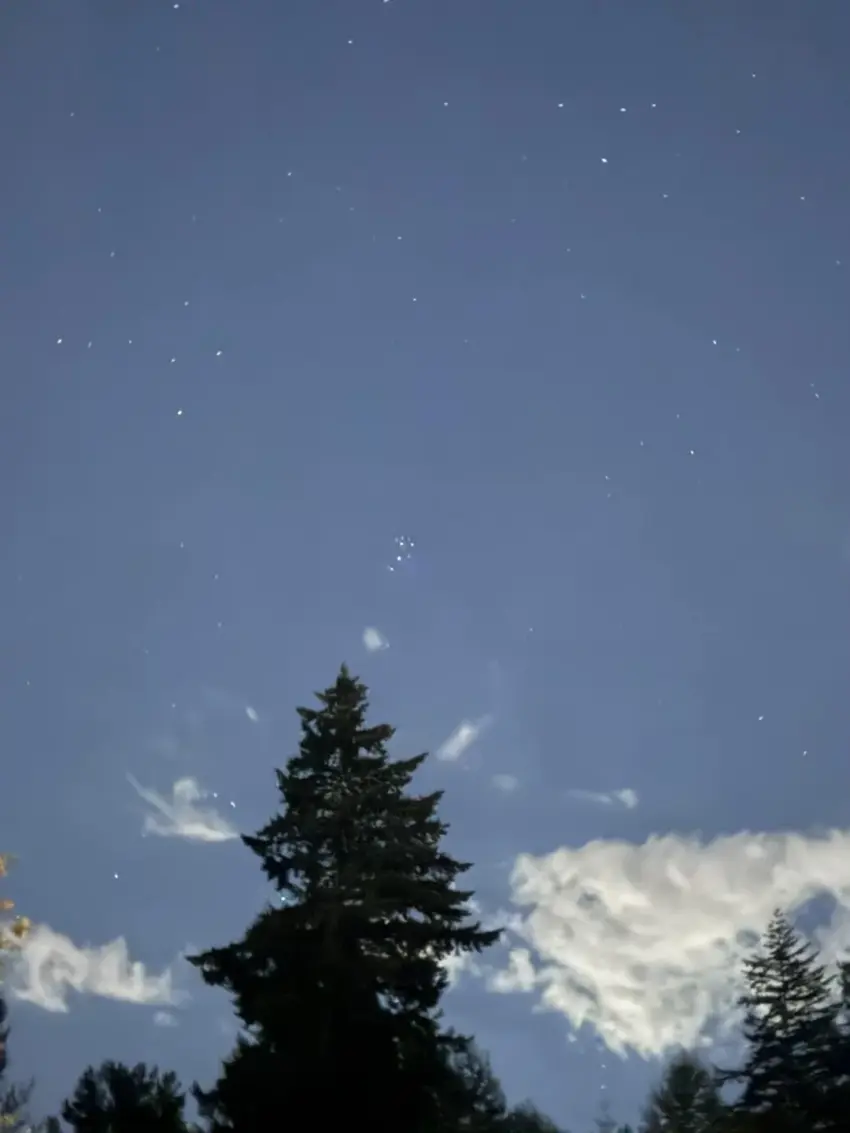
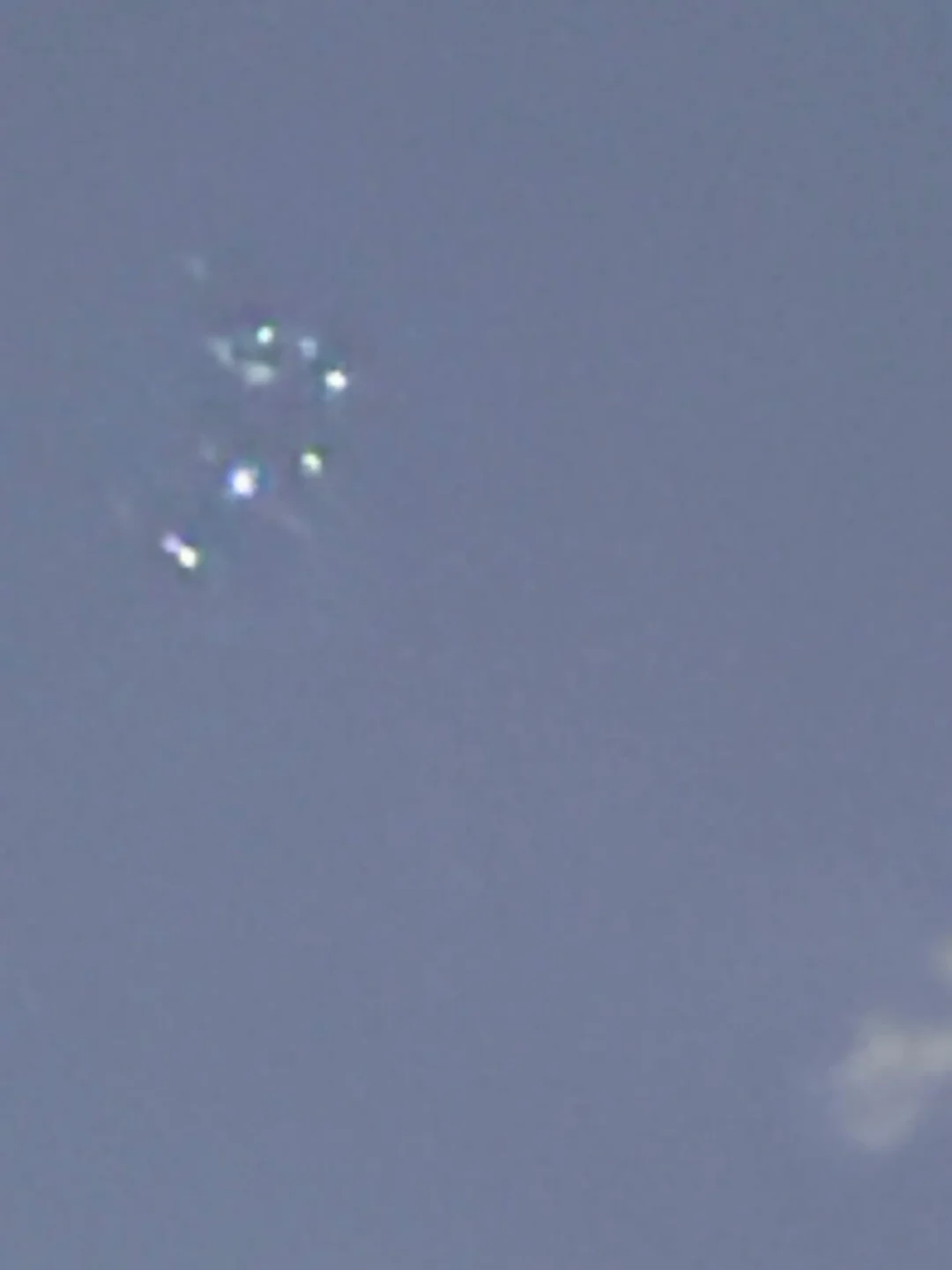
A person on Reddit asked this exact question after stepping into a quiet local park late at night: “What is this??” Hovering just above the dark crown of tall pine trees was an uncanny, shimmering sparkle. It did not glide across the dark like an airplane, nor did it flash the steady red blink of a radio tower. Instead, this compact cluster of lights in the night sky flickered, danced, and seemed to pulse through subtle shifts of electric blue, mint green, and pale magenta.
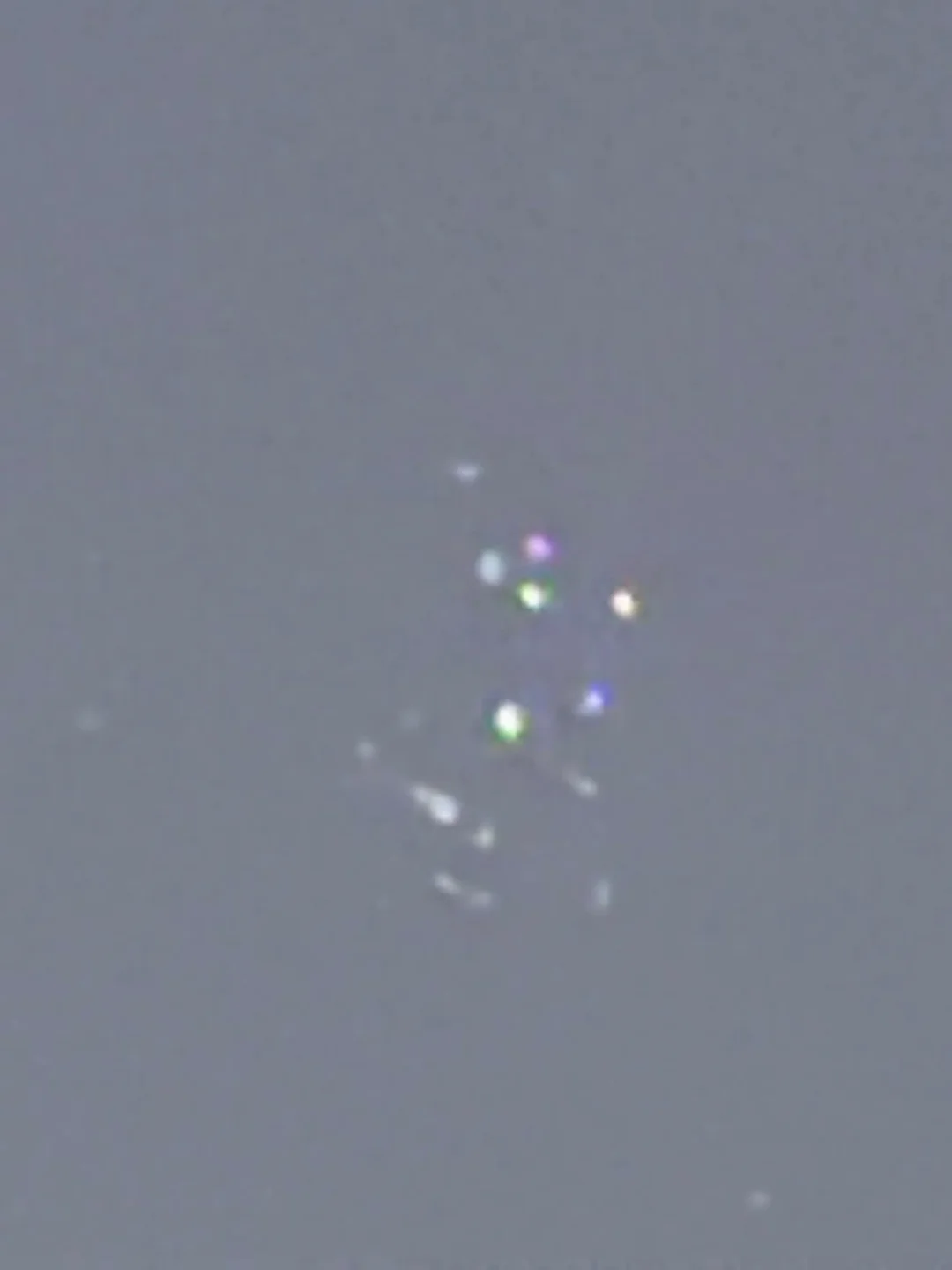
The original poster stood with a friend on the damp grass, pointing their phone upward in pure disbelief. When they zoomed in, the tiny dots took on an almost biological quality, shimmering like soap bubbles floating on a breeze. Within hours, thousands of internet sleuths flooded the post with theories ranging from military drones to cosmic visitors.
The Midnight Walk That Stumped the Internet
Night skies have a way of humbling us. You step outside to take out the compost or let the dog roam the backyard, glance up between the chimney and the cedar trees, and suddenly catch sight of something that seems utterly out of place. That was precisely the mood when these photos hit the web.
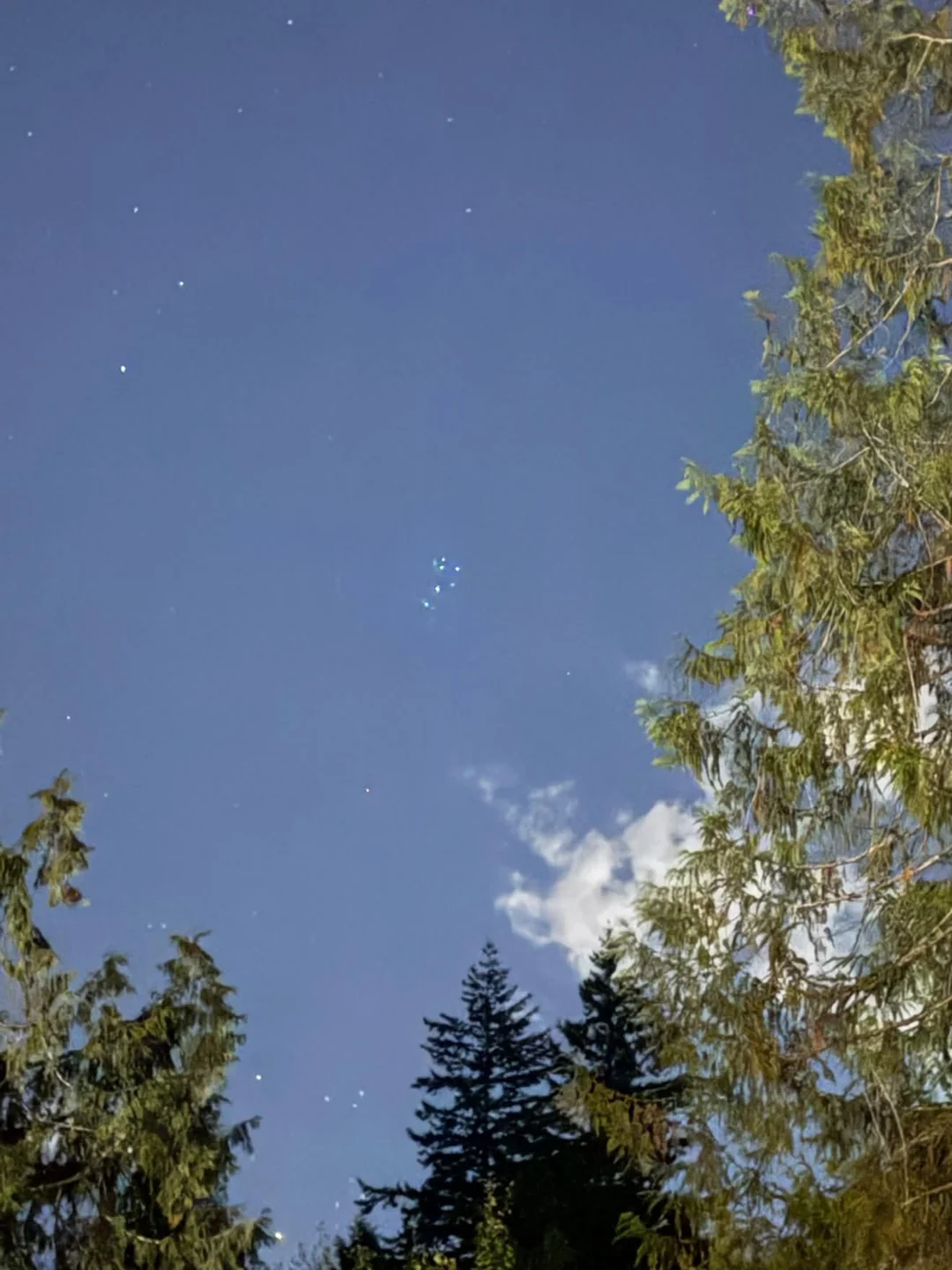
The photographer caught the glowing cluster suspended against deep indigo sky just above a stand of evergreens. To the naked eye, it looked like a tiny fistful of diamond dust thrown against velvet. Many people who stumble upon this sight assume they are watching a cluster of high-altitude surveillance drones flying in tight formation. Others swear they are witnessing satellites reflecting solar flares in synchronized harmony.
Before jumping to exotic conclusions, it helps to examine what human eyes and digital sensors actually do when confronted with faint illumination in the cold air.

Why Did the Lights Appear to Shift Colors?
One of the most unsettling details reported by the photographer was the color-shifting effect. The lights seemed to ripple between green, violet, and frosty white. That spectral dance is what convinced many onlookers that the lights had to be artificial.
The real culprit here is a natural phenomenon known as atmospheric scintillation. Earth is wrapped in miles of churning air made of warm pockets, icy drafts, and varying pressure zones. When beams of light travel billions of miles through empty vacuum, they move undisturbed. The second they plunge into our turbulent atmosphere, those straight light rays bend, wobble, and scatter like sunlight passing through running river water.
This air turbulence refracts different wavelengths of light at micro-second intervals. Red, blue, and green light wavelengths bend at slightly different angles. When you observe faint light through cold, fluctuating night air, your eye perceives rapid twinkling that frequently looks like a cycle of prism colors.
The Smartphone Camera Trap: When Pixels Lie
We rely on our phones to document our lives, from freshly baked sourdough loaves to backyard garden blooms. Night photography, however, pushes tiny phone sensors far beyond their design limits.
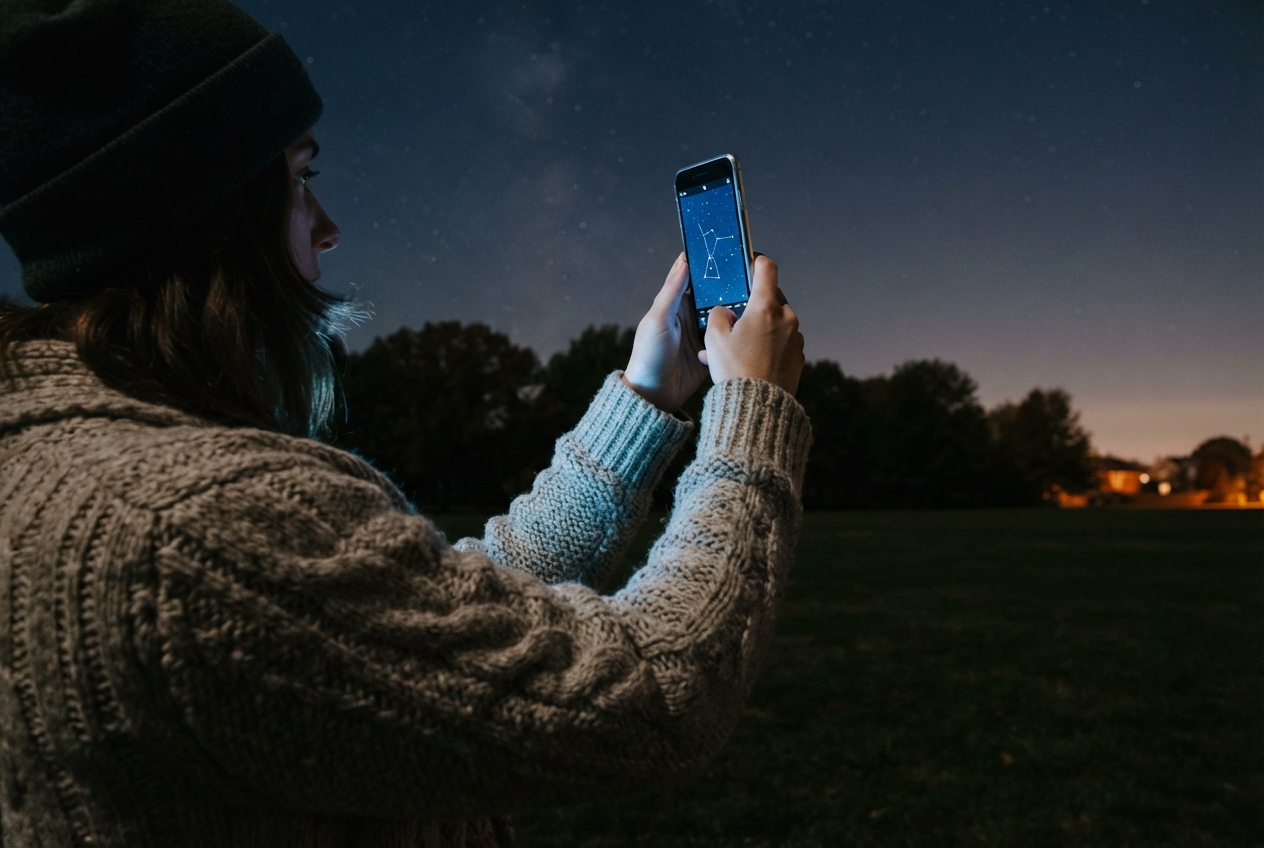
When you point a smartphone at a dark sky and pinch-to-zoom, the device engages digital zoom rather than optical glass magnification. Digital zoom takes a tiny group of pixels and stretches them across the screen. To brighten the murky image, the phone’s internal software automatically cranks up its light sensitivity (ISO) and applies aggressive noise reduction algorithms.
The result? Crisp pinpricks of light become bloated, watery discs with chromatic fringing along the borders. That explains why several Reddit commenters remarked that the cluster looked just like a bunch of soap bubbles drifting together. The phone’s camera processor was simply inventing details while struggling to map faint signals onto a noisy sensor.
Ruling Out Drones, Satellites, and Optical Pranks
Whenever an unusual sight appears overhead, modern speculation quickly turns to gadgets. Could this have been a coordinated drone light show? It seems plausible at first glance, but drone displays require massive preparation, generate audible motor hums, and rarely hang motionless in random residential zones without moving into choreographic shapes.
Satellites like Starlink trains are another common suspect. Yet satellite trains travel in tidy, straight lines, marching steadily across the sky within minutes before fading out of sight. This formation remained anchored in space, rising and drifting solely with the natural rotation of the Earth.
What about the Little Dipper? Many novice skywatchers mistake this tight gathering for the famous ladle constellation. In reality, Ursa Minor spans a massive arc across the northern sky and requires a wide field of view to trace. This mystery object was tiny, compact, and packed tightly into a pocket of sky barely wider than your thumb held at arm’s length.
The Grand Reveal: Unmasking the Cluster of Lights in the Night Sky
So, what was that mysterious entity glowing above the park? Thousands of Reddit commenters correctly identified it: you are looking at the Pleiades, also designated by astronomers as Messier 45 (M45), or affectionately known as the Seven Sisters.
This open star cluster sits within the constellation Taurus, approximately 440 light-years away from your garden bench. Far from being a drone fleet or an optical prank, this is a dazzling stellar nursery. It contains more than 1,000 young, scorching-hot blue stars that formed roughly 100 million years ago, surrounded by wisps of reflective cosmic dust.
You may also recognize this star cluster every time you drive down the street. In Japan, this cluster is known as Subaru, which translates to “gathering together” or “united.” When six manufacturing companies joined forces in the 1950s to form Fuji Heavy Industries, they adopted the star cluster as their brand logo. Next time you pull up behind a Subaru car at a traffic light, look closely at the emblem on the tailgate—it is this exact group of stars.
The 100,000-Year-Old Mystery of the Lost Sister
Look up at the Pleiades on a crisp night with clear skies, and you will likely count only six stars with the naked eye. Why, then, have cultures across the globe independently referred to them as the Seven Sisters for thousands of years?
Greek mythology tells of the seven daughters of Atlas and Pleione, with one sister—frequently identified as Merope or Electra—hiding her face in shame or sorrow. Indigenous Australian oral traditions, dating back tens of thousands of years, share strikingly similar stories of seven young women fleeing across the sky from a hunter, with one sister falling behind.
Astrophysicists have discovered that over the past 100,000 years, two of the prominent stars in the cluster, Pleione and Atlas, have drifted so close together from Earth’s vantage point that our naked eyes merge them into a single point of light. Our ancient ancestors genuinely saw seven distinct pinpricks, preserving an astronomical observation that outlived civilizations.
How to Spot the Cluster from Your Own Backyard
You do not need an expensive backyard observatory to witness this cosmic wonder. You only need a warm jacket, a bit of patience, and a clear evening.
- Find Orion First: Locate Orion’s Belt—the three bright stars in a tidy row. Follow the line of the belt upward and to the right, past the reddish star Aldebaran, until your eyes rest upon a delicate, sparkling smudge.
- Let Your Eyes Adapt: Step outside and give your vision at least fifteen minutes in the dark. Avoid glancing down at bright phone screens, which instantly resets your natural night vision.
- Use Averted Vision: Faint clusters reveal their brightest sparkle when you do not look directly at them. Gaze slightly to the side of the cluster, and your peripheral rods will catch the luminous dust cloud in vivid detail.
- Grab Basic Binoculars: Even a simple pair of birdwatching binoculars will transform that blurry smudge into dozens of crystalline blue gems hanging in deep space.
The next time you spot that shimmering cluster of lights in the night sky on a chilly evening stroll, you will know you are not looking at secret technology. You are sharing a breathtaking view that humans have wondered at, celebrated, and written stories about for a hundred thousand years.