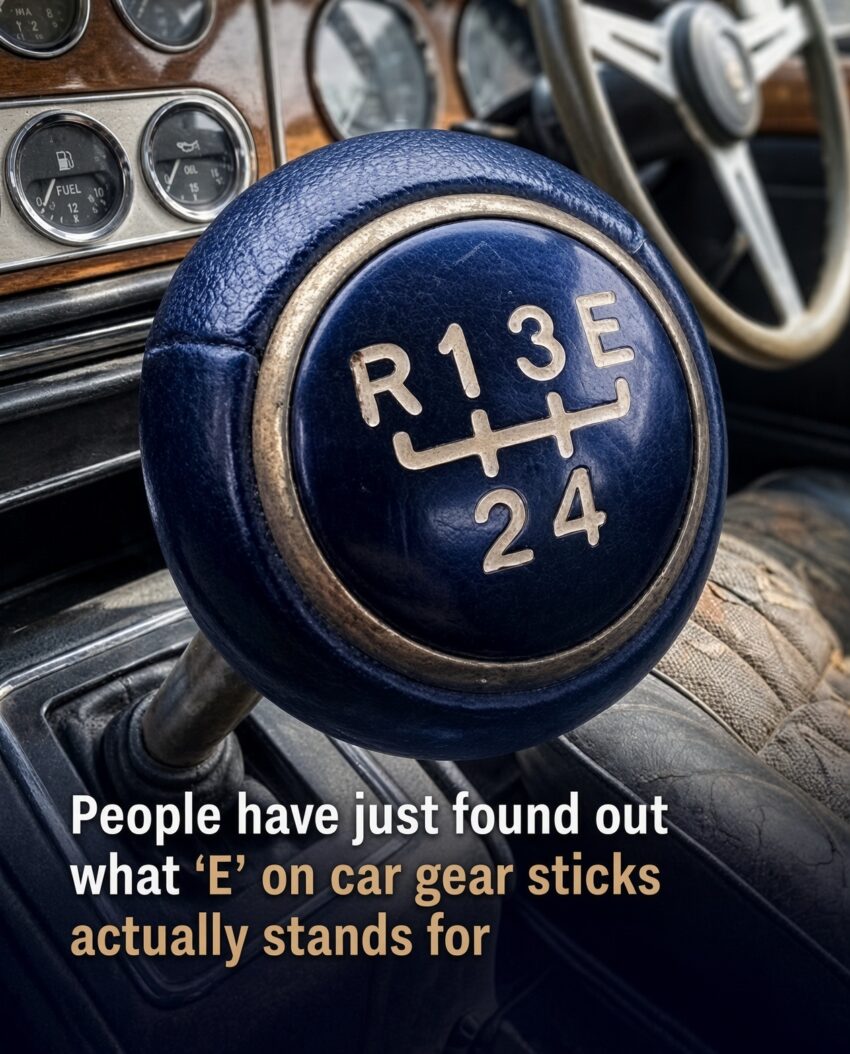
If you have ever settled into the worn leather seat of a vintage sedan or browsed through retro automotive forums, you might have spotted a peculiar detail that looks out of place today. Nestled right beside the standard shift pattern—or tucked into the PRND gate of an older automatic—sits a lonely, enigmatic letter “E” stamped directly into the knob.
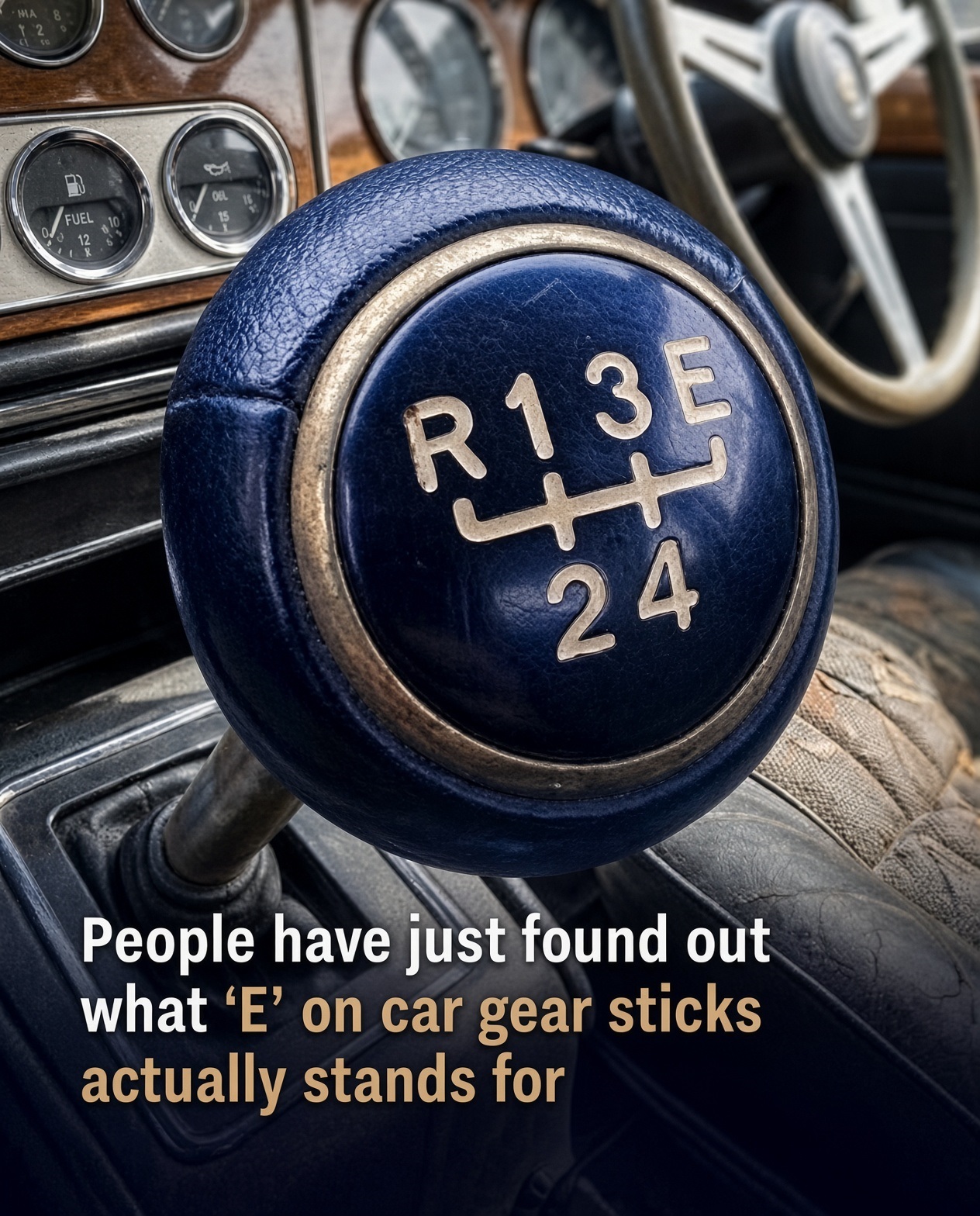
A classic vintage manual gear stick displaying the distinctive R-1-3-E layout where drivers traded fast acceleration for relaxed highway miles.
For modern drivers raised on digital gauge clusters and eight-speed transmissions, that solitary letter is an absolute mystery. Does it mean Emergency? Electronic? Extra gear? The reality takes us straight back to the oil crises of the late 1970s and 1980s, when automakers scrambled to squeeze every last drop out of a gallon of fuel.
The True Meaning of the “E” on Classic Gear Sticks
The short answer is simple: the “E” stands for Economy. Depending on whether you were driving a manual stick shift or an automatic transmission, this humble letter transformed how power traveled from the crankshaft out to the pavement.
During the 1980s, fuel economy shifted from an afterthought into the primary obsession of automotive design. Carburetors were giving way to early electronic fuel injection, cars shed hundreds of pounds of unnecessary weight, and gearboxes received specialized gearing designed purely to tame thirsty engines on long stretches of asphalt.
Instead of revving hard toward the redline, a transmission set to “E” dropped engine revolutions down to a relaxed, quiet hum, saving money at the pump while taking the stress out of long-distance family road trips.
The Famous “4+E” Manual Transmission
While automatics had their own variations, the most iconic appearance of the letter stamped directly onto a stick shift belonged to manual gearboxes. European manufacturers—most notably Volkswagen and Audi during the era of the Golf Mk2, Passat, and Scirocco—introduced what they officially marketed as the “Formel E” or “4+E” gearbox.
In these cars, the transmission wasn’t technically a traditional five-speed designed for incremental speed climbing. Gears one through four functioned as standard, tightly spaced driving gears. You used first gear to pull away from a red light, second and third to navigate suburban streets, and fourth to reach your maximum sustained driving speed.
The fifth slot—marked proudly with the letter “E”—was an extraordinarily tall overdrive gear. When you slotted the lever up and to the right, the gear ratio was so steep that the car could not actually reach its top speed in that position. Instead, the engine revs plummeted dramatically, reducing fuel flow and settling the cabin into an easy, whisper-quiet glide on the highway.
How Economy Gearing Changed the Driving Feel
Sliding a manual transmission into “E” or driving an older automatic with an economy gate felt noticeably different behind the wheel. The immediate response under your right foot disappeared, replaced by a steady, measured pace that rewarded gentle inputs rather than spirited acceleration.
- Significantly Lower RPMs: Cruising at sixty miles per hour in fourth gear might have kept an older four-cylinder spinning around 3,200 RPM. Shifting into “E” pulled that figure down below 2,200 RPM, calming engine vibrations instantly.
- Quieter Cabins on Long Drives: Without modern layers of composite acoustic foam, vintage cars let in substantial motor hum. The overdrive ratio silenced that roar, allowing soft conversation and tape-deck music to take center stage.
- Mellow Throttle Response: Because the mechanical gearing sat so tall, pressing the gas pedal in “E” produced steady momentum rather than sudden thrust. Passing a slow truck on a two-lane road meant dropping the stick back down to fourth gear first.
In older automatic vehicles from brands like Volvo, Mercedes-Benz, and BMW, the concept lived on through physical console switches labeled “E/S” (Economy vs. Sport) or special shift gates. Selecting “E” forced the hydraulic valve body to shift up earlier under light throttle and resist kicking down to a lower gear unless the driver mashed the pedal to the floorboard.
When You Should (and Shouldn’t) Use Economy Mode in an Older Car
If you own or rent a classic vehicle carrying a “4+E” manual or an older automatic with an economy switch, knowing when to engage it makes all the difference for your engine’s long-term health. Tall gearing brings genuine perks, but misusing it can cause mechanical fatigue.
The secret to driving an overdrive economy gear is momentum: let the flat highway carry the load, and never force a high gear to climb a steep mountain pass.
Flat, open freeways are where the “E” gear truly shines. Once you reach steady cruising speed, clicking into overdrive reduces fuel consumption, lowers operating temperatures, and spares your water pump and alternator unnecessary cycles. It turns a buzzy retro ride into a comfortable touring car.
However, you should avoid lugging the engine in “E”. If you approach a steep hill or get caught in stop-and-go highway crawling, keeping the transmission in a tall economy gear puts heavy strain on the connecting rods and bearings. When you feel the engine shudder or lose speed despite pressing the throttle, shift down to fourth gear to let the engine breathe freely within its powerband.
From Mechanical Sticks to Digital Dashboards: Where Did the “E” Go?
As the automotive world progressed through the late 1990s and into the modern era, the standalone “E” stamped onto gear shifters quietly disappeared. It wasn’t because automakers abandoned efficiency—rather, computing power caught up with mechanical design.
Electronic transmission control units (TCUs) took over the work that once required a driver’s hand. With computer processors reading wheel speed, throttle angle, and incline gradients dozens of times per second, cars learned to optimize shift points entirely in the background. Modern automatic gearboxes now boast eight, nine, or ten forward speeds, blending tight acceleration gears with multiple overdrive ratios automatically.
Today, the spirit of that old letter survives as the familiar “Eco” button on modern dashboards, or the regenerative “B” and one-pedal modes found in modern electric setups. Seeing that vintage blue-capped knob with its bold “E” remains a charming reminder of an era when saving fuel began with a conscious flick of the wrist and a simple, mechanical connection to the road beneath you.