The Chief’s Ultimatum: Why No Warrior Would Take His Daughter, and the Quiet Truth That Followed a Drifter Home
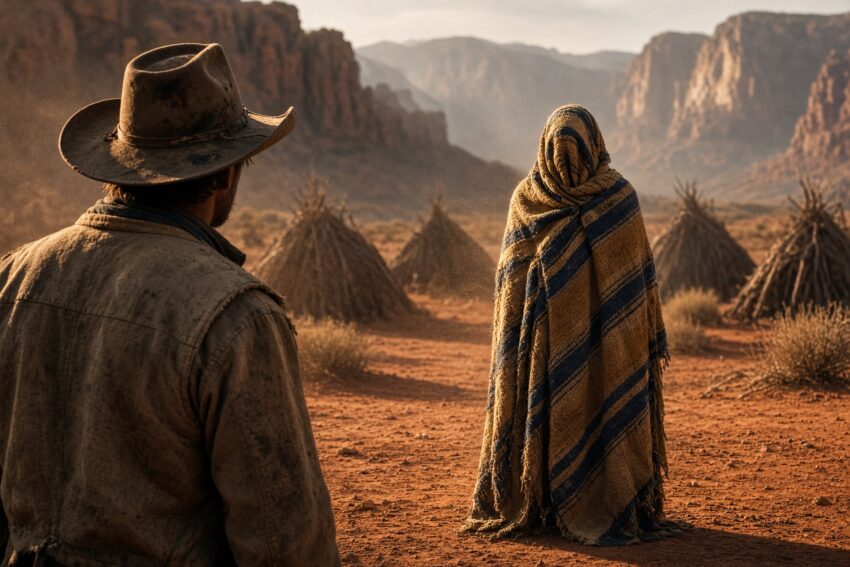
The wind pushing through the red sandstone gorge blew thin and dry, carrying the scent of baked dust and old cedar smoke. In the center of the clearing, where the shadow of the cliff cut the afternoon glare in half, Chief Kineo stood motionless. His dark eyes remained fixed on Caleb Vance.
Around them, the camp had gone completely still. Women holding woven baskets stood frozen between the brush wickups. Lean warriors with hard eyes and trail scars along their arms leaned against their lances, deliberately avoiding looking toward the center of the ring. It was not anger that kept their eyes down; it was a cold, uneasy dread.
Caleb stood with his boots planted in the dirt, his right thumb hooked over his cartridge belt. His hands were weathered from years of rope and barbed wire, his work shirt stiff with trail salt across the shoulders. He had ridden into this canyon for one reason: to find a path for thirty thirsty head of cattle, carrying a d.y.i.n.g child he couldn’t leave behind on the rocks. Now, everything had narrowed down to the edge of a woven trade blanket.
“An obligation is not a gift, Caleb Vance,” Kineo said, his English slow, hard, and deliberate. “A gift can be turned away with polite talk. An obligation left unpaid festers inside the man who owes it, and it poisons the camp of the man who forgives it. You brought my kin out of the heat. My lodge gives what it has. Take her, or ride out of this canyon and never turn your mount toward these passes again.”
Caleb cleared his dry throat. “Chief, a man doesn’t take a partner the way he ropes a stray out of a bog.”
“You gave your word,” the old chief answered. “A man’s word is an iron stake driven into stone. If it bends, he has nowhere left to walk.”
Kineo raised his hand.
From the shade of the main lodge, two elder women stepped out into the blinding light. Their skin was creased like dry river clay, their eyes hooded with age. Between them moved a figure wrapped from head to moccasin in an enormous wool blanket dyed in deep indigo, yellow ochre, and red. The weave was thick enough to hide every line of the figure beneath it, shifting only with the slow, measured pace of her boots.
Caleb felt a knot cinch tight in his chest. In the saloons and border towns along the Gila, men traded rough talk about things hidden away in mountain camps—crippled limbs, faces scarred by smallpox, minds broken by fever. A woman turned away by every warrior in an entire band sounded impossible. Frontier men needed women who could work hides, haul wood, and survive bitter high-country winters. For every man in the camp to turn his back on a chief’s daughter… there had to be some terrible affliction beneath the wool.
Caleb set his jaw. He had survived the fever seasons in Missouri; he had worked cattle across the dry plains; he had built a homestead out of raw brush with his own two hands. If she was scarred, he would treat her with plain decency. If she walked lame, he would carry the timber. He had given his word, and he needed the canyon trail open if his herd was going to reach water.
“Uncover her,” Kineo said in his own tongue.
The two elder women took hold of the top edge of the wool and pulled it down in one clean motion. The blanket dropped into the dust with a heavy thud.
Caleb braced himself, his teeth set against whatever disfigurement was about to show.
The air left his lungs all at once.
There was no twisted frame. There was no missing eye, no skin pitted by sickness.
The woman standing before him was tall, with a straight, rigid posture. Her buckskin dress was pale as lime, worked with thousands of tiny blue glass trade beads that caught the white sun. Her hair reached past her waist in a thick, raven-black braid that caught the desert light. Her jaw was clean, her cheekbones high and sharp, set in an arresting, severe symmetry.
She possessed a striking, undeniable presence.
Yet, as Caleb stared, the woman raised her chin.
Her eyes met his.
They were not dark brown like her father’s. They were a pale, piercing amber, unblinking as a hawk cornered on a ledge. There was no hesitation in them, no fear, and no submission. Only an icy, razor-sharp intelligence and a deep, buried rage that dared him to take a single step closer.
A cold chill ran down Caleb’s neck. The dead silence across the camp suddenly made sense.
The braves standing at the edge of the clearing weren’t looking away out of disgust. They were looking away because they were terrified of meeting her stare.
“Her name,” Kineo said, cutting through the quiet, “is Tala. She goes with you now. She takes her gear, her saddle, and her paint mare. Do not bring her back. If your boots touch this dirt again without her beside you, my riders will leave you d.e.@.d for the crows.”
The chief turned and ducked through his lodge flap without another glance. The camp broke apart around them. The women slipped into their shelters; the men faded into the brush with quick, quiet steps, leaving Caleb, his gelding Copper, and the woman with the amber eyes standing alone in the red dust.
Tala did not wait for Caleb to speak. She didn’t look at him twice. She walked over to a lean paint mare tied to a cedar post, threw her rawhide pack behind the saddle with easy, wire-tough strength, and swung up onto the horse. Holding the reins in one hand, she pointed the mare south, waiting for him not like a companion, but like a guard waiting on a prisoner to walk the trail.
Caleb wiped cold sweat from the back of his neck, walked over to Copper, and pulled himself into the saddle.
“Well, old horse,” Caleb muttered under his breath, “we got our water right. Now let’s see what we bought with it.”
The ride south toward the foothills took two long days, and through all of it, Tala never spoke a word.
She rode three paces off Copper’s flank, holding the same steady gait through the alkali flats and the loose shale of the draws. When Caleb pulled up to let the mounts blow and clear the dust from their noses, she got down on her own. She watered her mare from the seep, took a strip of jerky from her saddlebag, and sat in the shade of a mesquite bush with her knees drawn up, whittling a stick of hard ash wood with a heavy skinning knife made from a sharpened wagon leaf spring.
Caleb tried opening his mouth that first evening.
“The place isn’t big,” he said, nodding toward the blue outline of the ridges ahead. “Just peeled pine logs and a rock storehouse. Good spring water, though. Cold enough to freeze your teeth, even in late summer.”
Tala carved another thin ribbon from the pale wood. She didn’t blink. She didn’t turn her chin. She acted as if he were just another rock on the hillside.
Caleb let the words drop and went back to checking his cinch. He was an easy man with quiet—he had spent four years drifting through Texas and the Indian Nations before buying a scrub spread out in Arizona. He understood silence. But this quiet was wound tight, humming with an edge that made the skin between his shoulders twitch whenever he turned his back.
Late on the second day, as the sun threw long purple shadows over the scrub, they crested the last ridge.
The homestead sat down in the hollow of a creek bed: a low, thick cabin of rough pine logs, roofed with sod and river mud. Past it stood a pole corral where his red steers stood gathered near the timber trough, fed by a steady seep pouring out of the limestone bank above.
Copper blew hard through his nostrils, smelling home. Caleb turned in the saddle.
“This is the spread,” he said, his voice dry from the trail. “I know you didn’t ask for any of this. But nobody bothers you out here. Nobody puts a hand on you. You have my word on that.”
Tala looked over the cabin. Her amber eyes took in the corral, the lean-to barn, the empty desert hills stretching in every direction, and finally settled on the heavy timber door.
For the first time since the blanket dropped, she spoke. Her voice was low, steady, and sharp around the edges.
“A wooden box,” she said, her English clean and direct. “A settler builds four walls so he can d.i.e in the dark.”
Caleb stared, caught off guard by the ease of her words. “Four walls keep the wind down, and they keep the wolves out.”
Tala dropped from her mare before the horse had stopped moving, grabbed her rawhide bundle, and looked dead into his eyes.
“Wolves aren’t what will ruin you in this valley, Caleb Vance.”
She walked past him, her buckskins brushing his stirrup, and stepped through the cabin door before he even hit the ground.
The next three months were an armed truce.
Caleb took a rough rope cot near the hearth, throwing his wool blanket over a ticking filled with dry grass. Tala took the rear storage room—a dark space meant for flour sacks and salt meat. She brought in nothing except her bedroll, her ash stick, and the heavy leaf-spring blade.
She didn’t touch his provisions. When Caleb brought down a mule deer in the scrub, he would leave half the dressed meat on the flat stone bench outside the kitchen. By morning, it was gone—cut thin and hung over cedar frames behind the barn, dried with wild sage and mountain berries he had never paid attention to.
She worked from first light until the sun dropped, but never within arm’s reach of him. If he took an axe to the juniper stand to cut posts, she walked miles out across the benchland, digging edible roots, gathering mesquite beans, or twisting yucca fibers into cord stronger than any hemp rope from the dry goods store.
Still, her presence filled every corner of the dirt yard.
The few drifting cowpokes who stopped by looking for day work never stayed past breakfast.
In late October, a drift-line rider named Roy Calloway came through from the south. He was a broad-shouldered man with a tobacco-stained beard and an old Remington pistol tied low on his thigh. Needing help stringing wire before the winter rains hit, Caleb offered him two dollars a day and meals.
That night at supper, Calloway shoveled beans off his tin plate, his eyes darting toward the dark doorway of the back room where Tala sat by tallow candlelight, working an awl through tough rawhide.
“Didn’t know you kept an Apache girl out here, Vance,” Calloway muttered around a piece of salt pork, leaning back against the rough pine wall. “Heard talk in town about the chief’s daughter. Word is she got pushed out because she poisoned three braves in their sleep. They say she’s got bad blood running through her.”
Caleb’s fork stopped over his plate. His eyes went flat. “Her name is Tala. She’s here by her father’s word and mine. You speak with some manners at this table, Roy, or you can roll your bed in the brush.”
Calloway let out a wet sneer. “Manners? You haven’t laid a finger on her, Vance. A blind man could feel the ice in this room. A woman like that doesn’t need talk. She needs a heavy hand to break her to harness.”
Before Caleb could push his seat back, a faint sound cut the air.
The hiss of cold steel sliding out of dry leather.
Calloway’s grin vanished.
Tala was standing in the doorframe. She hadn’t made a whisper of sound on the rough floor. She stood barefoot, her amber eyes wide, clear, and completely stripped of any human warmth. In her hand, the heavy wagon-spring knife hung down by her skirt. She didn’t raise it. She didn’t drop into a stance.
She just tilted her chin, her breath coming slow, and took one deliberate step into the room.
Calloway’s hand dropped toward his leather holster, but his fingers froze when he met her face. The ruddy color washed completely out of his cheeks. He was a man who had put down two men in border fights; he knew what a drunk or angry man looked like before pulling a trigger.
What was looking back at him from Tala’s face wasn’t temper. It was the complete absence of hesitation. It was the look of a mountain lion deciding where to sink its teeth.
“Touch the iron,” she whispered. Her voice sounded like dry gravel dragged across slate. “Pull it, white dog. I’ll take both your ears before your thumb hits the hammer.”
Calloway stood up so hard his bench flipped back and banged against the pine floor. He kept both hands level with his shoulders, palms out, breathing hard.
“She’s out of her head,” Calloway stammered, backing toward the front door without taking his eyes off the blade. “She’s unhinged, Vance! You’re sleeping under the same roof with a rattler! You’re a d.e.@.d man—mark my words, d.e.@.d!”
He shoved through the heavy door into the night, threw his saddle on his horse in the dark, and tore out of the wash like the brush was on fire.
Caleb stood beside the table, the room dead silent again. He looked at Tala.
She hadn’t moved. She was still staring at the open door where Calloway had run.
“You didn’t have to step in,” Caleb said quietly, his pulse thumping. “I can handle my own yard.”
Tala slowly lowered the knife. She looked at him, her pale eyes studying his shoulders, his weathered face, his calloused hands, searching for something she clearly didn’t expect to see.
“He was carrion,” she said flatly. “A man who talks about breaking things always runs the minute teeth show.”
“And you?” Caleb asked, the words coming out before he thought to check them. “Are you going to show your teeth to me, Tala?”
For half a second, the hard mask on her face slipped. A hollow, dark ache showed behind her amber eyes, so raw it caught him off balance.
“You haven’t tried to break me, Caleb Vance,” she said softly, turning back into the shadow of her doorway. “If you try, you will learn what the men of my father’s camp already know.”
She pulled the cedar door shut, leaving him alone by the red coals.
The winter rains hit in November, turning the dry creek into a red torrent. For three weeks, Caleb stayed in the saddle from dawn to dusk, dragging mired cattle from the mud and rebuilding washed-out fence lines until his hands were cracked and bleeding from the wet cold.
Every evening he rode in shivering, water pouring from his hat brim, his heavy coat soaked clear through. And every evening, without a word said, a tin pot of dark tea brewed from cedar bark and dried roots sat simmering on the hearth stones, with a dry wool blanket laid across his cot.
She still kept the latch down on her door at night. She still walked the high rimrock alone when the sky cleared. But the line between them was thinning down.
One night, while Caleb sat by the tallow candle trying to run a needle through a torn stirrup strap with stiff, clumsy fingers, Tala stepped into the room. She reached down, took the leather and awl right out of his hands, and sat down on the plank floor beside his stool.
Her fingers worked with smooth, quiet speed, punching through the heavy harness leather with even stitches.
Caleb watched her in the yellow light. Close up, he noticed a pale, narrow scar running into the hair above her left ear—the mark of an old lead graze or a piece of flying stone.
“Your father said you were twenty summers,” Caleb said quietly, keeping his tone even.
“Twenty-one now,” she said, not looking up from the stitch.
“He told me… he said no warrior would take you into his lodge. Said something was wrong that couldn’t be undone.” Caleb leaned forward, his forearms across his knees. “I’ve shared a roof with you four months, Tala. You work harder than most men I’ve hired. You don’t take what isn’t yours, and you don’t lie. You’re whole. So what happened? Why would an entire band turn its back on the chief’s daughter?”
The awl stopped dead.
Outside, the freezing rain drummed against the sod roof. A pine knot cracked in the hearth, throwing a spat of red embers against the chimney rock.
Tala didn’t lift her head. Her hands stayed frozen on the leather strap.
“My father had two sons before me,” she said, her voice turning flat and hollow, stripped of all its edge. “They were riders. They rode the border trail. When I was fourteen, the soldiers came down through the pass while our men were three days south in Mexico.”
Caleb felt a tightness in his stomach. He had seen the burnt wickups and the border outposts along the river.
“They didn’t come to face warriors,” she went on, her fingers tightening around the wood of the awl. “They came to burn the winter seed. They came to k.i.l.l the old people and the women so there would be nothing left to ride back to. A cavalry sergeant on a bay horse shot my mother while she was grinding mesquite.”
She raised her head. The lamplight caught the amber of her eyes; they were glassy with moisture, though not a drop ran down her cheek.
“My brothers came back that night. They took six braves to track the blue coats to the river. I took my father’s knife and trailed them through the brush in the dark. I was just a girl, but my heart was full of soot.”
She took a slow, jagged breath that rattled in her throat.
“The soldiers were set up in an ambush in the narrow canyon. My brothers went down in the first volley of carbines. The braves lost their nerve. They wheeled their ponies and ran. They left my brother Chato in the mud with his legs shattered, yelling for someone to end it before the cavalry horses trampled him.”
She stared straight into Caleb’s face, her gaze burning into him.
“The warriors of my blood spurred their mounts and ran like coyotes from the fire. I stayed.”
“What did you do?” Caleb asked, his voice low.
“I crawled through the scrub behind the cavalry line,” she said, her words turning hard as flint. “I pulled my brother into the rocks. And when the young lieutenant leading them walked into the brush looking for stragglers, I didn’t hide. I took his own sabre from his scabbard while he was clearing a jam in his gun, and I put it through his neck.”
Caleb sat rigid. The cabin was completely silent.
“I carried my brother back to our camp across my own shoulders,” Tala whispered. “I dropped the soldier’s bloody coat at the feet of the braves who had bolted. I named them cowards before the council fire. I spat on their shields. I told them their lances were dry grass and their courage was dirty water spilled on the rocks.”
She dropped the stirrup leather. It hit the floor with a heavy smack.
“An Apache warrior will forgive a woman who burns the meat,” she said, her amber eyes drilling into him. “He will forgive a woman who is barren, or one who brings bad luck. But a brave will never forgive a woman who saw him run like a dog, and then stayed behind to k.i.l.l his enemy.”
She stood up, tall and straight in the small room.
“They didn’t turn away from me because I was broken, Caleb Vance. They turned away because every time a man in that camp looked at my face, he saw his own cowardice staring right back at him. My father knew it. He knew if I stayed, someone would put a knife in my back in the dark—not out of hate, but out of shame. That is the c.u.r.s.e I carry. That is what keeps them away.”
She turned and walked into the dark back room, leaving Caleb sitting by the smoking candle with the mended stirrup lying by his boots.
The real trouble didn’t come from the mountains, or from the winter cold. It came in late February, on a raw afternoon when the gray clouds hung heavy over the peaks.
Caleb had been out on the south range since sunrise, digging two steers out of a clay sinkhole left by the floods. Copper was caked in mud and blowing hard by the time they got the cattle onto solid ground.
As Caleb cleared the ridge above the homestead, Copper threw his ears back flat against his neck, snorting a hard, wet warning.
Caleb pulled up.
Down in the clearing, three strange mounts were hitched to the corral rail.
They weren’t Indian horses. They were big American geldings carrying the vent-brand of the border gangs that worked the hills around Tombstone. Heavy, greasy smoke was pouring out of the cabin chimney—not the sweet cedar smoke Tala burned, but wet pine jammed into the hearth.
Caleb slipped out of the saddle, his boots making no sound in the soft dirt. He pulled his Winchester carbine from the scabbard, levered a shell into the breech with an oily click, and moved down through the mesquite brush behind the barn.
When he reached the back log wall, the voices drifted out through the chinking.
“Come on now, girl,” a voice drawled, thick with whisky. “You’ve been out here with this dirt-farmer long enough. We know what your old man traded you for. We’ve got five dollars silver, and when we’re through, we might leave that plow-chaser enough skin to remember us by.”
A crash echoed from inside—a timber chair smashing into splinters against the wall.
Caleb rounded the front doorframe with his rifle up at his shoulder, his finger ready on the trigger.
Three men were in the room.
One was a heavy man in a greasy canvas coat standing by the hearth, holding a half-empty jug of Caleb’s liniment. A second was a skinny kid with bad teeth, holding a cocked pistol pointed at the floor.
The third man was on his knees in front of the oak table, screaming at the top of his lungs.
Tala was standing over him. Her left hand was tangled deep in his hair, hauling his head back until his throat was stretched tight. In her right hand, the heavy wagon-spring knife was driven two inches deep through the meat of his right palm, pinning his hand flat to the thick oak tabletop.
The kid with the pistol was trembling, his barrel shaking between Tala and the door. “Let him go, you wild b.i.t.c.h! Let him up or I’ll put a hole through your ribs!”
“Drop the iron,” Caleb said.
The voice was quiet, but it fell on the room like a sledge on an anvil.
The kid spun around, eyes popping, finding the black muzzle of the Winchester pointed right between his eyebrows.
“I won’t tell you twice, son,” Caleb said, his finger taking up the slack on the trigger. “Drop the gun, or they’ll be scraping your head off my log wall before dark.”
The boy’s fingers let go. The pistol hit the pine boards with a sharp crack.
The man by the hearth froze, his hand hovering over his hip, his eyes darting between the carbine and the woman at the table.
Tala didn’t flinch. She didn’t look at Caleb. She kept all her weight leaning onto the hilt of the blade, driving it deeper into the oak while the man beneath it shrieked like a trapped pig.
“Who sent you down here?” Caleb asked, his tone ice cold.
“Calloway,” the man on the table choked out, spit spraying from his teeth. “Calloway told us… said you had an Apache woman out here… said you were soft… said there was gold from the steer sale…”
“There’s no gold here,” Caleb said. “Just rocks, lead, and bad luck for men who don’t know where their ground ends.”
Caleb shifted the carbine barrel an inch, pointing it dead at the man by the chimney.
“Unbuckle your belt with your left hand,” Caleb said. “Drop it. Both of you. Right now.”
The man unbuckled his rig and let it hit the planks with a heavy clatter. The boy kicked his fallen Colt toward the woodbox.
“Now haul your partner off that table,” Caleb said. “Put him across his saddle and ride south. If I catch your tracks within ten miles of this draw again, I won’t use the rifle. I’ll turn her loose on your trail.”
The two men scrambled forward like beaten dogs. Tala didn’t let go of the blade until Caleb took two steps forward, his left hand reaching out slow and steady until his fingers closed over her knuckles on the hilt.
Her skin was burning hot, her arm vibrating with hard, coiled strain.
“Easy,” Caleb said, his voice dropping low, the same way he had spoken to the terrified girl in the canyon dust storm. “Easy, Tala. The fight is done. Let them ride.”
For three long seconds, she didn’t give an inch. Her amber eyes drilled into the screaming outlaw’s face with cold, ruthless focus.
Then Caleb’s hand tightened over hers—not forcing her, just steady and warm.
She let out a long breath through her teeth. With a sharp wrench, she yanked the heavy leaf-spring blade upward out of the wood.
The wounded man dropped to the boards, clutching his mangled hand against his ribs, howling. The other two hauled him up by his collar, dragged him through the doorway, and slung him across his horse. Within seconds, iron shoes were pounding down the rocky draw, the noise dying away into the gray scrub.
Caleb stood in the middle of the torn-up room.
The quiet that settled back in was heavy, broken only by the wind rattling the sod on the roof and the sound of Tala’s ragged breathing.
She turned on him, her chest rising and falling, the bloody knife still in her grip. Her black braid had come untied, hair hanging across her face in wild strands.
“Why did you stop me?” she rasped, her voice shaking with fury. “They came through your door! They came to take what you have! A warrior doesn’t leave a snake alive to strike again tomorrow!”
“I’m not an Apache warrior, Tala,” Caleb said, his voice level as he eased the hammer down on the Winchester. “I’m just a man trying to run a spread.”
“You’re a fool!” she snapped, taking a step toward him, the knife edge catching the gray light. “You give mercy to wolves, and they bring the pack! You think you’re strong because you let them ride? They’ll call you weak! They’ll laugh at you in every saloon on the river!”
Caleb didn’t step back. He didn’t lift the rifle. He stood his ground until the point of the blade was barely inches from his flannel shirt.
“Let them talk,” Caleb said, looking right into her amber eyes without flinching. “A man who knows his own backbone doesn’t need to butcher every dog that barks at his fence. I didn’t help you to look brave. I didn’t bring you here to keep a servant. And I didn’t stop you just now because I was scared to see them d.i.e.”
Tala went rigid. “Then why?”
“Because you’ve carried enough b.l.o.o.d for three lifetimes,” Caleb said, his voice dropping soft. “Because when I look at you, I don’t see the troopers in the pass, and I don’t see the cowards who ran from your brother. I just see a woman who was left to carry the whole sky by herself, with nobody around to tell her she could set it down.”
The knife in her hand gave a sudden, hard tremble.
Tala stared at him as if he had hit her with a cedar fence post. Her lips parted, but no sound came out. The fierce, cold fire that had kept her moving through the raid, through the shunning of her camp, and through the long, freezing months in this cabin… suddenly broke apart.
The heavy leaf-spring knife slipped from her fingers, hitting the pine planks with a loud clatter.
Her knees gave out.
Caleb caught her before she hit the floor.
He pulled her against his coat, his arms locking around her shaking shoulders, holding her with the same steady strength he had used in the red canyon.
Tala didn’t pull away. She buried her face into the rough wool of his coat, her hands clutching his shirt until her knuckles turned white. And for the first time since the troopers rode into the pass seven years before, she wept.
It was not a quiet cry. It was a hard, tearing sob dragged up from the bottom of her chest—grief, bitterness, and long isolation finally tearing through the wall of stone she had built around herself. Caleb held her while the twilight drained from the room. He held her as the night settled over the flats, and he didn’t let go until the shivering stopped and her breath came slow and steady against his collar.
Spring came to the high desert in late March.
The winter rains had soaked deep into the hardpan, and the flat benchland was covered in yellow poppy blooms, wild mustard, and red ocotillo tips reaching into a clear blue sky. The creek behind the cabin ran clear, cold, and steady over clean gravel.
The cabin door stood open to the morning breeze, letting in the smell of blooming brush and sun-warmed stone.
At the timber table, scraped clean with sand to take out the mark where the knife had bitten the grain, Caleb sat oiling a bridle.
The door to the back storage room had been taken off its hinges weeks before. Tala’s bedroll was gone from the dark corner; her pack now sat beside his saddle chest under the south window, where the first light came in.
She walked in from the creek bank, her sleeves rolled past her elbows, carrying a heavy cedar bucket of fresh water without straining. Her black hair was braided neat down her back, tied off with a strip of red cloth. The hard, cold look in her amber eyes hadn’t vanished entirely—the frontier was rough, and country like this never let a person go soft—but the bitter, hunted shadow was gone. In its place was a quiet, steady stillness.
She set the water bucket on the bench, wiped her hands on her apron, and walked up behind Caleb.
Without speaking, she rested both hands flat against his shoulders. Her grip was warm and sure.
Caleb leaned his head back against her hip, looking up at the face that had frightened a camp of warriors into silence.
“We have riders coming up the creek,” she said quietly.
Caleb looked toward the window, his hand resting on the table. “More of Calloway’s crowd?”
“No,” Tala said, a faint trace of an edge touching her lips. “Men who know how to sit a horse.”
Caleb stood up and walked out onto the split-log porch, squinting into the morning glare.
Three riders were walking their ponies down the gravel trail from the north canyon. They rode sure-footed mountain stock, their lances wrapped in rawhide, their faces marked with red earth from the high passes.
In the lead rode Chief Kineo.
Caleb waited on the porch boards, his arm resting easy at Tala’s side as she stepped out beside him. She didn’t lean on him; she stood square on her boots as his equal, her chin up, watching her father ride in without a hint of fear or apology.
The old chief reined in his pony ten yards out. The two braves behind him sat their saddles like stone, their eyes drifting over the stout cabin walls, the red steers grazing along the creek, and finally settling on Tala.
Nobody spoke for a long stretch. The only sound was the dry wind through the mesquite and the click of a pony’s iron shoe on gravel.
Kineo looked at Caleb. Then he looked at his daughter. He saw her hand resting easy against Caleb’s sleeve; he saw the light in her eyes where the killing frost used to sit; he saw a homestead that was neither a stockade nor a jail, but a home.
The old man’s weathered face loosened slightly, the deep lines around his mouth relaxing for the first time since Caleb had met him.
“The canyon road stays open to your stock, Caleb Vance,” Kineo said, his voice carrying clear across the dirt. “It stays open as long as the creek runs and the sage grows in the wash.”
Caleb tipped his hat brim. “The seep up back is always running cold, Chief. You and your people are welcome to water here whenever the trail brings you down this way.”
Kineo looked at Tala one last time. He didn’t ask her to return to his lodge. He didn’t speak of regrets. A chief of the desert took the world as it stood.
“You found a man who does not back away from the fire, my daughter,” the chief said softly in his own tongue.
Tala held her father’s gaze, her voice ringing clear in the morning air.
“No, Father,” she answered in their language, her fingers tightening around Caleb’s forearm. “I found a man who knew how to put it out.”
Kineo gave one short nod. He turned his pony back toward the north trail, raised his lance once in a silent gesture, and rode back into the red rock country, his riders trailing behind him like smoke.
Caleb watched them until the dust settled flat on the road. He turned to the woman beside him, the chief’s cast-off daughter whose wild spirit had broken the loneliness of his Arizona spread.
“Well,” Caleb said, a slow grin breaking across his sunburnt face, “we’ve got twenty head of yearlings to brand before the sun gets high.”
Tala looked toward the iron stove where the irons were waiting, then turned her amber eyes back to his, clear and unshakeable.
“Then build the fire hot, Caleb Vance,” she said, pulling her work gloves from her belt. “I’ll heel the calves.”
This is a fictional story found on the internet. It is for entertainment purposes only. Any resemblance to real persons, living or d.e.@.d, or actual events is purely coincidental.