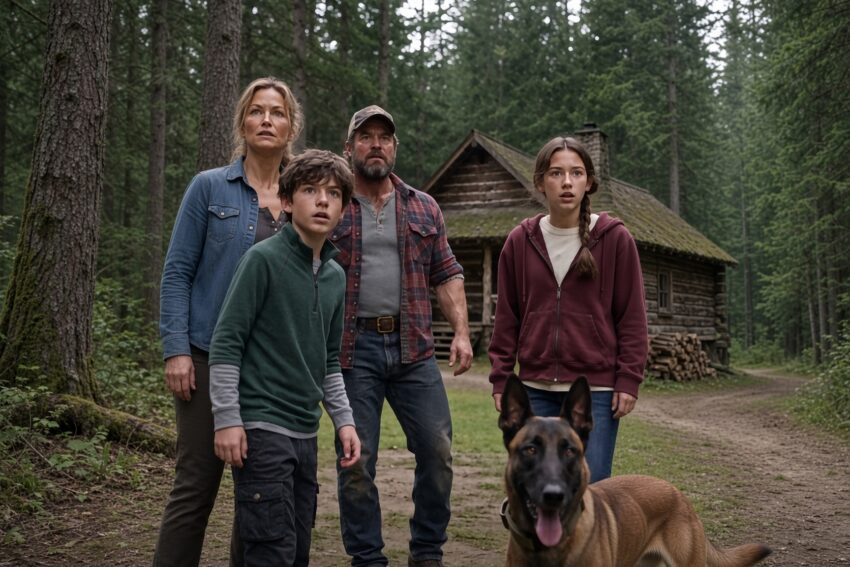
HE MOVED HIS FAMILY OFF THE GRID TO HIDE—THEN THREE BLACK QUADS FOUND THEM.
PART 2:
When the past breaches the tree line, a father’s final defense turns their sanctuary into a steel trap—and forces his family into the wild.
THE CLICK
Wyatt’s calloused thumb drove the red mushroom cap down into the brass collar until it seated with a dead, pneumatic thud.
The red LED ring went dark.
For half a heartbeat, the hallway went dead quiet, save for Clara’s ragged breathing and the wet panting of Dutch pressed hard against Toby’s legs.
Then the house groaned.
Heavy counterweights dropped inside the exterior walls with the shriek of ungreased steel cables.
Overhead, magnetic locks fired in sequence—sharp, metallic clacks that sounded like rifle bolts chambering rounds behind the drywall.
Outside on the porch, heavy corrugated steel rolling shutters dropped over every window frame in a blinding three-second cascade, slamming into the sill plates and vibrating the floorboards under their boots.
Nora pulled Toby behind her shoulder, her fingernails digging through the fabric of his green fleece.
“Wyatt,” she whispered. Her voice was flat, ice-cold, stripped of panic. “How long?”
“Two minutes,” Wyatt said, not looking back. “Maybe three if they don’t have shaped charges.”
A heavy combat boot struck the front door from the exterior porch.
The heavy Douglas fir timbers shuddered against the three hardened deadbolts, but the frame held.
Through the gaps in the planking, a muffled, digitized voice barked from the porch: “Clear the door. Breaching charge on the hinges. Move!”
THE FLOOR GRATE
Dutch let out a low, guttural vibration in his chest, the hair along his spine standing rigid like wire brush.
“Good boy,” Wyatt murmured, dropping to one knee before the hallway coat rack. “Quiet now.”
He shoved the heavy iron coat rack aside, caught the edge of a false baseboard, and wrenched it upward.
A four-foot section of tongue-and-groove flooring sprang open on silent gas struts, revealing a square concrete shaft dropping eight feet into black soil.
Cold, damp earth air rushed up into the warm timber hallway, smelling of wet slate, sulfur, and rotting cedar mulch.
“Clara first,” Wyatt ordered, pointing down into the dark. “Feet on the rung ladder. Drop down, clear the base. Take Dutch’s harness.”
Clara didn’t hesitate. The tears were still wet on her cheekbones, but her jaw locked tight as she swung her legs over the rim.
Her sneakers found the cold rebar rungs welded into the concrete shaft wall, and she slid down into the darkness.
“Dutch, down,” Toby commanded softly.
The Malinois gathered his hindquarters and dropped straight through the hatch opening, landing on the packed gravel floor below with a muffled thud and an immediate scuffle of paws.
“Toby, go,” Nora said, her hand steady on the boy’s back.
Toby grabbed the rungs, scrambling down with practiced haste, his breathing tight and shallow.
Above them on the porch, a high-frequency electronic whine cut through the wood—a wireless detonator charging.
“Nora,” Wyatt said, grabbing her forearm.
Her blue eyes met his in the dim yellow amber of the hallway bulb. No blame. No questions. Only the unspoken pact they had made six years ago when they built this place forty miles past the end of the county pavement.
“Down the ladder,” he said. “The gate at the culvert has a padlock. Key is around my neck, but the bolt cutters are on the shelf by the batteries.”
“You’re right behind us,” she said. It wasn’t a question.
“Right behind you.”
She swung down into the shaft.
Wyatt reached to the interior frame of the hatch, grabbed the tripwire release for the secondary deadweight, and pulled.
Above the ceiling, the house’s main structural breaker dropped. Every light died instantly.
A split second later, the front porch erupted.
THE BREACH
The blast was a blunt hammer against Wyatt’s eardrums.
The heavy fir door didn’t shatter; the timber splintered inward as the frame sheared from the rough-cut studs in a blinding shower of yellow sparks, pulverized drywall, and white smoke.
The overpressure slammed Wyatt flat against the concrete shaft lip.
He didn’t wait for his ears to stop ringing. He rolled off the edge and dropped straight down into the cellar.
He hit the damp gravel in a crouch, spun, and shoved the heavy oak access hatch shut above him.
The three spring-loaded steel slide latches snapped home into the concrete header just as the heavy, rubber-soled combat boots of the strike team thudded onto the floorboards directly above.
Footsteps moved fast above their heads. Heavy tactical gear, radios crackling with harsh digital static.
“Clear left! Hallway clear! Target is not in the primary room!”
“Check the perimeter! They didn’t come out the back—shutters are locked down!”
Wyatt turned on a pocket red-lens penlight, shielding the beam with his fingers.
Nora stood ten feet ahead in the narrow, earth-walled trench, clutching Toby to her waist. Clara held Dutch by his tactical collar, her hand buried in the dog’s thick neck fur to keep him silent.
The trench was narrow—scarcely three feet wide, braced with treated two-by-six timbers and corrugated iron sheets, dug beneath the frost line toward the drainage ravine behind the property.
“Move,” Wyatt whispered, his voice vibrating through his chest. “Crawl space for forty yards, then the concrete pipe. Keep your heads below the timber caps.”
Above them, through eight inches of earth and timber, came the dull, heavy clink of a sledgehammer striking the reinforced floor hatch.
They had found the trapdoor.
THE ROOT TUNNEL
The trench slanted sharply downward into the bedrock beneath the cabin’s root cellar.
Water seeped through the clay seams, dripping steadily onto Toby’s shoulders as the boy moved forward in a low, rapid crouch.
“Dad,” Toby whispered, his voice shaking against the cold dampness. “Who are those men?”
“Men who work for people who think I still owe them something,” Wyatt said, keeping his eyes on the rear flank. “Keep moving, Tobe. Eyes on your sister’s heels.”
The boy didn’t ask another question. He tightened his grip on his knees and pushed through the mud.
Behind them, back at the vertical shaft, a muffled dull crump vibrated through the shale walls.
“Shaped charge on the hatch,” Nora muttered, wiping clay from her forehead. “They’re down the shaft.”
“Dutch, lead,” Clara whispered.
The dog slipped past her, nose skimming the muddy floorboards, his gait low, silent, and purposeful.
The timber-braced trench ended abruptly at a massive corrugated galvanized steel culvert—four feet in diameter—installed three summers ago under the guise of an erosion control ditch.
A heavy iron rebar grate blocked the mouth, secured with a four-dial brass combination lock.
Nora was already at the grate. Her fingers were smeared with gray clay, but she spun the tumbler wheels without hesitation: *0 – 8 – 1 – 4.* Clara’s birth date.
The padlock clicked open with a wet snap.
Nora swung the heavy rebar grate outward. “Go, go, go.”
Dutch plunged into the corrugated culvert first, his nails drumming softly against the galvanized ridges. Toby followed on hands and knees, then Clara.
Wyatt reached into his plaid flannel shirt, pulled a small magnetic strobe beacon from his pocket, flipped the switch to an infrared blink, and slapped it against the inside flange of the culvert mouth.
“What does that do?” Nora breathed as she prepared to crawl in.
“Gives their night-vision goggles a white-out bloom the second they round the timber bend,” Wyatt said grimly. “Buys us forty seconds.”
He pushed her inside, crawled in behind her, and pulled the rebar gate shut, clicking the padlock locked from the inside.
THE RAVINE
The culvert emptied out sixty yards down the ridge, half-buried under a dense canopy of rotting ferns, blackberry briars, and fallen hemlock logs.
Toby scrambled out into the drizzling mountain air, gasping as the cold, pine-scented wind hit his face.
The gray sky hung low over the ridge, weeping a steady, misty Pacific Northwest rain that coated the fir needles in slick moisture.
Above them, through the dense screen of second-growth timber, the sound of the quads’ high-displacement four-stroke engines roared back to life.
“They’re circling the cabin perimeter,” Nora said, crouching low beneath the fan of a giant sword fern. Her denim shirt was soaked through at the shoulders.
Wyatt slid out of the pipe, his boots digging into the black loam of the ravine slope.
Down below in the creek bed, the water ran brown and turbulent over basalt boulders.
“They have thermal drones,” Wyatt said, looking up through the canopy at the gray cloud ceiling. “The cloud cover helps, but the canopy won’t hide our body heat for long once they get the birds airborne.”
“Where do we go?” Clara asked. She was shivering now, the thin maroon cotton of her hoodie clinging to her arms. “The truck is at the barn. They’re right next to it.”
“We leave the truck,” Wyatt said flatly. “The truck is a beacon. We go down the wash, into the creek. Water kills the scent if they have tracking dogs, and the cold water lowers our thermal signature if we stay under the cutbanks.”
“Wyatt, that water is straight runoff from the snowpack,” Nora said, touching Toby’s pale cheek. “The kids can’t stay in that creek for two miles.”
“Not two miles,” Wyatt said, checking his watch. “Nine hundred yards. Down to the old logging culvert under Spur Nine.”
“Silas?” Nora asked, her eyes narrowing.
“Silas,” Wyatt confirmed. “He’s the only one within twenty miles who doesn’t show up on a county land registry.”
A high, buzzing drone whine—like an angry hornet the size of a lawnmower—drifted down through the overcast mist directly above the clearing.
“Creek. Now,” Wyatt ordered.
THE CUTBANK
They hit the water at an angle, sliding down the wet mud bank on their boot heels.
The cold was an instant shock that drove the breath from Toby’s lungs with a sharp gasp.
“Keep your feet,” Wyatt whispered, catching the boy by the collar of his fleece. “Step on the gravel bars, not the slick boulders. Clara, keep Dutch beside you.”
The Malinois waded through the current without a whimper, his powerful chest cutting through the foam, his amber eyes fixed intently on the wooded ridge above them.
They moved in single file under the overhanging roots of ancient western red cedars that grew out of the eroded banks.
Every twenty yards, Wyatt paused, scanning the tree line through the rain.
Farther up the mountain, back toward the clearing, a burst of small-arms fire echoed through the trees—controlled, three-round bursts.
“They’re clearing the barn,” Nora said quietly.
“Or putting down anything that moves,” Wyatt added. “They aren’t here to serve an indictment, Nora. You saw the gear. No state emblems. No federal crests. Just black Kevlar and sterile plates.”
“Who sent them, Wyatt?” Clara’s voice cracked slightly, the cold getting into her jaw. “You said whatever you did before we were born… you said it was over.”
Wyatt didn’t answer immediately. He stopped under a massive overhang of sandstone rock where the creek undercut the ridge, sheltering them from aerial view.
He looked at his daughter. Her face was smudged with black creek mud, her braid dripping wet.
“I built communication networks for people who ran privatized black sites overseas,” Wyatt said, his voice level, harsh, and clear. “When I left, I took the encrypted ledger of every off-book payment, every shell company, and every site coordinator. I buried the physical hard drive in concrete under the cabin hearth.”
Nora’s head snapped toward him. “You kept it? You told me you burned it in the incinerator before we bought the land!”
“If I burned it, Nora, they would have killed us six years ago,” Wyatt said. “The only reason we had peace was because they spent six years trying to prove whether I actually had it or died in the fire. Now they know.”
Above them on the logging road that ran parallel to the creek ridge, an engine idled.
One of the black ATVs had pulled up onto the wooden bridge crossing seventy yards downstream.
THE SCOUT
The rumble of the quad’s single-cylinder engine vibrated through the shale rock above their heads.
Wyatt held up a flat palm. Everyone froze.
Dutch dropped belly-first into the mud, his muzzle resting between his forepaws, ears pinned back flat against his skull.
Through the screen of dripping hemlock boughs, Wyatt saw the front tires of the machine: wide, mud-caked, aggressive knobbies resting on the timbers of the bridge.
The operator dismounted.
He was tall, broad-shouldered, wearing an unbadged black shell jacket, a tactical plate carrier, and a matte-black ballistic helmet with an integrated comms headset.
He held a suppressed short-barreled carbine at the low ready, his movements smooth, methodical, and disciplined.
He walked to the edge of the wooden bridge rail, leaned over, and peered down into the creek wash.
Wyatt pressed Nora and Toby deeper into the shadows of the sandstone recess.
The cold creek water swirled around Wyatt’s knees, numbing his shins until they felt like lead pipes.
The operator reached to his chest rig, unclipped a handheld thermal optic, and brought it to his eye.
“He’s scanning the bank,” Nora breathed into Wyatt’s collar.
Wyatt reached slowly to his belt, unhooking the heavy forged-steel camp hatchet he had clipped to his work belt before running out of the kitchen.
If the operator swung the lens twenty degrees to the left, the thermal signature of their faces against the freezing stone would light up like flares on his display.
The operator adjusted the focus ring on the optic.
Suddenly, fifty yards upstream, a rotten fir snag gave way under the weight of the recent rain, crashing down through the vine maples with a loud, snapping crack.
The operator’s rifle snapped instantly toward the noise upstream.
He raised a gloved hand to his throat mic, spoke two clipped words into his transmitter, turned back to his quad, swung his leg over the saddle, and accelerated hard up the logging spur, the tires throwing roosts of wet shale into the creek below.
“Move,” Wyatt hissed. “Before he circles back.”
THE LINE SHACK
They scrambled under the bridge timbers, out of the creek bed, and plunged into the dense thicket of spruce on the opposite ridge.
The ground rose steeply here, climbing toward an abandoned mining spur that had been decommissioned in the late seventies.
Toby stumbled on a mossy root, going down hard on his hands and knees.
Clara caught him under the arm, hauling him upward before Wyatt even reached him. “I’ve got him. Keep moving.”
At the crest of the ridge, hidden behind a deliberate barrier of unpruned blackberry brambles and stacked cordwood, stood a low-profile structure built into the hillside.
It was clad in rusted corrugated tin and covered in living moss, looking more like a collapsed storage shed than a dwelling.
Wyatt approached the heavy cedar plank door and tapped three times with the butt of his hatchet: two quick beats, a long pause, then one heavy strike.
From inside came the dry, distinctive mechanical click of a twelve-gauge shotgun sliding off safe.
“Wyatt?” an old, gravelly voice rasped through the wood seam.
“It’s me, Silas. Nora and the kids are with me.”
Three heavy iron barrel bolts slid back with a dry scraping noise.
The door swung inward six inches. A weathered, gray-bearded man in a heavy wool work shirt and faded canvas overalls looked out, a Remington 870 cradled across his forearm.
His pale, rheumy eyes took in their soaked clothes, the mud on Toby’s face, and the tactical collar on Dutch.
“Saw the black birds in the sky ten minutes ago,” Silas MacCallister said, pulling the door wide. “Get inside before their downlink sweeps the clearing.”
THE WORKSHOP
The inside of the shack smelled of kerosene, solder resin, machine oil, and woodsmoke.
Workbenches lined the rough-hewn walls, piled high with vacuum-tube ham radios, modified circuit boards, lithium battery banks, and brass reloading dies.
Silas dropped the iron bolts back into place and turned a deadbolt key, hanging it on a nail beside the frame.
“Sit them down by the stove,” Silas commanded, pointing to a small cast-iron box heater radiating intense cedar heat in the corner. “Clara, strip that wet hoodie off before your lungs seize up. Here.”
He tossed two rough wool Hudson’s Bay blankets across the table.
Nora wrapped Toby tightly, pulling him onto a timber bench beside the hearth. The boy’s teeth were chattering uncontrollably, his skin a mottled blue-white.
“How many?” Silas asked, walking over to a long bench where three modified commercial frequency scanners clicked silently through bands.
“Six on the ground,” Wyatt said, leaning against the doorframe to catch his breath. “Three quads. Sterile operators. Professional movement, military-grade comms suppression. They breached the front door with det cord.”
Silas spat into a tin can beside his drill press. “They didn’t come to talk about your back taxes.”
“They want the drive,” Wyatt said.
“Did you give it to them?”
“I triggered the failsafe,” Wyatt replied.
Silas stopped, his gnarled hands hovering over the radio dials. He looked back at Wyatt with genuine astonishment. “The whole cellar bank?”
“Every capacitor,” Wyatt said grimly. “When the main door breached, it armed a ninety-second thermal delay. If they breached the hearth floor, the thermite charges inside the concrete safe liquidated the silicon plates into slag.”
Nora’s head came up from the blankets. “You destroyed it? You said that drive was the only reason they hadn’t killed us!”
“If they get the drive, Nora, we’re loose ends,” Wyatt said, walking over to kneel beside her. “If the drive is intact, they take us alive, interrogate us until they verify the key, and dump us in a mine shaft. With the drive melted, their employers don’t have proof of our death, and they don’t have their ledger back. The contract becomes toxic.”
“They don’t know it’s destroyed yet,” Silas interjected, tapping a glowing monitor. “Listen.”
He reached out and flicked a rotary knob on a modified base station.
A voice, heavily scrambled but parsed through Silas’s homemade decryption filter, crackled through the small speaker:
*“…Team Lead to Command. Primary structure breached. Safe location identified under the stone masonry. We have heavy thermal burn inside the vault. The media is completely incinerated. I repeat, package is ruined.”*
A long pause of crackling static followed.
Then a second voice answered, colder, crisper, transmitting from a high-altitude repeater:
*“Understood. Shift to scrub protocol. No witnesses to the breach. Find the family and terminate. Do not let them reach the state highway.”*
THE PLAN
The small room went dead still, save for the crackling of pine bark inside the woodstove.
Clara stared at the floorboards, her knuckles white around the wool blanket. “They’re not going to stop, are they?”
“No,” Nora said, her voice dropping into that terrifyingly quiet register Wyatt knew from the worst days. “They aren’t.”
She looked at Silas. “What runs out of this hollow?”
“Nothing with an engine that won’t show up on their thermal sensors,” Silas said, shaking his head. “They have an orbital surveillance pass in forty minutes, and their drone has infrared that can pick up an idling manifold through a barn roof.”
“What about the river?” Wyatt asked.
“The Clearwater is running twelve feet above summer pool,” Silas replied. “You’d be in an aluminum skiff in class-four rapids with two children and a dog in the dark.”
“Then we don’t run,” Wyatt said.
Nora looked up at him. “Wyatt, you have a hatchet and Silas has a duck gun. They have night vision, body armor, and automatic weapons.”
“They have gear,” Wyatt said. “They don’t have the mountain.”
He walked over to Silas’s workbench, sweeping aside a tangle of patch cables to reveal a hand-drawn topographical survey map pinned to the plywood.
“Spur Nine runs along the old quarry cut,” Wyatt pointed with a grease pencil. “It narrows down to eight feet wide between the high shale wall and the five-hundred-foot scree drop into the river gorge.”
“They have to use that road to bring their quads back down to their transport trucks,” Silas noted.
“They won’t bring all three,” Wyatt said. “They’ll leave two to comb the creek, and send one scout back to the transport rig on the highway to set up a perimeter roadblock.”
“We cut the scout off,” Nora realized, leaning in. “We take his transport.”
“We take his comms,” Wyatt corrected. “His radio has their encrypted team frequency. If we have their live audio, their night-vision advantage drops by half.”
Silas reached under his bench and pulled out an old olive-drab steel ammo crate.
He popped the latch, revealing half a dozen vintage commercial seismic blasting caps and three sticks of damp, seventy-percent nitroglycerin ditching dynamite wrapped in wax paper.
“Left over from the culvert clearing three years back,” Silas said with a dry, wicked grin. “Stable enough if you don’t drop it on the rocks.”
THE QUARRY ROAD
Night fell fast under the storm clouds, turning the dripping fir forest into an ink-black maze of moss, rock, and mud.
The rain had intensified, drumming a deafening roar against the forest canopy that masked the sound of their footfalls.
Wyatt and Nora moved along the high ridge above the quarry road, leaving Silas with Clara, Toby, and Dutch in the concealed drainage tunnel fifty feet above the rock cut.
Wyatt’s plaid shirt was soaked through, the cold seeped into his collarbone, but his blood was pumping hot with focused adrenaline.
Below them, the quarry road was a narrow shelf carved out of rotten shale.
On the left rose an eighty-foot sheer wall of cracked, wet basalt; on the right fell away a sheer, terrifying drop into the black roaring froth of the Clearwater River gorge.
“Here,” Wyatt whispered.
He dropped to his knees in the mud by a natural drainage culvert where water ran across the roadbed, eroding a foot-deep trench in the gravel.
He took two sticks of the ditching dynamite from his coat, slid the seismic cap into the center of the wax cartridge, and buried the package six inches deep in the wet gravel wash.
He ran the thin, twin-lead blasting wire up the rock face, using split pine wedges to pin it into the seams of the stone.
“Hear that?” Nora whispered, crouching beside him, her shotgun leveled at the dark bend.
Down the mountain, the low, throaty thrum of a high-displacement engine climbed the grade.
Single headlights cut through the sheets of falling rain, slicing yellow wedges across the wet rock faces.
It was the lead scout, returning along the quarry shelf at twenty-five miles an hour, his ATV tires throwing wet gray slurry into the canyon.
THE AMBUSH
Wyatt scrambled up the broken rock ledge, catching Nora’s hand as she pulled him into the cedar roots six feet above the road.
He held the two stripped ends of the blasting wire against the terminals of a small nine-volt battery pulled from his pocket.
“Wait for the front axle to cross the wash,” Wyatt breathed. “If he sees the disturbed gravel, he’ll back down.”
The quad rounded the hairpin turn.
The machine was blacked out, its headlights dimmed to low tactical amber slits.
The operator was riding standing on the pegs, his weight forward, leaning into the grade, scanning the road ahead with night-vision monocles mounted to his helmet.
His tires hit the running water in the wash.
Wyatt touched the copper wire to the battery terminal.
The blast wasn’t a roar; it was a violent, shocking crack that displaced the air with an iron fist.
The gravel under the ATV’s front tires vanished in a fountain of pulverized stone and yellow flame.
The machine’s front suspension collapsed into the sudden crater, the rear end flipping up and over in an violent end-over-end arc.
The operator was thrown clear, slamming hard into the wet shale wall with an impact that knocked the breath and his weapon clean out of his hands.
The ATV tumbled over the edge, crashing down through the hemlock tops before disappearing into the black roar of the river five hundred feet below.
THE CAPTURE
The operator hit the gravel road, rolling instantly into a defensive tuck, reaching for his sidearm with military reflex.
Before his glove cleared the Kydex holster, Nora was off the ledge.
She landed boots-first in the mud, bringing the heavy walnut stock of Silas’s twelve-gauge down across the operator’s forearm with a sickening crack.
The operator groaned, his handgun spinning into the ditch.
Wyatt dropped beside him, planting his knee firmly into the center of the operator’s chest plate, pinning his shoulders against the wet rock, the edge of his camp hatchet pressed flat against the operator’s throat.
“Don’t move,” Wyatt hissed.
The man went rigid.
Through the rain, Wyatt reached down and ripped the black balaclava and tactical goggles from the man’s face.
He was young—not more than twenty-eight—with close-cropped blonde hair, pale skin, and cold gray eyes that showed no fear, only the hard, calculating detachment of a paid professional.
On his collar was a small, subdued rubberized patch: an eagle clutching a pair of broken scales.
“Vanguard Directorate,” Wyatt muttered, recognizing the private security outfit’s clandestine operations branch. “Who signed the field contract?”
The young man clamped his mouth shut, blood trickling from a split lip.
Wyatt didn’t strike him. He reached to the man’s tactical vest, ripped off the tactical radio transceiver, and pulled the encrypted earpiece from his ear.
In the speaker, a voice was already barking through the hiss of static:
*“Bravo Two, report status. We heard an explosion on the lower spur. Bravo Two, report!”*
Wyatt clicked the push-to-talk button on the collar mic.
“Bravo Two is down,” Wyatt said, his voice completely level. “And the package you came for is gone. It was liquidated in the hearth safe twenty minutes ago.”
Silence fell on the channel for four long seconds.
Then the commander’s voice returned, cold and measured:
*“Wyatt Vance. You shouldn’t have run. You know the corporate charter. No unvetted liabilities survive a breach.”*
“I don’t have the ledger anymore,” Wyatt said. “You have nothing to recover.”
*“You have your memory, Vance. That’s enough to hang twelve directors. We hold the highway. We hold the county bridges. You have two children and a wounded wife. You won’t make the state line.”*
Wyatt clicked the radio off, smashed the channel selector knob against the rock wall with his heel, and pocketed the unit.
THE COST
They retreated back up the rock chimney to Silas’s shack.
The rain was turning to wet mountain sleet, freezing as it touched the timber needles.
Inside the shack, Silas had packed a canvas rucksack with dry socks, ammunition, and three jars of canned venison.
Clara sat on the floor, her arms wrapped around Dutch.
The dog looked up as Wyatt entered, gave a single soft thump of his tail, and let his head drop back onto Clara’s knee.
Toby looked at the captured tactical gear Wyatt carried in his hands: the radio, the thermal monocle, and a satellite uplink pad pulled from the downed scout’s pack.
“Dad?” Toby asked quietly. “Are we ever going back to the house?”
Wyatt looked down at his son.
The cabin was gone. The soccer net in the clearing was probably tire-shredded mud by now. The timber walls he had notched by hand over two long summers were scorched with breach soot.
“No, Tobe,” Wyatt said gently. “We’re not going back.”
Clara swallowed hard, a single tear cutting through the dried clay on her cheek. “All my books. My pictures.”
Nora knelt beside her, pulling both children into her chest. “We have each other. That’s what the house was keeping safe. Not the things inside it.”
Silas walked over from the workbench, holding an old leather-bound ledger and a heavy cast-iron key.
“You can take the mine cart down the old drain tunnel under the ridge,” Silas said. “It drops out three miles south, right behind the abandoned county gravel quarry. But someone has to operate the manual winch from this side to lower the cable car down the vertical incline.”
Wyatt looked up at Silas. “Silas, no. If they sweep this ridge, they’ll find this shack.”
“Wyatt, I’m seventy-four years old,” Silas said with a tired, dry chuckle. “I’ve lived in this hollow forty years. I ain’t running down no wet river gorge with a pack on my back.”
“Silas—” Nora started.
“Take the kids, Nora,” the old man said firmly, his eyes softening as he looked at Clara and Toby. “I’ll drop you down the shaft. Once the cable bottoms out, I’ll grease the rails and drop a couple sticks of dynamite down the vent. They won’t follow you through the mountain.”
THE WINCH
The entrance to the old mining incline was located beneath a trapdoor under Silas’s drill press.
The iron ore cart hung from a two-inch braided steel cable, rusted but heavily greased, suspended above a forty-five-degree shaft that dropped into the pitch-black heart of the mountain.
Wyatt helped Toby into the cart first, wrapping him in two dry wool blankets.
Clara climbed in beside him, holding Dutch tightly against the cold iron floor of the bucket.
Nora stepped in next, her face pale in the kerosene light, her hands steady as she gripped the rim.
Wyatt stood on the timber platform, looking at Silas.
“The satellite pad,” Wyatt said, handing the captured Vanguard tablet to the old man. “It has an automated emergency beacon. If you turn it on, their drones will lock onto this shack in ninety seconds.”
“Good,” Silas said, taking the pad with a grin that showed three missing teeth. “I’ll give them something to look at while you hit the valley road.”
Wyatt gripped the old man’s shoulder. His throat was tight, words failing him. “Thank you, Silas.”
“Don’t thank me yet,” Silas rasped. “Get them out of the state. Go east, past the divide. Don’t look back.”
Silas grabbed the heavy wooden brake lever of the hand winch, released the dog pawl, and the ore cart lurched forward.
The iron wheels screamed against the narrow-gauge rails as the cart plunged down into the cold, dripping blackness of the mountain shaft.
Above them, the rectangular opening of kerosene light shrank to a tiny golden postage stamp, then vanished entirely as Silas dropped the heavy timber trapdoor shut.
THE TUNNEL DESCENT
The descent took twelve terrifying minutes.
The iron cart rattled and bucked on the uneven rails, cold groundwater raining down on them from the rock fissures above.
Toby held onto Clara’s sleeve with both hands, his eyes squeezed shut, while Dutch leaned his heavy weight across both of their boots, providing warm, solid comfort in the roaring dark.
Wyatt stood at the front of the cart, the captured thermal optic pressed to his eye, scanning the tracks ahead for cave-ins or fallen timber props.
The air grew steadily colder, smelling of iron ore, stagnant groundwater, and wet granite.
Then the pitch of the rails leveled out.
The cart slowed, its iron wheels screeching to a halt against a heavy timber bumper packed with rotten hemlock logs.
They were out.
Wyatt jumped down into six inches of gravel sludge, helping Nora and the kids out of the iron bucket.
A cool, steady draft of night air blew in from the end of the adit fifty yards ahead.
They walked out through the collapsed mouth of the old adit into the abandoned gravel quarry.
The rain had finally stopped, replaced by a biting mountain wind that blew the gray clouds apart, revealing a jagged sliver of cold autumn stars above the ridge.
Behind them, high on the mountain they had just fled, a dull, muffled boom echoed through the bedrock.
A second later, a brilliant orange flash lit up the cloud deck above Silas’s ridge, followed by the distant, dying rumble of a rockslide sealing the upper vents.
Clara stopped, turning back to look at the high mountain.
“Silas,” she whispered.
Wyatt put his hand on her shoulder, turning her gently toward the dark quarry floor below.
“Keep walking, Clara,” he said softly. “Don’t let what he did be for nothing.”
THE HIGHWAY TURN
At the edge of the abandoned quarry, parked half-hidden under the rotting eaves of an old gravel sorting shed, sat Silas’s ancient 1994 Ford F-250—unregistered, beat-up, covered in dried yellow mud, with two full fifty-gallon drums of farm-grade diesel tied into the bed.
The key Silas had given Wyatt slipped cleanly into the worn ignition cylinder.
The old seven-point-three diesel engine turned over with a heavy, rattling groan, caught, and settled into a steady, rumbling idle that vibrated the rusted floorboards.
“No headlights,” Wyatt instructed, engaging the four-wheel-drive lever with a sharp yank. “We run on parking lamps until we cross the county culvert.”
He pulled the heavy truck out onto the deserted two-lane blacktop that wound south toward the interior plateau.
Nora sat in the passenger seat, the captured Vanguard radio resting in her lap.
She reached down, picked up the handset, and adjusted the frequency dial to the emergency state broadcast channel.
“What are you doing?” Wyatt asked, his eyes locked on the faint, winding gray ribbon of asphalt illuminated by the amber marker lights.
“They’re going to call this an accidental propane explosion,” Nora said, her voice trembling with suppressed fury. “They’re going to report four bodies found in the timber ash, close the file, and collect their fee.”
She looked back at Clara and Toby huddled together under the blankets on the bench seat behind them, Dutch resting his chin on Toby’s knee.
“We don’t let them close the file,” she said.
She plugged the downed scout’s comms unit into the truck’s auxiliary port, broadcasting the recorded Vanguard frequency traffic—the orders to scrub the site, the commands to execute the family, the operational codes—directly onto the county sheriff’s open emergency dispatch loop.
Across three counties, every radio in every state police cruiser, forest service truck, and emergency dispatch console suddenly crackled to life with the unedited, digitized voices of the Vanguard tactical team coordinating a clandestine strike on domestic soil.
THE SAFE HARBOR
Dawn broke over the high desert plateau four hours later.
The dark, claustrophobic conifer forests of the coast were gone, replaced by endless rolling swells of sagebrush, gray basalt rims, and a pale yellow sunrise cutting through the cold morning frost.
The old diesel truck rattled along a forgotten gravel frontage road forty miles north of the Nevada state line.
Wyatt pulled into a small, weathered service station that sat alone beside a dry alkali flat.
He shut off the engine. The silence that followed was immense, broken only by the ticking of the cooling exhaust manifold and the steady, dry wind rustling through the sage.
Toby was asleep, his head resting against Clara’s shoulder, his breathing deep and even for the first time in eighteen hours.
Dutch sat upright, his ears forward, watching a lone red-tailed hawk circle above the telephone poles.
Nora stepped out of the truck, her boots crunching on the dry white gravel.
She walked to the edge of the lot, wrapping her denim shirt around herself as she looked out over the vast, open desert basin.
Wyatt walked up behind her, placing his hands on her shoulders.
Her body was trembling—not from cold, but from the sudden, overwhelming release of terror that had kept her upright through the night.
“They won’t come out here,” Wyatt said quietly. “The radio broadcast forced the regional justice commission to freeze Vanguard’s domestic operating licenses pending federal review. The operation is blown wide open.”
“And when the review ends?” Nora asked, turning her face toward his. “When the news moves on to something else?”
Wyatt looked down at his rough, scarred hands—the hands that had pressed the button, notched the cabin logs, and pulled his family out of the earth.
“Then we keep moving,” Wyatt said. “We build another life. Out here, where you can see the dust coming from twenty miles away.”
Clara opened the truck door, stepping down into the cold desert sunlight, holding Dutch by his nylon collar.
She didn’t look like the terrified girl who had cried in the dark hallway anymore.
Her jaw was firm, her eyes clear and watchful as she scanned the wide, empty highway stretching east toward the horizon.
“Dad,” she called out, her voice steady in the morning wind. “Which way are we going?”
Wyatt walked back to his daughter, reached down, and took the dog’s lead in his hand.
“East,” Wyatt said, opening the truck door for her. “Until the road runs out.”
***
DISCLAIMER: This story is an entirely original work of fiction created solely for entertainment purposes. All characters, organizations, tactical groups, events, and incidents portrayed in this story are purely the product of the author’s imagination. Any resemblance to actual persons (living or dead), real-world agencies, commercial entities, or real events is entirely coincidental. This text does not constitute operational, survival, or security advice.