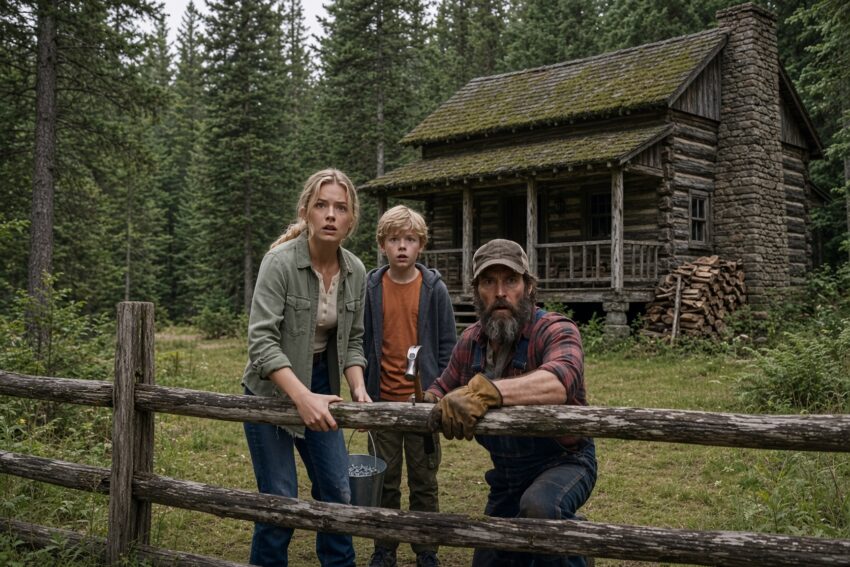
HE TOOK HIS FAMILY DEEP INTO THE WOODS TO HIDE—UNTIL THEY SHOWED UP
PART 2:
They had ninety seconds of wood and steel between a nail bucket and the men who already knew his name.
THE FENCE
The nail was half in.
Caleb Brennan held it with a gloved thumb and brought the hammer down once, clean, the way he had taught the boy not to rush. Moss licked the cabin roof. The stone chimney held yesterday’s smoke. The fence rail was soft where the rain had worked it.
Lena stood at his left with the bucket. Blonde hair tied back. Green jacket. Cream henley. Jeans dark at the cuffs from the wet grass. She was watching the tree line because she always watched the tree line, even when he told her the road was a dead spur.
Jonah stood between them in the orange shirt and the gray hoodie, nine years old and trying to look like the work mattered. The hammer rang. A jay cut across the porch and was gone.
Then the sound changed.
Not a truck yet. A low note under the firs, the kind that arrives before the tires. Lena’s hand tightened on the rail. Jonah looked up. Caleb set the hammer on the wood and did not pick it up again.
He knew the note. He had heard it on a night he did not talk about, on a graded road outside a place that did not have a name on any county map.
“Caleb,” Lena said.
He did not answer. His mouth had already gone dry.
THE TRUCKS
The first dark SUV came through the wooden gate posts with its roof bar lit, white and hard against the green. Mud threw up behind the tires. A second truck held back in the dust, same shape, same light, same lack of plates he could read at that distance.
They were not county. County trucks had seals and dents and coffee rings. These were squared, armored at the corners, quiet in the engine the way money is quiet.
Jonah’s mouth opened. Lena took one step toward the boy and stopped, because running too soon was how people got cut off from the door.
Caleb felt the old cold move up his spine and sit behind his eyes.
“Oh shit,” he said. “They found me.”
The lead truck stopped on the rutted track. Doors opened into the dust. Men in black came out low, masks over the lower face, hoods up, rifles held the way men hold tools they trust. Four he could count. More behind the second truck, shapes in the haze. No shouting. No announcement. That was worse than shouting.
Lena looked at him, and the look said she had always known there was a before.
“Run,” Caleb said. “Get to the house.”
He shoved the rail. The bucket tipped. Nails spilled into the grass and winked once and were nothing.
“Run to the house.”
THE RUN
They went together because apart was how the trucks wanted them.
Caleb’s left arm found Lena’s shoulder. His right caught Jonah at the hoodie. The boy was fast and scared in the same legs. Boots hit wet grass, then the pale dirt of the path. Behind them a voice, muffled by cloth, gave a short order he did not need to hear to understand.
Almost there. The porch boards. The open door and the dark of the hall beyond it.
“Almost there, get inside.”
Jonah hit the threshold first. Lena next. Caleb last, turning once, seeing the black shapes already off the road and onto the grass, spacing themselves so no one man made a single target of the family.
“Get inside.”
He pulled the door. The old wood stuck the way it always stuck in damp weather. He put his shoulder into it. The latch took.
For one second the cabin was only their breathing.
Jonah’s face was white under the freckles. “Dad, what’s happening?”
Caleb looked at the wall beside the coat pegs. The plate was there, set into the wood, a rectangle with a dull red heart he had tested once a month and prayed never to use.
“I have to press the button now.”
THE CLICK
His palm met the plate.
The red woke under his skin, hot through the callus, not a burn, a signal. A click traveled the wall the way a knuckle travels a stud. Somewhere under the floor a motor took a breath. Somewhere in the header above the door a pin dropped.
Lena flinched at the sound. Jonah grabbed her jacket.
“What did you do?” she said.
“Locked it,” Caleb said. “And opened the other way. Both. Don’t touch the windows.”
Steel sang.
Shutters he had framed as storm boards dropped on their tracks, interior leaves, three inches of plate behind the look of painted wood. The front door threw a second bar, magnetic, into a pocket he had cut the summer Jonah was learning to ride. The porch light died. The little lamp in the hall buzzed and held, on the battery he changed every spring.
A thud hit the door. Not a knock. A test.
Then another, lower, at the hinge side.
“Dad.”
“I hear them.” Caleb was already moving. “Kitchen. Now. Both of you. Shoes stay on.”
THE SHUTTERS
The kitchen shutter took the first real hit.
Glass popped behind the steel and fell inward in a sheet, harmless, spending itself on the plate. Jonah made a sound and swallowed it. Lena pulled him behind the table without being told.
Outside, a man spoke into a collar mic. The words were chopped by the wall. Caleb caught only the shape of them. Breach. Family. Primary.
Primary was him. He had known it at the fence.
He dragged the rag rug off the floor by the pantry. Under it the boards looked like boards until he hooked two fingers into a knot that was not a knot. The panel lifted on a piston, slow, smelling of cold earth and machine oil.
A square of dark opened in the kitchen. A ladder went down.
“You built this,” Lena said. Not a question.
“After the hearing that wasn’t a hearing,” he said. “Get on the ladder. Jonah first. I’ll hand you the bag.”
Another hit, this time at the side window. The shutter held. Dust sifted from the beam.
Jonah looked into the hole and did not move.
Caleb knelt so they were eye to eye. “It is a room. Then a pipe. Then trees. I go last so I can close it. You do not wait for me in the pipe. You keep Lena’s hand. If I say drop, you drop. Understand?”
The boy nodded once, the way he nodded when a nail was about to bend.
“Good. Down.”
THE ROOM UNDER THE HOUSE
The room was barely a room. Concrete poured against stone, low enough that Caleb had to duck. A shelf. A crate. A bulb on a pull chain that painted their faces the color of tin.
Jonah’s breath fogged. Lena’s hand found the shelf and stayed there, counting them by touch.
On the shelf: two packs, a water bladder, a folded wool blanket, a tin of oats, a hand lamp, a paper map in a plastic sleeve, and a flat metal box no bigger than a book. Caleb took the box first. The latch was stiff. Inside, wrapped in cloth, a drive the size of a thumb and a second, smaller wafer he had copied on a night the rain sounded like gravel.
“This is why,” he said.
Lena stared at it. “You said the statement was in the docket.”
“A statement. Not the tape. The tape has the yard. The voices. The man who gave the order without a mask because he thought the camera was a porch light.” He closed the box. “They burned the courthouse copy. They did not know about the second.”
Above them, something heavy walked the kitchen. A boot. Then the scrape of a table being thrown.
Caleb shoved a pack at Lena and the smaller one at Jonah. “Wear it. Don’t argue with the straps.”
“Where does the pipe go?” Lena said.
“West culvert. Past the fern cut. It comes out under the old log bridge if the screen is still on. If it isn’t, we crawl into brush and we do not stand up until I say.”
Jonah’s voice was small. “Are they police?”
Caleb hated the answer and gave it anyway. “Some of them were. Not tonight. Tonight they are a recovery crew for a company that does not put its name on trucks. Vesper Compact. You don’t need the name. You need the pipe.”
A metallic kiss hit the kitchen floor above the hatch. They had found the rug.
“Lamp off,” he said.
He killed the bulb. Dark took the room except for the red bleed from the plate circuit, a thread along the conduit. He pulled the hatch down from below and shot the inner bolts. The piston sighed. For a moment the boots were the whole world, patient, looking for the seam.
THE CACHE
He let them breathe once.
Then he opened the crate. Not guns in a row. He would not make the boy carry that picture. A flare he hoped not to use. A coil of wire. A roll of tape. A folding shovel. A radio the size of a brick with a cracked face, tuned to a frequency he and one other person had agreed on in a parking lot three years ago.
He thumbed the radio. Static. Then a click, as if someone on the other end had been sitting with a hand already on the key.
“Quill,” he said, low. “Brennan. Red plate is live. Two trucks. Masks. West culvert if we make it. Do not come to the cabin.”
A woman’s voice, dry as cedar. “Copy. Fire road. Not the tower. If you’re bleeding, say so now.”
“Not yet.”
“Then move. They’ll sweep the creek in six minutes once they figure the house is a box.”
The radio went quiet. Lena was staring at him in the thin red light.
“Maren,” he said. “She poured the culvert with me. She doesn’t owe us this.”
“Then why is she answering?”
“Because she was on the road that night too. Different truck. Same yard.”
Above, a saw started, high and angry, biting at the hatch seam. Sparks would be next. The inner bolts would buy them a little. Not a life.
Caleb pointed at the round mouth in the far wall, ribbed metal, shoulder-wide, black as a throat.
“In.”
THE TUBE
Jonah went first because small was an advantage and because Caleb needed to see him moving.
The culvert smelled of iron and leaf rot and old rain. Corrugations grabbed at sleeves. Every shift of a knee rang a little, a dull bell the earth mostly ate. Lena followed, pack scraping. Caleb came last and pulled a mesh screen across the mouth, not a door, a lie. From the room it might look like stored pipe.
They crawled.
Water stood in the low bend, cold through denim, up to Jonah’s wrists. He made a hurt sound and kept going. Lena’s hand found his ankle once when he slowed, not to stop him, to tell him she was still the next body in the dark.
Caleb counted bolts in the ribs. Twenty. Forty. His shoulders burned. Behind them, faint, the saw found the hatch and screamed.
“Don’t stop,” he said.
The tube climbed. The water fell away. Air changed, less iron, more fir and wet bark. A gray coin of daylight appeared and widened.
Jonah reached the screen at the outlet and froze, which was right.
Caleb wormed past Lena, awkward, apologizing with a shoulder, and looked through the mesh.
The log bridge was twenty feet above the outlet, half-collapsed, ferns on the near bank. No boots on the mud. No light bar. A thrush moved in the salmonberry and that was all.
He cut the two ties on the screen with the knife from his belt and pushed it aside.
“Out. Left. Into the ferns. Stay low. Do not run until the bank hides you.”
They spilled into the green. Mud took their knees. The cabin was a rumor behind the rise, and then it was a sound: glass, a shout, the saw dying because the hatch had finally given and the room under it was empty.
THE CREEK
They followed the water down, not on the stones, in the brush beside them.
Caleb took the rear. Lena kept Jonah on the inside, away from the open bank. The boy’s hoodie was dark with culvert water. His teeth clicked once. He put a hand over his own mouth and left it there.
A truck engine turned over on the fire road above. Not Maren’s. Maren’s was a four-cylinder that missed. This was the same low note as the gate.
“Down,” Caleb said.
They went flat in sword fern. The SUV crawled the ridge, light bar off now, a man on the running board with a scope. He glassed the creek. The scope paused on the bridge. Moved on. The truck kept going, toward the cabin lane, not toward them. A miss. A small one.
When the engine faded, Lena’s whisper was almost a laugh and not a laugh. “He looked right at the outlet.”
“He looked at the bridge,” Caleb said. “People look up. We go under. Keep crawling till the split rock.”
The split rock was a gray tooth in the bank, familiar from the summer he and Maren had walked the line with a spool of string and argued about pitch. Beyond it the ground opened into a skid trail, old, needled over, rising toward the fire road.
Jonah’s knee slipped. He caught himself on a root and tore the heel of his hand. Blood welled, bright. He stared at it as if it belonged to someone else.
Lena tore the hem of her henley without asking and wrapped it. “Pressure. You can cry later. I might cry with you.”
“I’m not crying.”
“Good. Neither am I.” Her eyes were wet anyway.
Caleb listened. The forest gave him dripping and a far door slam. They had entered the cabin. They would clear rooms. They would find the nursery that was not a nursery, Jonah’s room with the drawings taped to the log, and they would know the boy was real and not a story. That would make them faster.
“Up the skid,” he said. “Single file. If I tap you, you drop. No voices.”
THE RIDGE
The fire road was two ruts and a strip of grass. Maren Quill’s truck was already there, nose in, a dented green thing with a canoe rack and no light bar. She stood at the tailgate in a wool coat and mud boots, gray hair cropped, a scar through one eyebrow from a limb that had not cared who she was.
She did not hug them. She looked at hands, faces, the wrap on Jonah’s palm.
“In the bed,” she said. “Under the tarp. Not the cab. They’ll glass cabs.”
“Maren,” Lena said.
“Later. Under.”
They climbed into the bed. The tarp smelled of cedar rounds and chain oil. Maren weighted the edge with a splitter’s maul and a gas can so it would not drum. She got in the cab. The engine missed, caught, missed, caught.
They rolled.
Through a gap in the tarp Caleb saw fir trunks strobe past. Jonah’s head was on Lena’s arm. The boy’s eyes were open and not blinking enough.
“You did the pipe,” Caleb said to him, quiet. “That was the hard part.”
“You said they found you,” Jonah said. “At the fence. Not us. You.”
The truck hit a rut. The maul knocked once.
“They found the house because of me,” Caleb said. “You and your mother were the part I was supposed to keep off the paper. I failed that before the trucks. I’m not failing the road.”
Lena’s fingers found his wrist under the tarp. She did not forgive him. She held on. Those were different things, and he knew it.
Maren’s voice came through the cab window, cracked open an inch. “South spur is taped. Fresh. They’re ahead of us or beside us. I’m taking the wash.”
“The wash floods,” Caleb said.
“Not in October unless the sky decides to be funny. Hold the boy.”
The truck tipped onto a steeper line. Brush screamed along the panels. Jonah’s breath hitched. Lena pulled him in until the pack buckles dug, and she did not care.
THE ALLY
The wash was a gut of stone and alder. Maren took it slow, tires hunting purchase, the missed cylinder making the whole bed shudder. Twice the tail slid. Twice she corrected with a patience Caleb remembered from the pour, when she had refused to rush the culvert and he had wanted it done before winter.
At the top of the gut she killed the engine and let them coast into a pocket of vine maple. She got out. They did not.
She came to the tailgate and lifted the tarp a hand’s width.
“Listen,” she said. “Tower’s burned. Not today. Last month. I didn’t tell you because telling you was a beacon. I moved the receiver to the wash cache. If your plate sent, it sent. If it didn’t, we are only three people and a bad truck.”
“It sent,” Caleb said. “I heard the motor.”
“Then someone else may have heard it too. Vesper buys ears.” She looked at Lena. “You didn’t know.”
“I knew he came home different,” Lena said. “I did not know he poured a second house under the first one.”
“He poured it wrong in two places,” Maren said. “I fixed them. That’s the whole friendship.”
A drone passed somewhere east, a thin electric whine, not close enough to see. They went still until it faded toward the cabin.
Maren nodded at the metal box in Caleb’s pack. “That the copy?”
“The copy and the original wafer. Courthouse file is ash. If these go in the creek, it’s a story with no spine.”
“Then they don’t go in the creek.” She reached under the seat of the cab and brought out a oilskin packet. “Civic night docket. Milltown. Tonight. Judge Pell. Not a friend. A bore with a spine. If you can get the wafer into the clerk’s tray before they pull the session, it becomes a public exhibit. Public is not safe. Public is harder to bury than a culvert.”
Lena stared. “You want us to walk into a town.”
“I want the wafer in a tray,” Maren said. “You can hate the plan and still use it. I’ve got a coat for the boy and a hat that makes Caleb look like every other man who cuts shake. We have until dusk if the drone stays east.”
Jonah spoke from under the tarp. “Do they shoot kids?”
The wash went quiet in the way woods go quiet when a question is too large.
Maren answered before Caleb could lie. “They shoot problems. A kid is a problem if the kid is a witness and nobody is watching. So we make people watch. That is the work. Not the truck. Not the plate. Eyes.”
She dropped the coat in. It was too big. Jonah put it on anyway.
THE COST
They left the truck in the maple pocket and walked the last mile on a deer trail Maren knew from survey seasons. The town sat in a bowl of pasture and metal roofs, a river on the south edge, a school with a dead scoreboard. Late light turned the puddles copper.
Caleb wore the hat. Lena had her hair down and Maren’s extra scarf. Jonah kept his hurt hand in the coat pocket. They looked like people coming in from a cut job. They were people coming in from a cut job, if you subtracted the wafer and the men on the ridge.
The civic hall was a brick box with a side door for the clerk. A handwritten board said NIGHT DOCKET 6:30. Land splits. A fence dispute. A well permit. Ordinary paper. Ordinary was the point.
Maren stopped them at the alley.
“I take the front,” she said. “If they’re already in the seats, I cough twice on the radio and you abort to the river path. If I’m quiet, Lena walks the wafer to the tray. Caleb, you do not go in the hall. Your face is the face on their brief.”
“I’m not sending her alone,” he said.
“You’re sending her with a public room,” Maren said. “That is not alone. That is the only trick we have that their rifles are bad at.”
Lena took the wafer from the box. Her hand was steady and her mouth was not. “If I don’t come out—”
“You come out,” Caleb said.
“Say the rest.”
He swallowed. “River path. Maren has a skiff tied at the third piling. Jonah stays with me until you call the number on the card in the coat.”
She kissed Jonah’s hair. She did not kiss Caleb. She went.
They waited in the alley with the radio cracked to a whisper of hall noise. Chairs. A gavel testing itself. A clerk calling a name that was not theirs.
Then Maren’s channel opened, not a cough. A breath. Then a shout that was not hers, male, too close to the mic.
“Down—”
The channel clipped.
Caleb was already moving when the side door banged. Lena came through it at a run, scarf gone, wafer still in her fist, a man in a black jacket behind her without a mask because the hall had lights. He caught her sleeve. She turned and drove the wafer tin into his cheek, not a plan, a reflex. He swore and lost the sleeve.
A second man came off the street, rifle low, illegal in the open and not caring. Maren was between him and the door. She had a survey rod from the truck bed, stupid against a rifle, and she used it anyway, a jab at the hands.
The shot was one. Flat. Close.
Maren sat down on the brick as if the alley had decided she was tired. The rod rang on the concrete. Blood darkened the wool at her ribs, not a spray, a welling.
“Tray,” she said, and her voice was almost annoyed. “Lena. Tray. Don’t you waste the rod.”
Lena looked at Caleb. He nodded because nodding was all he had. She went back through the side door into the noise of a room that had just heard a shot and did not yet know what to do with it.
Caleb got to Maren and pressed the coat Jonah had been wearing, the big one, into the wound. Jonah stood against the alley wall with both hands on his mouth.
“Eyes on me,” Caleb told him. “Not on the blood. On me.”
The man with the rifle stepped in. Caleb rose into him with the maul handle Maren had left by the door, a short ugly swing at the barrel, not a movie swing, a deflection. The shot went into brick. Dust. The second man from the hall tackled Caleb at the knees. They went down in the puddle. Copper water. Grit in his teeth.
Sirens, real ones, town ones, started from the volunteer barn two streets over. The rifleman looked at the sound, looked at Maren, looked at the open hall door where people were standing up, phones out, faces out. He made the calculation men like him are paid to make. Witnesses in a lit room. He grabbed his partner. They ran for the street, not for the kill.
Maren’s hand found Caleb’s wrist. Stronger than the blood suggested.
“Don’t you follow,” she said. “Clerk has it or she doesn’t. If she does, you sit in a chair and you bleed where people can see you. If she doesn’t, you take the boy to the skiff and you do not come back for me. I am not the exhibit.”
“You’re not dying in an alley.”
“I’m not asking.” She coughed, and it was wet. “Pell. Make her say the number of the exhibit out loud. If she says it out loud, they have to log it. Logging is how you steal a night from them.”
THE ROOM WITH THE LIGHTS
Lena came back with a clerk who had flour on one cuff, as if the docket had interrupted a dinner. The clerk saw Maren and went pale and did the job anyway.
“Judge is holding the room,” the clerk said. “She wants the object and the names. Volunteer medics are two minutes. If you run, she will not read it in.”
“We’re not running,” Lena said.
They carried Maren as far as the side bench. A woman from the fence dispute gave her scarf. A man from the well permit held the door. Ordinary people, bad at this, present. Presence was a kind of lock the red plate could not throw.
Judge Pell was sixty, hair pinned, glasses on a chain, voice built for land splits. She looked at the wafer. She looked at the blood on the floor tile. She looked at Caleb and did not offer comfort.
“Name.”
“Caleb Brennan.”
“The object.”
“Audio and video from a yard on the east grade, three years ago. Men in unmarked trucks. An order to burn a docket copy. A face.” He put the wafer in the tray. His hand left a print. “There is a second drive still on me. This is the one that enters.”
Pell did not take it out of the tray. She nodded at the clerk. “Mark it. Night docket, supplemental exhibit. Read the mark.”
The clerk’s voice shook and held. “Exhibit N-14. Brennan. Electronic wafer. Entered 6:41.”
Phones were up. A woman near the back was already speaking to someone offsite, not a station Caleb knew, a cousin maybe, a page, a habit. The number N-14 moved from the clerk’s mouth into the room and from the room into the street. That was the theft Maren had meant. A number is harder to call a rumor.
Pell pointed at Caleb. “You will sit. You will not leave the county tonight. A shield order is not a pardon and it is not a castle. It is paper. Paper slows rifles. It does not retire them. Medic.”
The volunteers came in with a board. Maren’s eyes were open. She found Jonah.
“You crawled the pipe,” she said. “Remember the count if you ever have to do it again. Forty ribs to the bend. Don’t let him tell you it was twenty.”
Jonah nodded, crying now, finally, quietly, as if the hall had given him permission.
They took her out to the barn ambulance. Caleb did not know if the well at her ribs was a cost that ended or a cost that continued. The doors shut. The light turned. The alley smelled of brick dust and iron.
THE STATEMENT
Pell made him speak into the room, not a camera she owned, the room’s own ears.
He did not make a speech. He said the yard. He said the man without a mask. He said Vesper Compact and the recovery crew and the cabin shutters and the culvert. He said he had kept the wafer because the first file burned. He said his wife and son were in the house because he had thought distance was a kind of safety, and he had been wrong.
Lena stood at the aisle with Jonah against her side. When he said wrong, she did not look away. That was its own exhibit.
A man in the back stood up, jacket ordinary, posture not. “This proceeding is interfered. That object is property of a sealed matter.”
Pell did not raise her voice. “Then your sealed matter can file in the morning. Tonight the exhibit is marked. Sit or leave. If you leave with a weapon, the volunteers will have an opinion.”
The man sat. He did not look like the alley. He looked like paper that had grown legs. Caleb memorized the face anyway. Narrow nose. A nick in the left ear. No mask, because masks were for dirt roads, and this was a room with a gavel.
When the statement ended, Pell signed a one-page shield. It barred seizure of the family for forty-eight hours pending a review she did not pretend would be friendly. She handed Lena a copy.
“Sleep where there are witnesses,” she said. “Not the cabin. The cabin is a box they have already opened.”
THE CHURCH BASEMENT
The basement of the mill church smelled of crayon and old coffee. Cots in a row. A woman named Inez who ran the night kitchen put Jonah on the end cot and brought him a bowl of rice and a clean shirt from the donation bin. The shirt had a faded fish on it. He did not complain.
Lena washed the alley off her hands until the water ran clear. Then she sat on the cot edge and did not eat.
Caleb stood because sitting felt like a lie. His knee was swelling from the puddle tackle. His palm still remembered the red plate, a ghost heat.
“You can hate me in a full sentence,” he said.
“I don’t have a full sentence,” she said. “I have a wafer in a tray and a woman in a barn ambulance and a boy who heard a shot. Ask me tomorrow.”
“Tomorrow they file.”
“Then tomorrow I will have the sentence.” She looked at him. “Did the plate only lock the house?”
“Lock, hatch, beacon. And a decoy drive upstairs that cooks itself. They’ll think they got the file. They got a shopping list and a recording of me reading weather.”
A small sound from Jonah, almost a laugh, gone at once.
Inez came back with a phone message on a scrap. “Medic says Quill is in surgery at the county cot. Not dead. Not walking. The man with the nick in his ear asked the desk for her name. Desk did not give it. Desk is my sister. You’re welcome.”
Caleb closed his eyes once. A cost, not a grave. Not yet. He would not spend relief he had not earned.
“Tell your sister thank you,” he said.
“Tell her yourself when you testify,” Inez said. “She likes short men who admit things. You’re tall, so keep it extra short.”
THE NIGHT WATCH
They slept in shifts that were not sleep.
Jonah dropped first, fish shirt too big, hurt hand on his chest. Lena took the first watch at the basement door with a church bat from the kids’ bin, absurd, held across her knees. Caleb took the second. He sat where he could see the high window and the cot and the copy of the shield under a Bible Inez had put there without comment.
At two in the morning the radio, Maren’s brick, clicked.
Not Maren. A filtered voice.
“Brennan. Exhibit N-14 is a delay. The review seat is already bought. Bring the second drive to the grade at dawn and the woman in surgery keeps her remaining ribs. Bring it late and the cot has a visitor the volunteers will not stop.”
Caleb did not answer. Answering was a location.
He woke Lena with a hand on the bat so she would not swing.
“They want the second drive,” he said. “They’re using Maren.”
“We knew they would use someone.”
“I won’t hand it over in the dark.”
“You won’t hand it over at dawn either.” She rubbed her face. “Pell said paper slows them. So we make more paper. Before dawn. The clerk. A copy of the second drive into the same tray, marked, before their review seat sits down.”
“The clerk goes home.”
“Inez’s sister doesn’t.”
It was a thin plan. Thin plans were what they had left after the thick one had bled on brick.
Caleb copied the second drive onto a spare wafer from Maren’s oilskin, hands clumsy, the church copier in the office wheezing through a still frame he printed beside it: the face from the yard, the man who had thought the porch light was only a porch light. He wrote the exhibit number on the print in block letters. N-14. Supplemental. Dawn filing.
Jonah woke when the copier clacked.
“Are we running again?”
“We’re walking to a desk,” Caleb said. “Then we’re coming back to the rice. You stay with Inez if you want.”
The boy sat up. The fish shirt slipped off one shoulder. “I stay with you. You said the road.”
“I did.”
“Then the desk is the road.”
Lena looked at Caleb over the boy’s head. The sentence she did not have yet moved behind her eyes and stayed there.
THE DESK
The county cot and the clerk’s night window shared a hall that smelled of floor wax. Inez’s sister, Ruth, unlocked the tray slot without a speech. She had flour on her cuff too. It might have been a family trait.
“Pell said if you came, take it,” Ruth said. “She also said if a man with a nicked ear comes, I call the volunteers before I call the review.”
Caleb slid the spare wafer and the still frame through. Ruth marked it in a book with a time. 4:12. Exhibit N-14-B. She read it out loud because Maren had said out loud was the lock.
In the surgery wing a door stood open. Through it, Maren on a cot, color wrong, eyes closed, a tube he did not understand and did not need to. A volunteer at the chart looked up, saw the shield copy in Lena’s hand, and did not ask them to leave.
“She asked for the boy’s count,” the volunteer said. “Before they put her under. Forty. She was specific. I don’t know what it means.”
“It means she was right and I was short,” Caleb said.
They did not stay. Staying was a crowd around a target. They walked back through streets that were starting to consider morning. A dark SUV idled two blocks off, light bar dead, no approach. Watched. Not taken. The shield was paper. Paper had held for a night. He did not insult it by calling it a wall.
THE REVIEW
The review sat at nine in the same brick hall, different faces, better suits. The man with the nicked ear was counsel now, name given as Harp for the Compact. He did not mention the alley. Pell did.
“Shot fired. Exhibit marked. Supplemental marked at 4:12. Shield stands through the day. Any seizure attempt before the full hearing is contempt I will actually enjoy writing.”
Harp smiled a thin administrative smile. “The wafer is partial. A porch. A voice. No chain of custody a review can honor.”
“Then honor the chain you burned,” Pell said. “Noted. Next.”
It was not a victory. It was a continuance. Caleb felt the difference in his teeth.
Outside, Harp passed close enough that Jonah stepped behind Lena.
“Dawn offer expires,” Harp said, pleasant. “The cot is a soft place. Soft places leak.”
“You leaked first,” Lena said. “N-14. People have the number. Try the cot and the number gets a second page.”
Harp looked at her as if recalculating a bid. Then he walked to a car that was not the armored truck, a gray sedan, ordinary, worse for being ordinary.
Jonah watched him go. “Is that the man from the yard?”
“No,” Caleb said. “That’s the man who buys the men from the yard. The yard man is on the still frame. He’ll see his own face by noon if Ruth’s book does what books do.”
“And Maren?”
“We visit when the volunteer says. We don’t camp at the door. Camping is how they draw a circle.”
THE CABIN, EMPTIED
They did not go back that day. A neighbor on the party line, old Vetch from the next spur, called the church and said the trucks had left at first light. Shutters up. Door split. Hatch open like a mouth. Drawings still on Jonah’s wall. The decoy drive a black crisp on the kitchen table. Nails still in the grass by the fence, bright and useless.
Vetch had not touched anything. He had looked and left. Looking and leaving was a skill.
Lena heard the part about the drawings and put her face in her hands for less than a minute. Then she stood.
“We get the drawings later,” she said. “Not today. Today we eat.”
They ate rice again. Jonah asked for the nail bucket story and Caleb told it straight: the hammer, the sound, the line he had said, the run, the plate. He did not decorate it. The boy corrected him once, about who had reached the door first. Caleb accepted the correction. Accuracy was a kind of respect.
AFTERMATH
Maren lived.
That was the sentence the volunteer gave them at dusk, on the church steps, while bats took the millpond. Surgery had held. Two ribs were not ribs anymore. She would not survey a grade this season. She might not survey a grade next season. She had asked, first words, whether the number had been read out loud. Told yes, she had slept.
The cost stayed in the room anyway. A body that would not kneel to a culvert again. A cabin that was a broken box. A boy who woke once and said “get inside” to no one. A shield with an end date.
Caleb sat with Lena on the basement cot after Jonah was down.
“The full hearing is in eleven days,” he said. “Pell kept it in the county. Harp will bring paper. We bring the still and the voice. It can still go against us.”
“I know.”
“If it goes against us, the skiff is still at the third piling. Maren told Ruth. Ruth told me. I won’t pretend the hearing is a wall.”
Lena was quiet long enough that he thought she had chosen sleep. Then she said, “The sentence. You asked.”
“All right.”
“I am angry that you built a life over a hole and called it a home. I am here because the hole was real and the home was also real, and I will not let them have the boy to settle the difference. That is not forgiveness. That is a side.”
“I’ll take the side.”
“You don’t take it. You stay on it.” She lay back. The crayon smell was still in the blankets. “Tomorrow Jonah wants the drawings. We go with Vetch and two volunteers. We do not sleep there. We take the paper horses off the wall and we leave the nails.”
“Leave the nails,” he said.
“Someone else can hammer them. We are done pretending the fence was the job.”
CONTINUATION
Eleven days is a long culvert.
On the third day the still frame of the yard man appeared on a mill notice board, pinned under a lost-dog flyer, no caption except N-14. Ruth said she had not pinned it. Inez said she had not either. The board was public. Public had hands.
On the fifth day a gray sedan idled by the school scoreboard and left when a teacher walked out with a whistle and a question. No shot. A reminder.
On the seventh day Maren sat up and told Caleb the wash cache had a third wafer, older, worse audio, a voice saying the burn order twice. He did not cheer. He wrote the time and walked it to Ruth, who marked N-14-C and read it out loud to an empty hall because the ritual mattered more than the audience.
On the ninth day Jonah asked if the men would go to jail.
Caleb said some might, if the hearing held and if other rooms copied the number, and some would change trucks and keep the job. He did not give the boy a cleaner answer. Cleaner answers had built the hole under the kitchen.
On the morning of the hearing they walked to the brick hall in the same boots. Lena carried the drawings in a folder, not as evidence, as weight she refused to leave in a broken house. Jonah wore the fish shirt under the green jacket she had washed. Caleb’s palm, when he flexed it, still knew the red plate.
Harp was there. Pell was there. The yard man’s name had been added to a witness list no one expected him to answer. The trays held three marks now. A continuance was still possible. A loss was still possible. The skiff still knocked the third piling when the river breathed.
They went in anyway.
Behind them, on the fire road, somewhere past the wash, an engine with a light bar turned over and did not come closer. Not yet. Watched. Not ended.
Caleb put his hand on Jonah’s shoulder at the door, the way he had on the grass, and did not tell him they were safe.
“Inside,” he said.
The boy went first.
DISCLAIMER: This is fiction for entertainment only. Names, groups, places, and events are invented. Any resemblance to real people, agencies, companies, or cases is coincidental. This is not a report, not news, and not a how-to.