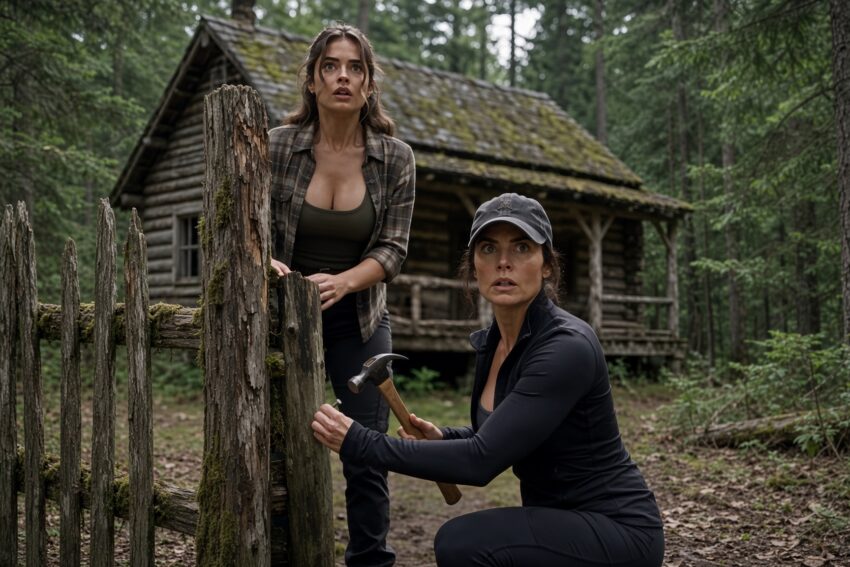
She pressed the button she swore she would never touch—and the cabin stopped being a home.
PART 2:
THE BUTTON
Sloane Ward’s palm hit the red disc hard enough to sting.
The metal housing around it was cold. The little brass knob under the disc clicked once, like a clock agreeing to something ugly. Inside the wall, something heavier than wood answered. A deep mechanical thud ran through the logs, then another, then a third, traveling the length of the cabin as if the house itself had drawn a breath and decided to hold it.
Maya flinched against the hallway wall.
“Sis—”
“Stay on me,” Sloane said. “Don’t touch the windows. Don’t talk loud.”
Dust sifted down from the ceiling boards. Outside, boots hammered the porch. A shoulder tested the front door. The deadbolt held. For now.
Maya’s voice was small. “What’s happening?”
Sloane had already answered that once, out by the fence, and again in this hallway. The words still sat in the air between them.
Sis, what’s happening?
I have to press the button now.
The button was not a lock.
It was a sequence.
Steel shutters dropped over the two front windows with a scream of old rails. The kitchen window followed. The back bedroom last. Each plate hit home with a sound like a truck door slamming. The cabin went dim. The only light left came from the thin gap under the front door and the gray wash leaking down the hall from the rear.
Maya’s breathing went ragged.
“Sloane. Talk to me.”
“Ninety seconds,” Sloane said. “Then the floor opens. If they breach before that, we fight in a box.”
“Who are they?”
Sloane looked at her sister’s face. Sweat on Maya’s throat. Plaid shirt hanging open over the olive tank. Eyes too wide. Twenty-six years old and still asking the question Sloane had spent eight years refusing to answer in full.
“People I took something from,” Sloane said. “People who don’t send letters.”
A rifle butt smashed the front door. Wood cracked. Not through yet.
Sloane grabbed Maya’s wrist and pulled her down the hall toward the kitchen. The concealed panel behind them hung open, the red disc still glowing a dull, ugly color, like a coal that had decided not to go out.
THE COUNT
The cabin had been built in 1961 by a man who did not trust banks, neighbors, or weather. Sloane had bought it with cash under a name that was not hers and spent the first winter tearing out the floor in the pantry.
Under the pantry was a hatch.
Under the hatch was a room the county maps did not know.
Under that room was a corrugated tube no wider than a man’s shoulders, packed in clay, running downhill toward the creek.
The button did three things.
First: shutters and magnetic clamps on every exterior door.
Second: a one-shot burst on a dead frequency Sloane had not used in five years.
Third: a ninety-second delay, then the pantry floor unlocked. If nobody pulled the secondary pin, the hatch stayed sealed and the tube stayed a rumor.
Sloane yanked open the pantry. Canned beans. Rice. A dented kettle. She kicked the kettle aside, dropped to her knees, and found the iron ring set flush in the boards.
Maya hovered in the doorway. “They’re going to shoot the door.”
“They will.”
“Then what?”
“Then they waste time on a door that doesn’t matter.”
Another hit. The front frame splintered. A man’s voice, muffled by a mask, shouted something short and sharp. Not a name. A command.
Sloane checked her watch. Fifty-one seconds.
She had not kept a gun in the cabin. That had been the deal she made with herself when she took Maya off the map. No rifle over the door. No pistol in a drawer. If the life she had buried ever climbed up through the trees, the button was supposed to be enough.
It was not enough. She knew that now. She had known it when she heard the engines.
Oh shit, they found me.
They had. Three black dual-sport bikes through the fence cut, dust like a flag, riders in full black stepping off with rifles already up. Not police. Not any badge that answered to a town. Masks. Chest rigs. The kind of men who practiced coming through a door.
Maya crouched beside her. “I can hear them on the porch.”
“Good,” Sloane said. “Means they’re still outside.”
Thirty seconds.
Sloane wrapped both hands around the ring and pulled. The boards did not move. They were not supposed to. Not yet.
Maya’s fingers found Sloane’s sleeve. “If this is about Dad—”
“It isn’t about Dad.”
“Then who?”
Sloane stared at the ring. “A ledger. Names. Payments. A company that doesn’t exist on paper and pays men like the ones on our porch to make sure it stays that way.”
Maya’s mouth opened. Closed.
Twelve seconds.
The front door gave a final, ugly crack. Light knifed into the front room. A boot crossed the threshold.
Sloane whispered, “Now.”
The ring came up in her hands as if the house had been waiting for permission. Boards folded back on a hidden hinge. Cold air climbed out of the dark, wet and mineral, smelling like root and rust.
“Go,” Sloane said.
Maya went first. She dropped through the square on her stomach, boots kicking, plaid shirt catching on the lip. Sloane shoved her the rest of the way and followed.
A masked man filled the front hall as Sloane pulled the hatch down. She saw the rifle come up. She saw the red dot hunt the pantry wall.
The hatch sealed.
The first rounds punched wood above them. Splinters rained into Sloane’s hair.
THE ROOM UNDER THE HOUSE
The under-room was eight by ten. Stone walls. A single battery lantern on a hook. Sloane slapped it on. Yellow light found shelves of dry stores, a folded tarp, a metal box, and the mouth of the tube in the far wall, black and ribbed.
Maya sat on the packed earth, shaking.
“You built this,” Maya said.
“I found it. I finished it.”
“You finished a tunnel under our house and never told me.”
Sloane pulled the metal box off the shelf. Inside: a compact flashlight, a folding knife, a plastic-wrapped stack of cash, two cheap phones that had never seen a tower, and a hard drive the size of a cigarette pack in a rubber sleeve.
She shoved the drive into her jacket.
Maya stared at it. “That’s what they want.”
“That’s what they think they want.” Sloane tossed Maya a phone and the flashlight. “If we get separated, you call the only number in there. You don’t explain. You say the word ‘creek’ and you hang up.”
“Whose number?”
“Someone who still owes me a favor he hates.”
More gunfire above. Not wild. Measured. They were making holes to look through.
Sloane crawled to the tube. The first three feet were dry. After that, clay sweat beaded on the ribs. She had crawled it twice a year in the dark, just to remember the turns. Left after the root bulge. Right where the pipe dipped. Then the grate at the creek bank, hidden under fern and a fallen cedar.
“Maya.”
“I’m here.”
“You crawl. You don’t stop. If I tell you to run when we come out, you run uphill, not back. Understand?”
Maya’s jaw tightened. For a second she looked older than twenty-six. “You said we were done running.”
“I lied,” Sloane said. “On three.”
They went in.
THE TUBE
The tube was worse than memory.
Sloane’s shoulders scraped. Her cap brim caught and she had to twist it backward. Clay smeared her black sleeves. Behind her Maya’s breathing bounced off the metal, too fast.
Water ticked somewhere ahead.
Sloane counted the ribs. Twenty. Forty. The root bulge came like a knuckle in the dark. She took the left and felt Maya follow, a hand briefly on Sloane’s ankle, then gone.
Above them the cabin was no longer a cabin. It was a box being opened by professionals. Sloane heard it in the way the shots stopped. They had found the pantry. They would find the seam. They would need tools for the hatch. Tools took time.
Time was the only clean thing she had left.
The pipe dipped. Cold water soaked through Sloane’s pants at the knees. Maya made a sound that was not quite a word.
“Keep coming,” Sloane said.
“I am.”
“Don’t talk. Save air.”
The last stretch flattened. Daylight—not much, just a green suggestion—showed at the grate. Sloane put her eye to the slats.
Creek. Shallow. Brown from last week’s rain. Ferns. The fallen cedar exactly where she had left it. No boots in the frame. No bikes.
She listened.
Forest noise. Water on stone. Far off, an engine—idle, not close.
Sloane worked the inner latch. The grate swung inward an inch, then stuck on a root. She put her shoulder into it. The root tore. Cold air and wet green poured in.
She crawled out into mud and pulled Maya after her.
They came up under the cedar like animals leaving a den.
THE CREEK
Maya coughed and wiped clay from her mouth. “I hate you a little.”
“Good. Hate keeps you moving.”
Sloane scanned the slope. The cabin sat uphill through the trees, a dark shape with its shutters down. From here it looked asleep. It was not. Men were inside it now, tearing boards, finding the hole.
Three bikes had come through the fence. That meant at least three men. Frame eleven had shown more—four shapes in the dust, rifles up, one bike left standing like a statement. There would be a driver still in the trees. There would be a second element if they were paid properly.
Sloane pointed along the creek, downstream. “We follow water for two hundred meters. Then we climb the east bank. There’s an old skid road.”
Maya looked at Sloane’s hands. They were shaking. Sloane made them stop.
“You said they found you,” Maya said. “Not us. You.”
Sloane started walking. Mud sucked at her gray sneakers. “They found the cabin because they found me. You were never in the file. That was the point.”
“Then tell me the file.”
“While we walk.”
They moved. Water to their right. Pine to their left. Sloane kept them off the shiny rocks. Shine meant open. Open meant a scope.
Maya waited ten steps, then could not.
“Sloane.”
“I used to work numbers for people who cleaned other people’s money,” Sloane said, low. “Not a bank. A private outfit. They called themselves Northline Recovery on the invoices and nothing at all in the rooms that mattered. I was supposed to make the books look like consulting. I made copies instead.”
“Why?”
“Because a payment trail went through a warehouse fire that killed six contract workers, and the next month the same account paid for a funeral that wasn’t listed and a bonus that was. I thought if I held the ledger I could force a quiet exit. I was stupid in a specific way.”
Maya’s boots slipped on a root. Sloane caught her elbow.
“They came to my apartment in the city,” Sloane said. “Not these men. Cleaner ones. They called it a conversation. I left that night. I took you out of your apartment before dawn because your name was on a lease I had co-signed when you were twenty. That was enough.”
Maya was quiet for a stretch of creek.
“Eight years,” she said.
“Eight years.”
“And the button?”
“The man who sold me the cabin showed me the hatch like it was a joke. I turned it into a plan. The red switch was already in the wall. I only wired it to things that would buy minutes.”
An engine changed pitch uphill.
Sloane pulled Maya down behind a nurse log. The note of the bike was wrong for the dirt track. It was searching the shoulder. A second engine answered it, farther west.
“They split,” Sloane whispered.
Maya’s lips barely moved. “Can they see the grate?”
“If they walk the bank they can. That’s why we don’t stay.”
They crawled the last forty meters in the ferns and climbed the east bank on their hands. The skid road was a scar of old gravel and moss, wide enough for a truck that no longer came.
Sloane stood, listened, and started north.
THE ALLY
Elias Crowe lived in a metal shop that had once been a mill shed, three kilometers down the valley where the county road forgot to be a road. He repaired saws, radios, and, on weeks he was bored, other people’s bad decisions.
Sloane had not seen him in fourteen months. The last time, she had left a paper bag of cash on his workbench and a note that said, If I send creek, you bring the truck and you don’t ask.
She hated owing him. He hated being owed. That was why it worked.
Maya kept pace, plaid shirt dark with sweat. “This friend.”
“Not a friend.”
“Then what?”
“Someone who used to run parts for people he shouldn’t have. He got out. I helped him get out. He hates that I know that.”
The shop appeared as a rust-colored roof through the alder. No smoke. One white pickup with a cracked canopy. The bay door half open.
Sloane stopped in the trees and watched for a full minute. No extra vehicles. No men in black. A radio talking to itself in the bay, some call-in show about weather.
She stepped into the open with her hands visible.
“Elias.”
A chair scraped. Elias came out holding a socket wrench like it might become a better idea. He was fifty, gray at the temples, work shirt open over a white undershirt, eyes already doing the math.
He saw Sloane’s cap, the clay, Maya behind her.
“You used the word,” he said.
“I used the button first.”
Elias looked past them into the trees. “How many?”
“Three bikes. More men than bikes. Masks. Rifles. They came through my fence on the dirt track and they were inside the cabin when we left the tube.”
He swore once, quietly. “Get in the bay. Not the truck yet.”
They went in. The shop smelled like oil and cut metal. Elias pulled the bay door down to a slit and killed the radio.
Maya stood with her arms folded, trying to look like she belonged in a place that sold nothing and repaired everything.
Elias pointed the wrench at Sloane. “You said this place was dead.”
“It was.”
“Then you pressed the thing I told you not to wire to my frequency.”
“I pressed the thing that would make you answer.”
Elias looked at Maya. “She your sister?”
“Maya,” Maya said. “And I found out about the tunnel ten minutes ago, so if you’re about to lecture her, get in line.”
A corner of Elias’s mouth moved. Not a smile. Recognition.
He went to a locker, pulled out a faded hunting jacket, and threw it at Sloane. “You look like a target in that black. Her too. Flannel’s fine. Face is not. Dirt on the cheeks. Both of you.”
Sloane smeared creek mud along her jaw. Maya copied her, hands unsteady.
“What does the button do besides scream at me?” Elias asked.
“Lockdown. Hatch. One burst.” Sloane took the hard drive from her jacket and set it on the workbench. “And this is still alive. If I don’t keep it moving, they don’t need me. They need the copy.”
Elias did not touch it. “I am not a vault.”
“I need the truck and the back road to Harrow. There’s a locker in the bus depot. If the drive goes in and the key goes to a man named Pell at the weekly paper, the ledger stops being a secret. After that they can chase a story instead of a cabin.”
Elias stared at her. “Pell prints tractor ads and high school scores.”
“Pell prints whatever you put in his hand if you tell him it will outlive him. I already had that conversation. Years ago. He thinks I’m dead. That’s useful.”
Maya picked up the drive, then set it down as if it were hot. “And if they get to Harrow first?”
“Then we don’t go through town. We go around it.”
An engine note climbed the valley. Not a truck. A bike, high and lean.
Elias’s face changed. “Bay. Behind the compressor. Now.”
They moved. Sloane pulled Maya down between the compressor and a stack of tire rims. Elias picked up a rag, stepped to the slit in the door, and waited like a man who had done this kind of waiting before he promised himself he was finished.
The bike rolled past on the county track. Slow. Then a second. They did not stop.
Elias let out a breath. “They’re cutting the roads. You don’t have an hour.”
“Then we take the truck now.”
He hesitated. Sloane saw the cost land in his shoulders before he spoke it.
“I come with you to the ridge,” he said. “Not to town. I have a daughter in Mill Crossing. You don’t get to make my name part of your ledger.”
“I won’t.”
“You already did the second you used my frequency.” He grabbed keys. “Get in. Keep your heads below the glass.”
THE RIDGE
The pickup took the logging spur like it remembered being younger. Elias drove. Sloane sat on the floor of the canopy with Maya, the drive in Sloane’s jacket again, the knife in her fist because a knife was not a plan but it was not nothing.
Through the dirty window she watched the trees stripe by. The spur climbed, then cut across a burned slope from a fire three summers back. Open ground. Bad ground.
“Stay down,” Elias said through the back slider.
A bike engine rose behind them, then fell away, then rose on a different line. They were trying to bracket the ridge.
Maya’s voice was barely there. “If they catch the truck—”
“They want the drive more than they want a crash,” Sloane said. “They’ll try to pin us, not flip us. If I tell you to run, you take the east ditch and you don’t look back at me.”
“I’m not leaving you.”
“You are if I say so. That was the deal when I took you out of the city. I get you through. You don’t get noble.”
Maya’s eyes flashed. “You don’t get to decide what I am every time the world gets loud.”
Sloane almost smiled. It died. “Fair. Still run if I say run.”
The truck lurched. Elias swore. “Tree down. Not old. Cut.”
Sloane came up to her knees and looked.
A pine blocked the spur, pale chips still on the bark. Fresh. Someone had dropped it in the last hour.
“Back up,” Sloane said.
Elias already was. The pickup’s rear tires slid in wet gravel. He cranked the wheel toward a skid trail that was more suggestion than road.
A figure in black stepped out of the alder thirty meters behind them and raised a rifle.
“Down!”
The first shot punched the canopy skin and left a clean, ugly hole. Light came through it like a mistake. The second shot starred the rear window.
Elias put the truck into the skid trail hard. Branches whipped the hood. Maya grabbed Sloane’s arm hard enough to hurt.
They burst onto a lower track. For ten seconds there was only engine and leaves.
Then the white pickup hit a rut that was deeper than it looked.
The world tilted.
THE COST
Metal screamed. The canopy frame folded in on the left side. Sloane’s shoulder slammed the wheel well. Maya hit the opposite panel and made a sound Sloane would hear later in rooms that were quiet.
The truck stopped against a stump, nose down, ticking.
Elias was already out, wrench gone, a short-barreled shotgun in his hands from under the seat. He fired once into the trees, not at a body, at a space, to make a man think twice.
“Out the right,” he said. “Move.”
Sloane shoved the bent canopy door until it gave. She pulled Maya with her. Maya’s left ankle folded when it took weight. Not a scream. A bitten-off breath.
“Don’t look at it,” Sloane said. “Look at me.”
They ran a broken run into the spruce. Elias came last, shotgun up.
Behind them, a bike engine died. Boots hit dirt. A voice called a short code. Another answered from higher on the slope.
Sloane found a depression behind a blowdown and put Maya in it. The ankle was already swelling inside the boot. Maya’s face had gone white under the mud.
Elias dropped beside them. “I can hold the trail two minutes. After that I’m a man with a bird gun against rifles.”
Sloane met his eyes. “Go home. Take the spur west. They want us.”
“They saw the truck. They saw me.”
“Then don’t go home. Go to Mill Crossing the long way and pick up your daughter from school like nothing in the world is interesting.”
Elias’s jaw worked. He looked at Maya’s ankle, at the drive-shaped bulge in Sloane’s jacket, at the trees.
“I am going to regret every minute I ever liked you,” he said.
“That’s the job.”
He put a spare set of keys in Sloane’s hand. “Green wagon behind the feed store in Harrow. Belongs to a man who owes me for a winter. Plates are current. Don’t speed.”
He moved off through the spruce without looking back.
Sloane listened to him go until the forest took the sound.
Maya whispered, “He’s going to die.”
“Maybe,” Sloane said, and the word tasted like metal. “Maybe not. He’s older than their map.”
A shout upslope. Close.
Sloane got Maya up. They went downhill, not fast, Maya’s arm across Sloane’s shoulders, Sloane’s cap low, the black jacket a problem she could not fix. Every step on Maya’s left side was a small theft.
They reached a drainage ditch running toward the county road. Sloane put them in it. Cold water to the shins. Good. Water confused dogs if dogs were coming. She had not seen dogs. She did not assume that would last.
THE COUNTY ROAD
They walked the ditch until the trees thinned and the asphalt showed, a two-lane with no shoulder worth the name. A mail truck passed, then nothing.
Sloane checked the cheap phone. No signal yet. The valley was a fist around them.
Maya sat on the ditch wall, breathing through her teeth. “Say the rest.”
“What rest?”
“Why they came today. Not eight years ago. Today.”
Sloane watched the road. “Because last month a man who used to move their money got arrested in another state for something smaller. He started talking to save himself. Not my name. A description. A woman who left with a drive and a sister. They ran old photographs against new ones. Someone sold them a cabin listing that never should have been in a database.”
“So this is one man’s mouth.”
“This is what happens when a secret gets lonely.”
Maya laughed once, no humor in it. “I missed college. I missed a job that wasn’t cash under the table. I missed being a person who didn’t jump when a truck backfired. And the reason is a spreadsheet.”
“The reason is six people in a warehouse and the men who paid for the fire,” Sloane said. “The spreadsheet is just how you prove it.”
Maya looked at her for a long time. “When we get to town, I want my own copy of the truth. Not the version you feed me while we run.”
“You’ll get it.”
A dark SUV appeared far up the road, then turned off onto a logging gate before it reached them. Not theirs, or theirs being careful. Sloane did not wait to learn which.
They crossed the asphalt during a gap and entered the opposite trees.
Harrow was still eight kilometers by road, less if you stole the geometry and paid for it in hills.
They paid.
THE FEED STORE
Harrow was a wide place pretending to be a town: a feed store, a diner with a clock that lied, a bus depot with two benches, a weekly paper above a barber who worked Thursdays.
Sloane left Maya in a stand of cedar behind the feed store and went alone.
The green wagon was there, older than Elias had made it sound, primer on one fender. The key turned. The engine caught like it was doing her a favor.
No one in the lot looked at her twice. That was the gift of small towns and dirty clothes. People assumed you belonged to a job they did not want.
She drove around the block once, watching mirrors, then collected Maya.
Maya climbed in and shut her eyes. “If I throw up, don’t take it personal.”
“I’ve seen worse from you. You were twelve and it was a ferry.”
“Don’t be charming. I still hate the tunnel.”
Sloane drove to the alley behind the bus depot. She sat with the engine running and watched a man in a canvas coat sweep the same square of concrete twice.
“Stay,” she told Maya.
“Sloane—”
“If I don’t come back in ten minutes, you drive north until the tank is empty and you call the number. Creek. That’s all.”
Maya grabbed her wrist. “You don’t get noble either.”
Sloane pulled free, gently. “Ten minutes.”
The locker was 214. She had paid cash for it on a winter day when the clerk wanted to talk about snow. The envelope inside was still there: a second drive, older, and a letter in her own hand to Pell that began without greeting and did not waste paper on sorry.
She put the new drive with the old one, added a page she wrote on the back of a feed-store receipt—three bikes, masks, cabin on the north track, Elias Crowe is not in this—and she closed the locker.
Then she walked two streets to the weekly paper.
Pell was in the back room eating something from a microwave tray. Sixty. Thin. Glasses that had given up. He looked at Sloane as if a ghost had learned to wear mud.
“You’re supposed to be a rumor,” he said.
“Locker 214. Key.” She set it on the table. “You print the names. You print the payments. You print that men with rifles came through a fence on three black bikes to stop it. You do not print the cabin location. You do not print the mechanic. If you get scared, you still print it, because scared is already the job.”
Pell did not touch the key. “They’ll burn this office.”
“Then scan it first and send it to every paper that still has a pulse. I don’t need you brave. I need you fast.”
He picked up the key. His hand shook. “Is the sister alive?”
“Yes.”
“Good. That’s the only decent sentence I’ve heard this year.”
Sloane left by the back stair.
In the alley, a man in a black jacket that was not quite tactical enough to be honest watched the depot door. He had no mask. He did not need one in town. He had a phone to his ear.
Sloane did not break stride. She took the long way to the wagon, sat, and pulled out.
Maya saw her face. “What.”
“They’re here.”
“Then we did it too late.”
“No,” Sloane said. “We did it loud enough that late doesn’t matter the same way.”
She took the north road out of Harrow with both hands on the wheel and the speed of a woman who belonged on that road.
THE PUBLIC
They heard it before they saw it.
Not sirens. A helicopter is a rumor until it is a fact. This one was a fact over the ridge, then a smaller fact as it slid west, searching a pattern that had nothing to do with rescue.
Maya watched the sky through the wagon’s dirty glass. “Is that them?”
“Or someone who noticed three armed men on bikes and decided the valley was interesting. Either way we don’t wave.”
Sloane turned onto a farm lane, killed the engine under a barn overhang, and waited. The helicopter’s note changed, receded, came back thinner.
Her cheap phone found a single bar, then two.
Messages she did not want began to stack from a number she had not saved: local alert language, a vague warning about armed individuals in the north valley, a request that people stay off logging roads. No names. No cabin. The machine of a county doing what counties do when they are not ready.
Then a different tone. A news ping from a regional site that stole from smaller sites.
Sloane opened it.
HARROW WEEKLY POSTS DOCUMENTS ALLEGING PRIVATE RECOVERY FIRM TIED TO WAREHOUSE FIRE PAYMENTS.
She did not smile. She felt the thing in her chest loosen one notch and tighten two others.
Maya read over her shoulder. “He did it.”
“He started it. Starting is not finishing.”
The comments under the article were already a mess of people who knew nothing and people who knew too much. That was fine. Noise was a kind of cover.
Sloane started the wagon.
“Where now?” Maya asked.
“Somewhere with a door that is not mine and a name that is not ours. Tonight we sleep in the wagon if we have to. Tomorrow we find out if Elias made it to Mill Crossing.”
Maya’s voice went careful. “And if he didn’t?”
Sloane watched the lane. “Then that’s the cost, and we don’t pretend it isn’t.”
They drove.
THE NIGHT ROAD
Rain found them after dark, light at first, then steady. The wagon’s wipers argued with it. Maya slept in pieces, waking whenever the road changed note.
Sloane did not sleep.
She kept seeing the hatch close. The red disc. Maya’s face in the hallway. The bike lights in the trees. Elias walking away with a shotgun that was not enough.
At a rest pull-off with no lights, she stopped and wrapped Maya’s ankle with a shirt from the back seat that did not belong to either of them. Maya hissed and then laughed at herself for hissing.
“You’re a terrible nurse,” Maya said.
“You’re a terrible patient.”
“Are we safe?”
“No.”
Maya nodded, as if that was the only honest lullaby left. “Will they come for Pell?”
“Yes. He knew that when he picked up the key.”
“Will they come for us still?”
“Yes. The ledger is out. That makes us less valuable as a secret and more valuable as a lesson. Different problem. Same men.”
Maya stared at the rain on the glass. “I keep hearing you in the yard. Run to the house. Almost there, get inside. Like the house was a person.”
“It was a plan.”
“Plans get people killed.”
“So do apartments in the city with your name on the buzzer.”
They sat with that until the rain eased.
Sloane drove again.
Near midnight a pair of headlights sat on their tail for too long, then turned off at a junction that went nowhere useful. Sloane took the next three turns at random and hated that random was now a skill.
THE PHONE
At dawn they bought gas with cash at a station that sold bait and coffee that had given up overnight. Sloane used the second cheap phone outside the bathroom.
She called Elias’s number.
It rang. Rang. Went to a voice that was just the factory greeting.
She hung up.
Maya saw it on her face when she came back.
“No,” Sloane said. “Not no. Not yet. Just no answer.”
They sat in the wagon and watched a man walk a dog that did not care about ledgers.
Maya said, “I want to go back for him.”
“We don’t know where he is. We don’t know if going back is walking into a line they drew around the shop.”
“So we do nothing.”
“We do the next thing that keeps you breathing. Then we try him again.”
Maya’s eyes were red. Not just from the night. “You don’t get to make me the reason every time. I’m not a child you pulled out of a fire so you can ignore the other people in the building.”
Sloane put her forehead on the wheel. The vinyl was cold.
“I know,” she said. “I know.”
She called again at nine. Nothing.
At ten the regional site updated.
FOLLOW-UP: COUNTY SEARCHES NORTH VALLEY AFTER REPORTS OF ARMED RIDERS; MECHANIC’S SHOP FOUND EMPTY.
Empty was not dead.
Empty was not alive.
Sloane started the wagon because sitting still had started to feel like a kind of surrender she had not agreed to.
THE FAMILY THAT IS LEFT
They reached Mill Crossing at noon because Sloane could not not go.
It was smaller than Harrow. A school with a painted mural of salmon. A grocery. A church with a sign about a potluck that had already happened.
Sloane did not drive to the school. She parked two streets off and walked to a playground bench where she could see the pickup lane without being in it.
Maya stayed in the wagon with the engine off, window cracked, watching Sloane’s back.
At 3:10 a woman in a blue coat collected a girl of nine or ten. The girl had Elias’s chin. They got into a small red car and left. No pickup. No shotgun. No man with gray at the temples.
Sloane did not follow the red car. That would have been another debt.
She walked back.
“His daughter went home with someone else,” Sloane said. “That’s all I know.”
Maya cried then, quietly, the way a person cries when they are too tired to perform it. Sloane sat in the driver’s seat and let her. She did not say it would be fine. She did not say Elias was clever. Clever men still ended up empty shops.
When Maya was done, she wiped her face on the plaid sleeve.
“What do we do with the rest of our lives,” she said, “if the rest of our lives is this.”
“We change names again. We don’t go back to the cabin. We watch the story to see if it grows teeth. We keep one copy of everything in a place that is not a locker in Harrow. And we don’t pretend the button made us free.”
Maya nodded. “I want a doctor for the ankle.”
“Walk-in in the next county. Cash. You twisted it in a creek. That’s the whole story.”
“And you?”
Sloane looked at her hands on the wheel. Clay still in the knuckles. “I want a night where I don’t hear bikes.”
“That’s not a plan.”
“It’s a direction.”
They left Mill Crossing the way they had come, which was to say without anyone waving.
AFTERMATH
Two weeks later the story had a second wind and then a bruise.
Pell’s office window was bricked by someone who did not leave a name. He printed anyway, then went to stay with a sister in a city that had too many windows to brick. The regional site picked up three more documents. A man from Northline Recovery—still not a company that existed properly—released a statement through a lawyer that called the files incomplete, stolen, and defamatory. Incomplete was the only word Sloane believed.
County men walked the cabin with cameras. They found the shutters. They found the hatch. They found three spent clusters of rifle brass on the porch and a fence with a hole that had not been made by weather.
They did not find Sloane. They did not find Maya. They found Elias Crowe’s truck against a stump on a skid trail with a starred rear window and no blood that the report was willing to call a conclusion.
Elias did not call.
Sloane stopped calling every hour. She called every third day, then once a week, then she kept the phone charged in a drawer like a superstition.
They slept in a rented room above a laundry in a river town where nobody asked for a story if the rent was early. Maya’s ankle went from purple to yellow to a limp she could hide if she tried. She tried in public. She did not try in the room.
At night Sloane stood at the window and watched the street. No black bikes. Once a motorcycle that was the wrong shape entirely, and her body still went cold before her mind caught up.
Maya, from the bed: “You’re doing the thing.”
“I know.”
“Come away from the glass.”
Sloane came away.
They did not talk about the button much. When they did, Maya always asked the same question in different clothes.
“If you knew they’d find us, would you still have pressed it?”
“Yes.”
“Even with Elias.”
Sloane took a long time. “Yes. And I will carry that like it’s supposed to be carried. Not like a speech.”
Maya accepted that the way you accept weather.
WHAT THE BUTTON UNLOCKED
The button had not woken a weapon under the cabin.
It had woken a set of minutes, a hole in the ground, a frequency, and a version of Sloane that could not keep pretending the forest was a country.
It had also woken the story.
That was the part the masked men had not budgeted correctly. Men with rifles are good at doors. They are worse at a page that has already left a locker.
On a Thursday, a woman Sloane did not know gave an interview on a cheap local channel about the warehouse fire. She had lost a brother. She said the payments in Pell’s files matched a year she had never been able to explain. She did not say Sloane’s name. She did not have it.
Sloane watched the interview on the laundry’s lobby TV and felt nothing that looked like victory. She felt a ledger getting heavier in the right direction.
Maya stood beside her with a basket of wet sheets.
“That’s the justice part,” Maya said. “It doesn’t feel like television.”
“It isn’t. Television is the wrapper.”
“Are we done?”
“No.”
Maya almost smiled. “Good. I was going to call you a liar if you said yes.”
THAT WHICH CONTINUES
In the third week a postcard arrived at the laundry addressed to the room in a handwriting Sloane knew.
No return.
One line.
Creek froze. Thaw later. Don’t visit the ice.
No name. Elias’s joke about winter, from a winter they had both survived for different reasons.
Sloane sat on the stairs and read it until the card went soft at the edges from her thumb.
Maya read it over her shoulder and started crying again, different this time.
“He’s alive.”
“He’s alive enough to warn us,” Sloane said. “That’s not the same as safe. Don’t write back. Don’t go to Mill Crossing. Don’t make his daughter a line in anyone’s file.”
Maya wiped her face. “So we just live here.”
“We live here until the story either dies or gets big enough that hunting two women in a river town becomes a bad investment. Then we live somewhere else.”
“That’s not an ending.”
“No,” Sloane said. “It’s a Tuesday.”
That night they ate cheap food on the floor because the room had one chair and they had decided the chair was for the person whose ankle still complained. Maya took the chair without ceremony.
Sloane told her the rest of the file, name by name, payment by payment, until Maya’s eyes glazed and then sharpened again. No more versions. The ugly whole.
When she finished, the laundry below thumped into another cycle. Warm air came up through the boards. Somewhere a truck downshifted on the bridge.
Maya said, “If they find us again, we don’t have a cabin.”
“We have legs. We have cash. We have a story that already left the house.”
“And the button?”
Sloane saw the wooden panel. The red disc. The brass knob. Maya’s wet face in the hall. The exact words.
Sis, what’s happening?
I have to press the button now.
“If there is another button,” Sloane said, “we talk before I touch it. That’s the new rule. I don’t get to be the only one who decides when the house changes shape.”
Maya held out her hand. Sloane took it.
Outside, the river town did what river towns do after dark. A dog barked at nothing. A light went off in a window. A motorcycle passed on the far bank, ordinary, legal, loud in the way ordinary things are loud when your nerves have not caught up to the calendar.
Sloane listened until it was gone.
She did not sleep quickly.
She slept.
In the morning they would need milk and a better lock and a plan for what to do if Pell’s next letter asked for a meeting. They would need to decide whether the rented room was a month or a season. They would need to live inside a victory that was not clean and a loss that had not finished introducing itself.
The cabin still stood in the trees with its shutters down and its hatch open to anyone with a warrant or a crowbar. The fence still had a hole. The dirt track still held the memory of three black bikes and the men who had stepped off them as if the forest belonged to their invoice.
Sloane Ward and Maya Ward were not there.
That was not safety.
It was the next page.
And the page, for once, was not blank.
DISCLAIMER
This is a work of fiction created for entertainment only. Any resemblance to actual persons, living or dead, or to actual events, organizations, locations, or private groups is coincidental. It is not a report, not an accusation, and not a guide to any real-world activity.