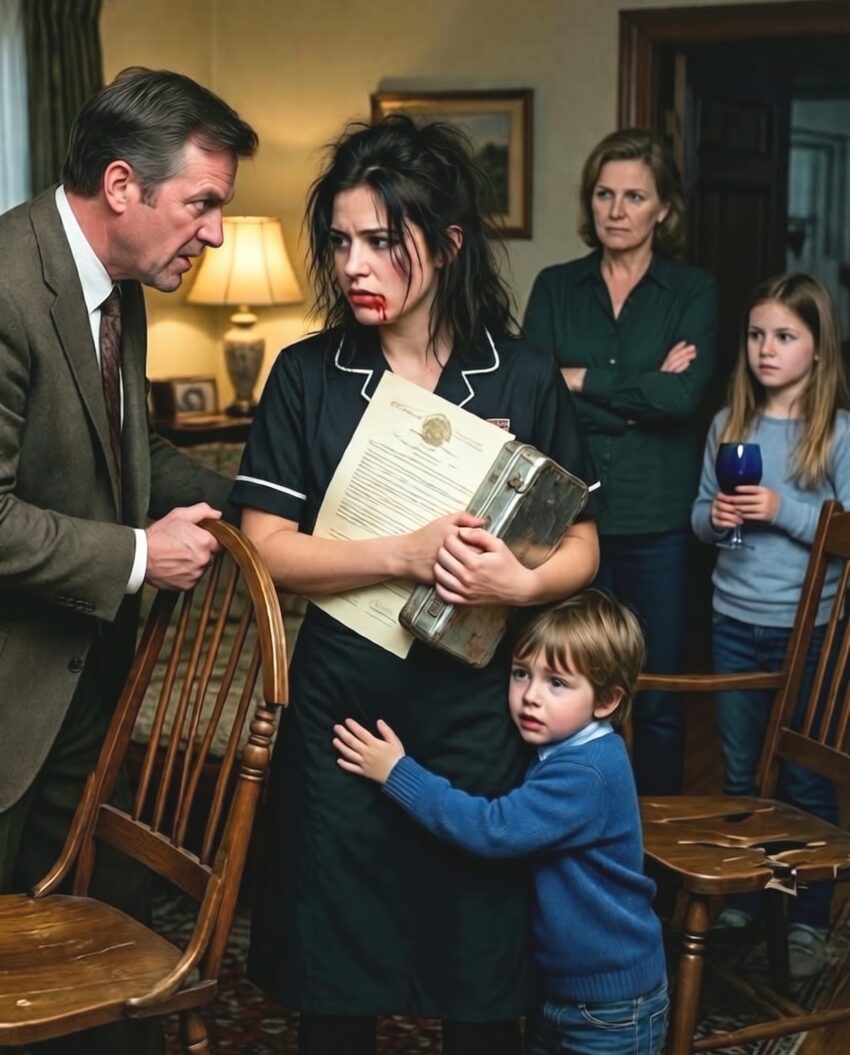
The House on Elmwood Terrace: How a Broken Chair, an Old Lockbox, and a Grandfather’s Secret Deed Stripped My Family of the Kingdom They Never Owned
The House on Elmwood Terrace: How a Broken Chair, an Old Lockbox, and a Grandfather’s Secret Deed Stripped My Family of the Kingdom They Never Owned
Now he stood beside his attorney with one hand pressed flat against the polished mahogany table, staring at the deed as though the ink had committed high treason against him.
“That is impossible,” he said.
His voice was not the booming roar that had terrified me throughout my childhood.
It was a dry, hollow rattle.
The judge adjusted his wire-rimmed glasses, peering over them with the tired skepticism of an official who had seen every variety of human greed.
“Sit down, Mr. Vance,” the judge said calmly.
“My father would never have deeded her this house,” Thomas insisted, his voice rising, scraping against the tall acoustic tiles of the courtroom.
He gripped the edge of the counsel table until his knuckles turned as white as bone.
“She was nineteen years old,” he continued, gesturing wildly toward where I sat. “A child. An irresponsible girl who couldn’t even manage her own life. My father was eighty-two years old and dying of heart failure. He wasn’t in his right mind. That signature is an amateur forgery, and I demand an immediate dismissal.”
Sarah Mitchell remained seated beside me.
She did not flinch.
She did not raise her voice.
She simply turned a crisp page in her leather-bound portfolio, exuding the serene calm of an architect watching an ill-built wall collapse under its own weight.
Her composure made my father’s frantic posturing look small and loud.
“The grantee was legally an adult of sound mind when the conveyance was executed,” Sarah said, addressing the bench with precise diction.
“The document was signed before two independent witnesses and formally certified by a licensed notary public. Furthermore, Your Honor, we have conclusive evidence of physical delivery.”
A muffled, theatrical sob erupted from the gallery directly behind Thomas.
My mother, Diane, had begun her performance.
It was never the quiet, inward weeping of a parent mourning a shattered home.
Diane cried for an audience.
Her shoulders rose and fell in exaggerated spasms.
She pressed a monogrammed lace handkerchief against her throat, tilting her face just enough to ensure the court clerk and the bailiff caught the tragic silhouette of a wounded mother.
“We raised that girl,” Diane murmured loudly enough to echo across the bar. “We gave her food from our own mouths. We put a roof over her head when no one else would look at her.”
I stared straight ahead at the state seal emblazoned in bronze upon the wall.
Behind my ribs, the memories ignited one after another, vivid and scalding.
I thought of the damp garage apartment where the cold seeped through uninsulated walls from November to April.
I thought of the black mold blooming in damp patches beneath the particleboard sink.
I thought of the radiator that hissed and gave up heat only when it felt like it, leaving Noah sleeping in two sweaters beneath three wool blankets.
I thought of the envelopes of cash I handed to my mother on the first of every month, scrimped together from diner tips and double shifts while my feet blistered inside cheap service shoes.
And I thought of the sudden, sickening arc of a wooden dining chair descending through the yellow lamplight.
I remembered the taste of warm pennies filling my mouth, the crunch of tooth against wood, and Noah’s desperate, high-pitched scream cutting through the ringing in my skull.
I kept my hands folded in my lap.
I did not offer them a single tear.
Sarah opened the heavy, wax-sealed county archives folder resting on our table.
From it, she withdrew an oversized, cloth-bound notary ledger with gilded corners.
She placed it squarely in front of the bench.
“This is the official registry from the county clerk’s repository,” Sarah explained.
The judge leaned forward, his fountain pen hovering above his pad.
“The original entry,” Sarah said, pointing with an manicured index finger, “is dated October fourteenth, eight years ago. It records the full legal parcel description of 412 Elmwood Terrace, Arthur Vance’s state identification number, his thumbprint, and the sworn signatures of two independent witnesses.”
She paused, allowing the silence to settle like dust.
“The first witness was Charles H. Lind, Mr. Vance’s personal accountant of thirty-five years. The second was Robert Vance-no relation-the senior partner of the estate firm that drafted the document.”
Then Sarah slid a second piece of paper across the polished wood.
“And here is the original delivery receipt,” she added.
The paper bore my own signature, written in the shaky, loopy handwriting of my late teens.
The memory hit me with the physical force of a wave, carrying the faint, comforting scent of pipe tobacco, peppermint, and old leather that had always defined Grandpa’s private study.
I had been nineteen years old.
I was barely two months pregnant, sick to my stomach every morning, and shivering with an unbearable, lonely dread.
The night before, Thomas and Diane had backed me into a corner of the kitchen.
They had called me a disgrace to the family name.
They told me that no respectable man would ever touch a ruined girl with another man’s bastard, and that if I stayed under their roof, I would do exactly what I was told, when I was told, until the day I died.
The next morning, Grandpa Arthur had called me to his office downtown.
He hadn’t cross-examined me.
He hadn’t demanded to know the boy’s name, nor had he offered the cheap, pitying condolences that sting worse than insults.
He had simply pulled his cardigan tight, poured two mugs of black tea from a silver kettle, and pushed a dented, olive-green metal lockbox across the mahogany desk.
“Take it,” he had said, his deep voice carrying a rough tenderness. “And do not let your father know it exists.”
“What is it, Grandpa?” I had asked, clutching my mug with trembling fingers.
“It is your footing,” he answered, looking directly into my eyes with an intensity that had frightened me at the time. “It is for the day someone tries to convince you that because they threw you a scrap, they own your life. It is for the day they tell you that you have nowhere to go.”
He handed me a receipt slip to sign.
He told me the law was a fortress made of paper, and that a fortress required every stone to be placed in the proper ledger.
I signed the slip without reading the fine print.
I took the brass key.
I took the green lockbox back to the drafty garage apartment and slid it beneath the frame of my narrow bed, letting dust cover the lid.
I never opened it.
For eight long years, I refused to turn that brass key because turning it felt like an admission of despair.
It felt like admitting that my father truly hated me.
It felt like preparing for the moment my mother would discard me, and my stubborn, foolish heart had desperately wanted to believe that if I just worked hard enough, paid enough rent, and kept my head down, they might eventually love me.
Grandpa had known human nature far better than I did.
He knew that some people do not see family as a bond of blood, but as an arrangement of leverage.
Thomas’s attorney, a man named Henderson who looked increasingly regretful of his retainer, adjusted his spectacles and peered into the notary ledger.
He leaned down and whispered something urgent into Thomas’s ear.
Thomas jerked his head back, his face darkening with a mottling of rage and disbelief.
“Your Honor,” Henderson stammered, clearing his throat twice, “we are… surprised by this submission. We respectfully request a continuance of thirty days to allow our handwriting specialists to inspect the county archives.”
The judge looked down over his glasses, his expression flat.
“Counsel, these are certified public records brought here under judicial subpoena from the county archives vault. The ledger has been under state custody since the notary’s retirement in twenty-twenty.”
He tapped his gavel once against the leather strike pad.
“Motion for continuance is denied. I will grant a fifteen-minute recess for you to confer with your clients, after which we will address the petition for immediate possession.”
The judge rose, his robes billowing around him as he exited through the rear door.
The moment the wooden latch clicked, Thomas turned on his heel.
He did not walk; he lunged toward our table, his face twisted into an ugly, sneering mask.
“You scheming little parasite,” he hissed, his spit spraying across the corner of our documents. “You sat up in that apartment for eight years waiting to ambush us. You planned this.”
A burly court officer instantly moved between us, placing a gloved hand firmly on the leather holster at his hip.
“Back to your side of the bar, sir. Now.”
Thomas pulled himself up, but his posture was fractured.
Without the dining room walls around him, without a child cowering behind my apron and a heavy oak chair in his grip, he was nothing more than an aging, bitter man in an off-the-rack suit.
“I didn’t know what was in that box until the night you broke a chair over my head,” I said.
My voice was quiet, but it cut through the room like a scalpel.
Diane came rushing forward, clutching an accordion file stuffed with glossy photographs.
The tears on her cheeks were already drying, disappearing with an unnatural speed that would have made a stage actress envious.
“Chloe, talk to her,” Diane pleaded, looking frantic. “Make her see sense. Think of the shame this will bring on the church. Think of what the bridge club will say. Sweetheart, we can resolve this like civilized people. We will go back to Elmwood Terrace, sit down in the parlor, and draft a sensible family agreement.”
I looked at the woman who had birthed me.
“When I was lying on the carpet, trying to keep my blood from ruining your rug, you curled your lip and called me a pig,” I told her.
Diane’s eyes flashed with venom, her rehearsed maternal warmth vanishing in a millisecond.
“Because you were being utterly impossible!” she hissed, leaning as close to the wooden railing as the bailiff allowed. “You were defying your father in front of your sister! You flaunted your disobedience, pretending your little waitressing job was more important than your own niece’s welfare! You brought every ounce of that onto yourself!”
Sarah laid a gentle, warning hand on my forearm.
“Do not waste your breath on them,” Sarah said softly. “The record speaks.”
Near the double oak doors at the back of the courtroom, my sister Chloe was standing with her arms crossed over her chest.
She was wearing a tailored wool coat the color of heavy cream, knee-high leather boots that cost more than two weeks of my tips, and delicate gold hoops in her ears.
She had dressed for court as if attending a charity brunch.
The mocking, victorious smirk she had worn on the night she ordered me to quit my job was completely gone.
Her lips were pressed into a thin, bloodless line.
“Where are they supposed to sleep tonight, huh?” Chloe demanded as I reached the aisle to stretch my legs. “You’re really going to throw your own parents into the street? Does that satisfy your sick little grudge?”
I stopped and looked her up and down.
“You told me to watch what happened when you called Dad,” I said.
A flicker of defensive panic crossed her eyes, but she quickly masked it with indignance.
“I told him you were being selfish. I didn’t tell him to lose his temper.”
“You stood by the buffet table with a glass of wine in your hand and watched him pick up the chair.”
“I was frozen,” she said, her voice turning shrill. “I went into shock!”
“You didn’t look in shock when you pulled out your phone and posted on Facebook that I had attacked him,” I replied. “You told every cousin from here to Cincinnati that I was a drug-addled lunatic trying to rob an elderly couple of their life savings.”
“Mom told me that was what happened!” she cried, color flooding her neck in splotches. “I was only defending our family!”
“You were standing four feet away from me when my lip split open,” I said, holding her gaze until she was forced to look down at her designer boots. “You heard Noah screaming. And you didn’t even put down your wine.”
She opened her mouth to shoot back another barb, but her throat seized up.
The bailiff rapped his knuckles against the courtroom door.
“All parties inside. Judge is returning.”
We filed back into our seats.
The room smelled of old paper, floor wax, and the dry, artificial heat blowing through the overhead grates.
When the judge sat back down, Sarah stood up immediately.
“Your Honor, with the court’s permission, we wish to present an exhibit that provides complete clarity regarding the grantor’s intent.”
Henderson leaped up. “Objection! Discovery is closed on this preliminary hearing.”
“This exhibit,” Sarah countered smoothly, “is a self-authenticating testamentary statement deposited with the county repository alongside the ledger in twenty-twenty. It was to be unsealed only in the event of an adverse possession claim or title dispute initiated by Thomas Vance.”
The judge waved his hand dismissively at Henderson. “Overruled. I’ll hear it.”
Sarah took a compact black thumb drive from her briefcase and handed it to the court technician.
A massive flat-screen monitor mounted on the courtroom wall flickered to life.
For three seconds, there was only blue screen and static.
Then the image resolved into high definition.
Grandpa Arthur was sitting behind his old walnut desk in the study.
He looked younger than he had in the final months of his illness, his silver hair neatly combed back, wearing his favorite olive-green knit cardigan over a button-down shirt.
Behind him, through the bay window, the leaves on the big sugar maple were brilliant shades of amber and gold.
On the desk beside his elbow, a brass clock ticked with a rhythmic, steady cadence.
He cleared his throat, adjusted his glasses, and looked directly into the camera lens.
His eyes were fierce, clear, and utterly devoid of hesitation.
“My name is Arthur Vance,” he began, his voice rumbling through the courtroom speakers with that familiar, gravelly resonance that used to make the floorboards vibrate.
“I am eighty-two years of age. I am of sound mind, fully cognizant of my actions, and uncoerced by any living soul.”
He paused, taking a deliberate breath.
“Thomas,” he said, staring straight out of the monitor as if he were looking through the glass directly at the man sitting at the defense table.
“If this recording is being viewed in a court of law, it means you have done exactly what I spent twenty years praying you would not do.”
Beside his lawyer, Thomas stopped breathing.
His eyes were wide, bulging with a mixture of terror and disbelief.
“You have confused my patience for weakness,” Grandpa Arthur said, his tone flat and unsparing.
“Forty years ago, I purchased the land and built the house at 412 Elmwood Terrace. I paid off every red cent of the mortgage before you even graduated from high school. When you married Diane, I allowed you to live there. I let you raise your children under that roof. I let you boast to the neighbors that it was your estate, because I hoped the responsibility would turn you into a man.”
Grandpa leaned forward, resting his weathered forearms against the walnut wood.
“Instead, it made you a tyrant,” he said softly.
The silence in the courtroom was absolute.
Even the court reporter seemed to hold her breath, her fingers hovering silently over the keys.
“You turned my home into a private prison,” Grandpa continued. “You treated kindness like a weakness to be exploited. And worst of all, you took my granddaughter—a sweet, gentle girl who never asked for anything but a scrap of affection—and you made her your domestic servant.”
A single tear tracked through the foundation on my cheek, hot and clean.
All those years, I had thought Grandpa had been blind to it.
I thought he hadn’t noticed when Thomas forced me to eat alone in the kitchen during holiday dinners.
I thought he hadn’t seen Chloe wearing clothes bought with my birthday money while I wore second-hand sneakers with holes in the soles.
He had seen every single indignity.
“I watched you charge her rent for an unheated room above my garage,” Grandpa’s voice grew hard, metallic with outrage. “I watched Diane pocket that poor girl’s tip money while telling her she was a drain on family resources. You convinced her that gratitude requires absolute submission.”
He shook his head once.
“It does not. A roof offered with one hand cannot be used as an instrument of terror in the other.”
Grandpa reached into the drawer of his desk and pulled out a thick cream document bearing blue notary ribbon.
He held it up to the camera lens.
“This is the deed of gift. It conveys the full fee simple absolute title of 412 Elmwood Terrace to my granddaughter. I have signed it freely. I have delivered it to her hand. From this day forward, she may live in it, lease it to strangers, tear it to the ground, or sell it to the highest bidder.”
He leaned in closer to the lens, his face filling the frame.
“No legal promise of inheritance was ever made to Thomas or Diane Vance. They hold no equity. They hold no tenancy rights beyond those granted by at-will permission. Their presence on that property exists entirely at her mercy. And should you, Thomas, ever raise a hand or a voice against her, I have instructed my attorneys to ensure this video is played before every judge, every relative, and every neighbor who ever took you for a gentleman.”
Grandpa’s gaze softened slightly, his lips curving into a melancholy, tender half-smile.
“To my little bird,” he whispered, using the pet name he had given me when I was five years old. “I hope you never have cause to use this key. I hope your father miraculously learned how to be a father. But hope is not an estate plan. Stand tall. Do not let them take your peace.”
The screen went black.
The soft hum of the monitor’s cooling fan was the only sound in the cavernous room.
Thomas sat frozen, his mouth half-open, looking as though someone had pulled the plug on his vital organs.
Beside him, Henderson buried his face in both hands, shaking his head with a slow, resigned finality.
“Jesus,” Henderson muttered under his breath.
Diane had gone utterly silent.
Her handkerchief hung limp from her fingers, forgotten.
The color had drained completely from her face, leaving her skin the pallor of wet dough.
The judge cleared his throat, the sound sharp as a pistol crack.
“Mr. Henderson,” the judge said, his voice ice-cold. “Do you have any further arguments regarding the validity of this conveyance?”
Henderson stood up slowly, not looking at his client.
“No, Your Honor. The defense has no further legal challenge to the validity of the deed.”
“Very well,” the judge said, pulling a stack of court orders toward him. “The court finds that fee simple title to 412 Elmwood Terrace vested in the petitioner eight years ago upon valid delivery. The respondents have presented no evidence of ownership, no written lease, and no lawful grounds for continued occupancy.”
He took his heavy pen and signed his name with three sharp strokes.
“The petition for emergency possession is granted. The respondents are ordered to vacate the premises within fourteen calendar days. A formal writ of assistance will issue to the county sheriff to enforce this order upon the expiration of that period.”
He looked directly at Thomas.
“And Mr. Vance? The temporary order of protection currently in place is hereby extended to a permanent five-year order. You will not contact the petitioner, you will not come within five hundred feet of her, her child, or her place of employment. If you violate this decree by so much as a text message, you will serve the remainder of your suspended assault sentence in the county correctional facility. We are adjourned.”
The gavel came down with a heavy, concussive thud.
The aftermath was not a tidy victory; it was a slow, exhausting war of attrition.
For two weeks, my phone buzzes were relentless until Sarah stepped in and obtained an emergency contempt citation against my mother.
Before the citation was served, Diane had left forty-seven voicemail messages over forty-eight hours.
In the morning, she was weeping, begging me to remember the vacations we took when I was ten, promising that if I let them stay, she would cook for Noah every night.
By noon, she was spitting fury, swearing that God would strike me down with cancer for dishonoring my parents, and promising that every aunt, uncle, and second cousin in the state would cut me out of their lives forever.
Chloe launched an all-out digital offensive.
She posted glossy photo albums from our childhood: picnics in the backyard, Thomas teaching her to ride a bicycle, family holidays around the fireplace.
She wrote long, melodramatic essays painting me as an estranged, bitter child who had taken advantage of an old man’s dementia to rob two retired elders of their sanctuary.
She got three hundred shares from strangers who knew nothing about the family.
She didn’t post the color photographs taken by the triage nurse at Memorial Hospital.
She didn’t post the image of my split lower lip requiring seven internal stitches, or the massive purple-black contusion running from my left cheekbone down into my throat.
She didn’t post the audio transcript from the 911 call where Noah’s terrified four-year-old voice could be heard crying, “Don’t hurt my mommy, please don’t hit her anymore.”
And she certainly didn’t mention the thirty-six carbon-copy bank receipts Sarah Mitchell filed with the court, proving that my parents had extorted over twenty-one thousand dollars in rent from me for an apartment I legally owned.
Sarah had kept everything in a thick manila folder labeled Harassment / Extortion.
When Chloe’s posts crossed the line into actionable defamation, Sarah didn’t argue on social media.
She sent a formal cease-and-desist letter directly to Chloe’s personal address, attached to a draft of a civil lawsuit for libel that named her husband’s business as a co-defendant.
Within twelve minutes of the delivery driver leaving, every single post vanished from the internet.
The criminal case for the assault resolved with brutal simplicity three weeks later.
Thomas had initially told the arresting officers that I had suffered a hysterical breakdown, lunged at him with a kitchen knife, and that he had merely used a dining chair as a shield to protect his wife and daughter.
Chloe had signed a sworn affidavit corroborating his lie word for word.
What neither of them realized was that Thomas had brought about his own destruction months prior.
He was a paranoid man, always convinced that contractors, yard workers, or delivery drivers were stealing from him.
In November, he had paid two hundred dollars to have a high-definition, motion-activated security camera installed on top of the antique china cabinet in the dining room, facing the front foyer.
He had connected it to a cloud server through his tablet, but because he was technically illiterate, he never realized the camera had an integrated wide-angle lens, recorded crystal-clear audio, and automatically saved every motion event to a secure off-site server.
The county prosecutor played the recording in a closed chambers hearing.
The video showed everything.
It showed me standing near the threshold, holding Noah’s hand, my winter coat still zipped, speaking in a quiet, exhausted monotone.
It showed Thomas cornering me, bellowing into my face, his veins bulging in his forehead like blue ropes.
It captured his exact words: “Give Chloe your keys or you’re out on the street tonight.”
It captured my quiet, single-word response: “No.”
It captured the moment he seized the solid oak dining chair by its back slats, hoisted it above his head, and swung it downward like an executioner’s axe.
It captured the sickening crack of wood against cartilage and bone.
It captured me hitting the carpet, instantly dazed, while Noah screamed in visceral terror, trying to cover my face with his little hands.
And it captured Diane standing three feet away, smoothing the pleats of her skirt, curling her lip in cold disgust, and whispering, “You deserved it, pig.”
The camera even captured Chloe, holding her stemmed glass of Chardonnay, taking a casual sip, and saying, “She should have just listened to you, Dad.”
When the prosecutor offered Thomas a plea agreement—two years of intensive supervised probation, mandatory domestic violence intervention classes, restitution for all medical expenses, and a guilty plea to felony assault—Thomas took it without uttering a single word of defiance.
Had he gone to trial before a jury, that video would have sent a sixty-two-year-old man to a state penitentiary for five years.
Chloe, terrified of being charged with felony perjury for her false affidavit, broke down in the prosecutor’s office, sobbing that her father had forced her to sign it under threat of financial disownment.
Her cowardice was breathtaking.
The moment pressure was applied, the tight-knit Vance family turned into scorpions in a bottle, stinging one another just to survive.
The day of the eviction arrived on a cold, overcast Tuesday in late October.
The two-week grace period had expired at midnight.
At precisely nine in the morning, two marked county sheriff cruisers pulled up to the curb of 412 Elmwood Terrace.
Sarah Mitchell and I parked across the street.
I refused to step foot on the property while my parents were still inside.
I stood on the cracked municipal sidewalk beneath the towering sugar maple that Grandpa had planted with his own hands in the spring of the year I was born.
Noah stood beside me, his small hand tucked safely into the pocket of my coat.
He was quiet, his wide brown eyes tracking every movement on the porch.
Two uniformed deputies walked up the brick walkway and knocked loudly on the front door.
When Thomas opened it, he looked as though he had aged twenty years in three weeks.
His hair was uncombed, his button-down shirt was wrinkled, and his face had that gray, sunken quality that comes with catastrophic defeat.
Behind him, a team of professional movers—hired with money my father had scrambled to borrow from his brother—began carrying boxes out to a waiting diesel truck.
Diane stood on the porch steps, performing for the entire neighborhood.
Every time a neighbor walked a dog or slowed their car to watch, Diane let out a loud, shuddering wail, dabbing at her face with a sodden tissue.
“They’re throwing us out!” she shouted toward Mrs. Gable across the hedge. “Forty years in this neighborhood, and our own blood is turning us out into the gutter!”
Mrs. Gable didn’t offer a word of comfort.
She turned on her heel, walked back up her driveway, and pulled her garage door shut with a heavy rattle.
The neighborhood had heard the police sirens the night of the assault.
They had seen the ambulance.
The illusion of the distinguished Vance household had already been dismantled; Diane was merely performing for empty bleachers.
Chloe sat parked three houses down inside her luxury SUV, the engine idling, dark tinted windows rolled up tight.
She refused to step out.
She refused to help her mother lift a single cardboard box.
She was there only to ensure her own childhood heirlooms—the silver sets, the porcelain dolls, the vintage mirrors—made it onto the truck without being damaged.
Noah tugged at my pocket.
“Mama?” he whispered, his voice small against the chilly wind.
I knelt down on the pavement so our eyes were level.
“Yes, my love?”
“Are we going to sleep in the big house now?” he asked, looking at the two-story brick colonial with a mixture of confusion and lingering dread.
“No, Noah,” I said, smoothing down the soft curls peeking out from under his woolen beanie. “We aren’t going to live here.”
He looked toward the porch, where Thomas was currently waving his arms, arguing with a deputy about a grandfather clock in the foyer.
“Is Grandpa Thomas still mad at us?” Noah asked.
The question caught in my throat like glass.
A four-year-old child should worry about cartoon characters, puddles, and peanut butter sandwiches.
He should never have to carry the emotional weather of a violent grown man.
“Grandpa Thomas’s anger belongs to him,” I told him, holding his little face in both of my hands. “It was never your fault. It was never your job to make him happy, and it is not your job to fix him. Do you understand me? You are completely safe now.”
He studied my eyes for a long moment, looking for any trace of fear.
Finding none, he let out a tiny breath that fogged in the autumn air, nodded once, and leaned his forehead against my cheek.
By two o’clock in the afternoon, the moving truck was packed full.
The heavy hydraulic ramp clattered shut.
The movers climbed into the cab and rumbled down the street, spewing a plume of dark diesel exhaust into the gray sky.
Thomas walked down the brick path for the very last time.
He stopped at the end of the driveway, barely five feet from where Sarah and I stood.
The deputy remained positioned between us, his arms resting casually across his chest, his presence an impenetrable boundary.
Thomas didn’t look at Sarah.
He didn’t look at Noah.
He fixed his hollow, bloodshot eyes on me.
“Your grandfather would spit on your grave for what you’ve done to this family,” Thomas rasped, his voice trembling with a hideous, impotent hatred. “You have destroyed your mother. You have disgraced our name. You will die alone, girl.”
I reached into my pocket, pulled out the heavy brass key Grandpa had placed in my hand eight years ago, and held it up between us.
It caught the faint, pale afternoon light.
“We both heard what Grandpa said on that tape, Thomas,” I said, keeping my voice utterly level, completely devoid of anger. “He knew exactly who you were. And for the first time in your life, you can’t hit your way out of the truth.”
Thomas’s jaw worked furiously, his teeth grinding together so hard I could hear the enamel clicking.
He looked as though he wanted to lunge across the pavement, but the deputy took one deliberate step forward, his boots crunching on the fallen maple leaves.
“Time to move along, Mr. Vance,” the officer said firmly. “Get in your car.”
Thomas turned, his shoulders hunched against the cold, and shuffled toward the sedan where Diane was already sitting in the passenger seat, weeping into her hands.
They pulled away from the curb without looking back.
I stood there on the pavement until the red glow of their taillights rounded the bend at the end of Elmwood Terrace and vanished.
Sarah turned to me, offering a quiet, warm smile.
“Let’s go inside,” she said.
The porch steps felt strangely hollow beneath my feet.
On the third step, Diane had deliberately left an object behind: an eight-by-ten framed family portrait taken fifteen years earlier.
In the photograph, Chloe and I were teenagers, standing stiffly in matching velvet dresses between our parents in front of a massive Christmas tree.
Thomas’s hand was resting on my right shoulder—a pose that to an outsider looked paternal and protective, but which I remembered with chilling clarity.
Just before the photographer snapped the shutter, his fingers had dug into my collarbone with enough force to leave bruises, whispering through a clenched smile that if I didn’t stop slouching, he would give me something to cry about.
I picked up the frame.
I turned it over, popped the metal clips, and slid the photograph out.
I tossed the gilded wooden frame into the trash can by the garage, folded the glossy paper in half, and slipped it into my coat pocket.
I didn’t burn it.
I didn’t tear it to pieces.
The past does not disappear simply because you set fire to it; healing only comes when the past loses its power to dictate your present.
Inside, the house felt cavernous, frozen, and completely stripped of life.
It smelled of chemical furniture polish, cheap lemon floor cleaner, and Diane’s overpowering lilac perfume.
Every piece of furniture was gone, leaving pale, unfaded rectangles on the hardwood where rugs had lain for decades.
In the dining room, near the threshold of the kitchen, there was a faint, scrubbed circle in the grain of the oak floorboards.
It was the spot where my blood had pooled while Thomas stood over me with the splintered chair leg.
Diane had tried to bleach it out before the deputies arrived, but the wood had absorbed it.
The house remembered.
Sarah walked through the empty rooms, her heels clicking against the bare floors.
“The locksmith is parked out front,” she said, glancing out the bay window. “Do you want to proceed?”
“Every single lock,” I said, looking around the empty dining room. “The front door, the back door, the basement bulkhead, the sliding glass patio doors, and the overhead garage mechanism. Change every code. Hand me every key.”
“You have the absolute right to move in tonight,” Sarah reminded me gently. “It is entirely yours.”
I looked down at Noah, who was standing in the empty hallway, gazing up at the high ceiling with an expression of guarded unease.
“No,” I said softly. “I will never spend another night under this roof.”
“Are you sure?” Sarah asked. “It’s a valuable property. Four bedrooms, two baths, prime school district.”
“It’s not a home, Sarah,” I replied, feeling a deep, unshakeable certainty settle into my bones. “It’s a fortress built on fear. Every baseboard in this place has heard screaming. Every doorway has seen intimidation. I will not raise my son in a monument to my father’s cruelty.”
Over the next two months, I went to work.
I didn’t touch the main house at first.
Instead, I focused all my energy on the small apartment above the garage—the place where Noah and I had survived for three long years.
I hired a licensed remediation contractor to tear out the rotten particleboard cabinets beneath the sink.
We eradicated every trace of the black mold that had given Noah chronic coughs every winter.
I hired an electrician to install a modern, safe baseboard heating system that kept the rooms warm and dry.
I painted the walls myself, rolling over the dingy institutional beige with coats of warm buttermilk cream and soft sage green.
I hung bright white linen curtains in the small dormer windows.
When it was finished, the apartment was no longer a cold attic where an unwanted daughter was hidden away from view.
It was a clean, bright, dignified living space.
I listed it for rent at a modest, below-market rate and leased it to an exhausted pediatric oncology nurse who needed a quiet, affordable place near the children’s hospital.
I handed her a legally binding, ironclad lease agreement.
There were no midnight poundings on her door.
There were no demands for cash in unmarked envelopes.
There was only professional respect, basic decency, and the peace of mind that comes with lawful shelter.
Then, I put 412 Elmwood Terrace on the open real estate market.
When the listing went live, a few distant relatives tried to reach out through third parties.
An aunt called my diner, leaving a message with the head cook claiming that selling the family estate was an act of unforgivable spite, that I was squandering my inheritance, and that keeping the house was the only way to prove I had truly won.
I never called her back.
Winning wasn’t about occupying their territory.
Winning wasn’t about sleeping in the master bedroom where my father had plotted his cruelties, or sitting at the head of a dining room that reeked of old fear.
True freedom was having the power to walk away from their kingdom entirely.
The market was strong.
A young couple expecting their first child fell in love with the big yard and the sturdy brick bones of the house.
They made an all-cash offer well above the asking price.
At the closing table, I signed thirty-two legal documents with the very same blue ink pen Grandpa Arthur had given me in his office eight years earlier.
When the title company wired the proceeds, the numbers on my bank statement looked completely surreal.
I sat in my beat-up car in the bank parking lot and wept for twenty minutes—not tears of sorrow, but tears of absolute, crushing relief.
The money wiped out every single penny of debt I had accumulated.
It paid Sarah Mitchell’s legal fees in full.
It settled the seven thousand dollars in outstanding medical bills from the night of the assault.
It funded an irrevocable college education trust for Noah, ensuring that no matter what happened to me, my son would never have to grovel before anyone for his education.
And with what remained, I bought a small, single-story craftsman cottage in a quiet, tree-lined neighborhood twenty minutes away, just three blocks from Noah’s new elementary school.
It was not grand like Elmwood Terrace, but it was honest.
It had a bright navy-blue front door with a polished brass knocker.
It had a deep front porch with plenty of room for a wooden swing.
It had a sprawling back garden bordered by cedar fencing, overflowing with wild lavender, hydrangea bushes, and sweet pea vines.
And best of all, it had a wide kitchen window that caught the soft, golden light of the morning sun from the moment dawn broke over the rooftops.
For the first time in his life, Noah had a bedroom with freshly sanded pine floors and walls painted the color of a summer sky.
The first night we slept there, I tucked him into his bed beneath a new quilt.
I sat on the edge of the mattress, watching him drift off to sleep.
For three years in the garage apartment, Noah had insisted on sleeping with his little sneakers on his feet, terrified that we would have to flee in the middle of the night if his grandfather came up the stairs.
That night, for the very first time, his shoes were sitting neatly by his closet door.
He was fast asleep, his breathing soft, rhythmic, and deep, his small body relaxed completely into the pillows.
I kissed his forehead, walked out into the hallway, and left his bedroom door cracked open just two inches.
Four days later, on a chilly Saturday morning, the front doorbell chimed.
Noah was sitting on the woven wool rug in the living room, humming a quiet tune to himself as he constructed an elaborate castle out of smooth, unfinished wooden blocks.
I walked to the front hallway and glanced through the leaded glass sidelight beside the front door.
My breath hitched in my throat for a fraction of a second.
Standing on my front porch, huddled against the crisp autumn wind, were Thomas and Diane Vance.
Thomas was wearing the same dark wool overcoat he had worn to his criminal sentencing hearing.
The collar was frayed at the edges.
His face was drawn, his skin pasty, his shoulders bowed under the weight of an invisible, crushing exhaustion.
Beside him stood Diane.
She wasn’t wearing her elegant church suits or her expensive pearl earrings.
She wore a faded quilted jacket that was two sizes too large, and her graying hair was pulled back into a messy, unwashed bun.
Resting on the porch floor between them was a single, scuffed canvas suitcase with a broken zipper.
Through the family grapevine, I had already learned how low they had fallen.
After being evicted from Elmwood Terrace, they had moved into Chloe’s spare bedroom in her upscale suburban townhouse.
Chloe had tolerated them for exactly eleven days.
Accustomed to being the coddled princess of the household, Chloe quickly discovered that living with Thomas’s explosive, bitter temper and Diane’s relentless, passive-aggressive complaining was intolerable.
When Thomas got into a screaming match with Chloe’s husband over a thermostat setting, Chloe had packed their belongings into garbage bags, set them on the curb, and changed her smart-lock codes.
She had done to them precisely what they had done to me for twenty years.
Desperate, they had bounced between the couches of various church acquaintances and distant cousins.
But nobody wanted Thomas’s volatility or Diane’s toxic grievances poisoning their home for more than a weekend.
One by one, every door in their social circle had slammed shut in their faces.
And now, stripped of their house, their money, their prestige, and their flying monkeys, they had arrived on the porch of the daughter they had thrown away like trash.
I did not open the door wide.
I undid the deadbolt, cracked the heavy oak door precisely four inches, and engaged the heavy, hardened-steel security chain.
Diane stepped forward instantly, her hands flying up to press against the wood, her eyes wide, watery, and desperate.
“Noah… sweetheart,” she whispered, her voice cracking with a frantic, wheedling tremor. “Oh, thank God you’re here. We’ve been driving for two hours trying to find this place.”
Behind me, the clicking of Noah’s wooden blocks stopped for a moment.
“Mama?” his little voice called out from the living room. “Who is at the door?”
“Stay on the rug, baby,” I answered gently, not taking my eyes off the porch. “Mommy is just talking to someone.”
Noah resumed his play, the soft clack-clack of wood on wood filling the warm hallway.
Thomas stepped closer, his eyes peering past my shoulder, scanning the interior of my home.
I saw the cold, predatory calculation flicker behind his dull eyes.
He took in the pristine hardwood floors, the high ceilings, the clean paint, and the wide hallway that led back toward two empty, furnished guest rooms.
“We need a place to stay,” Thomas said.
His voice was hoarse, but beneath the fatigue, the old, familiar entitlement remained entirely intact.
It was the voice of a man who still believed the universe owed him deference simply because he existed.
“Just for a few weeks,” he added, his tone shifting into that practiced, patronizing cadence he had used when I was a child. “Just until my pension paperwork is finalized and we can secure a senior apartment. You have plenty of room here. You owe us that much for taking care of you when you had that bastard child.”
There it was.
Even now.
Even standing on the porch of a house he didn’t own, with nowhere left to sleep tonight except the back seat of a rusted sedan, he could not bring himself to offer a single word of genuine remorse.
He could not say, “I am sorry for hitting you.”
He could not say, “I am sorry for terrorizing your son.”
He could only issue another demand, dressing up his desperation as an invoice for past charity.
Diane began to weep, real tears finally spilling down her cheeks—tears born not of grief for the daughter she had broken, but of terror for her own comfort.
“Please,” Diane whimpered, her trembling fingers curling around the edge of the door frame. “Look at us. We are an old couple. We have nowhere to go. Have you no Christian forgiveness in your heart? The Bible says—”
“When I was lying on your carpet with blood pouring from my mouth,” I interrupted, my voice dropping to a calm, steady whisper that froze the air between us, “you looked down at me and said, ‘You deserved it, pig.'”
Diane’s eyes darted away, her mouth working uselessly.
“I… I was overwrought,” she stammered, pulling her hands back against her chest. “Tempers flare in families. People say things they don’t mean when they’re upset—”
“And when Noah was screaming, curled up in a ball against my legs, terrified that his mother was going to die,” I continued, “neither of you called for help. You didn’t even hand him a paper towel. You stood there and told me to take my bastard kid and get out of your house.”
Thomas’s face flushed a dark, dangerous crimson.
The humiliation of having his sins recited back to him was more than his fragile ego could bear.
The mask of the weary elder slipped entirely, revealing the snarling beast that had ruled my childhood.
“Are you really going to shut this door on your own flesh and blood?” he growled, leaning his face into the four-inch opening, his teeth bared. “You insolent little bitch. Everything you have came from our family! If it weren’t for Arthur’s money, you’d be scrubbing toilets in a shelter!”
He threw his shoulder against the door, attempting to force his way past the threshold.
The heavy steel security chain snapped taut with a sharp, violent metallic ring.
The frame groaned, but the three-inch case-hardened steel screws anchored deep into the wall stud held fast.
I did not flinch.
I did not back up an inch.
I lifted my right hand, holding my phone so the screen was illuminated directly in front of his face.
The screen displayed the active timer of a call connected to the county emergency dispatch center.
“The permanent order of protection is active, Thomas,” I told him, looking squarely into his bloodshot eyes. “The dispatcher has our address and can hear every word coming out of your mouth. You have exactly thirty seconds to pick up that suitcase and get off my driveway, or the sheriff will be here to escort you directly to a holding cell.”
Thomas froze.
His chest heaved with ragged, furious breaths.
For one terrifying second, I saw that familiar, wild madness in his eyes—the look he had given me right before he raised the oak chair above his head.
Then, his gaze flickered upward.
Mounted discreetly in the beadboard ceiling of my front porch, glowing with a steady, quiet green indicator light, was an outdoor security camera.
It was recording in full four-K resolution, streaming directly to an off-site cloud server.
Thomas saw it.
He knew what courtrooms did with video footage.
He knew what another police report would do to his suspended sentence.
Slowly, agonizingly, the rage drained from his face, replaced by a hollow, sickening defeat.
He took a stumbling step backward off the welcome mat.
Diane looked at me through the gap, her voice cracking into a desperate, broken wail.
“Chloe… please…” she sobbed, using the childhood nickname she hadn’t spoken with warmth in fifteen years. “Please, don’t leave us out in the cold.”
“My name is not yours to speak anymore,” I said softly.
I pulled the door shut.
The heavy brass deadbolt slid home into the steel strike plate with a deep, authoritative click.
I stood in the silence of my entryway, my back against the sturdy wood, listening through the glass.
I heard Diane’s muffled weeping on the porch.
I heard Thomas’s hoarse voice swearing under his breath, commanding her to pick up the bag.
I heard their heavy, dragging footsteps descend the porch steps, crunch across the gravel walkway, and fade away toward the street.
A moment later, an old car engine turned over, coughed, backfired once, and rattled away into the distance.
The street outside returned to silence.
My hands were resting against my sides.
I looked down at my fingers.
They were not shaking.
My pulse was slow, rhythmic, and steady.
The phantom pain in my jaw—the dull ache that had haunted me on rainy mornings ever since the chair had struck my face—was completely gone.
Noah came padding down the hallway in his warm woolen socks, holding two unfinished pine blocks in his hands.
He stopped at the entrance of the foyer, looking up at me with clear, innocent eyes.
“Who was that at the door, Mama?” he asked.
I knelt down on the polished hardwood, opening my arms to him.
He walked into my embrace, wrapping his small, sturdy arms around my neck, smelling of oatmeal, baby shampoo, and sunshine.
“Nobody who lives here, baby,” I whispered against his soft hair, kissing the crown of his head. “Just some people who used to know where we lived, but don’t anymore.”
Noah pulled back, studying my face for a moment.
He saw no tears.
He saw no fear.
He smiled, satisfied with the answer, and pressed a smooth blue block into my open palm.
“Can you help me build the roof of my castle now?” he asked. “It has to be really, really strong so the wind can’t blow it over.”
I smiled, feeling a warmth spread through my chest that had nothing to do with radiators or wood stoves.
“Yes, my love,” I said, taking his hand as we walked back toward the living room rug. “Let’s build it strong. Let’s build it so nothing can ever knock it down.”
We sat together on the floor in the wash of warm morning sunlight pouring through the wide bay window.
Outside, the porch was empty, the autumn leaves dancing across the clean concrete in the crisp breeze.
Inside, every single square inch of the house belonged to us.
It was a home bought not with submission, not with silence, and not with the agonizing currency of an abused daughter’s obedience.
It was bought with the courage to tell the truth.
For years, my father had taught me that power sounded like shouting, threats, and heavy furniture breaking against fragile skin.
He had taught me that survival meant bowing your head, swallowing your dignity, and accepting crumbs while someone told you that you were worthless.
Grandpa Arthur had left me a vastly different lesson.
He had taught me that sometimes, power is a single piece of paper kept safe inside a dented metal box.
Sometimes, power is the quiet, unbreakable dignity of a woman placing the truth before a judge and refusing to look away.
And sometimes, the greatest power in the entire world is simply closing your own front door, turning the lock, and knowing with absolute, unshakeable certainty that no one on the other side can ever force it open again.
This story is a work of fiction created solely for entertainment purposes. Any resemblance to real persons, living or dead, actual events, locales, or legal proceedings is purely coincidental.