The dust hung suspended in the desert air like powdered bone.
Between the homestead porch and the circle of thirty mounted mercenaries, nobody moved.
Nobody drew breath.
The single rifle s.h.o.t from the eastern ridge was still bouncing off the red sandstone cliffs, its echo decaying into a low, rolling rumble that felt more like thunder than gunfire.
Four inches in front of Thomas Sterling’s white stallion, a fresh scar was torn into the dry earth.
A thin wisp of blue-grey smoke curled upward from the blackened soil where the heavy lead slug had buried itself deep into the caliche.
The stallion shrieked again, its hooves drumming a frantic, frantic rhythm against the dirt as Sterling hauled back on the reins, his knuckles white, his crimson silk waistcoat trembling beneath the gold watch chain.
“Hold!” Sterling snarled, spitting dust from his lips. “Hold your mounts, damn you all!”
Not a single hired g.u.n looked at him.
Every head among the thirty riders had swung toward the high ground.
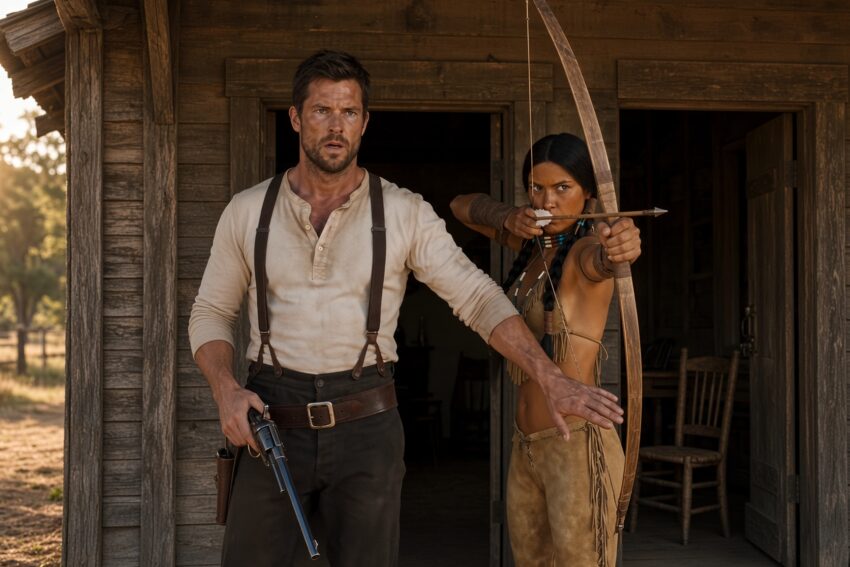
Silas Vance stood on the cabin porch, his left hand still resting against the smooth cedar limb of Sena’s bow.
His Winchester was down at his hip.
His fingers had gone completely numb around the receiver.
For five years, Silas had carried an empty hollow where a man’s chest ought to be.
He had buried a pine box beneath the cottonwood tree beside the dry wash.
He had shoveled sixty spades of red dirt over charred timbers and a melted silver chain.
He had spent five winters listening to the wind rattle the loose boards of an unfinished barn, convincing himself that the silence in his bed was permanent.
And now, staring up through the blinding morning glare at the crest of the eastern ridge, the world cracked open.
The rider was real.
She sat astride a lean bay horse, flanked on her right by Chief Tolan and on her left by two dozen mounted warriors holding lances decorated with hawk feathers.
Her face was darkened by the relentless Arizona sun.
Her hands—the same hands that had once patched his canvas work shirts and pressed wildflower seeds into the garden soil—held a long-barreled Sharps buffalo rifle across the pommel of her saddle.
The dark scarf she had dropped was still tumbling down the brushy slope behind her, carried south on the hot canyon breeze.
Her hair was chestnut brown, tangled by the wind and tied loosely with a rawhide strip.
Her eyes were wide, unwavering, and clear grey-blue.
Silas tried to speak, but the name caught in his throat like dry lime.
“Clara…”
The word came out as nothing more than a ragged exhalation.
Beside him, Sena slowly eased the tension from her bowstring.
Her dark eyes moved from the woman on the ridge down to the thirty men trapped in the yard.
“She told my father she would not let you fall,” Sena murmured quietly.
Silas didn’t turn his head. He couldn’t.
“You knew,” Silas whispered, his voice trembling with a terrifying blend of awe and rage. “You knew she was breathing.”
“I knew a woman survived Fort Bell,” Sena answered softly. “My father would not speak her name until he was certain you were the man she remembered.”
Down in the dirt yard, the balance of power had evaporated in three seconds.
The thirty mercenaries Sterling had brought from Red Creek and Silver Basin were hard men—bounty hunters, border drift, former cavalry deserters who would burn a homestead for twenty dollars in silver.
They knew how to bully a lone rancher.
They knew how to terrify unarmed homesteaders.
They did not know how to fight three hundred mounted Apache warriors holding the high ground with a clear field of fire.
A tall gunman in a greased leather duster slowly backed his gelding three paces toward the corral rails.
“Mr. Sterling,” the gunman said, his voice dry and thin. “We ain’t paid for this.”
“Shut your mouth, Miller!” Sterling hissed, his eyes darting frantically along the ridgeline.
The entire skyline was blackened by horses.
They lined the eastern crest.
They lined the northern saddle.
More riders were emerging through the scrub oak on the western ridge, closing the canyon like the iron jaws of a bear trap.
Three hundred rifles, carbines, and cedar bows rested in plain sight.
No war paint.
No shouting.
No wild whoops.
Only the cold, terrifying discipline of an army that had surrounded its quarry without snapping a single twig.
Then the lead bay horse on the ridge began to move.
Clara Vance walked her horse down the rocky deer trail, unhurried, steady, deliberate.
Tolan rode at her right shoulder.
Behind them came twelve seasoned warriors, their horses picking their way through the shale with ancient ease.
The only sound in the entire valley was the crunch of iron horseshoes on loose gravel.
Silas stepped off the wooden porch.
His boots struck the dirt with a dull, hollow thud.
He walked past the circular stone well, his gaze anchored to the woman descending the hill.
Every step felt like wading through deep water.
His heart pounded against his ribs until his temples throbbed with a dull ache.
Sterling watched Silas move, his hand trembling as he held his nickel-plated Colt.
For a second, the baron considered raising the weapon.
A rifle hammer clicked back on the slope sixty yards away.
A heavy, metallic clack that echoed like a snapped timber.
Sterling slowly lowered the revolver, resting the cylinder against his thigh.
Clara reached the valley floor.
She rode past the line of hired g.u.n.s without sparing them a glance.
Her bay gelding stopped ten feet from the stone well, its nostrils flaring as it caught the scent of fresh water.
Clara swung her right leg over the cantle and dropped to the ground.
She landed lightly in the dust, her fringed leather trousers and faded blue shirt caked with the red dirt of five hundred miles of trail.
She stood upright.
She was thinner than Silas remembered.
There was a pale, jagged scar tracing from her left temple down to the corner of her jaw—the silver mark of an iron wagon tire or a falling beam.
Her skin was brown as a walnut shell from years under the open sky.
Yet the line of her mouth, the stubborn set of her chin, and the fierce intelligence behind her blue eyes were unchanged.
Silas stopped four feet from her.
The Winchester hung uselessly in his right hand, the muzzle pointing straight into the dirt.
“Clara,” he said, his voice breaking entirely.
She looked at him.
For five long seconds, neither of them moved.
Her lower lip trembled, just once, before she forced it still with the fierce pride that had always defined her.
“You still haven’t mended that barn wall, Silas,” she whispered.
A terrible, broken sound tore out of Silas’s chest—halfway between a sob and a laugh.
He dropped the rifle.
He crossed the remaining distance in one stride, throwing his arms around her shoulders and burying his face into the rough, dust-stiff fabric of her collar.
She dropped her Sharps into the dirt and caught him around the neck, her fingers digging through his hair, her face pressed against the hollow of his shoulder.
She was trembling.
Not with fear.
With the accumulated weight of five years of survival.
Silas could feel the sharp edge of her collarbones beneath the shirt, the hard muscle in her arms, the heat radiating from her sun-baked skin.
“You’re alive,” he whispered against her neck, tears finally breaking past his lashes and carving pale tracks through the dust on his cheeks. “God Almighty, you’re alive…”
“I tried to send word,” she choked out, her breath ragged against his skin. “Three times, Silas. Hargrove k.i.l.l.e.d every runner.”
Silas’s hands tightened around her back as if letting go would cause the desert heat to dissolve her into smoke.
“I stood by your grave,” he said, the agony of those five empty years rushing to the surface. “I buried you, Clara.”
“You buried someone else’s bones,” she whispered fiercely, pulling back just far enough to look into his eyes. “Hargrove brought a body from the county poor farm after the fire. He burned the house to hide the fact that he was looking for the territorial boundary surveys.”
Her hand came up, her rough, calloused thumb wiping a tear from Silas’s cheek.
“He thought I’d break in Fort Bell,” she said. “He didn’t know who he was dealing with.”
A cold voice cut through the dust behind them.
“A touching reunion, Mrs. Vance.”
Silas turned, his arm remaining firmly around Clara’s waist.
Thomas Sterling had recovered his composure, though his face remained as pale as lard beneath his grey brim.
The baron sat up in his saddle, his eyes flickering toward the three hundred Apache riders who now formed a solid, unmoving ring around the perimeter of the ranch yard.
“However,” Sterling continued, trying to inject territorial authority into his trembling voice, “this sentimentality does not change the law. The Vance homestead has been condemned under territorial eminent domain for the Silver Basin irrigation corridor.”
Sterling reached into his coat and pulled out a folded parchment bearing a heavy red wax seal.
“Signed by the territorial governor’s commissioner,” Sterling said, waving it slightly. “You have sixty minutes to collect your personal effects and vacate the valley. If these… savages… interfere with territorial business, the United States Cavalry at Fort Grant will wipe this tribe off the face of the earth.”
Silence met his words.
Not even the horses moved.
Then Chief Tolan walked his black stallion forward until his stirrup was three feet from Sterling’s knee.
The elder war leader looked down at the paper in Sterling’s hand.
Tolan spoke in English, his voice like grinding millstones, slow and heavy with ancient authority:
“The governor did not sign that paper.”
Sterling sneered. “You can’t read English, old man.”
“I do not need to read the paper,” Tolan replied calmly. “Because the man who wrote it is sitting in the Silver Basin hotel, counting silver dollars that do not belong to him.”
Clara stepped away from Silas, turning toward Sterling.
The soft vulnerability on her face vanished, replaced by an expression so cold and lethal that Sterling’s stallion shifted sideways in alarm.
“Tell him about Schedule B, Thomas,” Clara said.
Sterling’s eyes narrowed. “I don’t know what you’re talking about.”
“You do,” Clara said, taking two slow steps toward his stirrup. “Because you were there the night Colonel Hargrove dragged me into the cellar at Fort Bell.”
The thirty mercenaries stirred, their eyes darting between Sterling and the woman.
“You stood in the corner of that cellar with a ledger in your hands,” Clara continued, her voice ringing across the quiet yard like a tolling bell. “You were the territorial recording clerk before you bought yourself a silk vest and called yourself a baron.”
Silas felt the blood drain from his head.
The clerk.
The missing territorial records.
The deed Silas’s father had signed in 1859.
The handwriting on the bottom of the property ledger.
“You stole the second page,” Silas said, his voice dropping into a deadly register.
Clara nodded without looking away from Sterling.
“The original grant for this entire basin wasn’t issued to a cattle syndicate,” Clara said. “It was issued jointly to Elias Vance and the Chiricahua people by the territorial commission of 1858. Schedule B gave this well to both families in perpetuity. No syndicate could buy the valley as long as Schedule B existed.”
Clara reached into the pocket of her leather trail coat.
She pulled out a small, flat brass cylinder, sealed with lead at both ends.
Sterling’s face went from pale to grey.
“You couldn’t find it in the house,” Clara whispered, holding the brass cylinder up in the morning light. “Because Elias Vance didn’t hide it in the desk. He buried it under the fifth cornerstone of the well thirty years ago. I dug it up three hours before Hargrove’s men set the fire.”
Sterling’s hand twitched toward his holster.
Before his fingers touched the ivory grip, Sena’s bow thrummed.
An ash-wood arrow whispered through the air, piercing the leather pommel of Sterling’s saddle an inch below his fingers, burying itself six inches into the wood with a violent, vibrating thwack.
Sterling jerked his hand away with a sharp shriek, tumbling backward off his mount and landing heavily on his hands and knees in the red dirt.
The white stallion bolted, kicking up dust as it circled the yard.
The thirty mercenaries froze.
Not one man drew iron.
Chief Tolan raised his hand once.
From the ridges above, three hundred men notched arrows or levered rifle bolts in unison.
The sound was like an avalanche of iron and dry cedar.
Tolan looked down at Sterling groveling in the dust.
“Take your men,” Tolan commanded. “Ride to Silver Basin. Tell Reeves Hargrove that the woman he k.i.l.l.e.d has returned to claim what is hers.”
Sterling scrambled to his feet, clutching his bruised shoulder, his fancy hat lost in the dirt, his face smeared with grease and soil.
He looked around at his thirty hired gunmen.
“Mount up!” Sterling croaked, his voice cracking with humiliation and terror. “Mount up, you fools!”
The mercenaries didn’t need to be told twice.
They wheeled their horses in frantic circles, spurring their mounts toward the southern canyon gap.
Sterling caught his wandering horse, hauled himself into the saddle with clumsy desperation, and fled behind them, his crimson vest fluttering like a wounded bird as the cloud of dust swallowed them whole.
The sound of retreating hooves rolled away down the arroyo until it faded into the dry murmur of the prairie.
Silence reclaimed the homestead.
Silas stood beside the stone well, staring down the empty road.
The dust began to settle, settling on his boots, on the weathered planks of the porch, on the mane of Clara’s tired bay horse.
Clara walked over to him.
She didn’t speak.
She simply reached out and took his hand.
Her skin was rough, calloused from years of hauling timber, pulling bowstrings, and sleeping on granite ledges.
Yet when her fingers laced through his, the five years of ice inside Silas’s chest finally melted away.
He pulled her against his side, his arm holding her so tightly he could hear the steady rhythm of her heartbeat through her shirt.
“Five years,” Silas whispered, staring out at the ridges. “Where were you, Clara?”
Clara leaned her head against his shoulder, her eyes fixed on the distant bluffs.
“In the high mountains,” she said quietly. “Tolan’s people hid me in the Sierra Madre after Fort Bell. I was burning with fever for three months from the wound on my head. When I finally woke up, Tolan told me Hargrove had announced to the entire territory that my b.o.d.y had been found in the ashes.”
She looked toward the old cedar barn.
“I wanted to ride back immediately,” she whispered. “I wanted to walk up this path and tell you I was alive.”
“Why didn’t you?” Silas asked, his throat aching with the memory of the years he had spent alone in this valley.
Tolan dismounted, walking slowly toward them, his dark eyes solemn.
“Because Hargrove owned the telegraph,” Tolan said, answering for her. “He owned the sheriff. He owned the territorial judge. If Clara had returned to this valley alone, she would have d.i.e.d of an ‘accident’ before she reached the well.”
Clara nodded slowly.
“We needed the other half of the puzzle,” Clara said, looking at Silas. “We needed Finch’s manifests. We needed the ledger from the bank in Silver Basin. And most of all, we had to wait until the summer drought forced Hargrove to show his hand.”
She pointed toward the stone well.
“He didn’t just want land, Silas,” Clara said. “The water from this well doesn’t come from an underground seep. It comes from an ancient limestone cavern that runs under the entire northern valley. Elias knew it. Tolan knew it. And Hargrove figured it out six years ago.”
Silas frowned, looking down into the deep, dark circular shaft.
“The water network,” Silas said, remembering the conversation with Sena.
“This well is the headgate,” Clara said. “If Hargrove controls this stone well, he can choke off the water supply to twenty-four ranches and the entire reservation. He can starve the territory into surrendering every deed from here to the Mexican border.”
Sena walked over, carrying the tin cup from the porch table.
She dipped it deep into the wooden bucket Silas had hauled earlier, bringing it up dripping and cold.
She handed it to Clara.
Clara took the cup in both hands.
Her eyes met Silas’s.
Slowly, deliberately, Clara tipped the cup slightly, allowing a thin, glistening stream of water to pour onto the parched soil between their boots.
“For the earth,” Clara whispered.
Silas felt a shudder pass through him.
“Tolan taught you that,” Silas said.
Clara smiled—a genuine, radiant smile that erased ten years of weariness from her face.
“When I was fourteen,” Clara said. “My father broke his leg on the northern trail. Tolan carried him three miles to his camp and gave him water. My father never forgot it. And neither did I.”
She drank the rest of the cup in three long, steady swallows, then handed the empty tin back to Sena.
“Now,” Clara said, turning toward the southern road where Sterling’s dust was still fading into the horizon. “We have to finish this.”
Silas picked up his Winchester from the ground, levering a fresh brass cartridge into the chamber with a crisp, oily snap.
“Silver Basin?” Silas asked.
Tolan looked toward the ridges where his three hundred riders remained in silent formation.
“Hargrove will not wait in town,” Tolan said. “When Sterling tells him Clara is alive with the brass cylinder, Hargrove will know the game is broken. He will burn the records in the land office and take his wagons across the border.”
“Not before he visits the bank,” Clara said sharply. “The original survey books from 1858 are locked in the vault of the Territorial Trust. If he burns those books, our deed is nothing more than ink on paper without an official record to match it.”
Silas looked at his wife.
The frightened young bride who used to worry about loose barn boards was gone.
Standing before him was a seasoned frontier scout who had spent five years learning how to hunt men through the roughest country in North America.
“How do we take a town full of hired regulators without starting a war?” Silas asked.
Clara reached out, tapping the brass cylinder against Silas’s chest.
“We don’t take the town,” Clara said with a cold, fierce confidence. “We let the town see what Hargrove has been hiding from them for twenty years.”
By high noon, the heat had turned the basin into an anvil.
The road between the Vance homestead and Silver Basin was six miles of white alkaline dust and sun-baked greasewood.
Silas, Clara, Sena, and Tolan rode abreast at the head of a small escort of twenty Apache riders.
The remaining two hundred and eighty warriors had scattered into the surrounding bluffs, moving like shadows through the arroyos, invisible to any scout who didn’t know where to look.
Ahead, the wooden false-front buildings of Silver Basin rose above the shimmering heat haze like a crooked line of teeth.
Silver Basin was not a peaceful town.
It was an armed camp built around cattle shipping pens, freight depots, and the iron-barred building of the Territorial Land & Trust Company.
As the four riders crossed the dry riverbed at the town limits, the usual bustle of the street died instantly.
A teamster hauling timber hauled back on his mules, staring in slack-jawed amazement.
Two merchants standing under the awning of the dry goods store stepped backward into the shadows, their eyes wide.
Whispers raced down the boardwalks faster than the desert wind.
“Look at the horse…”
“That’s Vance… but who’s the woman with him?”
“Look at her face, Harry… look at her face!”
“My God in heaven… that’s Clara Vance. She’s been in the ground five years!”
The news struck the town like a physical blow.
Men walked out of the blacksmith’s shop, aprons dusted with soot, hammers hanging forgotten in their leather-gloved hands.
Women gathering groceries on the corner stopped dead, clutching their baskets to their chests as the ghost of the valley rode down the center of Main Street in broad daylight.
Clara rode with her head high, her eyes fixed on the two-story brick building at the end of the plaza:
THE TERRITORIAL LAND & TRUST COMPANY.
Outside the bank, five heavily armed men were hastily loading heavy iron-bound wooden crates into the bed of a canvas-topped freight wagon.
Standing on the boardwalk, directing the loading with a silver-headed cane in his hand, was Reeves Hargrove.
He wore a tailored black frock coat, a light grey Stetson, and the polished boots of a retired army colonel.
Beside him stood Thomas Sterling, his face pale and bruised, his eyes darting frantically toward the street.
“Hurry, damn you!” Hargrove was snapping at the loaders. “Leave the ledger cases! Take only the survey boxes and the cash drawers!”
“Colonel,” Sterling stammered, pointing a shaking finger down the street. “Look…”
Hargrove turned, his silver-headed cane freezing mid-gesture.
Silas Vance reined his horse in twenty paces from the freight wagon.
Beside him, Clara drew her bay gelding to a halt.
Behind them, Tolan and Sena sat unmoving on their mounts, the twenty Apache braves spreading out into a disciplined skirmish line across the dusty street.
Townspeople lined the boardwalks by the dozens, peering from behind posts, water barrels, and half-open saloon doors.
Hargrove didn’t run.
He didn’t draw a weapon.
He was a man who had built an empire out of calculated coldness, and even now, facing an impossibility, his mask barely slipped.
He slowly walked down the wooden steps of the boardwalk into the dusty street, his cane tapping rhythmically against the dirt.
“Well,” Hargrove said, his voice smooth, cultured, and resonant. “I have seen many miraculous things in this territory, Mrs. Vance. But I did not expect you to rise from the dead.”
Clara looked down at him from her saddle, her Sharps rifle resting easily across her knees.
“I was never dead, Colonel,” Clara said, her voice carrying clearly down the entire length of Main Street. “You just found it easier to tell people I was, so you could steal our water.”
Hargrove offered a dry, thin smile.
“Water belongs to those who develop it, my dear,” Hargrove replied, glancing briefly at the crowd of onlookers gathering on both sides of the street. “This valley cannot survive on small subsistence farms and wandering tribes. It requires capital. It requires order. It requires organization.”
“It requires murder, you mean,” Silas roared, his horse dancing under the tension in his reins.
Hargrove turned his cold gaze onto Silas.
“You were a good soldier once, Silas,” Hargrove said softly. “You should understand the concept of acceptable casualties for a greater strategic objective.”
“My wife was not an acceptable casualty,” Silas said, his knuckles white around the rifle grip.
“She was an inconvenient woman who put her nose into territorial affairs that did not concern her,” Hargrove said, his tone hardening. “And she has returned with an armed band of hostiles. That is an act of war, Silas. The cavalry from Fort Grant is already riding. Within two hours, this entire street will be cleared by federal authority.”
Clara didn’t wait.
She reached down, unbuckling the brass cylinder from her saddle horn, and held it high above her head for every shopkeeper, blacksmith, and ranch hand to see.
“Listen to me, people of Silver Basin!” Clara’s voice rang out like an iron gong. “In this cylinder is the certified survey of 1858! Schedule B of the territorial charter!”
The crowd leaned forward, murmuring in confusion.
“Inside those wooden wagons behind Colonel Hargrove,” Clara continued, pointing her Sharps barrel at the crates, “are the duplicate records he stole from the county courthouse three years ago! He has systematically forged boundary lines, choked off northern springs with dynamite, and blamed the Apache for the loss of your cattle!”
Hargrove’s smile disappeared completely.
“Shoot them,” Hargrove said.
His voice was quiet, but deadly.
The five armed guards around the wagon hesitated, looking at the thirty Apache warriors lining the street, then back at Hargrove.
“I said s.h.o.o.t them!” Hargrove snarled, drawing a compact double-barreled derringer from his waistcoat pocket.
Before the hammer could fall, the air split with the crack of a Winchester.
Silas fired from the hip.
The heavy lead round shattered the stock of Hargrove’s derringer, tearing the weapon from his grip and leaving his hand bloodied and numb.
Hargrove stumbled backward against the wagon wheel, clutching his wrist with a sharp cry of fury.
The five guards threw their hands into the air, dropping their revolvers into the dirt.
They were paid five dollars a week to guard wagons; they were not paid to d.i.e for a disgraced colonel.
From the surrounding rooftops and alleyways, another hundred Apache warriors suddenly materialized, their rifles leveled at the wagon from every direction.
The entire square was locked down.
Clara rode forward, stopping her horse directly over Hargrove.
She looked down at the man who had ordered her home burned, who had kept her prisoner in an abandoned cellar, who had stolen five years of her life with Silas.
Her finger rested against the trigger of the Sharps.
For ten agonizing seconds, the only sound was Hargrove’s ragged breathing and the distant creak of a weather vane on the bank roof.
Silas watched her.
He didn’t tell her to lower the weapon.
He didn’t tell her to show mercy.
He knew that whatever choice Clara made in this dirt street, she had earned the right to make it.
Clara slowly lowered the muzzle.
“Hanging is too clean for you, Hargrove,” she said, her voice trembling with cold contempt. “You’re going to sit in a federal penitentiary in Yuma and watch every single acre of land you stole handed back to the families who bled for it.”
Tolan signaled with his hand.
Two young warriors dismounted, stepped forward, and bound Hargrove’s arms behind his back with rawhide cord, forcing him to his knees beside the wagon wheel.
Sterling tried to bolt toward the alleyway, but Sena stepped into his path, her bow raised, an arrow resting on the shelf, her dark eyes daring him to take another stride.
Sterling dropped to his knees in the dust, weeping with terror.
The people of Silver Basin began stepping off the boardwalks.
Old man Miller, the town blacksmith, walked forward and kicked open one of the crates in the wagon bed.
Dozens of leather-bound ledgers spilled out into the sunlight.
Miller picked one up, opened it, and his jaw dropped.
“It’s the original titles…” Miller whispered, looking up at the crowd. “The county maps from before the war… he had them all along!”
A low, furious growl spread through the gathered townspeople.
Men who had lost their homesteads, families who had sold their cattle for pennies because the springs had gone dry, began pressing forward toward the wagon, their fists clenched, their faces dark with fury.
“Stand back!” Silas shouted, riding between the crowd and the prisoners. “The law will deal with them! The territorial marshals will take these records!”
The crowd halted, held back by the authority in Silas’s voice and the steady presence of the Apache warriors who flanked him.
For the first time in five years, the suffocating pall of fear that had choked the basin was broken.
Clara rode up beside Silas, her eyes reflecting the bright midday sky.
“It’s over,” she whispered.
Silas reached over and rested his hand against her knee.
“It’s over,” he said.
Yet even as he spoke the words, a deep, unsettling prickle of dread crawled along the back of Silas’s neck.
It was an instinct born from years of warfare, a feeling that something in the pattern was wrong.
Tolan suddenly stiffened in his saddle.
The elder war chief turned his head toward the southern pass, his nostrils flaring like an animal testing the wind.
“Riders,” Tolan said quietly.
Silas turned his mount toward the south.
Through the shimmering heat haze rising off the dry flats, a massive cloud of dust was rolling toward Silver Basin.
Not twenty riders.
Not fifty.
A column of cavalry.
Over a hundred blue-coated horsemen, guidons fluttering in the wind, accompanied by two horse-drawn light mountain howitzers.
Leading the column was an officer wearing the double stars of a territorial general.
Hargrove, kneeling in the dirt with his arms bound, began to laugh.
A low, wet, mocking chuckle that turned into a full-throated sneer.
“Did you really believe I acted alone, Clara?” Hargrove whispered, looking up at her with eyes burning with venom. “Did you truly think a retired colonel could manipulate territorial land grants without the army behind him?”
Clara’s face went rigid.
Silas drew his Winchester back into his shoulder.
The cavalry column crested the rise at the edge of the town limits, fanning out into a battle line across the southern road.
The brass barrels of the two howitzers swung forward, unlimbering in plain view of Main Street.
A young bugler raised his instrument, and a sharp, piercing call echoed across the dry roofs of Silver Basin.
COMMENCE ADVANCE.
Chief Tolan looked toward Silas and Clara, his expression turning grim as stone.
“They did not come to arrest Hargrove,” Tolan whispered. “They came to burn the town and bury the witnesses.”
Silas looked at Clara.
Clara looked at Silas.
Between them, the brass cylinder holding Schedule B gleamed beneath the merciless sun.
And on the southern ridge, an artillery crew loaded a canister shell into the open breech of the first cannon.
TO BE CONTINUED…
📖 Note: A serialized frontier drama shared strictly for entertainment and storytelling purposes. All characters and events are entirely fictional.