THEY TOLD HER TO SURRENDER OR D.I.E—UNTIL SHE WHISPERED THE ONE NAME THAT MADE AN ENTIRE ARMY FREEZE
The saltpeter hissed like a nest of disturbed vipers.
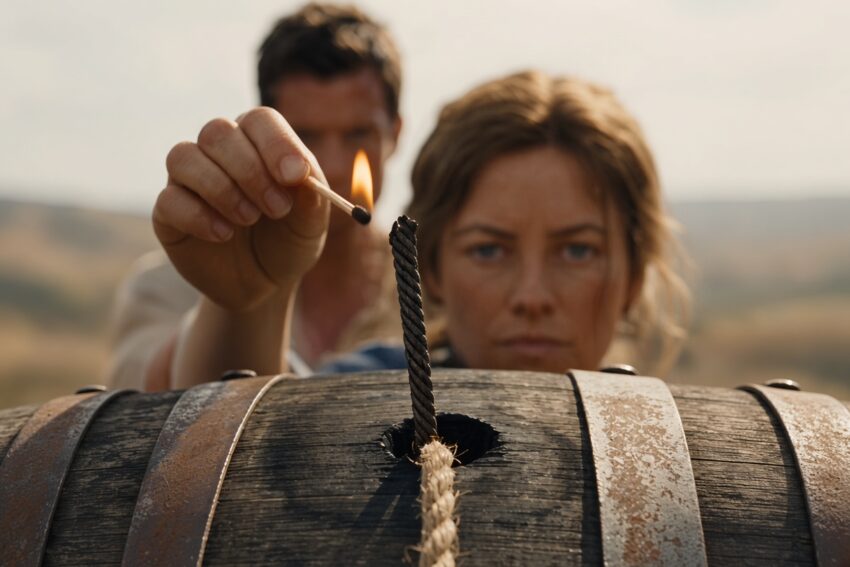
White-hot sparks cascaded off the braided hemp cord, spitting in violent arcs across the oak staves of the central powder keg.
Two inches.
That was all the cord that remained between daylight and total obliteration.
Colonel Reeves Hargrove thrashed against the wagon bed, a frantic, animal shriek tearing from his bruised throat as he tried to throw himself over the tailgate to escape the blast.
Nobody caught him.
Nobody was looking at him.
Every eye in the street was locked onto the grey-blue gaze of Clara Vance.
Her hand did not shake.
Her lips did not part.
She stood atop the timber planks with her head held high, watching the fire eat its way toward fifty pounds of DuPont black rifle powder with the terrifying calm of someone who had made her peace with the grave five years ago.
Across the dirt thoroughfare, the General’s black charger reared violently, its front hooves slashing the empty air.
The animal smelled the sulfur.
It knew what fire meant.
The young artillery sergeant standing beside the mountain howitzer went chalk-white.
His fingers went completely slack around the braided lanyard string.
He didn’t look at the General.
He didn’t wait for a military order.
He dropped the firing cord into the dust, turned on his heel, and sprinted blindly toward the brick shelter of the town bank.
“Sergeant, hold your post!” the General roared, his voice cracking against the dry canyon heat.
Nobody obeyed.
Behind the brass cannon, the front rank of blue-coated cavalrymen began to fracture.
Horses shied sideways, violently bumping stirrups and leather scabbards.
Men who had charged Confederate artillery lines in their youth broke formation, dragging hard on their curb bits, desperate to put distance between their mounts and the freight wagon.
One inch of fuse remained.
The flame reached the dark, beeswaxed lip of the bung hole.
A cloud of thick, acrid grey smoke rolled across Silas Vance’s knuckles as he held his Winchester steady.
“DROP THE IRON!” Silas bellowed, his voice cutting through the panic like an iron blade.
“STAND DOWN!” the General screamed, his sabre dropping flat against his saddle horn. “ALL TROOPS, STAND DOWN! SNUFF THE FLAME!”
Clara didn’t hesitate.
She didn’t use water.
She stepped forward with her right boot, driving the heavy leather heel down against the mouth of the bung hole with crushing force.
She ground the heel into the oak wood, twisting her foot in the dust.
The sizzling died instantly with a sharp, smothered pop.
A single wisp of black smoke drifted out from beneath the edge of her boot sole, vanishing into the dry prairie breeze.
Silence slammed down on Silver Basin.
It was a suffocating, ringing silence.
The kind that settles over a valley after a mine collapse.
Down on the wagon bed, Hargrove lay on his stomach, sobbing into the cedar splinters, his tailored black coat soaked through with cold sweat.
The General sat paralyzed in his saddle, his chest heaving under the heavy brass eagle buttons of his frock coat.
His hands were trembling so badly he could scarcely keep his sabre from clattering against the stirrup iron.
Silas Vance lowered the hammer of his Winchester with a slow, deliberate click.
He didn’t take his eyes off the General.
He stepped off the tailgate of the wagon, his boots hitting the hard-packed dirt of Main Street with a hollow thud.
Beside him, Clara dropped down lightly into the dust, her Sharps rifle resting across her left forearm.
From the rooftops and the wooden alleyways, Chief Tolan’s warriors stepped into the open.
Two hundred rifles clicked into cocked position in unison.
The cavalry unit was completely surrounded.
If a single trooper reached for his sidearm, the crossfire from the rooftops would sweep the street clean in four seconds.
A young cavalry captain riding third in the column slowly raised both hands away from his reins.
“Sir,” the captain whispered, leaning toward the General without looking at him. “We are out of position. Completely exposed.”
The General swallowed hard.
His face had turned the color of cold tallow.
The arrogance that had defined his carriage two minutes earlier was gone, stripped away by the smell of sulfur and the unwavering eyes of a woman who refused to yield.
“Who authorized this deployment, General?” Silas asked, walking forward until he stood ten feet from the black charger’s nose.
The General tried to square his shoulders.
He tried to gather the remnants of his command presence.
“I operate under the authority of the Department of Arizona,” the General said, though his voice was brittle and hollow. “This valley is under territorial military jurisdiction.”
“You are operating under a forgery,” Clara’s voice rang out, clear and steady.
She walked up beside Silas, holding the sealed brass cylinder in her right hand.
“You didn’t ride from Fort Grant to restore order,” Clara said, pointing the brass tube directly at his chest. “You rode here because Reeves Hargrove sent a private courier to your headquarters three days ago.”
The General’s eyes flickered toward Hargrove, who was still groveling in the dust behind the wagon.
“You have no proof of such an accusation, woman,” the General snapped.
“I have the ledger,” Clara replied.
She reached into the breast pocket of her trail coat and withdrew a small, leather-bound notebook with charred corners.
The townspeople lining the boardwalks leaned forward, their boots scraping on the pine planks.
“In this book,” Clara said, turning toward the gathered crowd, “are the personal bank transfers between the Silver Basin Land Syndicate and the private account of General Marcus Bradley.”
The name fell like a lead weight into the street.
The young cavalry captain’s head snapped toward his commander.
“General?” the captain whispered, his eyes wide with sudden horror. “Is that… true?”
General Bradley did not answer.
His jaw worked silently, a muscle twitching uncontrollably beneath his silver handlebar mustache.
“Every supply wagon diverted from the southern forts,” Clara continued, her voice rising to reach every ear on the boardwalks. “Every herd of cattle reported stolen by the Apache. Every parcel of land condemned after the water was choked off. Marcus Bradley took twenty percent of every deed.”
A collective gasp swept through the crowd of townspeople.
Old man Miller, the blacksmith, stepped down into the dirt, holding a heavy iron wrench in his hand.
“My brother lost his ranch two years back,” Miller shouted, his face purple with fury. “Bradley told him the military couldn’t protect him from raiders!”
“He told all of us that!” another voice called from the saloon porch.
“He told us the valley was condemned!”
The murmurs swelled into an angry, unified roar.
The townspeople began moving off the walkways, closing in around the cavalry horses from the rear.
They were armed with pitchforks, axes, hunting rifles, and skinning knives.
Men who had spent years cowering beneath the threat of military power had suddenly realized that the uniform was being worn by a thief.
Captain Reynolds, the young cavalry officer, looked at the crowd.
Then he looked at Chief Tolan’s silent warriors holding the rooftops.
Then he looked at the brass cylinder in Clara’s hand.
Slowly, deliberately, Captain Reynolds unbuckled his sword belt.
He let the heavy scabbard drop into the dust.
“Captain!” Bradley barked, his voice shrill. “What are you doing?”
Reynolds looked at his commanding officer with cold disgust.
“I swore an oath to defend the United States, sir,” Reynolds said quietly. “Not a real estate syndicate.”
Reynolds turned in his saddle, facing the ranks of blue-coated soldiers behind him.
“Troopers!” Reynolds commanded. “Holster your sidearms. Secure the howitzers.”
Not a single soldier hesitated.
Across the entire cavalry line, carbines were lowered and returned to their leather boots.
The artillerymen stepped away from the brass cannons, their hands open at their sides.
General Bradley sat alone in the center of the thoroughfare, his sabre trembling in his grip, his authority shattered in front of the entire county.
Silas stepped up to the stirrup of the black charger.
He reached up, grabbed the steel blade of Bradley’s sabre near the hilt, and wrenched it smoothly from the old man’s fingers.
With one hard motion across his knee, Silas snapped the iron blade in half, casting the broken pieces into the dirt.
“Dismount, General,” Silas said softly.
Bradley looked down at Silas, his eyes hollow, defeated, and empty.
He swung his leg over the saddle and dropped heavily to the ground, nearly falling before Silas caught him by the lapels and shoved him back against the side of the wagon.
Sena stepped forward with rawhide strips, binding Bradley’s wrists with the same cold efficiency she had used on Hargrove.
The two masterminds of the valley’s five-year nightmare sat shoulder to shoulder in the dust, their finery ruined, their conspiracy laid bare beneath the noon sun.
The crowd erupted into shouts of triumph.
Hats were thrown into the air.
Neighbors embraced neighbors.
For the first time in memory, the oppressive shadow that had hung over the basin was gone.
Silas didn’t join the celebration.
He stood beside the freight wagon, watching Clara.
She had lowered her Sharps rifle, her shoulders finally dropping an inch as the adrenaline drained from her body.
She looked tired.
More tired than any human being had a right to be.
The silver scar across her jawline stood out stark and pale against her sun-browned skin.
Silas walked over, reaching out to touch her hand.
Her fingers were freezing despite the desert heat.
“Clara,” he said gently.
She looked up at him, her eyes searching his face as if she were still trying to convince herself that he wasn’t a hallucination brought on by fever.
“It’s really over, isn’t it?” she whispered.
Silas pulled her close, wrapping both arms around her, holding her against his chest where she belonged.
“It’s over,” he murmured into her hair. “We’re going home.”
The sun was dropping behind the western ridges when the wagon reached the homestead.
The valley was bathed in a deep, burning crimson light.
Long violet shadows stretched out from the timber cabin, reaching across the dry yard toward the stone well.
Chief Tolan had kept fifty of his riders at the ranch to ensure the property remained secure while the territorial marshals were summoned from Tucson.
The rest of the tribe had pulled back into the high canyons, returning to their families with the water they had earned.
Sena rode beside the wagon, her cedar bow resting across her saddle pommel.
She looked toward Silas as they pulled the horses to a halt beside the corral.
“My father says you are a man of your word, Silas Vance,” Sena said quietly.
Silas climbed down from the wagon seat, turning to offer his hand to Clara.
“Your father kept my wife alive,” Silas replied, looking the young woman in the eyes. “There isn’t enough water in this entire territory to pay that debt.”
Sena smiled—a small, rare softening of her fierce expression.
“The water was payment enough,” she said. “The earth does not keep ledgers.”
She wheeled her horse around, trotting back toward the eastern ridge where Tolan’s campfire was already sending a thin plume of cedar smoke into the evening sky.
Silas and Clara stood alone in the quiet yard.
The wind had died down.
The loose boards on the northern wall of the barn gave a faint, lonely rattle, but the sound no longer carried the ghost of grief.
Clara walked slowly toward the circular stone well.
She ran her hand along the rough, sun-warmed masonry her father-in-law had laid down thirty years before.
She looked down into the dark water far below, watching the faint reflection of the evening stars beginning to appear on the surface.
Silas came up behind her, resting his hands on her shoulders.
He could feel the tension still knotted in the muscles of her neck.
“What was it like, Clara?” Silas asked, his voice barely above a whisper. “Those five years.”
Clara didn’t answer immediately.
She watched a pebble tumble from the lip of the well, listening for the faint, hollow plink as it struck the water deep in the earth.
“At first,” she said, her voice trembling slightly, “it was just darkness. The cellar at Fort Bell had no windows. You only knew it was day when the cracks in the ceiling turned pale grey.”
Silas closed his eyes, pain tightening his throat.
“They wanted the location of the survey,” she continued, staring into the well. “Hargrove came down every evening. He brought tea. He brought bread. He spoke like an educated gentleman, asking me why I was being so stubborn over a patch of alkaline dirt.”
She turned around, looking into Silas’s face.
“When that didn’t work, he brought Sterling,” she said, her eyes darkening. “Sterling wasn’t a gentleman.”
Silas’s jaw clenched so hard his teeth ached.
“Did he touch you?”
Clara shook her head.
“Tolan broke through the stockade wall that third night,” she whispered. “He had been tracking the ambulance wagon from the moment it left our burning yard. He took three slugs in the shoulder getting me out of that cellar.”
She looked toward the mountains in the north.
“For two years, I couldn’t walk more than twenty yards without falling,” she said. “The smoke had burned my lungs. Tolan’s women gathered roots. They boiled cedar bark. They nursed me through two winters when the snow was three feet deep and there was no meat in the camp.”
She looked back at Silas, her eyes shining with unshed tears.
“Every night, Silas, I pictured this well,” she said softly. “I pictured you coming out of that cabin door with the wooden bucket. I wondered if you had rebuilt the porch. I wondered if you were eating enough.”
She let out a dry, shaking laugh.
“And I wondered if you had finally fixed that damn barn.”
Silas smiled, pulling her head against his chest, his fingers gently stroking the rough waves of her hair.
“I left it broken,” he said, kissing the crown of her head. “I didn’t want to fix anything until you were here to tell me I was doing it wrong.”
They stood together by the well as the twilight deepened into indigo.
The desert night came on swiftly, cool and clean, washing away the heat of the day.
Inside the cabin, Silas lit the small oil lamp on the kitchen table.
The room smelled of old wood, dry dust, and the lingering scent of lavender that Clara had dried five years ago, still hanging from the ceiling beams in brittle bundles.
Clara walked around the small room, her fingers brushing every surface.
The rough-hewn pine table.
The cast-iron skillet on the hearth.
The ledger on the bedside crate.
It was as if she were reclaiming her life, piece by piece, drawing the reality of her home back around her like a blanket.
Silas brought out two cups and a pot of fresh water from the well.
He set them on the table, pulling out the heavy oak chair for her.
Clara sat down, resting her hands flat against the grain of the wood.
“There’s something else, Silas,” she said quietly.
Her tone made the hair on Silas’s arms stand up.
He stopped with the tin pot suspended above the cup.
“What do you mean?”
Clara reached inside the sleeve of her blue chambray shirt.
From a narrow pocket stitched against her forearm, she pulled out a folded slip of heavy vellum paper, sealed with a dark blue wax crest.
The wax was stamped with an insignia Silas had never seen before:
A coiled rattlesnake wrapped around a broken surveyor’s transit.
“I didn’t find this in the safe,” Clara said, her voice dropping into a tense whisper. “I found this in Hargrove’s coat pocket when we tackled him at the wagon.”
Silas set the water pot down.
“What is it?”
“It’s a telegram,” Clara said. “Dated yesterday morning. Sent from the territorial capital in Prescott.”
Silas took the vellum sheet, breaking the wax seal with his thumbnail.
He held the paper close to the warm yellow light of the oil lamp.
There were only three lines written in the clerk’s neat copperplate hand:
HARGROVE.
THE COMMISSIONER HAS APPROVED THE EXTENSION.
THE CHASE CANYON DETONATION IS SCHEDULED FOR MIDNIGHT ON THE TWENTY-THIRD.
ENSURE THE BASIN POPULATION IS REMOVED BEFORE THE WATER CEASES.
Silas read the words three times.
The paper began to rattle in his fingers.
“The twenty-third,” Silas whispered, his face going pale.
He looked up at the wall calendar hanging beside the doorway.
The date penciled at the top of the column was September 22.
“Midnight,” Silas breathed, cold terror gripping his chest. “That’s… that’s tonight.”
Clara nodded slowly, her grey-blue eyes wide with a horrifying realization.
“They never cared about the land titles, Silas,” Clara said, her voice shaking with dread. “The deeds… the lawsuit… the court records… it was all a distraction.”
“What is Chase Canyon?” Silas demanded.
“Chase Canyon is where the subterranean river enters the limestone caves,” Clara said, rising from her chair, her hands gripping the edge of the table. “It’s the underground aquifer that feeds every well in this territory.”
She pointed toward the window, looking toward the southern mountains.
“They aren’t trying to steal the water, Silas,” she whispered. “They’re going to dynamite the subterranean cavern. They’re diverting the entire river into the southern copper mines.”
Silas’s mind raced through the geography.
Chase Canyon was twenty miles south, through the roughest volcanic malpais in the territory.
A labyrinth of black lava rock, dry washes, and sheer drop-offs that no wagon could cross.
If that underground channel was collapsed by dynamite, the stone well in their yard would go completely dry by sunrise.
The springs at Tolan’s camp would dry up.
Every ranch from Silver Basin to the border would be turned into an uninhabitable desert within three weeks.
The copper syndicate in the south would have all the water they needed to run their industrial mills, and two thousand families would be starved off their land without a single g.u.n being fired.
“Who is at Chase Canyon?” Silas asked, his voice hardening into steel.
“The engineering corps,” Clara replied. “Mercenaries hired by the mining syndicate. And they have three wagon loads of commercial blasting gelatin.”
Suddenly, the night air was broken by a sound that made both of them freeze.
It wasn’t the wind.
It wasn’t a coyote.
It was the distant, hollow, metallic clang of iron on stone.
Coming from the yard.
Silas blew out the oil lamp with a quick breath, plunging the cabin into darkness.
He grabbed his Winchester from the table.
Clara took her Sharps from beside the door, her thumb silently thumbing back the massive hammer.
They moved to the window, peering through the split in the timber shutters.
The moon was high and cold, casting an eerie silver sheen over the dusty ranch yard.
Standing beside the circular stone well was a solitary figure.
He was not wearing Apache buckskins.
He was not wearing cavalry blue.
He wore the dark, tailored riding clothes of an eastern traveler, with a broad-brimmed city hat casting a deep shadow over his face.
The man had an iron crowbar in his hands.
He had jammed the tool beneath the heavy timber cover of the well, prying at the ancient oak planks that Silas’s father had bolted to the stone rim.
Beside the man’s boots lay a heavy leather courier bag, stamped with the official insignia of the United States Department of the Interior.
Silas eased the cabin door open half an inch, the iron hinges silent.
He stepped out onto the porch, Clara moving like a shadow at his left elbow.
The cool night breeze swept through the yard, carrying the scent of dust, pine, and the unmistakable metallic tang of black powder.
Silas raised the Winchester, settling the iron sight between the stranger’s shoulder blades.
“Step back from that well,” Silas said, his voice cutting through the dark with lethal authority. “Drop the iron, or I’ll put a hole through your spine.”
The stranger stopped prying.
He didn’t jump.
He didn’t reach for a weapon.
He slowly set the iron crowbar down on the masonry rim of the well, resting his hands flat against the stone.
The man let out a long, quiet sigh that sounded more like relief than fear.
“I was wondering how long it would take you to come outside, Silas,” the man said.
The voice was cultured.
Smooth.
Familiar.
A voice that Silas had not heard in ten years.
Not since the day his father was buried behind the barn.
The stranger slowly turned around, stepping out of the shadow of the well into the full glare of the desert moonlight.
He lifted his chin, letting the silver light wash over his face.
Silas stopped breathing.
The rifle barrel dropped two inches before his muscles locked.
The man standing beside the well had the same high cheekbones as Silas.
The same square, stubborn jawline.
The same piercing steel-blue eyes.
Only the silver streaks at his temples and the fine lines around his mouth showed that he was eight years older.
Silas’s older brother.
Julian Vance.
The brother who had gone East to study law in Philadelphia fifteen years ago.
The brother who was reported lost at sea off the coast of Florida three years before the homestead burned.
Julian looked at Silas.
Then his eyes moved to Clara, widening in profound, terrifying shock as he recognized the woman standing beside his brother.
“Clara?” Julian whispered, his face turning paper-white in the moonlight. “My God… you’re alive?”
Silas took three slow, measured steps down the porch stairs, his boots crunching in the dirt, the Winchester coming back up to level at his brother’s chest.
“You’re supposed to be at the bottom of the Atlantic Ocean, Julian,” Silas said, his voice flat, cold, and dangerous.
Julian looked down at the iron crowbar at his feet.
Then he looked toward the southern bluffs where Chase Canyon lay hidden in the dark.
“I never boarded that ship, Silas,” Julian said, his voice trembling with an emotion Silas could not read. “I’ve been working for the Department of the Interior for six years.”
Julian pointed a shaking finger down into the mouth of the stone well.
“And if you don’t help me open this shaft in the next ten minutes,” Julian whispered, his eyes wild with terror, “the men at Chase Canyon aren’t going to divert the water.”
Silas took a step closer, his finger tightening over the trigger.
“What are you talking about?”
Julian met his brother’s gaze, and what Silas saw there was pure, unadulterated horror.
“They aren’t using dynamite to redirect the aquifer, Silas,” Julian said, his voice dropping to a dreadful whisper that made the entire prairie feel cold. “They brought three wagon loads of chemical poison from the government laboratory in St. Louis.”
Julian swallowed, his throat making a dry clicking sound in the dark.
“They’re going to dump it into the headgate at midnight.”
Julian pointed down into the circular stone basin at his feet.
“And this well isn’t the outlet, Silas,” Julian choked out. “This well is the only ventilation shaft for the entire underground river system. If we don’t drop the sealing plates down this hole before twelve o’clock…”
Julian looked toward the northern hills where three hundred Apache families and two thousand settlers lay sleeping.
“…every man, woman, child, and beast that drinks a single drop of water in this basin tomorrow morning will be d.e.@.d before noon.”
From the southern horizon, ten miles away, a red flare suddenly shot into the night sky, curving high above the black silhouette of Chase Canyon before bursting into a blinding crimson blossom.
The countdown had begun.
TO BE CONTINUED…
📖 Note: A serialized frontier drama shared strictly for entertainment and storytelling purposes. All characters and events are entirely fictional.