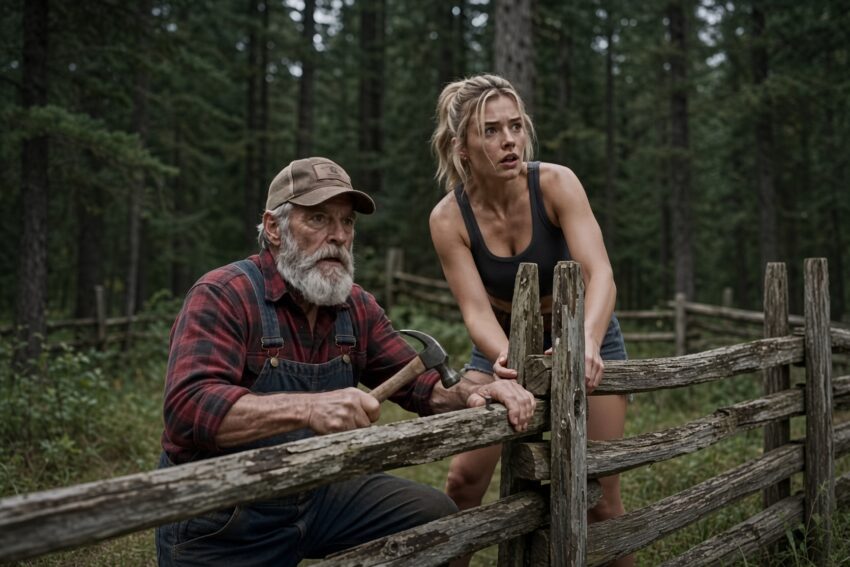
He hid her in the pines until the engines found the fence.
THE CLICK
Thomas Elias Harlan’s palm came down on the red button and the metal gave under his skin.
The circle sat in a square plate sunk into the hallway wall. Warm. Smooth at the rim. A low hum started in the studs, the kind you feel in your teeth before you hear it.
Clara Mae Harlan stared at his hand.
“Grandpa. What did you just do?”
“Bought us a minute,” he said. “Maybe two.”
From the porch came boots. Three sets. One of them hit the door with a shoulder. The timber jumped in its frame and held.
A bolt shot somewhere inside the wall. Then another. Steel pins, old and greased, driving into the jamb from both sides. The door stopped being a door. It became part of the cabin.
Clara flinched at the sound.
“The windows,” Thomas said.
Shutters dropped. Not the wooden ones she had seen from the yard. Heavier. They fell on cables behind the glass and locked with a clack that ran the length of the front wall. Daylight cut to slits. Dust lifted off the floorboards and hung in the lamp glow.
Outside, a man swore. Muffled. Close.
“Open it, Harlan.”
Thomas did not answer. He took Clara by the wrist, not hard, and pulled her down the hall toward the kitchen. His cap sat crooked. The stitched patch on the front read BWARS in cracked letters. She had asked about it once when she was twelve. He had said it was a crew that didn’t exist anymore.
“They found me,” he had said at the fence. She heard it again now, under the boots. Oh shit, they found me.
The kitchen smelled like coffee and wet wool. A pot still sat on the cold stove. Hammer rhythm was gone from the day. Only the shutters and the men.
“Grandpa, what’s happening?”
She had asked it against the wall. She asked it again because the first answer had been a button.
“Later,” he said. “Pantry. Now.”
THE LOCKDOWN
The pantry door was narrow. Thomas shoved the flour sack aside with his boot and knelt. His knee cracked. He did not look at it.
Under the bottom shelf a seam showed in the boards, no wider than a thumbnail. He hooked two fingers into it and lifted. The panel came up on a hinge she had walked over for years.
Beneath it, a square of darker wood. A ring pull. He hauled. The hatch rose on a groan and cold air came up, carrying concrete and standing water.
“Down,” he said.
“I’m not going in a hole.”
A window shuddered. Someone had found the shutter and was hitting it with something metal. The sound rang through the cabin like a bell in a bucket.
“Clara.”
She looked at his face. Mud on the overalls. White beard. Eyes that had gone flat the second the bikes cleared the gate.
She went down.
The ladder was iron, bolted to a wall that sweated. Six rungs. Her boots found them. The tank top stuck to her back. At the bottom her hand met a switch and a bulb snapped on, weak and yellow.
Thomas came after her and dragged the hatch shut. A bar fell into place on their side. Above them the cabin kept taking hits.
“What is this place?”
“A room I poured when you were small,” he said. “When I still thought a door would be enough.”
THE ROOM UNDER THE HOUSE
The room was low. Clara had to duck. Concrete walls, stained where water had tracked. A cot with a blanket rolled at the foot. Two jugs. A crate of cans with the labels gone soft. A metal cabinet. A map pinned with four nails, the creek drawn in pencil, the cabin a square, a line running west under the trees.
On a shelf, a radio the size of a breadbox. No light on it. A handset. Thomas did not touch it yet.
Clara turned in a circle. Her ponytail brushed the joists.
“You built a bunker under the pancakes.”
“Under the pantry,” he said. “Pancakes were upstairs.”
She almost laughed and didn’t. The ceiling ticked. Dust sifted down.
“Those men. The masks. You knew they were coming.”
“I knew they might.” He set his cap on the crate and rubbed his forehead with the heel of his hand. “I hoped the fence would be the last quiet thing we did today.”
“Who are they?”
“They ride for a outfit that calls itself the Hollow Mark. Private. No badge that holds up in daylight. They collect people who talked.” He met her eyes. “I talked.”
Above, wood splintered. Not the door. A shutter giving at the corner. A voice carried, thin through the floor.
“He’s got her in here. Check the back.”
Clara’s mouth went dry.
“Me?”
“You were never the secret,” Thomas said. “You were the reason I ran.”
He opened the cabinet. Inside, a canvas pack already filled. A flashlight. A folded paper in a plastic sleeve. A small recorder, the kind with a physical switch. He checked the switch, nodded once, and shoved it deep in the pack.
“Listen while we move. We don’t have a speech.”
“Then give me the short version.”
He slung the pack and pointed at a round metal mouth in the far wall. A culvert, big enough to crawl, rimmed with rubber that had cracked.
“Your parents died on the ridge road. Everybody said ice. It wasn’t ice. I had papers on a land take. Hollow Mark worked the take. I was going to hand the papers to a review clerk in the county seat. They got to the car first. I took you out of the hospital parking lot before the second car arrived. You were four. You don’t remember the lot. I do.”
Clara stood very still. The bulb buzzed.
“You told me a storm.”
“I told you a story that let you sleep.”
Something heavy hit the floor over their heads. Boots crossed the kitchen. A man called for a pry bar.
Thomas flicked the flashlight on and aimed it into the tube.
“The button locked the shell of the house. Pins in the doors. Shutters on the glass. It also opened this. And it started a clock.”
“What clock?”
“Six hours. If I don’t kill it from the other end, a packet goes to a woman who still owes me a debt. Copies of what I kept. Names. The route they used. After that it isn’t only our problem.”
“And if we die in the pipe?”
“Then the packet still goes.” He looked at her the way he had at the fence, when the nail was half in and the day still belonged to them. “I’d rather we walk out and hand it over ourselves.”
A boot found the pantry hatch. The bar rattled.
“Move,” Thomas said.
THE TUBE
The culvert smelled like wet iron and leaves that had rotted for a decade. Clara went first because he told her to. Elbows. Knees. The flashlight in her teeth until he passed it forward. The pack dragged behind him and caught on a seam. He swore under his breath and freed it.
Water stood in the low bend. Cold. It soaked her shorts and climbed her calves. She did not stop.
“How far?”
“Hundred and forty paces if you were upright. Crawling, longer. It comes out under the bank past the second cedar.”
Behind them the bar took another hit. A metallic ping. Then quiet. They had found the hatch and not the release.
Clara’s breath fogged the dark in front of her face. Pine roots had worked through a joint overhead. One scraped her shoulder. She thought of the hammer in his hand an hour ago. The split rail. Her palms on the timber. Ordinary. She held that picture and crawled away from it.
“They found me,” she said, not mocking. Repeating it so it would sit in the right place. “You said they found you.”
“They did. You’re with me. That’s the whole of it.”
The tube narrowed where the ground had shifted. She turned sideways. Her boot lodged. Panic rose fast and stupid. She kicked once, twice. The boot came free with a suck of mud.
“Almost there,” he said behind her, the same words he had used on the path. Almost there. Get inside.
Light changed. Not the flashlight. A gray seam ahead, the color of the overcast day they had left.
She reached it and stopped, listening.
No engines. Wind in needles. Water moving, small and steady.
“Clear?” he whispered.
“I think so.”
“Think isn’t clear. Look.”
She eased her head out under a lip of roots and moss. The creek ran left to right, brown from the rain that had passed in the night. Ferns. A deer trail. No black leather. No headlights. The cabin was a rumor through the trunks, and smoke was not rising yet.
“Clear.”
They slid out onto stone. Thomas killed the light. His overalls were black to the knee. Clara’s hands shook and she pressed them flat on the rock until they stopped.
From the direction of the house, a shout. Then the rip of a motorcycle catching.
“They’ll circle,” he said. “The tube exit isn’t on any map they bought. It is on the one in their heads if they walk the bank. We don’t stay.”
THE CREEK
They stayed in the water because the mud took prints. Clara hated it and did it. The current tugged at her boots. Thomas kept to the inside bend, one hand on the pack strap, the other out for balance. His cap was back on. The patch looked ridiculous against the ferns and he did not take it off.
A bike growled on the ridge road above them. Headlight swept the trunks and missed the cut of the creek. The rider slowed. Gravel ticked under a tire. Then the engine climbed and faded toward the gate they had not closed.
“Three,” Clara said. “I counted three.”
“Three on the bikes. There can be more on the highway. Hollow Mark doesn’t like loose ends in daylight, but they like a net.”
“You keep saying Hollow Mark like I should know the name.”
“You shouldn’t. That’s the point of the woods.”
She slipped. He caught her elbow. The same grip as at the fence, when he had said run.
“Get to the house,” she said quietly. “You already said that. We’re past the house.”
“Next house isn’t ours.”
They climbed out where a blowdown made a bridge of sorts. Moss. Ants. Clara scraped her shin and did not mention it. Thomas checked the sky through the canopy. Flat cloud. No sun to give a direction, so he used the creek, which he had used for twenty years.
“Where are we going?”
“Mill road. Ruth Keene. She pulls ticks out of dogs and lies to men with notebooks. She’ll lie for us if I ask right.”
“Is she the packet?”
“She’s the person. The packet is paper and a voice. Different thing. If the clock runs out, the paper finds a clerk who isn’t bought. Ruth is how we last until we can walk it in ourselves.”
A branch cracked upslope. Both of them froze. A squirrel. Then not a squirrel. A man in a hood, off his bike, picking through the ferns with a short light. Not close. Close enough that his boots carried.
Thomas put a finger to his lips. They sank behind the blowdown. Clara watched the man through a gap in the roots. Mask pushed up onto his forehead now that he thought he was alone. Young. A scar at the jaw. Leather vest over a black hoodie. He spoke into a radio clipped at his collar.
“No tracks at the south line. They didn’t take the truck. Truck’s still by the shed.”
A crackle answered. She could not make the words.
“Copy. I’ll cut to the creek.”
Thomas’s hand found hers and squeezed once. Not comfort. Instruction. When the man turned his head to the radio, they moved. Low. Fast. Downstream, away from his line. Clara’s lungs burned. She did not look back until the ferns closed.
THE RIDGE
The ground rose and the creek fell away to their left. Gravel showed through the duff where an old skid road had been. Thomas knew it. Clara knew the blisters starting on her heels.
“You should have told me,” she said.
“I should have told you when you could carry it. I waited too long. That’s on me.”
“My parents.”
“Mara and Ellis Harlan. Your mother drove. Your father had the folder on his lap. I was supposed to meet them at the switchback and ride in with them. I was four minutes late. A truck with no plate took the corner wide. They went through the rail. By the time I got down the bank the folder was gone and the truck was gone. County called it weather. I called a man I used to work with. He told me not to come to the office.”
“BWARS.”
He touched the patch without thinking.
“Border watch, auxiliary. Not a badge. We logged trucks on the north cut for a winter. Half of us were loggers. I kept a book. The book is what they want. The book is why the button exists.”
“And me?”
“You had a fever that night. You were with me, not in the car. That’s the only clean luck in it.”
They crested a shelf of rock. Below, the cabin roof showed through a gap. Two bikes in the yard. A third headlight raking the tree line. One man stood on the porch with a bar in his hands, working the door that would not be a door. Smoke had started at the back corner. Not a big fire. A patient one. They were going to burn what they could not open.
Clara made a sound she did not mean to make.
“Let it go,” Thomas said. “Wood. We can grieve wood later.”
“The hammer’s in the yard.”
“Then the hammer burns. Walk.”
She walked. The skid road curled toward a notch where the mill road cut through. Her legs shook. She counted steps the way she had counted rails while he set the nail. One. Two. The nail never got driven. She remembered his hand on the hammer and the way his face had changed when the first engine cleared the gate.
Oh shit, they found me.
She said it once, under her breath, so the woods would have the true line.
THE MILL ROAD
Ruth Keene’s place sat where the mill road crossed a culvert and gave up being scenic. A low house. A shed with a tin roof. A sign that had once said KEENE and now said nothing because the paint had left. A brown dog lay on the step and did not bark. It lifted its head, saw Thomas, and put its head down again.
“That’s a good dog,” Clara said.
“That’s a tired dog. Same as the rest of us.”
Ruth opened the door before they knocked. Sixty, maybe. Gray hair in a clip. Flannel shirt. She looked at the mud on them and at the tree line behind them and stepped aside.
“You tripped it.”
“I tripped it,” Thomas said.
“How long on the clock?”
“Started when the pins fired. Call it five hours if we’re lucky. Less if I bled time in the tube.”
Ruth’s eyes moved to Clara. “You’re taller than the picture.”
“What picture?”
“The one he wouldn’t put on a wall.” Ruth shut the door and threw a bolt that was ordinary and still sounded like mercy. “Kitchen. Don’t stand in the window.”
The kitchen was warm. Woodstove. A rifle on pegs above the door, old, unloaded by the look of the open bolt. Ruth did not touch it. She put water on and did not ask if they wanted tea. She was going to make it anyway.
Clara sat because her legs decided. The chair creaked. She watched Thomas peel the pack open and set the recorder on the table like it might bite.
“This is the ally,” she said.
“This is Ruth,” he said. “She stitched a hole in me in ’98 and didn’t write it down. That’s the debt. I don’t like debts. She doesn’t either. So we end it today if we can.”
Ruth snorted. “You don’t end a thing like this in a day. You hand it to somebody who has to sign their name.”
“That’s the plan.”
“Your plan got a cabin burned.” Ruth glanced at Clara. “Sorry. He doesn’t dress things up. I won’t either.”
Clara nodded. Her throat hurt. “They were at the fence. Three bikes. Masks. He said run. We ran.”
“I heard the engines,” Ruth said. “Sound carries down the cut when the wind is wrong. I put the dog in. I waited. I owe him that much and no more speeches.”
Thomas checked the recorder. A red dot. He pressed play for two seconds. His own voice, younger, naming a truck, a date, a man called Pender on a payroll that was not a county payroll. He stopped it.
“Hollow Mark pays Pender. Pender signs the take. The take ate the ridge parcels, including the one Mara’s brother wouldn’t sell. Ellis had the copies. I had the originals in a tin under the pantry. The tin is in the pack. The voice is on this. If we walk it into the county review in person, the clock doesn’t have to finish the job.”
“And if Pender owns the review?” Clara asked.
“He owns two clerks,” Ruth said. “He does not own the afternoon docket. I called a woman who sits the desk on Sundays when the regulars hunt. Her name is Ila Voss. No relation to anybody you hate. She’ll take a packet if a living person puts it in her hand. She will not take a rumor from the woods.”
Clara looked at her grandfather. Mud. Beard. The patch.
“Then we put it in her hand.”
“After you drink,” Ruth said. “And after he wraps that leg.”
Thomas frowned. “Leg’s fine.”
“Leg’s bleeding through the denim, you old liar. Sit.”
THE COST
He sat. Ruth cut the overalls at the calf with kitchen shears. A groove, not deep, where something had kissed him in the tube or on the rock. He had not said a word. Clara watched the blood and felt the day tilt.
“When?”
“Root. In the pipe. I didn’t want you stopping.”
Ruth cleaned it with water that steamed. Thomas gripped the chair and looked at the wall. No speech. Clara held the flashlight without being asked, though the kitchen had light, because her hands needed a job.
Outside, the dog stood up.
Ruth’s head turned. “Somebody on the road.”
Not an engine. Footsteps. One set, then a second, lighter. Ruth moved to the side window and lifted a corner of the curtain.
“Boy from the next bend. Niall. He runs errands. And a man behind him who isn’t from the bend.”
Clara stood. Thomas reached for the pack.
The door did not get a knock. It got a shoulder from the second man, and the bolt held for a breath and then the screws tore out of old wood. The dog barked once, high and shocked.
Niall came through first because he was pushed. Sixteen, maybe. Hands up. Eyes huge. Behind him a rider with the mask on, vest slick with damp, a short club in one hand and nothing else showing.
“Harlan,” the rider said. “End of the walk.”
Ruth did not reach for the rifle. She stepped in front of Niall instead, which was the wrong kind of brave and the only kind she had.
“He’s a kid. He brought eggs yesterday. You want the old man, you don’t get the kid.”
“Move.”
Thomas had the pack on one shoulder and Clara behind the table. The recorder was in his fist. The tin was in the pack. The room was too small for a chase and everybody knew it.
“Let the boy go,” Thomas said. “He doesn’t know a name.”
“He knows this house.” The rider tipped his head. “Pender wants the book. You can walk out with the girl or you can make me sort the room. Sorting is louder.”
Niall shook. Ruth’s hand stayed on his shoulder.
Clara saw the stove poker leaning where Ruth had left it after morning ash. She did not think in a straight line. She thought of the nail and the hammer and the door that had not held in the way doors are supposed to. She grabbed the poker and swung low, at the knee, because high was how people missed.
The rider grunted and folded a half step. Thomas moved then, not fast, heavy, and put his forearm into the man’s chest and drove him into the jamb. The club clattered. Ruth shoved Niall toward the shed door.
“Go. Don’t look. Tell your mother the road is closed.”
Niall ran. The dog went with him, which was not the plan and also was.
The rider came back up with a blade Clara had not seen. Short. Mean. It went into Ruth’s side as she turned from the boy. Ruth made a small sound, surprised, and sat down on her own floor like the chair had been pulled.
Clara heard herself yell. Thomas caught the wrist and twisted until the blade dropped. The rider’s mask tore. A face. Ordinary. Nobody from a poster. Thomas hit him once with the heel of the recorder, which was a bad use of evidence and a good use of weight. The man went down and stayed down, breathing.
Ruth had both hands on her side. Blood between her fingers. Not a spray. Enough.
“That’s the cost,” she said, almost calm. “Don’t stand there inventing a better one.”
“I’m not leaving you,” Thomas said.
“You’re leaving me with Ila’s number and a towel. Niall’s mother will come when the boy lands. You walk the packet in or this was a kitchen trick.” She looked at Clara. “Press. Hard. Then go.”
Clara pressed. Ruth’s blood was warm and ordinary and wrong. The towel darkened. Ruth’s eyes stayed open.
“Clock,” Ruth said. “Don’t waste what I just paid for.”
Thomas bound the rider’s wrists with a cord from the curtain. He took the radio and smashed it under his boot. He looked at Ruth for a long second that cost them and was not negotiable.
“I’ll send them back.”
“Send the paper first.”
They went out the shed side. The mill road was empty. Niall was a speck already, dog at his heel. Smoke from the cabin had climbed high enough to smell when the wind turned.
Clara’s hands would not unclench. “She might die.”
“She might. That’s the bill. We pay it by finishing.”
“You talk like a man who already decided she was spendable.”
“I talk like a man who heard her.” His voice cracked on the last word and he kept walking. “Don’t make me softer than she asked.”
THE COUNTY SEAT
The truck behind Ruth’s shed was older than Clara and started on the third try. Thomas drove with his bad leg stuck out at an angle. Clara held the pack on her lap like a child. The recorder. The tin. A smear of Ruth on the canvas she tried to wipe and then stopped wiping, because wiping felt like a lie.
The highway was wet. Logging trucks. A Sunday emptiness. No bikes in the mirrors for the first ten miles. On the eleventh, a single headlight hung back and did not pass.
“Still one,” Clara said.
“Two are at the cabin or at Ruth’s. This one drew the long straw.”
“Can we lose him?”
“Not on this road. We get to the seat and we get in the door. Public is the only room they don’t like.”
The county seat was a brick block with a flag that needed mending and a parking lot half full of nothing. Ila Voss was at the side desk because Ruth had told the truth about Sundays. Forty. Glasses. A cardigan. She saw the mud and the blood on Clara’s wrist and did not reach for a phone that would bring the wrong men.
“Ruth called,” Ila said. “Then Ruth stopped calling. You have something that isn’t a story?”
Thomas put the tin on the counter. Clara put the recorder beside it. Her voice came out steadier than her hands.
“My name is Clara Mae Harlan. His is Thomas Elias Harlan. Three men on motorcycles came through our fence. He said they found him. We ran to the house. He pressed a button. A woman named Ruth Keene is on her kitchen floor because one of them followed us. This is why.”
Ila opened the tin. Papers in a plastic sleeve. Dates. A payroll that was not a payroll. A name, Pender, written in Thomas’s hand and again in a hand that was not his. She pressed play on the recorder and listened to twelve seconds with her eyes shut.
“This is a review packet,” she said. “Not a miracle. I can log it on the afternoon docket under public submission. Once it’s logged, burning a cabin doesn’t unlog it.”
“Do it,” Thomas said.
“There is a man in the lot who followed you. I can see the bike from here. If I log this, he has a choice. He can ride away or he can come through that door and make a record of himself.”
“Let him choose,” Clara said.
Ila stamped a sheet. The sound was small. It was the loudest thing since the button.
THE DOCKET
The rider came through the door because men like that mistake a lobby for a room they own. Mask off now. Vest on. He saw the tin and the stamp and the woman with the glasses and he stopped with his hand still on the rail.
“That’s stolen property,” he said.
“It’s a submission,” Ila said. “You’re on the camera. Camera runs on Sunday because the regulars hunt and somebody still has to watch the hall.”
He looked at Thomas. “Pender will bury this by morning.”
“Pender can try,” Thomas said. “The clock already sent a copy to a second desk. I didn’t kill it. I was busy bleeding on a nice woman’s floor.”
Clara stepped out from behind the counter. She was still in the tank top and the ruined shorts. Mud to the knee. She did not look like a witness. She looked like a person who had crawled out of a pipe.
“You were at our fence,” she said. “I saw your headlight. He told me to run. I’m done running in a circle so you can feel tall.”
The rider’s mouth tightened. A clerk at the far desk had stood up. A man in a maintenance uniform had stopped pretending to mop. Public was not a crowd. Public was eyes that could say they had been here.
“Walk out,” Ila said. “Or stay and give me your name for the sheet. Both are records. Pick.”
He walked out. The bike started. It did not leave fast. It left like a man who had to call somebody and did not want the call.
Clara’s knees went. Thomas caught her the way he had caught her at the creek. Ila pushed a chair in without ceremony.
“Afternoon docket posts in an hour,” Ila said. “Pender sits on two clerks. He does not sit on the board chair. The chair is in town for a funeral and a funeral makes people mean about paperwork. I’ll put this in front of her before supper.”
“Ruth,” Clara said.
“I already sent a car to the mill road. Not a friend of Pender’s. A woman who owes me a different debt. If Ruth is alive she will be in the side clinic, not the main door.”
Thomas closed his eyes for a second. When he opened them the lobby was still there. Brick. Fluorescent hum. The smell of wet coats.
“We stay until it’s posted,” he said.
“We stay,” Clara said.
THE BOARD
The chair of the county review was a woman named Adele Priam, black coat still on from the funeral, rain on the shoulders. She did not like being handed a tin. She liked it less when she heard the twelve seconds. She read the payroll page twice.
“This alleges a private crew moving parcels through a clerk named Pender,” she said. “Hollow Mark. I don’t know that name.”
“You will,” Thomas said. “They burned my cabin while we walked here. They put a blade in Ruth Keene. They ran three bikes through a fence I was mending with my granddaughter.”
Adele looked at Clara. “You corroborate the approach?”
“I was holding the rail. He had the hammer. Engines on the muddy track. Three headlights. He said they found him. He told me to run to the house. We got inside. He pressed a red button in the hall. After that we were under the floor.”
“The button is not the case,” Adele said. “The paper is the case. The button is how you arrived.”
“The button is how we’re not ash,” Clara said.
Adele nodded once, the way people nod when they have already decided to be inconvenient.
“I’m opening a review. Pender is suspended from counter duty as of this stamp. That is not a conviction. That is a door held open. Hollow Mark is not a body I can arrest. I can name them in the notice. I can ask the marshal’s desk to log the bikes. Two of the three riders are not in this building. One left. The notice goes up tonight on the public board. Anybody who tears it down gets written up for tearing it down. That is the size of what I can do on a Sunday.”
“It’s enough to start,” Thomas said.
“It is not enough to sleep,” Adele said. “Do not go back to the cabin. Do not go back to the mill road alone. The side clinic has a room with a lock that isn’t famous. Use it. In the morning the notice is paper. Paper can be fought. So can you.”
Clara thought of the red circle under his hand. The hum in the studs. The hatch. Ruth’s kitchen.
“We’ll use the room,” she said.
THE CLINIC
Ruth was alive and angry about it, which Clara decided was a kind of proof. A bandage wrapped her middle. Her mouth was pale. Niall’s mother sat in the corner with the dog’s leash and no dog, because the clinic did not allow the dog.
“Packet logged?” Ruth asked.
“Logged,” Thomas said. “Board chair. Pender off the counter. Notice tonight.”
“Then I didn’t sit down for nothing.” She looked at Clara. “You pressed when I said press. Good. Don’t make it a personality.”
“You could have died.”
“I still might get an infection and complain about it. That’s later. You.” She pointed at Thomas’s leg. “They’ll sew that. You will let them. Pride is how men become stories instead of grandfathers.”
He let them. Clara sat in a plastic chair and watched the needle and did not look away. The room smelled like alcohol and raincoats. Somewhere a radio played a song she did not know and then the news, local, a cabin fire on the north cut, cause under review, no injuries confirmed at the scene. She almost laughed. Injuries had walked out through a pipe.
When the nurse left, Thomas spoke to the ceiling.
“I should have told you at sixteen. At eighteen. The morning you asked about the patch.”
“You told me today. The rest is late. Late isn’t the same as never.”
“Your mother hated the woods. She wanted the seat. Ellis wanted a fence and a kid who knew the names of trees. I gave you the trees and hid the rest. That was a theft. I’m saying it so you don’t have to dig it out of me.”
Clara nodded. Her eyes burned and she let them.
“The men aren’t finished.”
“No.”
“Then we aren’t finished. That’s the continuation. Not a parade.”
“Not a parade,” he said.
NIGHT NOTICE
They walked to the board at dusk because Adele had said the notice would be paper and paper needed witnesses. The public board stood under a light that clicked. Ila taped the sheet herself. Names. A date. A crew called Hollow Mark. A clerk suspended. A fire on the north cut tied to a submission, not to weather.
Two men watched from a truck across the street. Not masks. Coats. They did not cross. Clara watched them back until they understood she would remember the truck.
“This is the turn,” Thomas said. “Not justice. A turn toward it. Turns can be reversed.”
“Then we stand where we can see the reverse coming.”
A woman Clara did not know read the sheet and took a photo with a phone. Then another man. Then a kid who wanted the photo more than the words. Public was small and it was real. The bikes were not in the street. That did not mean the bikes were gone.
Ila tore off a copy and folded it into Clara’s hand.
“Sleep in the clinic room. In the morning you give a statement in your own words. No one writes it for you. If you embellish, the suspension becomes a gift to Pender. If you tell the fence and the button and the kitchen, it holds.”
“I can tell that,” Clara said.
She could. She could see the nail. The hammer. The open gate. Three lights in the dust. His mouth. Oh shit, they found me. Run. Get to the house. Run to the house. Almost there. Get inside. Grandpa, what’s happening? I have to press the button now.
All of it true. All of it hers now.
THE AFTERMATH
Morning came gray over the brick. Clara gave the statement in a room with a table and a recorder that was not theirs. She did not cry in the useful parts. She cried after, in the hall, into her grandfather’s sleeve, and he let her, which was new.
Pender did not appear. A lawyer did, with a smile and a phrase about stolen context. Adele listened and did not return the tin. The suspension held through noon. A marshal’s clerk logged three motorcycles from Clara’s description and from the camera in the lot. One rider had a name by evening, the man from Ruth’s kitchen, because his vest had a club patch and the patch had been photographed by a hunter last spring. The other two stayed shapes.
Ruth kept her spleen and lost a week. Niall brought the dog to the clinic window and was told no and waved anyway. The cabin was a black rectangle on the ridge. A neighbor who was not a neighbor posted the notice photo on a feed Clara did not use. People argued about land. People argued about old men in overalls. Nobody argued that the fence had been quiet before the engines.
Thomas bought a cheap shirt at a store that smelled like soap and would not buy a new cap. The BWARS patch stayed on the burned one, somewhere in the ash, and he seemed to think that was correct.
“We can’t go back,” Clara said, on the clinic steps, third day.
“We can go past it. There’s a room over the hardware in town. Ila knows the owner. It’s not the woods. It’s a door that locks from our side without a button.”
“I miss the button. I hate that I miss the button.”
“The button did its job. Jobs end. People don’t, if they’re stubborn.”
She leaned on the rail. Her blisters had broken and sealed. Her shoulder still had the scrape from the root. She thought of the tube and the gray seam of daylight and the way the creek had taken their prints.
“If they come again?”
“Then we are not a secret in a pantry. We are a docket number and a woman with a bandage and a boy who saw a mask. That is harder to burn.”
“Not impossible.”
“No. I won’t sell you impossible.”
A bike passed on the far street. Not theirs. She still tracked it until the sound died. He noticed and did not tell her to stop.
CONTINUATION
They took the room over the hardware. One window on the alley. A sink. Two cots. Thomas’s leg healed crooked and he walked it anyway. Clara learned the docket number by heart and said it when she could not sleep.
The review did not end in a week. Pender’s lawyer filed paper. Hollow Mark did not file anything, because crews like that don’t. One rider was held on the clinic assault and said nothing useful. The other two were named in a supplemental sheet after a fuel receipt and a vest zipper showed up in a second photo. Named is not caught. Caught is not finished.
In the second month a hearing room with bad chairs heard twelve minutes of the recorder and four pages of the tin. Adele kept the chair. A man in the back row left when Clara said the word fence. Thomas watched him go and wrote the coat color on a napkin. Ila took the napkin without comment.
Ruth sat in the hall and complained about the chairs, which meant she was herself again. She told Clara the debt was paid and then asked for a ride to the mill road to see if the shed still stood. The shed stood. The house needed a new bolt. They put one in. The dog slept on the step like the day had not happened.
Clara went once to the ridge. The rails were charred at the posts and sound in the middle, which felt like an insult and a fact. She did not pick up the hammer. The hammer was a twist of metal in the grass. She stood where she had stood and said the lines quietly, in order, so the place would have them right.
Oh shit, they found me.
Run.
Get to the house.
Run to the house.
Almost there.
Get inside.
Grandpa, what’s happening?
I have to press the button now.
Then she added her own, which the woods had not heard yet.
“We got out. It cost Ruth’s blood and the cabin and the quiet. They are not all gone. We are not done.”
Thomas waited by the truck and did not rush her. When she came down the track her face was set in a way he recognized from her mother and did not say so.
“Town?” he asked.
“Town. Then the next hearing. Then whatever the napkin turns into.”
“That’s a life. Not a victory.”
“Good. I don’t trust the other thing.”
They drove with the windows cracked. The pines kept their counsel. Somewhere a bike engine rose and fell on a road that was not this one. Clara kept her hand on the pack between them, though the tin was in a drawer at the review office and the recorder had a evidence tag. The weight was habit. Habit was how you stayed alive after the button.
At the hardware she paused on the stair.
“If the clock had finished without us?”
“Copies would have landed. Ila would have had paper and no people. Paper without people is easier to call weather.”
“So the crawl mattered.”
“The crawl mattered. The poker mattered. The stamp mattered. Ruth’s floor mattered. None of it is the end.”
She nodded and unlocked the door they locked from their side. Inside, the cots. The alley light. A copy of the notice on the table, edges soft from being read.
Down the street, evening came on. Not safe. Not finished. Theirs, for the hour, which was as much as the day had ever honestly offered.
DISCLAIMER
This is a work of fiction told for entertainment only. Names, places, crews, and events are invented. Any resemblance to real people, groups, or cases is coincidental. It is not a report, not advice, and not a guide.