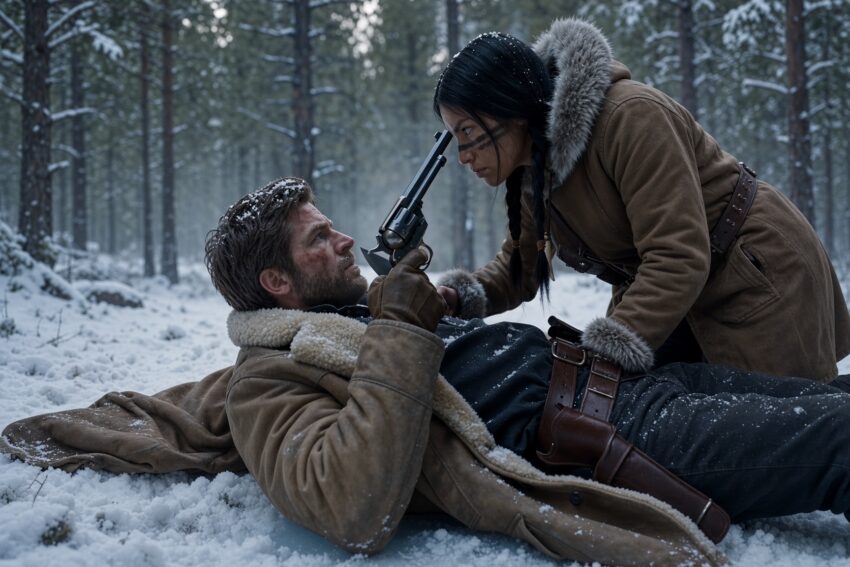
HE TRACKED HER ACROSS SEVENTY MILES OF SNOW TO FINISH IT—UNTIL A BONE WHISTLE BLEW BEHIND HIS HEAD
The hiss was louder than the wind.
It wasn’t just fire meeting ice.
It was pitch-soaked linen chewing through pine sap, bubbling and spitting black droplets into the snow crust three inches from Colter’s left boot.
The smell hit him before the heat did.
Rancid bear tallow.
Turpentine.
The chemical stench of cheap blasting oil mixed with sulfur.
Above them, the frozen canyon walls did not echo the shot.
They trapped it.
The sound of twenty heavy bows releasing at once was not a roar.
It was a dull, rhythmic thwack-thwack-thwack, like wet cedar shingles slapping against a barn roof in a gale.
“Move!” the woman hissed.
She didn’t grab his sleeve.
She didn’t try to haul his weight.
She slammed her left shoulder directly into Colter’s ribs, driving him sideways beneath the granite overhang just as the second volley struck the clearing.
Seven burning shafts slammed into the drift where he had been lying.
The crust gave way with a soft, hollow whumpf.
Steam geysered into the grey morning air, thick and grey as wool.
Colter rolled across the frozen gravel, his right hand locking around the cold steel frame of the Colt Army .44.
His fingers were white at the knuckles.
The snow had packed into the cylinder latch.
He wiped it across the grease of his sheepskin coat in one sharp, vicious jerk.
The iron clicked.
Six chambers loaded.
The spare cylinder she had slapped onto his chest was still tucked against his ribs, heavy, cold, and coated in stiff gun lard.
“How many?” Colter rasped, his lungs burning with the sudden intake of freezing mountain air.
The woman was already in a low crouch beside a split boulder of blue slate.
Her hood was thrown back now.
The frost in her coarse raven hair had melted against her skin, running down her temples in thin, clear beads that washed through the black charcoal war grease on her cheekbones.
Her eyes were fixed on the rim ninety feet above.
“Twenty on the limestone,” she said.
Her voice had no tremble in it.
It sounded like stones rattling together in an iron bucket.
“Four more dropping the ropes at the narrow throat,” she added.
Colter dragged his back up against the cold stone of the overhang.
His ankle throbbed where the horsehair snare had bitten through the leather of his cavalry boot.
The skin was numb, but the tendon beneath was hot and swollen.
He could walk on it.
He could run if he had to.
He wouldn’t be jumping any arroyos.
“They aren’t soldiers,” Colter said, peering past the granite lip.
“No,” she whispered.
“And they aren’t your people.”
She looked at him then.
Her gaze was flat, dark, and unyielding as river flint.
“My people do not dress in rusted iron plates stolen from territorial freight wagons.”
She spat into the red gravel.
“They are the Drift.”
Colter’s jaw tightened.
He had heard the name in the border towns two winters ago.
Deserters from the southern garrisons.
Convicts who had slipped the iron gangs in the silver mines.
Men who had pushed so far north into the high timber that the law simply stopped looking for them.
They didn’t trap beaver.
They didn’t mine quartz.
They hunted human meat and traded horses for powder at unmapped river crossings.
“They’ve been shadowing me since the timberline,” Colter said, his thumb resting against the knurled hammer of the revolver.
“They weren’t shadowing you,” she said coldly.
She reached down, her thumb testing the chipped edge of her obsidian blade.
A single dark bead of pine pitch was smeared across the black glass.
“They were using you.”
Colter frowned, the cold air stinging the raw skin of his wind-burned face.
“Speak plain.”
“You tracked me for three days, tracker.”
“Seventy miles from the lower forks,” he acknowledged.
“You followed broken twigs.”
“Yes.”
“You followed drops of red in the crust.”
“I did.”
She leaned closer, the smell of wolf fur and cedar smoke rolling off her shoulders.
“I did not break those twigs, white man.”
Silence settled between them, heavy and bitter as salt.
Colter looked down at the snow.
The trail had been clean.
Too clean.
In fifteen years of tracking deserters and runaways through the Apache breaks, he had never followed a quarry who left a trail that easy to read in a fresh powder fall.
A snapped birch branch at hip height.
A smear of crimson on a limestone face.
He had thought she was wounded.
He had thought she was getting careless.
“They drove me toward your snare,” Colter said, the realization settling in his gut like a swallowed bullet.
“They drove you toward the narrow gap,” she corrected. “My snare was meant for their scout.”
She glanced at his boot.
“You were just clumsy enough to step in it first.”
A shout drifted down from the cliff edge.
High.
Mocking.
The sound of iron scrapers clattering against frozen rock.
Colter leaned his head out an inch.
The first rope ladder had dropped.
It was made of spliced hemp and split cedar rungs, swinging wildly as it slapped against the limestone cliff.
Two men were already coming down.
They moved with heavy, clumsy urgency.
Their torsos were wrapped in crude cuirasses hammered out of iron boiler plate, held together with harness straps and copper rivets.
Over their shoulders hung short-barreled percussion shotguns, secured by greasy leather cords.
They were thirty feet down the wall.
Forty feet from the canyon floor.
“They want the horses at the lower camp,” she said, her voice dropping an octave.
“My horse is five miles south,” Colter replied. “Tied in a spruce thicket.”
“It was five miles south,” she whispered. “They took it two hours before dawn.”
Colter cursed under his breath.
His saddlebags.
His salt rations.
His eighty rounds of brass centerfire cartridges.
All gone.
“What’s your name?” Colter asked, not looking at her.
She paused, her fingers wrapping around the rawhide cord of the bone whistle resting on her chest.
“Shiye.”
“Colter.”
“I know your name,” she said quietly. “It was written on the paper.”
Colter froze.
He turned his head slowly, his eyes locking onto hers.
“What paper?”
Shiye reached into the breast of her fur-lined tunic.
She withdrew a crumpled piece of yellowed newsprint, folded into a tight square and stiffened by dried water and frost.
She tossed it onto his lap.
Colter unfolded it with numb fingers.
It was a territorial wanted circular.
His own likeness was crudely woodcut onto the top half.
COLTER MCCABE. FORMER TERRITORIAL RANGER. WANTED FOR THE THEFT OF SEVENTY HEAD OF CAVALRY STOCK AT FORT DEFIANCE.
FIVE HUNDRED DOLLARS IN COIN. DEAD OR ALIVE.
Colter stared at the ink.
“This is a lie,” he whispered.
“I know,” Shiye said.
“How do you know?”
“Because the man who gave it to the iron-skin renegades was wearing a major’s blue coat when he crossed the river two weeks ago.”
Colter’s breath caught in his throat.
The blue coat.
Fort Defiance.
The supply scandal that had pushed him out of the Rangers three years ago.
He had thought he had left the rot behind in the territorial capitals.
He had thought the mountains were clean.
A heavy iron thud rattled the shale sixty yards down the canyon.
The first renegade had hit the dirt.
The man landed on his boots, the boiled leather of his duster slapping against the iron breastplate with a dull clang.
He unslung the short shotgun, his greasy beard crusted with yellow icicles, his eyes scanning the grey brush beneath the cliff face.
“They’re under the shelf!” the man bellowed upward, pointing with a gloved hand. “The tracker’s down! Bring the irons!”
From the rim, three more arrows arched through the grey light.
These were not lit with pitch.
They were broad-headed iron points, heavy and forged for hunting elk.
They whistled through the birch branches, chewing through wood and bark, raining sharp splinters down onto Colter’s hat brim.
“We can’t stay in this crevice,” Colter said.
“If we run down the wash, the archers pick us off before we reach the spruce,” Shiye said.
Her blade was back in its chest sheath.
She reached over her shoulder, pulling a short, recurve bow made of laminated horn and sinew from its oiled fleece case.
She slipped three arrows from a quiver at her hip, holding them between the fingers of her drawing hand.
The arrowheads were black obsidian, serrated like wasp stings.
“Can you hit the ladder?” Colter asked.
“The ladder is seventy yards,” she said. “The wind is cutting east.”
“Can you hit the man on it?”
Her dark eyes flashed with cold pride.
“Watch his throat.”
She stepped out from behind the slate slab in one smooth, flowing motion.
Her left arm extended like an oak branch.
Her fingers drew the sinew string back until the goose-feather fletching brushed the cold skin of her jawline.
The horn limbs of the bow creaked once.
THT.
The bowstring sang a low, flat note.
Down the canyon, the second man on the cedar ladder had reached the halfway mark.
He was laughing, shouting something to the men above him on the limestone lip.
The black glass point entered the soft flesh beneath his chin and came out the back of his neck, severing the spinal cord before he could close his mouth.
The renegade did not scream.
His hands simply opened.
His heavy iron-armored body peeled away from the ladder, turning once in the empty air before crashing into the jagged granite boulders forty feet below.
The iron plate on his chest split with a sickening screech of tortured metal.
He did not move again.
A howl of pure animal rage erupted from the rim.
A dozen arrows hissed through the canopy, shredding the brush where Shiye had been standing.
She was already gone.
She had dropped back behind the slate the instant the arrow left her fingers.
“One,” she muttered.
“The other one’s behind the deadfall,” Colter said, cocking the Colt.
He scrambled on his belly through the snow crust, dragging his injured leg behind him until he reached the eastern edge of the overhang.
Twenty paces away, the first man who had landed was crouched behind a rotting pine log, struggling to cock both hammers of his double-barreled scattergun.
The man’s fingers were stiff with the cold.
He was cursing, spitting brown tobacco juice onto the white snow.
Colter laid the heavy barrel of the Army .44 across a shelf of granite.
He breathed out.
A cloud of white mist billowed from his mouth, briefly obscuring his sight.
He waited for the wind to drop.
The pine branches shivered.
The mist cleared.
The renegade lifted his head above the log to peer toward the shelf.
Colter squeezed the trigger.
The hammer fell with an iron slam.
A tongue of yellow fire and dense blue black-powder smoke erupted from the muzzle.
The heavy lead conical ball crossed the twenty yards in a fraction of an instant.
It caught the man in the center of his forehead, just beneath the rim of his grease-blackened wool cap.
The renegade was thrown backward out of his crouch, his legs kicking once in the air before he landed flat on his back in the drift, the shotgun discharging harmlessly into the limestone wall above him.
The thunder of the two shots rolled through the gorge, deafening and immediate.
“Up!” Shiye shouted, her hand grabbing Colter’s duster collar.
She didn’t ask if he could walk.
She hauled him to his feet by main strength, her teeth bared, her breath coming in ragged white gasps.
“The waterfall,” she said, pointing up the narrow gorge.
“The water’s frozen,” Colter coughed, shoving fresh cartridges into the warm cylinder of his revolver.
“The water is ice,” she said, pulling him forward. “The rock behind it is hollow.”
They broke from the cover of the overhang together.
Above them, the cliff face erupted in shouts and gunfire.
Two men on the rim had leveled long buffalo rifles, their heavy slugs cracking through the air with the sound of splitting timber.
Gravel and ice chips rained down from the canyon walls, biting into Colter’s cheeks and tearing through the wool of his collar.
He leaned his weight onto his left leg, driving his right heel into the crust, ignoring the hot, tearing pain that shot up his calf with every stride.
The gorge narrowed ahead of them until the limestone cliffs were barely ten paces apart.
A massive wall of solid blue-green ice hung suspended between the walls like a frozen cataract sixty feet high.
It was silent.
A monument of winter, pale and dead beneath the iron sky.
Shiye didn’t slow down.
She ran straight toward the base of the frozen fall where the ice met the talus slope in a jumble of jagged boulders.
She dropped to her knees, sliding through a narrow fissure between two massive columns of fluted ice.
“Inside!” she called back.
Colter threw himself through the gap after her.
The light changed instantly.
The blinding glare of the snowfield was replaced by a dim, ethereal turquoise glow.
The air in here was different.
It was dead calm.
It smelled of wet lime, ancient bat droppings, and the cold, metallic mineral tang of deep subterranean stone.
Behind them, the ice wall acted as a massive acoustic baffle.
The shouts of the renegades and the cracks of the rifles became dull, distant thuds, like fists beating against a heavy oak door three rooms away.
Colter collapsed against the damp rock wall of the cave, his chest heaving, his mouth open as he dragged in air.
His right leg was trembling uncontrollably.
He looked down at his boot.
The leather around the ankle was soaked through with dark, sticky fluid.
Not just water.
The horsehair snare had had wire woven into its core—fine, rusted wire that had sliced through the sheepskin and into the flesh above the heel bone.
Shiye was already kneeling beside him.
She didn’t speak.
She pulled the obsidian knife from her chest and sliced through the laces of his boot with two quick, precise movements.
She peeled the leather back.
The wool sock was crimson and frozen stiff against the skin.
She reached into her belt pouch, pulling out a handful of dried grey leaves that smelled sharply of camphor and bitter sage.
She crushed them between her palms until they became a coarse paste, then pressed them directly into the open cut.
Colter’s vision went white.
A groan tore through his clenched teeth, his fingers digging into the limestone floor until the rock cut his skin.
“Bite your coat,” she said without looking up.
“What is that?” he hissed, his jaw shaking.
“Spider silk and winter leaf,” she said. “It stops the rot. It stops the red water.”
She tore a strip of clean linen from the lining of her deerskin hood and wrapped the wound tight, tying the knot with an aggressive jerk that made his stomach heave.
She sat back on her heels, her dark eyes studying his face in the dim turquoise light.
“You won’t die today, tracker,” she said.
“I wasn’t planning on it,” Colter muttered, wiping the cold sweat from his forehead with the back of his sleeve.
He looked around the cavern.
The space was wider than he had thought.
It stretched back into the mountain, a high, vaulted fissure carved by thousands of years of meltwater eating through the limestone.
Ten paces back, the floor rose in a series of natural stone terraces, disappearing into absolute, pitch-black darkness.
“Does this go through?” Colter asked, nodding toward the dark.
“It climbs,” Shiye said.
“To the high bench?”
“To the ridge behind them.”
Colter’s mouth twisted into a hard, grim line.
“Then we aren’t running.”
Shiye looked at him, her head tilted slightly, the two black grease marks on her cheeks catching the faint light from the ice wall.
“You want to go up?”
“They have my horse,” Colter said, his voice flat. “They have my saddle. And they have that paper with my name on it.”
He looked into her dark eyes.
“Who was the man in the blue coat, Shiye?”
She went very still.
Her hands rested on her knees, her fingers long and scarred across the knuckles from winters spent working frozen leather.
“His name is Captain Bradley,” she whispered.
Colter felt the air leave his lungs again.
Not Marcus Bradley.
Marcus was the General in the southern territory.
“Julian?” Colter asked, the name tasting like ash on his tongue.
“He called himself Julian,” she nodded. “He came with eight riders from the north four weeks ago. He met the leader of the Drift at the old fur post on the high plateau.”
“What did he want?”
“He wanted the trail cleared.”
“Cleared of who?”
“Of everyone,” Shiye said, her voice rising with a quiet, terrible intensity. “My people have three winter camps along the creek beds in the high valley. The settlers have four spreads near the lower timber.”
She pointed a finger toward the dark stone terraces behind them.
“Julian Bradley told the iron-skins that if the valley was empty by the time the snow melted, the territorial syndicate would grant them full title to the iron mines in the canyon.”
“They’re buying the whole basin with blood,” Colter muttered.
“They are buying it with fear,” she corrected. “A few burned cabins. A few bodies left in the snow with Apache arrows in their ribs.”
She looked at her bow lying on the rock beside her.
“They use my people’s weapons to do their work. Then the army rides in next spring to ‘protect’ the survivors and take the deeds.”
Colter closed his eyes for five seconds.
The frontier was the same from the Mexican border to the Canadian line.
Men with titles and silk cravats sitting in warm rooms in Prescott or Santa Fe, drawing lines across maps with gold pens, while hiring butchers in rusted iron breastplates to do the wet work in the snow.
“How many men are with the Drift at the fur post?” Colter asked, opening his eyes.
“Thirty,” she said. “Maybe forty.”
“And Bradley?”
“He left three of his men with them. Troopers who took off their blue coats and put on greased leather.”
Colter reached down, checking the action of the Colt.
The cylinder turned smooth and true.
He had eighteen rounds in his belt loops.
Six in the spare cylinder.
Twenty-four bullets.
Against forty men holding an iron-roofed fur post on a mountain crest.
“We can’t fight forty men in the open,” Colter said.
Shiye reached to her throat, lifting the small, carved eagle-bone whistle.
The bone was yellowed with age, polished smooth by grease and fingers, with three small notches carved into the underside near the lip hole.
“We don’t have to fight forty,” she said.
“What does that whistle do, Shiye?”
She held it up so the pale blue light caught the grain of the bone.
“This belonged to my grandfather,” she said softly. “He was one of the twelve scouts who watched the northern passes for the allied tribes fifty winters ago.”
She looked toward the mouth of the cave where the ice wall stood between them and the gorge.
“There are five of those scouts’ sons living in the timber on the other side of the ridge,” she said. “They have been waiting for the signal since the first frost.”
“Why haven’t you blown it before now?”
“Because the whistle does not call for help,” Shiye said, her eyes boring into his.
“What does it call for?”
“The whistle calls for war.”
She tucked the bone back beneath her fur tunic.
“Once the whistle sounds in the high pass, there is no more talking. No more treaties. No more waiting for the territorial marshals to ride north with their papers.”
She stood up, her moccasins gripping the wet limestone with effortless grace.
“If I blow this whistle on the high ridge, every cabin and every lodge in this basin will take up iron. And the snow will stay red until the spring thaw.”
Colter hauled himself up, leaning his shoulder against the rock until his bad leg took his weight.
The throbbing was dull now, masked by the bitter camphor and the ice-cold air of the cave.
“Then let’s make sure we’re standing on the high ridge when you blow it,” Colter said.
She looked at him for a long beat, then turned and began walking into the dark.
The climb was five hundred feet of sheer, frozen misery.
The cave system was not a tunnel.
It was an ancient volcanic fissure that had been split by an earthquake ten thousand years before and then hollowed out by mountain runoff.
In some places, the walls were wide enough for three men to walk abreast, the floor covered in slippery black shale that shifted beneath their boots with a sound like broken crockery.
In other places, the crevice narrowed to eighteen inches.
Colter had to turn his shoulders sideways, dragging his rifle scabbard behind him, his sheepskin coat scraping against the jagged limestone ribs while cold water dripped continuously from the darkness thirty feet above.
His ankle burned like an open coal.
Every time his right boot struck a stone, a sharp jolt of fire raced up his spine, but he kept his teeth clamped shut.
He didn’t complain.
He didn’t ask her to slow down.
Shiye moved through the blackness ahead of him like a creature born without eyes.
She didn’t use a torch.
She didn’t strike a match.
Her left hand trailed lightly along the eastern wall of the fissure, feeling the microscopic changes in the stone grain, knowing every ledge, every drop-off, and every patch of treacherous black ice before her foot ever touched it.
After two hours of silent, grinding ascent, the air began to change.
The stagnant, dead-water smell of the cavern gave way to a sharp, needle-cold draft that smelled of ozone, spruce needles, and fresh blizzard.
Ahead, thirty feet up a vertical chimney of fractured granite, a faint grey disc of light hung in the darkness.
The chimney was narrow.
Its sides were stepped with natural handholds, but the rock was glazed with a thin, invisible skin of rime ice.
Shiye paused at the base of the shaft.
She looked back down at Colter.
“Can your foot hold?” she whispered.
“It has to,” Colter said through cracked lips.
She uncoiled a length of braided rawhide cord from her waist and tied one end securely beneath his armpits, looping the other around her own chest.
“If you slip,” she said, “do not fight the wall. Throw your weight toward the horn on the left.”
She didn’t wait for his answer.
She leaped upward, her moccasins finding purchase on a two-inch ledge of granite with the precision of a mountain goat.
Her hands moved with terrifying speed, testing each hold before shifting her weight, her slender body flowing upward through the chimney like smoke.
Within three minutes, she had reached the top.
The rawhide cord snapped taut against Colter’s chest.
“Now,” her voice came down, muffled by the howling wind above.
Colter reached up, his leather gloves finding the first shelf.
The cold bit through the horsehide instantly.
It felt like grabbing a bare iron stove in the dead of winter.
He hauled his weight upward, driving the toe of his good left boot into a fissure, his right leg trailing uselessly behind him like a dead log.
Halfway up the shaft, his left boot slipped on a patch of glazed ice.
His center of gravity peeled backward into the empty air.
The darkness yawned beneath him—a sixty-foot drop onto the jagged floor of the lower cave.
The rawhide cord snapped tight with a violent, bone-jarring jerk.
The leather bit into his ribs, driving the air from his lungs with an explosive grunt.
Above him, Shiye had wedged her knees against the chimney lip, her teeth bared, her veins bulging along her throat as she took his entire two-hundred-pound weight on her spine.
She didn’t cry out.
She didn’t slip an inch.
“Left hand!” she hissed down through the howling gale. “The horn! Grab the horn!”
Colter swung his left arm blindly through the dark.
His fingers struck a rounded nub of granite, curling over the lip with desperate, survival-driven strength.
He pulled.
His boot found another notch.
He scrambled upward, his chest heaving, his knees slamming into the frozen stone, until two hands locked around his sheepskin collar and hauled him over the snowy rim into the open air.
Colter rolled onto his back, gasping for breath.
The world above was a fury of white and grey.
They were standing on the high bench—a narrow, wind-scoured plateau of granite that separated the lower canyon from the northern peaks.
The blizzard had arrived in full force.
The snow was no longer falling in flakes.
It was driving horizontally across the rock in sheets of tiny, frozen needles that stung the eyes and drew blood from bare skin.
The wind shrieked through the stunted spruce trees like a dying locomotive.
Temperature was dropping by the minute.
Colter knew mountain weather.
In this wind, with wet boots and no shelter, a man had sixty minutes before his fingers stopped working.
Ninety minutes before his blood thickened and his brain turned to slush.
“Where is the post?” Colter shouted above the gale, squinting through the blinding whiteout.
Shiye was already on her feet, leaning forty-five degrees into the teeth of the storm.
She pointed toward a dark, brooding silhouette that rose above the dwarf timber two hundred yards to the north.
It was the old fur post.
It looked less like a trading house and more like a frontier blockhouse built for a siege.
The walls were made of two-foot-thick hewn larch logs, grey with age and reinforced at the corners with heavy slabs of rough-quarried slate.
The roof was low-pitched, covered in sheets of corrugated iron that had been salvaged from the territorial railroad camps sixty miles away.
Thick, oily black smoke poured horizontally from a stone chimney at the southern gable, whipped away into nothingness by the shrieking wind.
Around the perimeter of the post ran a log stockade eight feet high, the tops of the poles sharpened to deadly points.
Two horses were tied beneath a rough lean-to near the gate, their rumps turned to the storm, their coats caked in thick crusts of white frost.
“They’re inside,” Colter said, crawling behind a low ridge of wind-drifted snow.
“They are drinking,” Shiye said, her lips close to his ear. “They think we are pinned in the lower wash until we freeze.”
Colter peered through the driving snow.
Through a small, square loophole beside the main timber door, a dim orange light flickered.
Every few seconds, the wind carried a scrap of sound across the clearing—the coarse, braying laughter of men who believed they held all the cards.
“How do we breach the stockade?” Colter asked.
“The back wall,” she said. “The snow drifts against the western logs. It is six feet deep. A man can step right over the sharpened stakes.”
Colter nodded grimly.
He checked the Colt once more.
He pulled his sheepskin coat tight around his throat, buttoning the bone toggles with stiff, wooden fingers.
“We don’t take prisoners, Shiye,” Colter said, his voice flat as the ice beneath them. “Not in this wind.”
She didn’t answer with words.
She reached down, pulling her obsidian blade from its sheath, and held it before her eyes for a single beat.
Then she vanished into the swirling whiteout.
The western drift was as solid as packed salt.
The wind had driven the snow against the timber stockade until it formed a long, sloping ramp that led directly to the top of the sharpened larch posts.
Colter crept up the incline on his hands and knees, keeping his belly pressed flat against the crust to distribute his weight.
Shiye was already at the top.
She crouched on the top log like an owl, her eyes fixed on the narrow yard between the stockade and the main blockhouse.
The yard was empty.
Two dead hogs hung from a crossbeam near the smokehouse, their frozen bellies split open and covered in white frost.
A pile of split firewood lay beside the back door, half-buried under a fresh drift.
Shiye lowered herself down the inside of the wall, using the horizontal crossbars like a ladder, dropping silently into the soft snow beside the woodpile.
Colter followed.
His bad ankle gave way slightly as his boots hit the ground, but he caught himself against the rough bark of the larch logs, swallowing the groan that rose in his throat.
They moved along the timber foundation of the blockhouse until they reached a low, square window covered with oiled sheepskin.
A crack in the animal hide allowed a narrow beam of warm, yellow light to cut through the swirling snow.
Colter pressed his eye to the slit.
The room inside was thirty feet long and twenty feet wide.
In the center of the room sat a massive iron stove, glowing dull red around its belly, radiating a ferocious heat that had melted the frost off the interior logs.
Around the stove sat eight men.
Four of them were the armored renegades of the Drift—their iron breastplates unbuckled and resting against their chair legs, revealing greasy wool shirts stained with grease and dried tobacco.
They were gnawing on strips of dried venison, tossing the bones onto the dirt floor.
The other four men were different.
Three of them wore regulation cavalry trousers with the yellow side-stripes unpicked, their service revolvers resting on the plank table in plain sight.
And sitting at the head of the table, his boots propped up on an open wooden dispatch box, was the man Colter had known five years ago in the territorial capital.
Julian Bradley.
He was thirty-six now, his hair trimmed short and oiled back from his high forehead, a neat mustache tracing his upper lip.
He wore an expensive broadcloth frock coat with brass civilian buttons, but beneath it sat the blue wool vest of a cavalry staff officer.
On the table in front of him sat three objects:
A leather-bound field desk.
A stack of certified land deeds tied with red ribbon.
And a heavy, double-barreled brass derringer resting atop an open ledger.
“The wind will do the work for us, Julian,” one of the renegades was saying, his voice thick with grease. “Nobody survives a night in that lower wash. By morning, McCabe and the Indian girl will be as stiff as salt pork.”
Julian Bradley didn’t look up from his papers.
He dipped a steel pen into a small bottle of black ink and made a neat, precise entry in the ledger.
“McCabe is a resourceful animal,” Bradley said, his voice cultured, dry, and terrifyingly cold. “He served three years with the scouts in the Tonto Basin. I will not sign off on the third parcel until I see his ears on this table.”
The renegade spat on the floor.
“You’re too nervous, Captain. The gorge is ninety feet deep and the only way out is through our camp.”
“He had the woman with him,” Bradley said, setting the pen down with a deliberate tap. “And that woman carries the lineage of the northern scouts. If she reaches the settlements along the river, the governor will have a full uprising on his hands before the spring supply wagons leave Tucson.”
Bradley reached into the dispatch box, pulling out a sealed parchment envelope bearing the official crest of the Territorial Land Commission.
“This valley is worth three million dollars in copper and timber,” Bradley said quietly. “The syndicate has already paid two hundred thousand in bribes to the legislature. I will not have five years of planning ruined because three drunken deserters couldn’t corner a cripple in an arroyo.”
Outside the window, Colter felt the cold leave his skin.
The blood in his veins was suddenly boiling.
Five years.
Five years he had spent wandering the northern territories, believing he had been disgraced by his own incompetence.
Believing the cavalry supply wagons he had guarded had been lost to raiders because he had misread the trail.
It had all been Bradley.
Every missing wagon.
Every dead teamster.
Every forged warrant that had driven him out of the territory and turned him into a hired bounty tracker with a price on his own head.
Colter pulled his head back from the window.
He looked at Shiye.
Her face was illuminated by the sliver of yellow light cutting through the blizzard.
Her eyes were locked on his.
She didn’t need to ask what he had seen.
She had seen it in the set of his jaw.
“The back door is barred from the inside,” Colter whispered, his lips brushing her wolf-fur hood.
“The roof,” she replied instantly.
Colter looked up.
The corrugated iron sheets on the roof were rattling in the gale, their edges secured to the rafters with hand-forged iron spikes.
At the southern corner, where the stone chimney rose through the logs, the iron had pulled away from the framing, leaving an opening three feet wide.
“Can you reach it?” Colter asked.
Shiye reached into her belt, pulling out a four-pronged iron grappling hook spliced to thirty feet of twisted elk sinew.
“Watch the door,” she said.
She swung the iron hook twice in a tight, horizontal circle, then let it fly upward into the driving snow.
The iron caught the lip of the stone chimney with a dull, muffled clink that was completely swallowed by the shrieking wind.
She tested the line with both hands, nodding once.
She looked at Colter.
“When the whistle sounds,” she said, “shoot the man in the blue coat first.”
“No,” Colter whispered back. “Shoot the renegades first. Bradley is mine.”
A rare, terrifying glimmer of satisfaction crossed her face.
“Good,” she said.
She gripped the sinew line and began to climb the vertical log wall, her moccasins finding purchase on the rough bark, disappearing into the whiteout above.
Colter moved to the back door.
The door was made of three-inch oak slabs, studded with square-headed iron nails.
The latch was iron, set into a heavy timber frame.
Colter unslung the Colt Army .44.
He thumbed the hammer back until it clicked into full cock.
He placed the muzzle of the heavy revolver directly against the wood where the interior bar rested in its iron cradle.
He waited.
The wind shrieked through the stockade, carrying a sudden, blinding flurry of white needles that erased the clearing ten feet behind him.
Then, from the roof above, it came.
Not a shout.
Not the sound of boots on tin.
A single, piercing, supernatural screech that tore through the mountain blizzard like an iron saw through bone.
The eagle-bone whistle.
The sound was so shrill, so violent, and so deafening that the horses in the lean-to shrieked in terror, kicking through their timber rails and bolting into the whiteout.
Inside the blockhouse, the laughter stopped instantly.
“What in the name of—” a man’s voice roared.
Colter pulled the trigger.
BOOM!
The heavy lead slug punched through the three-inch oak door at point-blank range, shattering the pine bar on the inside into a hundred flying splinters.
Colter slammed his left shoulder into the door with all his weight.
The shattered timbers tore free of the hinges, crashing inward onto the dirt floor in a cloud of black powder smoke and swirling snow.
The scene inside was pure chaos.
From the gaping hole in the roof beside the chimney, Shiye dropped like an avenging spirit from the northern sky.
She landed directly on the table, her obsidian blade flashing once in the orange stove light.
The renegade sitting to Bradley’s right never even reached for his shotgun.
The black glass blade sliced across his jugular vein with a wet, hissing tear, spraying a sheet of dark crimson across the certified land deeds before his head even struck the table planks.
“ATTACK!” Bradley screamed, lunging backward out of his chair, his hands scrambling for the brass derringer.
Colter stepped through the shattered doorway, the Colt leveled from his hip.
A renegade in an iron breastplate was rising from his stool, leveling a short percussion shotgun at Shiye’s chest.
Colter fired.
BOOM!
The lead slug struck the man’s iron plate four inches below the collar.
The home-made boiler plate didn’t stop the bullet.
It mushroomed against the iron, punching a jagged, two-inch hole straight through the metal and driving the fragmented iron into the man’s lungs.
The renegade was thrown backward into the glowing stove, his body overturning the cast-iron kettle with a deafening crash of boiling water, steam, and flying embers.
The room filled with choking white vapor and sulfur smoke.
The two former cavalry troopers on the left side of the table drew their service revolvers, their faces white with shock as they fired blindly through the steam.
One bullet chewed through the sheepskin collar of Colter’s coat, singeing the wool and grazing the skin of his neck with a streak of white fire.
Colter didn’t flinch.
He cocked the hammer with his left palm, fanning the gun in rapid, mechanical rhythm:
BOOM! BOOM!
Two lead balls crossed the room six inches apart.
The first trooper took a bullet through the breastbone, his arms flying outward as he crashed backward over his bench.
The second trooper was hit in the throat, his revolver dropping from his fingers as he collapsed onto his knees, choking on his own blood.
In four seconds, the room had been cleared of four men.
The remaining two renegades threw their weapons down, bolting toward the front door of the blockhouse with screams of terror.
Shiye didn’t pursue them.
She stood atop the table, her deerskin tunic covered in blood, her recurve bow drawn taut to her ear, the black obsidian point aimed directly at Julian Bradley’s face.
Bradley was pressed flat against the stone hearth of the chimney.
His derringer was cocked in his right hand, but the barrel was shaking so violently that the sights were rattling against each other.
The ink was still wet on his fingers.
The grease of his hair had come undone, falling across his forehead in sweaty, unkempt strands.
“McCabe…” Bradley gasped, his cultured voice cracking into a high, petrified whimper. “McCabe, listen to me… this isn’t personal… it was the syndicate… I can pay you… I have forty thousand dollars in gold notes in the chest…”
Colter walked across the dirt floor, his boots crunching over shattered crockery and pooling blood.
He stopped three feet from Bradley.
The muzzle of the Colt was smoking, the iron barrel hot enough to blister skin.
“You forged my name on the Fort Defiance manifest, Julian,” Colter said, his voice dropping to a deadly, gravel-rough whisper.
“It was the General’s order!” Bradley shrieked, pressing himself harder against the stone. “He wanted the route cleared! He wanted the records destroyed! I had no choice, Colter! You know how the army works!”
“I know how you work,” Colter said.
Shiye lowered her bow half an inch.
She looked at Colter.
“He is the one who paid for the fire arrows,” she said.
“Yes,” Colter whispered.
Bradley saw the shift in their eyes.
In a last, desperate convulsion of terror, he whipped the brass derringer upward, his finger contracting around the trigger.
Colter didn’t fire his gun.
He stepped forward, his left hand moving with the blinding speed of a striking rattler, his fingers locking around the cylinder and barrel of the small brass pistol.
He twisted.
A sharp, wet snap echoed through the room as Bradley’s index finger broke against the trigger guard.
Bradley screamed, dropping to his knees on the hearth stones, clutching his mangled hand against his stomach.
Colter tossed the derringer into the red-hot embers of the stove.
The powder in both barrels cooked off with a muffled double pop, blowing ash and sparks across the room.
Colter reached down, his fingers gripping the front of Bradley’s blue wool vest, and hauled the man upright until his boots were barely touching the dirt floor.
“Where is the General, Julian?” Colter asked, his voice deathly calm.
Bradley was sobbing, tears washing through the soot on his cheeks.
“He’s… he’s at the railhead,” Bradley stammered. “At the southern crossing… waiting for the telegraph… waiting for me to confirm the valley was empty…”
“And the rest of the Drift?”
“There are… there are fifty more,” Bradley wept. “Coming up from the south… with the spring wagons… they have two Gatling guns, Colter… you can’t stop them… nobody can stop them…”
Shiye stepped down off the table.
She walked over to the open dispatch box, her fingers lifting the stack of certified land deeds.
She looked at the signatures.
The red wax seals.
The names of twenty-four families who had been marked for slaughter so an iron syndicate could dig their mines in peace.
She walked to the stove, opened the iron door, and threw the entire stack of papers into the heart of the coals.
The paper curled.
The ink flared green.
Within five seconds, the five years of planning, bribes, and bloodshed had been reduced to a handful of grey ash.
Bradley watched the papers burn with wide, horrified eyes.
“You… you burned them…” he whispered. “You don’t understand… without those deeds, the whole basin is open… anyone can claim it…”
“The earth belongs to the people who bleed for it,” Shiye said quietly, her eyes like black glass. “Not the men who write on paper.”
Colter lowered Bradley back down to his knees.
He didn’t raise his gun.
He unbuckled the heavy iron handcuffs from the belt of the dead trooper lying beside the table.
He snapped the iron bracelets around Bradley’s wrists, ratcheting them down until the metal bit into the bone.
“You’re going to walk, Julian,” Colter said.
Bradley looked up, bewildered.
“Walk? Where?”
“To the settlements along the river,” Colter said. “You’re going to tell every rancher, every farmer, and every tribal elder exactly what you wrote in that ledger.”
“They’ll hang me!” Bradley screamed. “They’ll lynch me from the first cottonwood!”
Colter leaned down until his eyes were two inches from Bradley’s face.
“Then you’d better hope you can talk faster than they can knot a rope.”
Colter turned to Shiye.
“We have to move,” he said. “If there are fifty more coming with the wagons, we need to be on the high trail before the storm breaks.”
Shiye walked to the doorway, peering out into the swirling blizzard.
Suddenly, she stiffened.
Her hand went back to her obsidian blade.
Colter stepped beside her, his thumb pulling the hammer of the Colt back to full cock.
Through the whiteout of the high bench, the sound was faint at first.
A low, rhythmic vibration that could be felt through the soles of their boots more than heard through the wind.
Not hooves.
Not the wind.
It was an answering whistle.
Far to the north, along the jagged crest of the high granite needles, a shrill, piercing screech echoed through the storm.
Then another.
Then three more.
Rising from the timbered draws, from the frozen creek beds, and from the deep passes of the mountain range.
The sons of the twelve scouts had heard the bone whistle.
The war had begun.
And as Colter looked up into the swirling fury of the mountain blizzard, a lone rider on a massive roan horse crested the western drift fifty yards away.
The rider was encased from head to toe in blackened iron armor, carrying a heavy cavalry standard that bore an insignia Colter had never seen before:
A silver skull encircled by a broken iron chain.
The rider halted his mount in the deep snow, raised a brass horn to his lips, and blew three long, deafening blasts that signaled the advance of an army.
TO BE CONTINUED…
📖 Disclaimer: A serialized frontier story found on the web and shared strictly for entertainment and dramatic storytelling purposes. All characters, names, places, and events are entirely fictional and any resemblance to real occurrences or persons is purely coincidental.