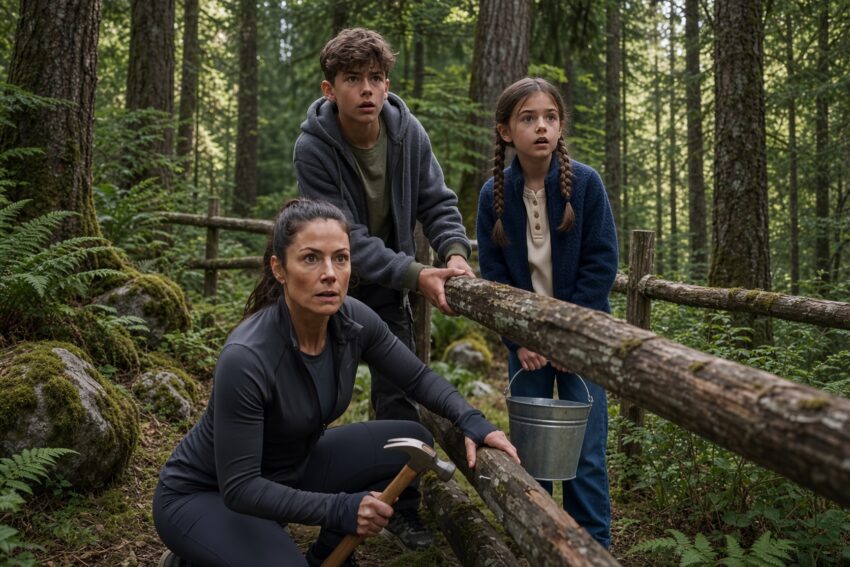
A mother’s buried past arrives on black ATVs, forcing a desperate flight through the wet timber.
THE CLICK
Mara Catherine Vance did not hesitate.
She slammed the heel of her right hand hard against the red mushroom cap.
The brass-mounted box groaned inside the pine studs.
Deep inside the walls, heavy relays clacked shut like closing bank vaults.
Cole stumbled back against the tongue-and-groove paneling, his eyes wide and chest heaving under his gray hoodie.
Maeve clutched her brother’s forearm with both small hands, her braided pigtails trembling against the wool of her cardigan.
Above their heads, the warm glow of the bulkhead cage lamp flickered twice, turned an eerie amber, and died.
Silence fell across the hallway for a single second.
Then the house came alive with the sound of dropping iron.
THE LOCKDOWN
Thick steel rolling shutters plummeted down the outer window frames with a succession of dull, bone-rattling thuds.
The living room went pitch black.
The kitchen went pitch black.
Through the heavy oak front door, the roar of the three black ATVs outside cut out.
Mara heard the wet squelch of combat boots hitting the muddy driveway gravel.
“Cole, take your sister’s hand,” Mara whispered, her voice dropping into a low, flat cadence.
“Mom, what did you do?” Cole asked, his breath hitching. “Who are those men?”
“Do not let go of her,” Mara said, grabbing Cole by the shoulder and turning him toward the back corridor. “Do you hear me?”
He looked at her face—the cold sweat tracing her temple, the total absence of panic in her posture—and swallowed.
“I hear you,” he said.
“Under the pantry,” Mara said. “Move now.”
THE BREACH
A heavy boot struck the exterior door.
The solid timber shuddered in its frame, but the three-inch steel pins driven into the sill by the emergency solenoids held fast.
“Breaching charge on one!” a muffled, digitized voice shouted from the front porch.
Mara sprinted down the narrow hallway, her sneakers silent on the pine boards.
She bypassed the woodstove, where the tea kettle from twenty minutes ago was still faintly whistling on the iron top.
A lifetime of quiet domesticity was vanishing in twenty-second increments.
She reached the kitchen pantry, ripped open the slatted bifold doors, and shoved two five-gallon buckets of dry oats aside.
Beneath the rough shelf lay an old braided oval rug.
She kicked it away.
An iron flush ring sat embedded in the tongue-and-groove flooring, coated in black anti-rust primer.
“Get down here,” Mara commanded softly.
Outside, the first shaped charge detonated with a concussive crack that shattered every pane of double-glazed glass behind the exterior steel shutters.
THE CELLAR
The shockwave punched downward through the subfloor, rattling the rafters.
Plaster dust fell like gray snow from the ceiling joints.
Maeve whimpered, burying her nose into Cole’s side.
“I’ve got you, Mae,” Cole muttered, dropping down to his knees beside the exposed iron ring.
Mara hauled the heavy wood-and-iron trapdoor upward on counterweighted gas struts.
The damp, cool smell of wet bedrock, dry rot, and motor oil billowed out of the dark void.
A steep wooden ship’s ladder vanished four feet down into black gravel.
“Feet first,” Mara ordered, guiding Maeve’s legs over the lip. “Go all the way down and don’t stop until your boots touch stone.”
Maeve scrambled down the rungs with surprising speed, survival instinct overriding her tears.
Cole followed immediately, ducking his head beneath the sill.
Mara reached into a shallow cavity cut into the joist beside the ladder.
Her fingers found the cold, textured grip of a matte-black 9mm sidearm tucked in Kydex, two spare magazines, and a heavy waterproof canvas rucksack.
She slung the rucksack over her shoulders, stepped onto the ladder, and reached up to pull the trapdoor shut.
Above her, the front door of the cabin caved inward with a catastrophic shriek of tearing hinges.
THE UNDER-FLOOR
The crawlspace beneath the Vance homestead was not a cellar; it was an abandoned drainage foundation from an old 1940s timber flume.
Water trickled across the slick river stones underfoot.
Above them, through the subfloor joists, heavy combat boots stomped into the hallway.
Dust sifted down between the floorboards, settling on Cole’s dark hair.
“Clear left!” a voice boomed through the lumber overhead. “Clear right! Down the hall!”
“They tripped the blast shutters,” another voice answered, flat and professional. “Check the secondary access points. She had an exfil prepared.”
Mara caught Cole’s eye in the dim, gray gloom filtering from the tunnel mouth fifteen yards ahead.
She pressed her forefinger across her lips.
Cole held Maeve firmly against his chest, tucking the girl’s chin down so her face was shielded.
Maeve was crying silently, her tears soaking into the green olive fabric of Cole’s shirt.
Mara clicked the safety off the pistol with her thumb.
The metal click was no louder than a snapping toothpick, but to Cole, it sounded like thunder.
He stared at the weapon in his mother’s hand.
She had spent three years teaching him how to prune fruit trees, how to cast for cutthroat trout, and how to notch logs for the pasture fence.
She had never once held a gun in front of him.
THE TUBE
Mara pointed toward the back of the foundation.
A corrugated galvanized drainage culvert, four feet wide, ran horizontally through the foundation masonry and disappeared into the forested slope behind the house.
It had been cleared of brush, lined with coarse pea gravel, and graded to drain runoff into the northern gully.
“Crawl,” Mara mouthed.
Cole took the lead, sliding onto his belly inside the ribbed steel pipe.
The metal was freezing to the touch, chilled by the autumn mountain air.
Maeve crawled right behind him, her small knees scraping against the galvanized ridges.
Mara slid in last, backing in on her stomach so she could keep the pistol leveled at the trapdoor opening behind them.
Above the trapdoor, boots paused.
A beam of blinding white tactical light stabbed down through the floorboard gaps, slicing the dust into geometric planes.
“Sir! Floor hatch in the pantry!”
“Blow the hinge!”
Mara pulled the culvert’s concealed wire lanyard with her left hand.
A thick panel of marine plywood, coated in gray river sand and gravel, dropped flush over the culvert entrance with a muted clop.
Total darkness swallowed them.
THE CRAWL
The air inside the pipe was thick with the scent of damp earth and zinc.
“Keep crawling, Cole,” Mara whispered forward into the dark. “Twenty more yards.”
Cole pushed through, his elbows aching against the metal ribs.
“Mom,” Cole whispered back, his voice cracked with strain. “My hands are bleeding.”
“Keep moving, sweetheart,” she answered. “Do not stop.”
Behind them, the muffled crump of an explosive breached the cellar trapdoor.
The shockwave rolled down the drainage line, vibrating against their ribs like a passing freight train.
Mara didn’t flinch. She had calculated the blast radius three years ago when she poured the reinforced footer.
The tube would hold.
The cold metal sloped upward gently, following the natural contour of the ridge.
Suddenly, a patch of damp daylight appeared through a screen of woven hemlock branches.
Cole reached the opening and pushed the boughs aside, tumbling out into a bed of wild ferns and rotting cedar needle duff.
THE TIMBER LINE
Rain was beginning to fall in earnest now, a steady Pacific Northwest mist that coated the spruce needles in silver beads.
Maeve tumbled out beside Cole, shivering violently.
Mara emerged, spinning immediately to tuck the brush blind back over the mouth of the culvert.
Through the dense curtain of old-growth Douglas firs, sixty yards downhill, smoke was rising from the ruined roofline of their cabin.
One of the black ATVs was idling at the edge of the split-rail fence where Mara had dropped her claw hammer.
A masked operative stood near the porch steps, assault rifle held at low ready, scanning the treeline with a thermal monocular.
“Down,” Mara hissed, dragging both kids into the hollow beneath a fallen hemlock nurse log.
The soil was damp, mossy, and cold against their bellies.
The operative downhill paused, his helmet swiveling toward the ridge.
Mara held her breath, watching through the green fern fronds.
The operator keyed a shoulder mic.
“Thermal bloom near the upper drainage,” his voice crackled faintly across the clearing. “Send Unit Two up the logging spur.”
THE CREEK
“Up,” Mara whispered the moment the scout turned his back. “Now.”
She grabbed Maeve by the wrist, hauling the girl to her feet.
Cole scrambled up, brushing black forest loam from his jeans.
They broke into a crouch-run, darting deep into the dark green cathedral of the forest.
The ground rose steeply toward the western ridge, slick with wet shale and moss.
Behind them, the high-pitched whine of a single-cylinder quad engine tore open the woods.
The second ATV had found the logging spur.
“Through the water,” Mara directed, angling them downhill toward Black Bear Creek.
The water was running fast and milky-gray with glacial silt, swollen by the early autumn rains.
Cole looked at the freezing, churning current and hesitated.
“Mom, it’s freezing!”
“Water erases the scent, Cole. And it hides our heat signatures from the tree canopy. Step in.”
She took Maeve into her arms, hoisted her onto her hip, and waded out into the current.
The water hit Mara’s thighs like liquid ice, threatening to knock her off her balance.
Cole gritted his teeth, plunged in behind her, and gasped as the mountain water soaked through his sneakers and cargo pants.
THE SHADOW BENEATH THE BANK
They moved downstream fifty yards, hidden beneath the overhanging roots of giant red cedars.
The ATV’s engine grew louder, its headlights cutting through the gray drizzle along the upper bank.
Mara pulled the children into an undercut bank where the creek had hollowed out a cavern beneath a tangle of root balls.
She stood waist-deep in the freezing current, her back pressed against the mud wall.
She pulled Cole and Maeve tight against her, wrapping her arms around them like a shield.
Ten feet directly above them, the heavy tread of ATV tires rolled over the root shelf.
Dirt rained down into the water, plopping into the froth around Mara’s neck.
Through the root cage, they could see the matte-black fairing of the machine, stamped with no logos, no serial plates, no departmental insignias.
Only a stark, stenciled glyph on the fuel tank: a white fractured diamond inside an open iron ring.
Cole looked up at the symbol, then looked at his mother.
Mara’s jaw was set like forged iron.
Her hand rested against the butt of the black pistol tucked inside her waterlogged jacket.
The ATV paused.
The engine revved twice, tires spitting wet gravel, and then it accelerated away down the ridgeline, its exhaust smelling of high-octane race fuel.
THE RIDGELINE
They climbed out of the creek two miles west, shivering so hard their teeth clicked together.
Maeve’s lips were tinted a pale, faint blue.
“I’m cold, Mom,” she whispered, her voice barely audible over the patter of rain on the pine canopy. “My boots are full of water.”
Mara dropped to one knee, pulled off Maeve’s sodden boots, and wrung out the girl’s wool socks with her bare hands.
She opened the waterproof rucksack she had carried from the cellar.
Inside were three thermal survival space blankets, a silver foil brick of emergency rations, and a dry microfiber pullover.
She stripped Maeve out of the wet cardigan and pulled the warm pullover over her braids.
She wrapped both children tightly in the reflective silver blankets, tucking the edges beneath their arms.
Cole sat on a mossy boulder, staring down at the valley below.
In the distance, a thin spiral of black smoke marked the remains of their home.
“They burned it,” Cole said. His voice was flat, hollowed out by disbelief.
“They didn’t burn it,” Mara said quietly, lacing Maeve’s wet boots back on. “They’re searching it. They brought heavy gear because they didn’t know what I left behind.”
“What did you leave behind, Mom?” Cole asked. His eyes locked onto hers, demanding an answer. “Who are those people?”
Mara stood up, slinging the pack over her shoulder.
“People who thought I died seven years ago in a private plane crash off the coast of Vancouver,” she said.
Cole stared at her.
“Your name isn’t Mara Vance, is it?”
“My name is Mara Catherine Vance,” she said firmly. “That part is real. The house was real. The life we lived was real. But before I had you, I worked for an organization called the Kestrel Group.”
“The police?”
“No,” Mara said. “A private security contractor. We audited accounts, recovered lost assets, and gathered intelligence for multinational energy consortiums.”
“You were a spy,” Cole said.
“I was an investigator who found out that my employers were assassinating municipal water inspectors in South America,” Mara said, her voice dropping. “When I gathered the evidence to take to the federal prosecutors, my car was run off the road outside Seattle. I took the files, I took you, and I disappeared.”
Maeve looked up from beneath the silver foil blanket.
“Did you take something that belonged to them?” Maeve asked innocently.
“I took the truth, Maeve,” Mara said. “And men with money will kill an entire mountain to keep the truth from coming out.”
THE RAIN SHIELD
The rain intensified as the afternoon waned into early twilight.
The sky over the Cascade Range turned the color of bruised slate.
Mara led them along an old logging grade abandoned in the late seventies, where the second-growth hemlocks grew thick enough to catch the worst of the downpour.
She kept them off the center track, walking along the brushy shoulder where the gravel was smothered by salal bushes.
“Where are we going?” Cole asked, his breath misting in the cold air.
“Three miles south,” Mara said. “To Jonas Thorne’s repair yard.”
“Mr. Thorne?” Cole asked. “The old man who sells firewood by the highway?”
“Jonas was my transport coordinator before I went off the grid,” Mara said. “He’s the only person alive who knew what valley I went to.”
“Did he sell us out?” Cole asked, his tone suddenly sharp and suspicious.
“If Jonas sold us out, those ATVs would have come through our front door at three in the morning with suppressed weapons while we were asleep,” Mara said. “The fact that they came in daylight on loud machines means someone tripped a search flag outside the county.”
She touched the pocket of her pants.
She had made a single phone call two weeks ago from a payphone behind the feed store in town to check on an old escrow account for Cole’s college fund.
A single ten-digit query.
That was all it took.
The modern algorithms had caught the ping, matched the voice print, and routed an extraction team to the nearest regional grid within forty-eight hours.
A rookie mistake.
A mother trying to secure her son’s future had handed the wolves her front gate coordinates.
THE OLD QUARRY
They reached the perimeter of Thorne’s salvage yard as darkness fell completely.
The yard was tucked into an old limestone quarry, surrounded on three sides by sheer granite walls forty feet high.
Rusted logging skidders, flatbed trailers, and stacks of peeled cedar logs sat like sleeping leviathans in the mist.
A single sodium-vapor work light buzzed yellow above the tin roof of a massive Quonset hut workshop.
Mara paused at the wood line, crouching behind a moss-covered Mack truck axle.
She held the children down with one arm and studied the yard.
No black ATVs.
No tactical headlights.
Just the steady, familiar thrum of an ancient diesel generator humming behind the shop.
“Stay here,” Mara whispered to Cole. “Count to sixty. If I whistle twice, you bring Maeve to the side door. If you hear a gunshot, you take her and run straight west to Highway 9. Flag down the first semi-truck you see. Do not stop for anyone else.”
Cole’s hand gripped her sleeve.
“Mom, don’t leave us.”
“Sixty seconds, Cole,” she whispered, looking him dead in the eye. “Be the man I taught you to be.”
She slipped out from behind the rusted axle and disappeared into the shadows between the stacked logs.
THE WORKSHOP
Mara crossed the mud in five long strides, pressing her back against the corrugated metal wall of the Quonset hut.
The smell of cutting oil, burning iron, and stale coffee drifted through the ventilation louvers.
She reached the heavy pedestrian door.
The handle was cold iron.
She didn’t knock. She turned the knob slowly, eased the door inward an inch, and stepped inside.
A heavy-set man in grease-stained denim overalls and a flannel shirt stood at a heavy drill press, his back to the door.
His beard was white and yellowed with tobacco smoke.
A 12-gauge Remington shotgun leaned casually against the workbench beside a can of WD-40.
Mara stepped forward, clearing her throat quietly.
“Your hydraulic seals are weeping on the lathe, Jonas.”
The man didn’t jump.
He switched off the drill press with a deliberate flick of his thumb.
The whine of the electric motor spun down into silence.
He turned around slowly, wiping his grease-blackened hands on an oily rag.
“You’re seven years late for dinner, Catherine,” Jonas Thorne said.
THE ALLY
Jonas looked past her toward the open doorway.
“Kids with you?” he asked, his gravelly voice dropping an octave.
Mara nodded. She stepped to the door and gave two sharp, low whistles.
Ten seconds later, Cole and Maeve slipped through the entrance, wrapped in their silver space blankets like shivering foil statues.
Jonas took one look at them, tossed his rag into a metal bin, and pointed toward an old woodstove glowing red in the corner of the shop.
“Get them over by that fire,” Jonas said. “I’ll pull some dry wool blankets from the office.”
He walked briskly into a small partitioned office in the back, returning with two heavy army-surplus blankets and an open thermos of hot black tea.
Maeve sat on an overturned wooden crate, wrapping her fingers around the metal cup.
Cole stood near the stove, his eyes darting between Jonas and his mother.
“They hit the cabin forty minutes ago,” Mara said, leaning against the heavy workbench. “Three operators. Tactical ATVs. Kestrel markings.”
Jonas sighed, pulling an old pack of unfiltered cigarettes from his front pocket.
“It wasn’t me, Cat,” Jonas said, meeting her gaze squarely.
“I know it wasn’t you,” Mara said. “I queried the Pierce Trust account from the feed store.”
Jonas closed his eyes and let out a long stream of smoke.
“Jesus, Catherine. You might as well have launched a signal flare from the top of Mount Rainier.”
“I needed to know if Cole’s trust was still funded,” she said, her voice tightening with regret.
“Well, it’s funded, all right,” Jonas muttered. “And now they’ve funded an eight-man sweep team out of the municipal airport in Portland. They chartered two twin-engine turbine birds this morning. The three boys on quads were just the advance scouts.”
THE CONVOY
Outside, through the heavy tin walls of the shop, the sound of an approaching vehicle cut through the rain.
It wasn’t an ATV.
It was the heavy, rumbling purr of a diesel V8 running without a muffler, followed by the crunch of heavy all-terrain tires on the quarry shale.
Jonas immediately picked up the 12-gauge shotgun from the bench.
“They didn’t waste any time,” he muttered.
“How did they find this place?” Mara demanded, drawing her sidearm.
“They’ve got drone surveillance over the whole drainage, Cat,” Jonas said. “A thermal lens on a high-altitude platform saw three heat signatures moving south along Black Bear Creek. My yard is the only dry structure within five miles.”
Cole stepped in front of Maeve, his hands balled into fists.
“What do we do?” Cole asked, fear giving way to a raw, defensive defiance.
Jonas pointed to a set of heavy wooden double doors at the rear of the Quonset hut.
“Behind those doors is my 1994 Ford F-350 flatbed,” Jonas said. “Dual rear wheels, full tank of farm diesel, and a heavy brush guard on the bumper. The keys are in the ignition.”
“Jonas—” Mara began.
“You take the truck, you hit the back trail through the gravel pit, and you punch through the logging gate to Highway 9,” Jonas said, checking the magazine tube of his shotgun with a practiced thumb.
“They’ll kill you, Jonas,” Mara said.
“I’m seventy-two years old, Catherine,” the old man said, spitting on the concrete floor. “My knees are shot, my liver is failing, and I’ve spent seven years waiting for these bastards to come knocking anyway. Take the damn keys.”
THE STANDOFF
The front doors of the workshop were kicked violently from the outside.
The heavy steel latch groaned, but held.
“Jonas Thorne!” a voice commanded over an exterior megaphone. “Step out with your hands raised! Harboring a fugitive corporate archivist is a federal felony under maritime jurisdiction!”
“Corporate archivist?” Jonas bellowed back with a dry laugh. “I don’t know what the hell that means, sonny, but you’re trespassing on private mining land!”
A spray of automatic gunfire ripped through the corrugated aluminum siding of the shop.
Pencil-thin streams of daylight punched through the metal, showering the concrete floor with sparks and metal shavings.
“Get them in the truck!” Mara yelled.
She grabbed Maeve and Cole, shoving them toward the heavy rear double doors.
Jonas raised the 12-gauge, leveled it at the front entrance, and fired twice.
The heavy blasts of 00 buckshot tore two gaping holes through the thin metal door, followed by a grunt of pain and curses from the outside gravel.
Mara threw open the cab of the Ford flatbed.
“Cole, get in the middle! Maeve, floorboard! Keep your heads down!”
Cole hauled Maeve into the cab, forcing her down into the passenger footwell and covering her with the army blanket.
He scrambled into the bench seat, reaching for the dashboard.
Mara lunged into the driver’s seat, grabbed the heavy iron key, and twisted it in the ignition cylinder.
THE FLATBED
The big 7.3-liter diesel engine churned three times, coughed a cloud of white soot, and roared to life with an earth-shaking vibration.
Mara dropped the floor-mounted shifter into low gear and hammered the accelerator.
The rear tires broke traction on the slick concrete, spitting twin plumes of black rubber smoke.
“Jonas! Come on!” Mara screamed out the open driver’s window.
Jonas was standing behind an engine block, pumping his third shell into the shotgun chamber.
A high-velocity round punched through the side wall, catching the old man high in the right shoulder.
He spun with the impact, hitting the concrete hard on his hip.
“Jonas!” Cole yelled from the seat beside Mara.
Jonas pushed himself up onto one elbow, his face gray with shock, but his eyes blazing with fury.
“Drive, Cat!” he roared, blood bubbling at the corner of his lips. “Drive the damn truck!”
He reached with his good hand, grabbed a road flare off the workbench, struck the sulfur tip with his thumb, and tossed the sputtering red flame straight into an open drum of industrial solvent beside the front entrance.
Mara dropped the clutch.
THE EXPLOSION
The F-350 launched forward like an iron battering ram.
The front heavy brush guard struck the rear wooden barn doors, splintering two-by-six cedar timbers into toothpicks.
Behind them, the solvent drum ignited with a brilliant orange fireball that sucked the air out of the shop and blew the remaining tin roof panels straight into the rainy sky.
The shockwave shoved the heavy flatbed forward as it cleared the wreckage.
Mara cut the wheel hard to the left, drifting the heavy rear dually wheels across the wet quarry gravel.
In the rearview mirror, two black tactical ATVs emerged around the side of the burning shop, their LED headlights cutting through the smoke.
One of the masked operators raised a short-barreled carbine, leaning over his handlebars.
Bullets spattered against the steel headache rack behind Mara’s head with the sound of a hammer striking an anvil.
“Keep down!” Mara yelled, leaning low over the steering wheel.
She slammed the transmission into second, then third.
The truck surged up the quarry haul road, bouncing violently over rocks and deep muddy ruts.
The logging gate loomed ahead: two ten-inch peeled spruce logs padlocked together with heavy transport chain.
Mara didn’t touch the brakes.
She gripped the wheel with both hands, tucked her chin into her chest, and floored the throttle.
THE GATE
The steel brush guard hit the center logs at forty miles per hour.
The impact threw Cole forward against the dashboard; Mara’s right arm shot out like an iron bar, pinning him back against the vinyl seat.
The spruce logs snapped with the deafening report of a cannon shot.
The steel chain sheared, throwing red sparks into the wet grass.
The truck bounded through the splintered debris, bottomed out on its heavy leaf springs with a bone-jarring crash, and landed on the slick blacktop of Highway 9.
Mara fought the steering wheel as the truck fish-tailed across the yellow centerline.
She corrected the skid, dropped the shifter into overdrive, and pushed the pedal to the floorboards.
Behind them, the two ATVs paused at the broken timber gate.
Their low-profile quad tires weren’t geared for high-speed highway pursuit, and their riders knew it.
One of the masked men lifted a radio transmitter to his helmet faceplate.
Mara watched them shrink in the side mirror until they were swallowed by the falling curtain of dark mountain rain.
THE HIGHWAY
The truck cab smelled of old grease, wet dog from previous years, and raw diesel exhaust.
The rhythmic thwack-thwack of the ancient vacuum windshield wipers cleared narrow arcs across the pitted glass.
Maeve slowly lifted her head from the floorboard.
“Did we lose them?” she asked, her voice small and trembling.
“For now,” Mara said, her hands trembling slightly against the plastic rim of the wheel.
She looked down at her own knuckles. They were scraped and bleeding from the culvert hatch.
Beside her, Cole was staring at the floorboards, his breath ragged.
“Mr. Thorne is dead,” Cole said. It wasn’t a question.
Mara kept her eyes locked on the white dashed lines unfolding in the truck’s headlights.
“Jonas made his choice seven years ago, Cole,” she said softly. “He knew what was coming.”
“You brought this to him,” Cole said, a sudden flare of anger cutting through his shock. “You brought this to our house! You told us our dad died in a logging accident! You told us you were an accountant!”
Mara didn’t answer immediately.
She reached over and clicked the heater fan on.
A blast of warm, dry air began to circulate through the cab, slowly thawing their freezing clothes.
“I was an accountant, Cole,” she said after a long mile. “I traced offshore shell accounts for people who used foreign money to buy politicians, judges, and shipping docks. Your father wasn’t a logger. His name was David Vance. He was a federal criminal investigator assigned to the Department of Justice.”
Cole turned his head, staring at her profile against the dark passenger window.
“Where is he?”
“He died in a car bomb outside our apartment in Seattle eight days before Maeve was born,” Mara said. Her voice didn’t waver, but a single tear cut through the dried mud on her cheek. “I buried an empty box because they never found enough of him to fill a grave.”
Silence filled the cab.
The only sound was the drone of the heavy tires on wet asphalt and the drumming of the rain on the steel roof.
Maeve climbed up onto the bench seat, wedging herself silently between her mother and her brother.
She reached out and took Cole’s hand.
Cole didn’t pull away.
THE USB IN THE PACK
Mara drove through the night, bypassing the interstate and sticking to secondary state highways that wound through the coastal dairy valleys.
At two in the morning, she pulled the truck into an overgrown rest stop nestled beneath weeping willow trees along the Skagit River.
The sodium lamps were burned out.
The rest stop was empty save for an abandoned camper shell and an overflowing trash barrel.
Mara left the engine idling to keep the heater running.
She unzipped the heavy rucksack she had retrieved from the cellar joist.
Deep in the bottom seam, wrapped inside three layers of anti-static foil and sealed inside a waterproof rubber pouch, was a ruggedized, military-grade solid-state flash drive.
No serial numbers.
No external markings.
Just a heavy lanyard loop made of paracord.
“What is that?” Cole asked, leaning forward.
“David called it the Iron Ledger,” Mara said, holding the small metal drive between her thumb and forefinger. “It contains five thousand pages of internal memos, banking ledgers, and audio recordings from the board members of the Kestrel Group.”
“Why didn’t you give it to the police seven years ago?” Cole asked.
“Because the man who signed the checks for Kestrel was appointed the Deputy Director of the Federal Marshals Service three weeks after your father died,” Mara said. “The police were the ones who handed over David’s home address.”
Cole looked at the drive with something resembling dread.
“Then who do we give it to?”
“Nobody,” Mara said. “We give it to everybody.”
THE SEATTLE COMMODITY EXCHANGE
She drove south toward the port district of Tacoma as the sky turned from black to a pale, smoggy violet.
She didn’t use an internet cafe.
She didn’t use a library terminal.
Every public terminal within two hundred miles would have an active automated scraper looking for the Vance family names or David’s old case references.
Instead, she drove the flatbed into the industrial maze of the port, parking behind an automated maritime communications relay tower operated by an independent foreign container shipping line.
The rain had stopped, leaving the gray morning smelling of saltwater, diesel exhaust, and wet creosote pilings.
Mara pulled a portable field terminal from the bottom of Jonas’s toolbox in the truck bed—an old Panasonic Toughbook Jonas used for marine engine diagnostics.
She plugged the flash drive into the terminal’s hardened port.
“Cole,” she said, motioning him around to the passenger door. “Watch this screen.”
The display flickered to life with green command lines.
“If anything happens to me, you need to know how this protocol runs,” she said.
Cole watched her fingers fly across the mechanical keyboard.
She didn’t open a browser.
She opened a peer-to-peer torrent seed client connected directly to eighteen independent open-source mirror servers based in Switzerland, Iceland, and Brazil.
“This is a distributed dead-man’s switch,” Mara explained, her voice steady and instructional. “Once the upload reaches five percent on three separate nodes, it cannot be deleted. It cannot be recalled. It replicates across thousands of public servers simultaneously.”
“What will happen to the men who attacked us?” Maeve asked from the warmth of the passenger seat.
“Their names, their bank accounts, their shell companies, and the locations of their offshore training compounds will be published on the front page of every major newspaper in the world by noon,” Mara said.
She hit the enter key.
A progress bar appeared: 0.1%… 0.8%… 2.4%…
A high-pitched beep sounded from the dashboard.
Mara looked up.
At the entrance to the terminal alley, three hundred yards away, two unmarked black Chevrolet Suburbans turned slowly onto the gravel apron.
Their grilles were fitted with heavy steel push bumpers.
Their windows were blacked out.
THE FINAL RUN
“They have the port monitored,” Mara said calmly, closing the laptop screen halfway to shield the display.
“Mom!” Cole gasped, reaching for the door handle.
“Sit still,” Mara said. “The antenna on the roof needs three minutes to finish the handshake.”
The Suburbans accelerated down the alley, kicking up plumes of standing saltwater from the potholes.
Mara put the truck into reverse.
She backed the heavy F-350 into the narrow space between two massive twenty-ton shipping containers, leaving only the reinforced front bumper exposed.
She pulled the 9mm sidearm from her waistband and rested it on the open windowsill.
“Both of you, down on the floorboards. Cover your ears.”
The lead Suburban slid to a halt twenty yards out, blocking the mouth of the container alley.
Four men in civilian jackets over black tactical vests stepped out, carrying short semi-automatic rifles.
None of them wore masks this time.
Their faces were hard, clean-shaven, and utterly devoid of hesitation.
The lead operative—a tall man with a scar running through his left eyebrow—raised an open palm.
“Catherine!” he called out, his voice calm, echoing off the steel container walls. “Shut down the uplink. We have the terminal pinged. If you cut the power right now, we can negotiate a relocation package for the children.”
Mara leaned out the window slightly.
“My name isn’t Catherine, Vance,” she yelled back. “It’s Mara. And my husband says hello.”
The laptop on the bench seat emitted a sharp, steady double-tone.
UPLOAD COMPLETE: 100%. SEED NODES SYNCHRONIZED: 18/18.
Mara slammed the laptop shut with her left hand, grabbed the shifter with her right, and floored the diesel.
THE SMASH
The heavy Ford flatbed surged out of the container gap like a charging freight train.
The driver of the lead Suburban lunged back inside his vehicle, but it was too late.
The F-350’s massive steel brush guard collided with the front left quarter panel of the Suburban with an ear-splitting crunch of tearing sheet metal and exploding safety glass.
The impact spun the three-ton SUV sideways into the wall of the shipping container, pinning its driver’s side door completely shut.
The second Suburban tried to wheel around to block the exit, but Mara didn’t let up on the throttle.
She rammed the rear bumper of the second vehicle, shoving it across the wet asphalt like a child’s toy.
Rifle fire erupted behind them, rounds punching through the flatbed’s wooden stake sides and blowing out the left rear dual tires.
The truck shook violently as the shredded rubber flapped against the steel wheel well, but the heavy dually rim held the road.
Mara swung the truck onto the commercial perimeter road, merged into a line of heavy semi-trucks hauling container chassis toward Interstate 5, and vanished into the morning traffic.
THE TRUCK STOP
Fifty miles south, near the Oregon border, Mara pulled the crippled truck behind an abandoned packing plant.
The rear rim was ground down to a bright, polished crescent of raw steel, smoking with the heat of friction.
The truck was done.
She cut the engine.
The silence that filled the cab was absolute.
Mara sat still for two full minutes, her forehead resting against the hard plastic of the steering wheel.
Her breath came in slow, deep shudders.
Cole reached over and gently touched her arm.
“Mom,” he said softly. “It’s over.”
Mara lifted her head, looked at her son, and slowly shook her head.
“It’s never completely over, Cole,” she said. “The files are out. The warrants will be issued. By tonight, the people who ordered your father’s death will be fleeing the country or sitting in federal holding cells.”
“Then what are we?” Cole asked.
Mara turned around to look at Maeve, who was fast asleep on the bench seat, exhausted beyond endurance, her small hand clutching the corner of the scratchy army blanket.
“We’re free,” Mara said. “For the first time in seven years, we’re not running from ghosts. We’re just moving forward.”
THE DINER
They walked half a mile along the frontage road to a small, brightly lit diner beside a travel plaza.
The sign above the door read THE TIMBERLINE CAFE.
The bell above the door jingled cheerily as they entered.
A waitress with a silver-streaked beehive looked up from behind the counter, taking in their mud-stained jeans, their disheveled hair, and the dark circles beneath their eyes.
“Rough night on the road, hon?” the waitress asked kindly, reaching for a stack of plastic menus.
“Truck broke down five miles back,” Mara said smoothly, her voice warm, natural, and completely ordinary. “Just need some pancakes for the kids and a black coffee.”
“Booth in the back is open, honey,” the woman said. “Take your time.”
They slid into the red vinyl booth.
Above the counter, a small television mounted on a swivel bracket was tuned to a national morning news network.
The crawler at the bottom of the screen suddenly broke from its financial summary to a bold red graphic:
BREAKING NEWS: MASSIVE LEAK OF CLASSIFIED PRIVATE SECURITY LEDGERS TARGETS FORMER JUSTICE OFFICIALS.
Cole stared at the screen, his mouth slightly open.
On the screen, a photograph of a polished office building in downtown Seattle appeared, followed by footage of federal agents in blue windbreakers walking through the front glass doors with cardboard evidence boxes.
Mara didn’t look at the television.
She picked up the plastic diner menu and handed it to Maeve.
“Get whatever you want, Mae,” Mara said gently. “Chocolate chips if they have them.”
Maeve smiled—a tiny, tired, beautiful smile—and began pointing at the pictures of waffles.
THE MORNING LIGHT
Outside the large plate-glass window, the clouds were finally beginning to break.
A shaft of pale, golden autumn sunlight cut through the mist, illuminating the wet asphalt of the parking lot and the long line of interstate highway stretching south into the hills.
Cole leaned across the table, speaking in a whisper so low the waitress couldn’t hear.
“Where do we go now?”
Mara took a sip of the scalding black coffee the waitress had just set down.
She looked at her son—at his broad shoulders, his clear eyes, and the quiet courage that had carried him through the darkest twelve hours of his life.
“Wherever we want, Cole,” she said.
“Do we get new names?”
“No,” Mara said, setting the ceramic mug down with a firm, quiet click. “We keep our names. We keep our father’s name. And if anyone ever comes down our trail again, we won’t hide in the floor.”
Cole nodded slowly.
A sense of calm, heavy and earned, settled over his shoulders.
Under the table, Mara’s right hand slipped into her jacket pocket.
Her fingers closed around the cold, textured grip of the sidearm, resting against her palm.
She looked out the window at the road ahead, watched the sun burn away the last gray ribbons of fog, and took a deep, clean breath of the morning air.
The trail was behind them.
The road was theirs.
DISCLAIMER:
This text is an entirely original work of dramatic fiction produced solely for entertainment purposes. All characters, names, events, organizations, and tactical scenarios depicted herein are entirely fictitious. Any resemblance to real persons (living or dead), actual agencies, private security contractors, corporations, or real-world events is purely coincidental. This narrative does not depict, describe, or instruct upon real-world security measures, defensive tactics, weapons handling, or law enforcement procedures.