By dusk, Nate Caldwell stood under the warped awning of Mercer’s Café at the edge of Willow Hollow, his duffel bag at his feet and the weight of six missing years pressing against his ribs like shrapnel that had never been removed. The tiny silver bracelet with the engraved initials L.A.C. lay on the counter, catching the weak yellow light. “I’m looking for the truth,” he told the silent room. “About my wife. About my daughter. About why this town buried them while I was still breathing.”
An elderly man named Walter Boone finally spoke, voice rough as old bark. He slid a faded photograph across the wood: Grace’s funeral, a small child in a white dress clutching the skirt, eyes swollen from quiet crying. “That girl was never abandoned,” Walter said. “But after Grace died, Eleanor Drake moved fast. Claimed the mother changed her wishes, claimed debts on the farm, claimed she was doing everyone a favor. Small towns run on silence when supper is on the line.”
That night Nate stood at the door of St. Bartholomew’s Church. Father Elias Byrne, older and heavier with shame, let him in. From a locked drawer he pulled Grace’s letter, the paper yellowed and tear-stained. Her handwriting sliced straight through Nate: she had begged the town to find him, named their daughter Lillian Aurora Caldwell so she would carry both light and legacy, and wrote the words that now haunted him: “If you see her, you will know her. She has my eyes and your stubbornness. Don’t let her grow up thinking she was forgotten.”
By morning Nate was in attorney Julian Cross’s cramped office. The file was damning: a temporary caregiving paper signed under suspicious circumstances, a forged notary stamp, a property grab that conveniently put the Caldwell farm under Eleanor’s control. “Two days from now she’s shipping the girl to a children’s home in Briar Ridge,” Julian warned. “We have to move.”
Nate didn’t wait. He circled back to the farm through the overgrown back field. Through the barn slats he saw Lillian on her knees scrubbing moss with raw red hands while Marlene Voss tapped a peach-tree switch against her boot. “Missed a corner,” Marlene hissed. “You sleep outside tonight.”
Nate stepped inside before thought could stop him. “That’s enough.”
Lillian looked up, those enormous hazel eyes — Grace’s eyes — wide with fear and something fragile that looked like hope. When he asked her full name she whispered it like a secret that could get her punished: “Lillian Aurora Caldwell.” Hearing it in her voice nearly broke him in half.
A county sedan arrived. Celeste Rowan from Child Services stepped out with papers. Eleanor appeared instantly, calm and merciless. But when Lillian clutched the silver bracelet and told Celeste in a trembling whisper, “I think he’s the one Mama said would come back for me,” the official’s expression changed. She granted Nate twenty-four hours.
The next morning the courthouse in Willow Hollow was packed. Nate stood beside Julian with Grace’s letter, the birth certificate, sworn statements from Father Elias and Walter Boone, and the forensic proof that Eleanor’s guardianship documents were forged. Eleanor’s mask finally cracked in open court. When Lillian herself stood and said softly, “Mama told me my daddy would come home… and yesterday he did,” the room fell silent.
Judge Whitmore’s gavel came down: full custody restored to Nathaniel Caldwell. The fraudulent claims were void. Eleanor and Marlene were escorted out to face charges.
Outside, Nate knelt in front of his daughter. She lifted the silver bracelet toward him. He closed her small fingers around it instead. “Your mother made that for you,” he said, voice thick. “I was just lucky enough to love you both.”
She wrapped her thin arms around his neck. For the first time in six years Nate felt something other than regret settle in his chest.
Life in Willow Hollow changed. Eleanor was convicted. Marlene was barred from working with children. The Caldwell farm became Grace House — a safe haven where lost children learned they belonged. Lillian grew taller every season, helping the younger ones line smooth stones along the driveway, each one carved with a name so no child would ever feel invisible again.
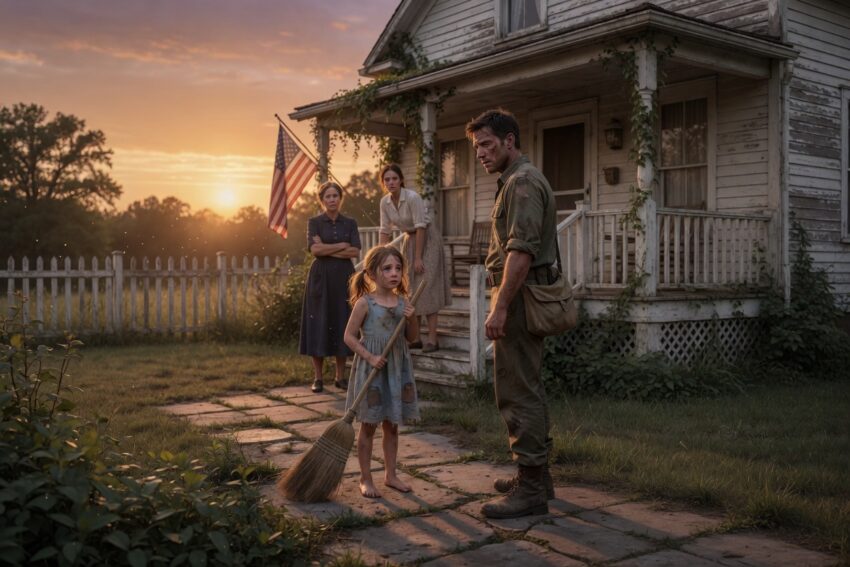
One golden evening a battered pickup pulled up. A frightened little boy stepped out with his parents. Nate opened the gate wider. Behind him Lillian stood on the porch, broom in hand, sweeping gently — not from fear, but because she loved the sound it made when people finally came home.
Every lost year, every hidden truth, every hard fight had led here: the child who once begged not to be sent away had grown into the keeper of a door that would never close on anyone again.
Disclaimer: This video and text is a fictional cinematic story created for entertainment purposes only. All characters and events are imaginary. It does not depict any real people or actual events.