The impact shuddered through the tempered safety glass.
Julian Mercer did not rattle the door handle like a father in the grip of blinding panic. He shook it like a landlord who had found an unauthorized tenant inside his property.
His knuckles struck the aluminum frame three times in rapid, measured succession.
Crack. Crack. Crack.
“Open the door,” Julian shouted through the narrow weather stripping. “Officer! Open this door immediately!”
Marcus did not move toward the entrance.
He stood behind the high laminate counter, his hand resting beside the telephone console, his body deliberately angled so that Julian could see only him.
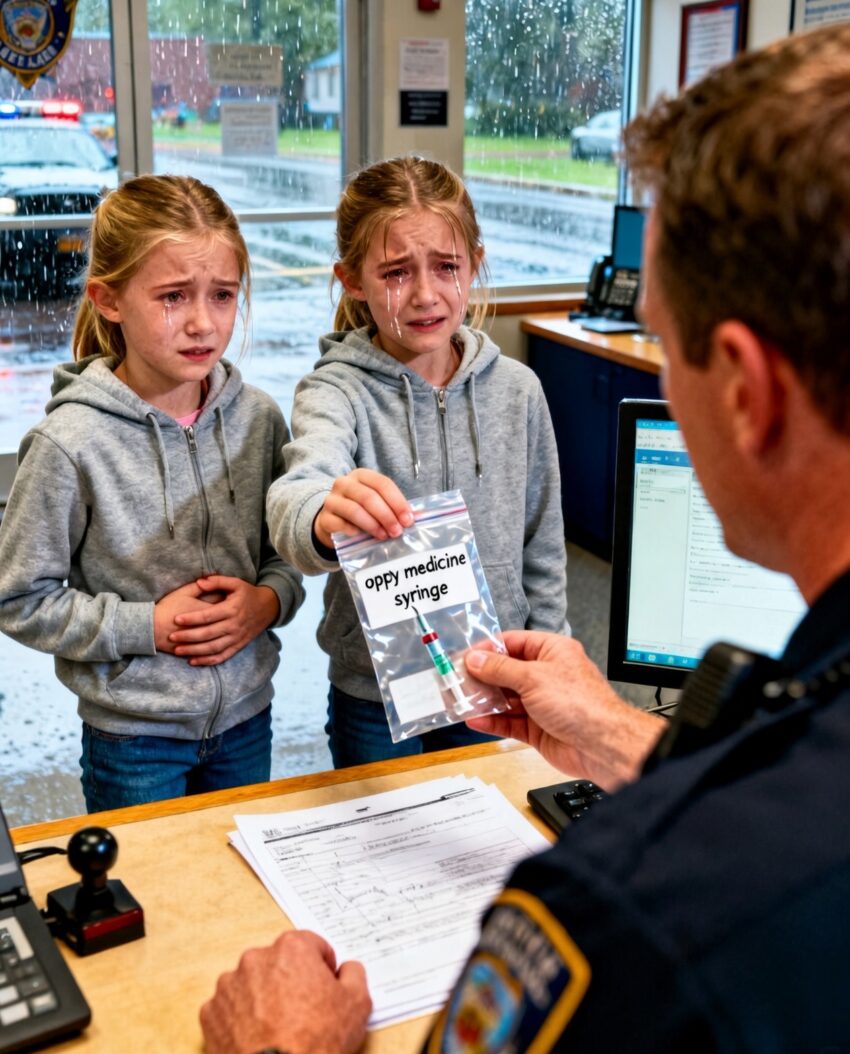
Behind the knee-well of the desk, tucked between the desktop computer tower and a stack of archived court binders, the two seven-year-old girls sat curled on an industrial fleece jacket Marcus had grabbed from his locker.
Claire had her forehead pressed against her knees. Her small hands were knotted into the fabric of her jeans, her knuckles pale, her breathing shallow and raspy.
Sophie sat with her back wedged firmly against the metal modesty panel of the desk, her arms wrapped around Claire’s shoulders like a living shield. Her socks were damp from the rain. One sneaker sat beside her; the other remained on her left foot, laces trailing in the dust.
Marcus looked down at them for a fraction of a second.
“Stay low,” he whispered, keeping his voice beneath the hum of the fan. “Do not move until I tell you.”
Sophie nodded once. Her eyes were dark, watchful, and terrifyingly unblinking.
Through the glass, Julian pulled his phone away from his ear and tapped the screen with an agitated thumb. He was wearing an expensive, tailored charcoal wool coat over navy scrub pants, with leather dress shoes that were now soaked with muddy curb water. A physician’s badge on a retractable lanyard hung clipped to his lapel, catching the harsh glare of the halogen parking lamps outside.
He raised his free hand and pressed his palm flat against the glass, leaning in until his breath fogged the surface.
“I am Dr. Julian Mercer,” he said, his voice muffled but sharp through the intercom speaker set into the wall. “My twin daughters are inside your lobby. They are medical minors under my sole legal care, and one of them is experiencing an acute psychiatric episode. Unlock this door right now.”
Marcus pressed the talk-back button on the console.
“Dr. Mercer, you need to step back from the glass and wait on the curb.”
“I will do no such thing,” Julian fired back instantly. “Do you have any idea what you’re doing? You are actively interfering with the medical management of a child. My daughter has a documented behavioral disorder. She requires immediate sedation and monitoring. I have her prescribed medication in my vehicle, and if she suffers complications because an uninformed desk officer wants to play hero, I will have your badge and your pension before the shift ends.”
The threat was delivered with smooth, clinical authority.
It was the voice of a man accustomed to having nurses jump when he clicked his tongue, a man who believed a professional license was an absolute shield against scrutiny.
Marcus kept his thumb on the button.
“Paramedics are already en route, Doctor. They are less than sixty seconds away. For everyone’s safety, you will remain outside until they arrive and assess the patient.”
Julian’s face tightened.
The color drained from around his nostrils, leaving two white creases in his sallow skin.
“Paramedics? On whose authority? I am her father, and I am a licensed physician! Cancel the dispatch! I am fully qualified to treat my own child!”
“The call is out,” Marcus said evenly. “Step away from the door.”
From behind the counter, a faint, metallic rustle broke the silence.
Sophie was shifting on her knees.
Marcus glanced down, lifting a cautionary hand, but the little girl wasn’t trying to run. She was pointing a slender, trembling finger toward the glass.
Marcus followed the line of her hand.
Julian was still standing at the door, but his left hand had dropped to his side. Clutched in his leather-gloved fingers was a bright pink nylon backpack with cartoon unicorns printed across the front pocket.
It was the kind of bag given to a second grader for their first day of elementary school.
“The front pocket,” Sophie whispered, her voice barely carrying over the rattling fan.
Marcus leaned down slightly. “What about it, Sophie?”
“That’s where he put the other tube,” she said, her chest hitching on a dry sob. “He had two of them on the kitchen counter. He gave Claire the one from the white box, and he put the other one inside her bag so the lady at the after-school program wouldn’t see it.”
Marcus felt the hair on the back of his neck prickle.
The initial pharmacy database check had returned a single dispensing transaction from an independent compounding pharmacy four miles west of the precinct.
Compounded oral suspensions were rarely prepared in solitary units; they typically came in matched sets or multi-dose regimens.
If Julian had a second pre-filled oral syringe in that child’s schoolbag, it meant this had not been an impulsive domestic accident. It was premeditated, measured, and packed for transport.
Down the boulevard, the low, pulsing growl of a siren cut through the rhythm of the rain.
Julian’s head jerked toward the sound.
He didn’t look relieved. He didn’t look like a parent waiting for medical salvation.
He looked cornered.
He took two quick steps backward toward his SUV, his eyes darting from the street corner back to the locked doors.
He reached toward the open driver-side window of his vehicle, his arm cocked to fling the pink backpack into the front footwell.
“Step away from the vehicle!” a voice barked from the darkness.
Officer Brody had arrived through the alleyway in patrol unit 104, cutting his lights before he entered the lot.
Brody had already cleared his cruiser door, his flashlight beam cutting through the rain and pinning Julian against the side panel of the black luxury SUV.
Julian froze, his hand hovering over the open window sill.
“Officer, this is an absurd misunderstanding—”
“Set the bag on the hood,” Brody instructed, keeping five paces of distance, his right hand resting loose near his service holster. “Both hands where I can see them. Do it now.”
Julian hesitated for one second too long. His jaw clenched, his eyes calculating the distance between Brody, the precinct doors, and his keys.
Then, with an exaggerated sigh of aristocratic boredom, he tossed the backpack onto the wet hood of the SUV and held up his palms.
“This is outrageous,” Julian declared, his voice carrying clearly across the tarmac. “I am a respected member of this community. My children wandered off while I was retrieving their coats. I track them here, and I am treated like a street criminal by two patrolmen who clearly lack basic reading comprehension.”
At that moment, the ambulance turned into the lot, its roof lights casting sweeping ribbons of crimson and amber across the rain-slicked pavement.
The ambulance bypassed the front entrance entirely, following the reflective signs toward the secure sally port on the building’s south flank.
Marcus keyed his radio. “Brody, keep him secured at the vehicle. Do not let him access that bag or his phone. I have the children in the administrative office.”
“Copy that, Marcus. Subject is detained for field investigation.”
Marcus turned the deadbolt on the station’s side security door, admitting two paramedics who wheeled a folding stretcher through the double doors.
The lead paramedic, Rachel Torres, was an eight-year veteran with tired eyes and a brisk, reassuring efficiency. Her partner followed with a pediatric jump bag and a portable cardiac monitor.
“Where’s our patient?” Rachel asked, shaking the rainwater from the brim of her cap.
Marcus pointed toward the recess behind the counter.
“Seven-year-old female. Acute onset abdominal cramping, severe lethargy, pale, diaphoretic. She was administered an unknown liquid medication via an oral syringe approximately thirty minutes ago. The syringe was recovered.”
Rachel’s brow furrowed. “Recovered from where?”
Marcus pointed toward the counter, where the white envelope sat beside the printed transaction log.
“Recovered from her twin sister’s shoe,” Marcus said quietly. “The sister hid it under her insole before running six blocks through the rain to get here.”
Rachel stopped. She looked from Marcus to the small envelope, then down to the floor where the two small shapes were huddled together.
Her face hardened into that professional mask healthcare workers wear when they realize they are looking at something monstrous.
“Understood,” Rachel said softly.
She dropped to both knees on the linoleum, setting her jump kit down with a muted click.
“Hi there, sweetheart,” Rachel said, keeping her voice warm, musical, and completely unhurried. “My name is Rachel. I’m an EMT. Can you tell me your name?”
Claire didn’t lift her head. She only let out a ragged, trembling breath that ended in a wheeze.
Sophie squeezed her tighter. “Her name is Claire. I’m Sophie.”
“Hi, Sophie,” Rachel said, smiling gently while her fingers found Claire’s wrist, checking the radial pulse. “You’ve done an amazing job looking after your sister today. Truly amazing. But I need to take a quick peek at her tummy, okay? Can she sit up for me?”
“It hurts when she sits,” Sophie said, her voice cracking. “She said it feels like hot water inside her.”
“Okay, no sitting. We’ll keep her right where she is,” Rachel murmured.
She pulled a pediatric stethoscope from her pocket, warmed the diaphragm against her palm, and gently slipped it beneath Claire’s damp gray hoodie.
Rachel’s eyes moved slightly, tracking the wall clock, counting the beats.
“Pulse is ninety-two, thready. Respirations are shallow, twenty-four. Pupillary response is sluggish, approximately two millimeters.”
Rachel looked up at Marcus. “Her belly is rigid. Involuntary guarding across the epigastric quadrant. Whatever she took, her stomach is reacting to it violently.”
“Did he poison her?” Sophie asked.
The question was so stark, so devoid of childlike metaphor, that the entire room seemed to lose its air.
Rachel didn’t flinch. She met Sophie’s terrified eyes with complete, unshakeable honesty.
“We are going to make sure that doesn’t happen, Sophie. That’s why we’re here. We are going to take her to the big hospital where the doctors have the right medicine to clean her tummy out. But I need to know: did you see the bottle this came from?”
Sophie shook her head. “It wasn’t a bottle. It was a big glass cup with a silver lid. Daddy had white powder on a little spoon, and he poured sweet water from the fridge into it and stirred it up with a plastic knife. He told Claire it was strawberry medicine for her brain.”
“Did he give you any, Sophie?” Rachel asked, her hand resting gently on the child’s knee.
“He tried to,” Sophie whispered, her chin dropping toward her chest. “He said good girls drink their medicine without crying. But I saw Claire make a face like she was going to throw up, and when he walked to the sink to get a paper towel, I spilled my cup down the heater grate in the dining room.”
Marcus felt a cold shudder run down the length of his spine.
This seven-year-old child had possessed the razor-sharp survival instinct to dump a poisoned drink down a heating vent, watch her father force her sister to swallow his concoction, retrieve the discarded applicator from the kitchen wastebasket, stash it beneath the footbed of her sneaker, and guide her sick twin out a side door while their father’s back was turned.
“Did you take anything at all, Sophie?” Rachel pressed. “Even a tiny sip?”
“No. It smelled like vinegar. Claire cried because it burned her throat, and Daddy pinched her nose until she swallowed.”
Claire let out a sharp, gasping sob against the floor, her small shoulders heaving.
“I tried to spit it, Sophie,” Claire whimpered, her voice muffled against her jeans. “I tried, but he held my mouth shut.”
“I know, Sissy,” Sophie whispered, stroking her sister’s wet hair. “I know. You’re at the police place now. The policeman has a gun. Daddy can’t come in.”
Marcus stepped back toward the side door, feeling an overwhelming, protective instinct that made his fingers tingle against his duty belt.
He opened the door just wide enough to signal Brody.
“Brody, bring that pink bag in here. Use gloves.”
Brody nodded, retrieved the bag from the hood of the SUV where Julian was still pacing under the watch of a third responding officer, and brought it through the secure entryway.
The backpack was damp, smelling of cheap synthetic fabric and rainwater.
Marcus laid a sterile paper runner across the intake counter and snapped on a pair of blue nitrile gloves.
He unzipped the front pouch.
Inside was a half-eaten packet of fruit snacks, a broken blue crayon, a small plastic hair clip shaped like a butterfly, and a bundle of brown commercial paper towels, identical to the ones used in medical clinic restrooms.
Marcus carefully unwrapped the paper towels.
Inside lay a second oral dosing syringe, sixty-milliliter capacity, identical to the one Sophie had pulled from her shoe.
It was capped with a rubber stopper, but unlike the first one, this syringe was not empty.
It was filled to the thirty-milliliter mark with a cloudy, viscous pink suspension that had begun to separate into two distinct layers: a thick, chalky sediment at the bottom and a pale, yellowish fluid floating on top.
Tucked beside the plunger was a torn strip of thermal adhesive paper—the remnants of a prescription label.
The patient name had been ripped away with deliberate force, taking the top third of the print with it.
The physician line was intact: Julian Mercer, MD – Lic. #44091-B.
The date was stamped: Today, 13:45.
The directions read: Administer 15ml via oral suspension as directed for sedation prior to procedure.
And beneath that, the drug name remained visible through the ragged tear:
CHLORAL HYDRATE COMP. SUSP. 500mg/5ml.
Rachel glanced up from the floor, her eyes widening as she read the chemical name across the counter.
“Chloral hydrate?” she hissed under her breath. “A compounding dose of chloral hydrate? That hasn’t been standard pediatric practice in twenty years! It’s a profound central nervous system depressant. If that child has fifteen hundred milligrams of unbuffered sedative in her stomach, she could stop breathing within an hour.”
“Get her to Children’s Memorial,” Marcus said, his voice flat, dangerously calm. “I will sign the emergency protective transport order right now.”
“Sophie comes with us,” Rachel said, already lifting Claire into her arms with practiced, maternal strength.
Claire let out a weak cry as her abdomen shifted, her head lolling back against Rachel’s shoulder. Her lips had taken on a faint, dusky blue tinge.
“Sophie rides in the captain’s chair right beside her,” Marcus agreed. “I’m escorting you in my patrol vehicle. Brody will transport Julian to interrogation room two.”
As Rachel carried Claire through the secure corridor toward the ambulance bay, Sophie scrambled to her feet, hopping on one sneaker while she tried to shove her right foot back into the damp shoe with the crumpled insole.
Marcus knelt before her.
He didn’t rush her. He took the wet laces in his gloved fingers, smoothed the tongue of the shoe, and tied a double knot with steady hands.
“You’re doing great, Sophie,” he said softly, looking into her exhausted, wide eyes. “You saved your sister’s life today. Do you hear me? You saved her.”
Sophie looked down at her tied sneaker.
“Is Daddy going to jail?”
“Your daddy is not going to touch either of you ever again,” Marcus said. “That is a promise from me to you.”
Sophie’s chin quivered, but she didn’t cry. She reached out and touched the brass badge pinned to Marcus’s chest, her tiny fingers brushing against the cold metal.
“Okay,” she whispered.
Five minutes later, the ambulance cleared the sally port, its high-low sirens echoing between the brick facades of the municipal district.
Marcus pulled his cruiser out directly behind them, his light bar painting the sodden trees and storefronts in violent flashes of blue and white.
In the rearview mirror of the transport cruiser behind them, Julian Mercer was being led through the heavy steel rear doors of the precinct in handcuffs, his expensive coat soaked, his face twisted in silent, impotent fury as the rain poured down upon his bare head.
Children’s Memorial Hospital smelled of antiseptic floor wax, warm plastic tubing, and industrial laundry detergent.
The pediatric emergency department had cleared trauma bay three before the ambulance wheels even stopped rolling in the bay.
A team of six—two doctors, three nurses, and a respiratory therapist—swarmed Claire the moment the stretcher hit the threshold.
Marcus stood just outside the sliding glass doors of the trauma bay, his uniform still damp, his service cap tucked beneath his arm.
Protocol required him to maintain custody of the physical evidence—the two sealed envelopes containing the syringes and the torn label—until the hospital’s forensic lockbox could be accessed and the crime scene investigator arrived.
Inside the bay, the clinical choreography was swift and merciless.
“Claire, honey, can you hear me?” a pediatric attending physician, Dr. Sarah Vance, asked as she shone a penlight into the little girl’s eyes.
Claire offered only a sluggish moan. Her eyelids fluttered, showing only the whites of her sclera.
“Pupils are two millimeters, sluggishly reactive,” Dr. Vance announced to the room. “Get her on four liters via nasal cannula. I need an eighteen-gauge IV in the left antecubital, draw a full toxicological panel, comprehensive metabolic profile, arterial blood gases, and liver function enzymes immediately.”
A nurse quickly sliced through the fabric of Claire’s gray hoodie with trauma shears, peeling away the damp cotton to expose her small chest.
Telemetry patches were slapped onto her pale skin, the heart monitor instantly chiming with a hollow, erratic beep: 88… 84… 81…
“Sinus bradycardia,” the nurse called out. “Blood pressure is eighty over forty-eight.”
“She’s dropping,” Dr. Vance said, her voice tightening. “Let’s prep for gastric lavage. We need to evacuate that gastric contents before the pyloric sphincter dumps the rest of that chloral hydrate into the duodenum. Get the charcoal suspension ready.”
From a plastic chair positioned against the hallway wall, Sophie watched through the plate glass.
She had refused to sit on the examination bed in room four. She had refused juice. She had refused a fleece blanket with cartoon bears on it offered by a social worker.
She sat on the hard vinyl chair, her feet dangling four inches above the floor, her hands gripping the edges of the seat so hard her fingers were translucent.
“They’re hurting her,” Sophie whispered as she saw the nurses insert a clear plastic nasogastric tube through Claire’s nose.
Claire gagged, her back arching in a desperate, reflexive spasm as two nurses held her shoulders still.
Marcus stepped over and sat in the chair beside Sophie, his large frame dwarfing the plastic furniture.
He didn’t offer a platitude. He didn’t tell her not to look.
He understood that for a child who had survived by vigilance, being forced to look away was its own kind of terror.
“They’re taking the bad medicine out of her tummy, Sophie,” Marcus said, his voice deep and steady. “It feels uncomfortable, and it looks scary, but it’s the only way to make sure the sleepiness doesn’t get into her lungs.”
Sophie watched as a large plastic syringe attached to the nasogastric tube pulled back a cloudy, dark fluid tinted with the sickly pink hue of the compounded syrup.
“He told her it was candy,” Sophie whispered, her gaze locked on the fluid. “He said if she drank it all without spilling, he would take us to the carousel at the mall this weekend.”
“Did he say why she needed it?”
Sophie shook her head slowly.
“Claire has bad dreams sometimes. She wakes up crying because she misses our mother. And when Claire cries, Daddy gets that face. The face where he doesn’t blink.”
Marcus took out his small pocket notebook, clicking his pen with his thumb.
“What happened to your mother, Sophie?”
“She went away two years ago,” the little girl said, her voice dropping into a rhythmic, mechanical cadence, as if reciting a poem she had been forced to memorize under duress. “Daddy told the judge that Mommy was sick in her head and couldn’t be a mommy anymore. The judge said Daddy got to keep us in the big brick house so we could have a stable environment.”
She paused, her fingers picking at a loose thread on the knee of her jeans.
“Mommy cried at the courthouse. She told us she would write letters every week. But Daddy threw all the letters into the fireplace in the living room. He made us watch them burn. He said letters from crazy people make children crazy too.”
Marcus felt a cold weight settle in his gut.
Julian Mercer hadn’t just drugged his daughter; he had methodically isolated these children from every potential lifeline, gaslighting the family court system with his professional credentials, constructing an inescapable domestic panopticon behind the manicured hedges of an affluent suburban neighborhood.
Inside the bay, the monitors shifted pitch.
The harsh, erratic chiming settled into a more rhythmic, stable cadence.
Dr. Vance emerged through the sliding glass doors, stripping her blue gloves off and tossing them into the biohazard bin with a heavy sigh.
She wiped a strand of hair from her forehead, her gaze landing on Marcus.
“Officer Cole?”
Marcus stood up. “How is she?”
“We pumped approximately two hundred milliliters of gastric fluid with heavy sediment,” Dr. Vance said, glancing down at Sophie with an expression of profound, aching tenderness. “We followed it with fifty grams of activated charcoal. Her oxygen saturation is back up to ninety-seven percent on room air, and her heart rate is stabilizing in the low nineties.”
Dr. Vance crouched down in front of Sophie, resting her hands on her own knees.
“Your sister is going to sleep for a long, long time, Sophie,” the doctor said gently. “Probably until tomorrow afternoon. But she is going to wake up. Her tummy is clean, her heart is strong, and she is going to be completely okay.”
Sophie stared at the doctor’s name tag for several seconds.
“Can I hold her hand now?”
“Yes,” Dr. Vance said, a small, genuine smile breaking across her tired face. “You can hold her hand as long as you want.”
Sophie didn’t hesitate. She slid off the vinyl chair and walked into the trauma bay with measured, quiet steps.
She pulled a rolling stool over to the edge of the high hospital bed, climbed up, and took Claire’s limp, tape-wrapped hand in both of hers.
Claire’s face was smeared with charcoal residue at the corner of her mouth, and a clear cannula ran into her small nostrils, but her chest was rising and falling with deep, natural breaths.
Marcus watched them from the doorway for a long moment before his radio clicked.
“Unit 102, dispatch,” the voice crackled. “Captain Reynolds requests your immediate return to station. Detective Evelyn Ward from Special Victims is on scene. Interrogation of the suspect is scheduled to commence.”
Marcus adjusted his belt, looked once more at the two little girls on the hospital bed, and keyed his mic.
“Unit 102, copy. En route.”
The interrogation room in the basement of the fourth precinct was designed to strip a person of their illusions.
There were no windows.
The walls were painted a dull, sickly institutional green that seemed to absorb light rather than reflect it.
The table was made of welded sheet steel bolted directly into the concrete subfloor, flanked by three utilitarian metal folding chairs.
Julian Mercer sat on the far side of the table.
He had removed his soaked wool coat, leaving him in his navy scrub top. The arrogance had not left him; it had simply crystallized into an icy, contemptuous silence.
Beside him sat his attorney, Arthur Vance—a high-priced criminal defense litigator with silver hair, cufflinks the size of silver dollars, and a monogrammed leather briefcase resting on the table.
Detective Evelyn Ward sat across from them.
Evelyn was fifty-two years old, with short-cropped iron-gray hair, sharp hazel eyes, and thirty years of investigative experience that had stripped her of any tolerance for professional posturing.
Marcus entered quietly through the heavy steel door, pulling a chair into the corner of the room to observe.
Julian didn’t look at Marcus. He kept his eyes fixed on Evelyn, his fingers steepled beneath his chin in a posture of refined condescension.
“Let me make something abundantly clear, Detective,” Julian’s attorney began, tapping an index finger against his legal pad. “My client is a board-certified pediatric surgeon with over fifteen years of exemplary service at St. Jude’s. He has zero criminal record. What we have here is an unconscionable overreach by an overzealous patrol officer who misconstrued a standard, benign domestic parenting difficulty.”
Evelyn didn’t blink. She opened a manila folder on the table, revealing three high-resolution color photographs.
The first was the clear oral syringe recovered from Sophie’s shoe, photographed against a measurement grid.
The second was the second oral syringe recovered from the pink unicorn backpack, showing the separated pink suspension.
The third was a certified digital copy of the compounding pharmacy record, highlighted in yellow.
“Mr. Vance,” Evelyn said, her voice smooth and devoid of inflection, “your client does not hold pediatric psychiatric credentials. He does not hold a valid certification in outpatient sedation management. Yet at one-forty-five this afternoon, he entered Mercer Compounding Pharmacy—a business owned by his first cousin—and personally ordered thirty milliliters of concentrated chloral hydrate under the name of an adult patient who died six months ago in his surgical recovery ward.”
Julian’s fingers tightened against each other, his knuckles whitening slightly.
The attorney didn’t flinch. “A clerical error on the pharmacy’s intake system. Dr. Mercer was preparing an educational demonstration for his surgical residents on historic sedative protocols.”
“Is that why he forced fifteen milliliters of it down his seven-year-old daughter’s throat?” Marcus asked from the corner.
Arthur Vance swung around, his face reddening. “Officer Cole, you are here as an observer! Keep your mouth shut before I have you cited for procedural misconduct!”
“Answer the question, Julian,” Evelyn said, leaning across the table, her eyes drilling into the physician. “Why did your daughter need fifteen hundred milligrams of a veterinary-strength sedative on a Tuesday afternoon?”
Julian closed his eyes for three seconds. When he opened them, the veneer of aristocratic calm had cracked, revealing the raw, venomous fury simmering beneath.
“You people have no idea what my life is like,” Julian hissed, his voice dropping into a low, vibrating register. “You sit in your little municipal cubicles and pass judgment on people who actually contribute to society! For two years, I have maintained that household alone! I work eighty hours a week saving other people’s wretched children, and I come home to chaos!”
“Julian, be quiet,” his attorney warned, reaching for his client’s arm.
Julian shrugged the lawyer off with a violent twitch of his shoulder.
“Claire is defective!” Julian snarled, his eyes bulging with manic intensity. “She has the same histrionic, manipulative rot that her mother had! She screams in the night! She throws tantrums because she wants her clothes folded a certain way! She refused to put her coat on today because the zipper touched her throat! She was hysterical, shrieking like a wounded animal in my foyer!”
“So you medicated her,” Evelyn said, her pen scratching across her pad.
“I calmed her down!” Julian barked, slamming his open palm against the steel table. The sound cracked through the small room like a shot. “I administered a therapeutic dose of an effective sedative so that I could have forty-five minutes of civilized silence to review surgical charts! It was a controlled pharmacological intervention! I am a doctor! I have the right to determine what enters my children’s bodies!”
“And Sophie?” Marcus asked quietly. “Why was there a second dose in her schoolbag?”
Julian sneered, his lip curling in utter disgust. “Because Sophie is the instigator. Sophie is the one who whispers in her ear. Sophie tells her not to eat. Sophie tells her to hide things. Sophie watched me prepare the dose, and she had that insolent, dead-eyed stare that her mother used to give me. I wasn’t going to spend my evening dealing with two of them. I was going to give Sophie her dose in the car on the way to the after-school program.”
The silence that followed was suffocating.
Arthur Vance closed his legal pad with a dull snap. He looked down at the table, his face ashen, realizing that his client had just dictated a full, unvarnished confession to premeditated felony child abuse and chemical endangerment into two operating digital recording devices.
“Julian,” the attorney whispered, sounding exhausted. “Stop talking.”
Julian looked around the room, breathing heavily through his nose, suddenly realizing what he had surrendered.
His eyes darted to Marcus in the corner, catching the look of absolute, unyielding condemnation on the officer’s face.
“They are my property,” Julian muttered, though the conviction had begun to bleed out of his voice, replaced by the hollow realization of his own ruin. “The court gave them to me. You can’t take them.”
Evelyn Ward stood up, sliding the photographs back into the file.
“Dr. Mercer,” she said, her voice dripping with ice. “You are under arrest for two counts of aggravated child abuse with a dangerous substance, two counts of chemical endangerment of a minor, one count of prescription fraud, and one count of tampering with evidence. You will not be seeing your daughters tonight. You will not be seeing them for a very long time.”
She looked at Marcus.
“Get him down to central booking, Officer Cole. Put him in a suicide gown. I don’t want him using his scrub ties to cheat the state out of a trial.”
The legal dismantling of Julian Mercer was swift, surgical, and devastating.
Within forty-eight hours of his arrest, a joint task force comprising the State Medical Board, the Drug Enforcement Administration, and the Special Victims Unit executed a search warrant on his residence on Oakridge Manor.
What they found turned a horrific domestic crime into an institutional scandal.
Beneath the false bottom of a gun safe in Julian’s private library, investigators recovered twenty-four pre-printed, blank prescription pads bearing the stolen DEA registration numbers of three retired colleagues.
They found six multi-dose vials of pharmaceutical-grade liquid sedatives, paralytics, and anti-nausea agents.
Most damning of all, they discovered the unopened letters.
Stacked neatly in chronological order inside an accordion file in his desk drawer were seventy-two letters addressed to Sophie and Claire Mercer.
They were postmarked from a small town in southern Oregon.
They were written on yellow legal paper, filled with pencil drawings of horses, pressed wildflowers, and the steady, desperate love of a mother who had spent two years fighting through rigged custody evaluations, bankrupting herself on legal retainers, believing her daughters had forgotten her.
Julian had documented every letter in a private leather ledger, noting the dates they arrived and writing brief, chilling annotations in the margins:
October 14: Another pathetic attempt at contact. Destroyed.
January 3: Mother sent birthday ribbons. Discarded in furnace.
May 22: Inquired about Claire’s asthma. Irrelevant. The children are mine.
When Detective Ward placed an international call to the Oregon telephone number listed on those envelopes, the woman who answered dropped the phone.
Her name was Hannah Mercer.
She had lived in a one-bedroom apartment, working two jobs as a veterinary technician, saving every dollar to file a jurisdictional appeal.
She arrived at the precinct forty-eight hours later on an emergency flight arranged through the county victim assistance fund.
Marcus was in the precinct breakroom when Hannah arrived.
She did not look like the unstable, chaotic figure Julian had painted in his court filings.
She was thin, with tired, kind eyes that carried the permanent hollow of prolonged grief, wearing a thrift-store coat that was far too light for the eastern winter.
When Evelyn Ward escorted her into the child advocacy family room where Sophie and Claire were waiting with their court-appointed foster advocate, Marcus watched from the open doorway.
Claire was sitting up on a low sofa, a warm cup of apple juice balanced between her knees, her color fully restored.
Sophie sat beside her, still wearing the gray hoodie, still watching the doorway with that guarded, ancient caution that had broken Marcus’s heart two days earlier.
Hannah stopped at the threshold.
She didn’t run. She didn’t scream.
She dropped to her knees right there on the commercial carpet, her hands flying to her mouth, tears spilling silently down her cheeks.
“Hi, my babies,” Hannah choked out, her voice trembling like a reed in the wind. “Hi.”
Claire blinked, her mouth opening in shock. “Mommy?”
Sophie didn’t speak.
She rose from the couch slowly, as if testing whether the image before her was made of glass that might shatter if she moved too fast.
She walked across the room, stopped two feet from Hannah, and reached out one small, hesitant hand.
Her fingers brushed her mother’s wet cheek.
“Daddy said you forgot where we lived,” Sophie whispered.
Hannah seized both of Sophie’s hands, pressing them against her heart, kissing her knuckles over and over until her own breath hitched.
“I never forgot,” Hannah sobbed, pulling both girls into her chest as Claire scrambled off the sofa to join them. “I looked for you every single sunrise. Every single one. I wrote you every week, my darlings. I never stopped looking for you.”
Sophie’s arms finally went around her mother’s neck.
And there, pressed into the worn wool of her mother’s thrift-store coat, the seven-year-old girl who had walked six blocks through the rain, who had stood before armed police officers without blinking, who had stared down her father’s rage through a sheet of glass, finally allowed herself to become a child again.
Sophie buried her face in her mother’s shoulder and wailed.
It was a deep, guttural, cleansing cry—the sound of an iron gate swinging open after years of darkness.
Marcus quietly pulled the door shut, turned his back to the glass, and wiped his eyes with the sleeve of his uniform.
Six months later, the spring sun was warm against the granite steps of the fourth precinct.
The azaleas planted along the municipal walkway were blooming in deep shades of crimson and white, and the smell of wet asphalt had been replaced by the sweet, dusty breeze of early May.
Julian Mercer had entered a guilty plea to two counts of first-degree felony child abuse and four counts of aggravated prescription fraud, accepting a negotiated sentence of eighteen years in the state correctional institution without the possibility of parole for the first twelve.
His medical license had been permanently revoked by an emergency session of the state board.
The house on Oakridge Manor had been seized under civil asset forfeiture to fund a permanent medical and psychological trust for his daughters.
Hannah had been granted sole legal and physical custody by an emergency family court decree, and the three of them had relocated permanently to a small farmhouse outside of Eugene, Oregon, surrounded by green pastures and Douglas firs.
Marcus was sitting at the front desk, clearing the afternoon shift logs, when the front glass doors swung open.
The chime rang once.
Marcus looked up, his hand automatically reaching for his pen.
Two little girls walked through the entrance holding hands.
They were dressed in bright yellow sundresses with denim jackets, their hair clean, shining, and pulled back in colorful ribbon braids.
They were walking upright, laughing at some private joke, swinging their joined hands between them like a pendulum.
Behind them stood Hannah, looking rested, her face radiant with a peaceful, quiet strength.
“Officer Cole?” Sophie called out, her voice bright, clear, and ringing across the high ceiling.
Marcus pushed his chair back and stood up, a massive, genuine smile breaking across his face.
“Well, look who it is,” he said, coming around the partition without hesitation. “Miss Sophie. Miss Claire. What are you two doing back in my precinct?”
Claire ran forward first, wrapping her arms around Marcus’s waist, burying her face into his utility belt before looking up with sparkling brown eyes.
“We came to return something,” Claire said proudly.
Hannah stepped forward, extending a clean, freshly laundered police department fleece jacket—the one Marcus had tucked around them on the floor of the dispatch station six months ago.
“We had it dry-cleaned,” Hannah said, her eyes shining with unspeakable gratitude. “The girls insisted on carrying it all the way from Oregon on the plane themselves.”
“Thank you, Hannah,” Marcus said, taking the jacket and setting it on the counter.
Sophie didn’t run. She walked up to Marcus with that same deliberate, thoughtful dignity she had possessed on that freezing October afternoon.
She reached into the pocket of her denim jacket and pulled out a folded piece of heavy white paper.
“This is for your desk,” Sophie said, handing it to him.
Marcus unfolded the paper carefully.
It was a drawing done in colored wax crayons.
It depicted the front of the police station with its heavy glass doors.
Behind the doors stood two small stick figures in yellow dresses.
Standing in front of the doors, tall and broad-shouldered, was an officer in a navy uniform with a bright golden star on his chest, holding up a giant, cartoonish shield that blocked out a dark storm cloud raining over a black car.
Above the two girls, Sophie had written in wobbly, second-grade lettering:
THE DOOR STAYS LOCKED.
Marcus looked down at the drawing for a long time, his throat tightening with an emotion so fierce it made his chest ache.
“This is the finest piece of evidence I have ever seen, Sophie,” Marcus said, his voice husky. “I’m going to frame it and hang it right above my computer terminal.”
Sophie smiled—a wide, brilliant, carefree smile that reached all the way to her eyes.
She looked down at her feet.
She was wearing a pair of brand-new, clean white canvas tennis shoes decorated with hand-drawn smiley faces and rainbow stars along the rubber soles.
Marcus noticed the shoes. He knelt down so that he was looking straight into her face.
“Those are pretty fancy shoes you’ve got there, Sophie,” he said gently.
Sophie wiggled her toes inside the canvas, letting out a bright, musical giggle that echoed off the institutional walls where so much sorrow had passed.
“Mommy helped me pick them out,” Sophie said proudly. “The insoles are glued down super tight with special purple glue.”
She looked at Marcus, her eyes steady, clear, and entirely free of shadows.
“I don’t have to hide anything in my shoes anymore, Officer Marcus,” she said softly. “Because nobody checks my pockets anymore.”
Marcus reached out, his big hand resting gently on her small shoulder.
“No, they don’t, Sophie,” Marcus told her. “Never again.”
Outside, the afternoon sun broke through the high spring clouds, pouring through the polished glass doors of the station, washing across the clean linoleum where two little girls had once huddled in terror, transforming the dark, forgotten corners of the room into brilliant, golden light.
This story is a work of fiction created solely for entertainment purposes. Any resemblance to real persons, living or dead, actual events, locales, medical cases, or legal proceedings is purely coincidental.