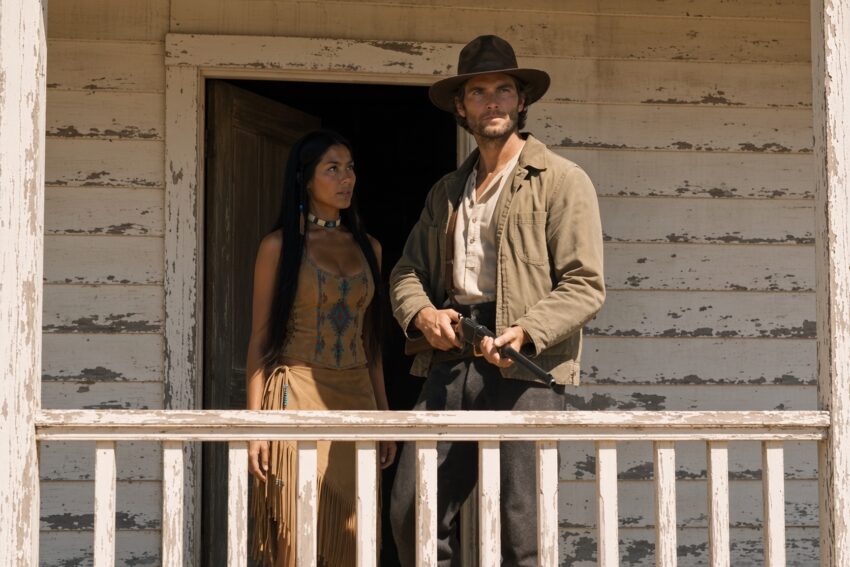
LONELY RANCHER “BUYS” THE LAST APACHE WOMAN — WHAT HE DID NEXT SHOCKED THE ENTIRE FRONTIER
Chapter 1
The heat hanging over the dusty square of Agua Fría did not simply rise; it settled like tallow, heavy and foul with the scent of horse sweat, alkali dust, and unwashed flannel. It was a harsh, blinding glare that burned away every scrap of shade, stinging a man’s eyes long before noon. At the center of the trading outpost stood the auction platform, four heavy cedar timbers hauled down from the Mogollon Range twenty years earlier, their rough edges worn flat by the iron-heeled boots of men trading cattle, pack mules, and broken freight wagons. On this particular afternoon, however, the platform held something far different.
“Take a good look at her!” the auctioneer roared, his brassy voice cutting through the sluggish air like the crack of a bull w.h.i.p.
His name was Grady Cole, a thick-necked man in a sweat-stained wool coat despite the furnace heat of the midday sun. He jammed the rounded end of his notched hickory stick against the small of the young woman’s back.
“The last full-blooded Apache woman left between here and the San Francisco River! Broad back! Sound teeth! Look at that stare—she’s got plenty of fight left, but three days behind a team of oxen will break that clean!”
A low chuckle rippled through the gathering of fifty or sixty men who had drifted over from the livery stables and the mercantile porch. They were rough men with sunburned throats, greasy rawhide vests, and heavy revolvers riding low at their thighs—teamsters, prospectors down from the canyon digs, and dry-scrub homesteaders who measured a human life strictly by how much field labor it could turn.
The woman stood motionless. Her wrists were bound tight before her with greasy hemp twine, the coarse yellow fibers digging so deep into the flesh that her fingers had puffed up, cold and discolored. Dark, stiff crusts of dried b.l.o.o.d marked the left seam of her buckskin tunic, caked with clay until they showed like dried rust. Her coal-black hair hung in thick, dusty strands around high cheekbones that looked chipped from dark river flint.
She never dropped her gaze. She never gave an inch to the hickory cane Cole kept grinding into her ribs. Her dark eyes, black as wet obsidian, tracked slowly across the sea of sweat-stained brimmed hats, fixing on nobody and conceding nothing.
“Eighty-five dollars!” called a raspy voice from under the shade of the wheelwright’s shed. It was Frank Mercer, a man scraping a living off four hundred rocky acres north of the dry wash. “She looks sturdy enough to clear timber!”
Cole turned hard, his heavy boot stomping against the cedar planks. “Eighty-five from Mercer! Who makes it ninety-five? Look at those shoulders! She’ll swing an axe from frost to thaw and never ask for a single penny! Ninety-five!”
A freight driver leaning against the hitching post threw up an arm. “Ninety-five!”
“One hundred and five!” Cole swept his stick toward the center of the yard. “One hundred and five dollars for the last of the red d.e.v.i.l.s! Built for the bitterest work you can give her! Who’s taking her? Who’s man enough to break that wild iron in her?”
The men grinned, spitting dark streams of tobacco juice into the gray powder beneath their boots. To them, she was not a soul with a family, a kinfolk’s camp, or a name. She was merely an oddity, an unclaimed piece left behind from the savage, b.l.o.o.d.y raids that had burned through the southern foothills—treated no different than an unbroken pack mule that might outlast a drought if you tossed it enough crushed oats and a pail of muddy water.
At the far edge of the gathering, sitting motionless atop a lean roan gelding, was Jesse Brand.
He had not ridden into Agua Fría to bid on a single thing. His saddle pouch held only a short list: fifty pounds of rock salt, two boxes of brass rifle cartridges, and fifty feet of braided fence wire. His saddlebags were flat, and the silver coins in his pocket were fewer still. He was forty-one years old, though the hard seasons and dry prairie winds had carved deep creases around his temples, making him look closer to fifty. His dark beard was trimmed short, threaded with gray at the jawline, while his wide brim sat low across his brow to shield his pale slate eyes from the punishing glare.
For seven years, Jesse Brand had lived six miles west of town in a solitary, rough-hewn log cabin nestled against the red sandstone bluffs. He was a man who spoke only when the silence grew too heavy, and even then, he spoke with few words. A brutal winter fever had taken his wife, Sarah, during their second spring along the creek, burying her under four feet of shale beneath a lone cottonwood. Barely fourteen months later, a grease-stained letter from a field surgeon in Virginia informed him that his younger brother, Luke, had d.i.e.d in a flooded trench outside Petersburg, buried in a mass trench he would never lay eyes upon.
Since that hour, Jesse had stepped back from the world. He harbored no hatred toward men; he simply found no purpose among them. He tended nine head of drought-hardened cattle, mended his cedar fences with his own hands, chewed cold jerky and boiled beans from a cast-iron skillet, and watched the cold southern constellations drift across the black New Mexico sky without caring what lay past the ridge. Grief had not k.i.l.l.e.d him, but it had drained the color from his life, reducing his days to a quiet, endless wait for an end he had no desire to rush.
He had observed the auction with a numb, distant disgust, the same sickness that gripped his gut whenever he watched a wounded wolf baited by town dogs. But as Cole hollered “One hundred and five dollars,” Jesse’s gaze shifted from the auctioneer’s glistening jowls directly to the woman upon the timber platform.
She had not flinched when the teamster threw out his bid. Yet when Cole’s stick rapped against her hipbone, her chin lifted half an inch higher. Her bare soles dug into the sun-split cedar, her knees locked straight, her spine upright despite the harsh bite of the cords binding her arms. There was no trace of terror in her face—only a cold, unbreakable defiance that refused to belong to the wood beneath her feet or the men shouting prices for her flesh.
You can bind my hands, those pitch-black eyes seemed to declare to the dust. But you will never own me.
Something inside Jesse Brand snapped clean through. It was not a sudden flood of righteous heroism, nor pity. It was a sharp, ice-cold fury—the sudden knowing that if he sat there and watched this take place without stepping forward, the last quiet remnant of his soul would rot away in the saddle where he sat.
He swung his boot over the cantle and dropped down from the roan. His spurs clicked with hard, steady cadence against the stone and gravel as he pushed through the circle of onlookers toward the platform.
“One hundred and five once!” Cole bellowed, raising his stick. “One hundred and five twice—”
“I’ll take her,” Jesse said.
His voice was quiet, yet it fell across the yard with the finality of an iron gate slamming shut. The coarse laughter instantly dried up. The teamsters squinted through the heat haze. Cole froze mid-motion, his hickory cane paused in the air, his heavy mouth hanging slightly ajar.
“Jesse Brand?” Cole rasped, leaning over the rail. “You don’t need no hand out on that rock pile, Jesse. You can barely keep bacon in your own skillet.”
“I said I’ll take her.”
Jesse reached inside his canvas coat, pulled out a thick rawhide pouch, and untied the leather cord. He dumped it across the pine table beside Cole’s open ledger. Heavy silver coins poured out with a dull, ringing clatter—worn Mexican pesos, Liberty eagles, hard currency tucked away over six hard seasons of selling beef calves to the cavalry supply post. One hundred and five dollars. It was every scrap of coin he possessed in the territory, down to the worn half-dime he had carried in his vest.
Cole stared at the pile of silver, then up at Jesse, and finally across the silent ring of onlookers. Nobody raised an arm. Mercer spat a dark wad into the dust and shook his head. “Old fool’s plumb lost his wits,” someone grumbled from the saloon porch.
Cole swept the silver into his open palm with greedy haste, as if terrified the rancher might take it back. “Sold,” he barked out. “To Jesse Brand. Cut your prize loose.”
Jesse climbed the first cedar step of the block. Reaching to his belt, he pulled a stag-handled folding knife from its sheath and thumbed the heavy carbon blade open.
A murmur ran through the crowd. “Watch yourself, Brand!” Mercer shouted. “Don’t you go slicing them ropes in the open square! She’ll bolt for the canyon scrub or slit your windpipe before nightfall!”
Jesse paid him no heed. He reached out, gathered the rough yellow twine between his calloused fingers, and drew the honed steel across it. The hemp severed with a sharp hiss.
The woman did not move. She remained standing with her wrists pressed together as though the binds still held her fast, her gaze locked upon her bruised hands. Gradually, the crimson b.l.o.o.d crept back into her fingertips, turning them from pale ash to a dark, throbbing red.
She lifted her head and locked her gaze onto Jesse. Her eyes were piercing, stripped of every mask, sharp as chipped obsidian.
“You paid,” she said. Her English was clipped and harsh, each syllable measured with caution, picked up from listening to soldiers around scout fires.
“I did,” Jesse answered, folding the knife and slipping it into his pocket.
“Then I belong to you.”
Jesse’s jaw hardened. The slate-grey eyes beneath the brim of his slouch hat turned flat as granite. “No.”
Her brow tightened, a deep crease forming between her dark brows. “That is the law of the white men. You trade silver, you take the cattle. You take the woman.”
“That isn’t why I laid down that silver,” Jesse said.
“Then why?”
Jesse glanced over his shoulder toward Cole, who was greedily stacking coins, and at Mercer and the loafers squinting from under the porch eves like crows on a fence.
“To get your feet off that block,” Jesse said. He stepped back down toward his horse. “Walk with me if you’re coming. If you’re heading elsewhere, take to the brush now.”
Her name was Ayana.
He did not learn it until they were three miles past the settlement, well beyond the muddy irrigation ditches where the salt-cedars grew choked and wild. The brutal midday furnace had finally softened into the long lavender dusk of the territory, the shadows of the scrub ridges reaching long and blue across the red earth.
Chapter 2
When they had ridden clear of the plaza, Jesse had gathered the roan’s split reins and extended them toward her, pointing toward the stirrup. “Get up,” he had said plainly. “It’s six miles of rough stone. You’re bleeding from that seam.”
Ayana had looked at the worn leather saddle, then down at Jesse’s cracked, dust-caked boots. She had stepped back half a pace, folding her arms across her chest to hide the dark stain along her tunic.
“You ride,” she had said, her voice completely even. “I walk.”
Jesse studied her for a quiet moment, grasping the fierce mathematics of her dignity. If she took the saddle while he walked the trail, she was an invalid he had salvaged, a burden in his debt. If they both rode, she was an owned possession trailing her buyer. But if they both moved on their own two feet across the dry wash, they were simply two travelers crossing the desert floor under the same sun.
“Have it your way,” Jesse said.
He hooked his elbow through the leather rein and stepped forward. She followed three paces behind his right boot, her bare soles touching the sharp shale without a sound, her breathing steady and deep in the dry wind.
By the time they reached the dry gravel bed of the arroyo four miles out, the silence between them had lengthened, yet it was devoid of malice. It was the careful stillness between two wild creatures that had confirmed neither carried a trap.
“Ayana,” she spoke suddenly.
Jesse halted, turning his head. The roan snorted softly, flicking its ears against the evening gnats.
“What’s that?” Jesse asked.
“My name,” she said, her eyes fixed toward the distant bluffs where the hills were turning the color of bruised iron. “Ayana. In the old tongue… it means a flower.” She cast a bitter glance down at her torn, mud-stained dress, a grim curl touching her lip. “A poor name for a day like this.”
“Jesse,” he answered simply. “Jesse Brand.”
She murmured the syllables beneath her breath, measuring the weight of them. “Jes-se.”
They stepped back onto the path. The sun slipped behind the rimrock, painting the jagged western ridgeline in a band of molten amber.
The stars were already breaking through the dusk when they reached the homestead. The cabin was a small, squat shelter constructed of hand-notched ponderosa timbers, chinked with river clay and roofed with dried sod. Beside it leaned a pole barn of cedar posts, fronting a rough corral where four young steers stood watching them with dark, glassy eyes.
Jesse led the gelding to the trough, pulled the bit from its mouth, and pitched an armful of wild grama grass into the manger. He walked to the cabin door, pushed the heavy cedar slab open, and struck a sulfur match to a tallow wick sitting on a shelf by the frame. The yellow light flickered to life, showing a stone hearth, a rough pine table flanked by a single chair, a pair of tin cups, an iron skillet, and a low rope-frame bed in the far corner dressed with an army-issue gray wool blanket.
He stepped out onto the porch planks and nodded toward the dark doorway. “You take the bed inside,” he said. “The iron bar drops into the frame from the inside. Nothing can push it open.”
Ayana remained standing at the bottom of the rough timber steps. She looked past him into the dimly lit room, studying the candle flame, then looked up into Jesse’s weathered face. She smelled of crushed cedar needles, dry alkali dirt, and old b.l.o.o.d.
“One room,” she said.
“I’ll bed down in the barn,” Jesse replied. “There’s clean winter straw in the tack bin.”
She gave no answer. Instead, she walked past him, her eyes averted, and stepped onto the planks. But rather than crossing the threshold, she sat down flat upon the edge of the weathered cedar floorboards, pulling her knees tight against her chest and resting her shoulders against the corner post.
“I sleep out here,” she said.
Jesse frowned into the dark. “Night air drops sharp in these foothills once the wind shifts off the bluffs.”
“I sleep out here,” she repeated, her tone leaving no room for argument.
Jesse watched her for a silent beat, then nodded slowly. He stepped inside, pulled the heavy gray wool blanket from the rope bed, walked back out, and laid it gently across the planks a few feet from her knees. He did not touch her. He kept his distance.
“Water bucket hangs off the winch out back,” he said. “Salt pork and hard biscuits on the pine table if your belly’s empty.”
He turned and walked toward the corral, his boots grinding into the gravel. When he reached the barn gate, he glanced back over his shoulder. She had not pulled the blanket over her shoulders, nor had she moved toward the cabin. She sat as still as carved timber against the cedar post, a lone silhouette against the endless sea of desert stars, watching him with dark, unblinking eyes.
The weeks that followed were an education in sharing ground with a ghost.
Jesse made no demands of her. He woke before the first light broke, kindled cedar kindling in the hearth, fried his cornmeal mush and salt pork, and ate in silence at the rough table. He left the cabin door unlatched and standing wide. He left his rifle—a heavy .45-70 Springfield—hanging across two deer-antler pegs over the hearth, loaded to the breech. He left his roan tied loosely at the hitching post whenever he went down to clear brush along the lower ditch.
Had she wanted to take the rifle, mount the roan, and vanish north toward the canyon ranges, she could have done so twelve mornings out of fourteen before he even climbed the rim. She had fifty chances to disappear into the scrub.
She never left. But neither did she step inside the house.
Every dawn, when Jesse stepped onto the cedar porch, she was already awake and moving. On the fourth morning, he found her at the stone well behind the lean-to. She had hauled up two cedar buckets of clear water and was lugging them toward a rocky, neglected square behind the kitchen where Sarah had once attempted to plant squash before the drought and locusts dried it out.
Jesse walked over, leather work gloves tucked in his belt. “You’ve got no call to do that,” he said, reaching toward the iron handle of the bucket.
Ayana yanked the pail away, her eyes flashing like chipped flint. “You paid hard coin,” she said.
“I told you once,” Jesse said, his voice tightening with frustration. “That coin wasn’t to buy chores. It doesn’t mean you owe me sweat. It doesn’t mean you owe me a single thing.”
She lowered the bucket slowly into the dirt, her chest rising and falling beneath the worn buckskin. She had scrubbed the dried b.l.o.o.d from the cloth in the creek bed, though a pale, water-thinned stain still clung to the hip seam.
“White men do not scatter silver without a price,” she said, her voice hard as river ice. “They pay silver for land. They pay silver for horses. They pay silver for women to bake their flour and lie beneath their blankets. If you trade silver and ask for nothing, you are either a madman or you are laying a snare.”
Jesse looked at her—at the dark shadows under her eyes, the thin line of her wrists, and the fierce, protective armor that had kept her breath alive through whatever hell had dragged her to Cole’s auction block.
“Maybe I am a fool,” Jesse said quietly. “Wouldn’t be the first time I heard it. But there’s no snare on this acreage, Ayana. The gate’s unhooked. The horse is standing at the rail. If you want to ride out, ride. If you want to sit on that porch and watch the bluffs turn red, then sit. But you don’t have to carry my water.”
She stared at him, her lips slightly parted. For the first time, the rigid, defiant iron in her eyes flickered. A deep, uncertain hesitation showed through. A man who demanded labor was an enemy she understood. A man who demanded obedience was someone she knew how to fight. But a man who offered freedom without a debt was a riddle that had no place in her memory.
She did not set the bucket down. But neither did she haul it another step that day.
As the days stretched into a month, the quiet of the homestead began to change in subtle ways.
Jesse would ride in from the boundary fence at noon to find the woodpile by the chimney stacked shoulder-high, the pinon logs split clean with solid strokes from his heavy splitting maul. He found his work shirt washed and laid flat across the corral rail to dry, smelling of sweetgrass and sun-baked water.
He never caught her at the work. She moved through the scrub like a desert breeze—felt only in the quiet tasks left completed behind her.
Chapter 3
One afternoon, as Jesse was walking back from the creek with a mended bridle, he heard a sound that had not touched his valley in seven years.
A voice. Low, rhythmic, moving through minor notes that rose and fell like the wind stirring through high mountain pines.
He paused behind the cedar barn, peering around the silvered logs.
Ayana was kneeling in the red dirt behind the kitchen shed. She had gathered split pine slabs from an old scrap pile, framing a neat six-foot bed in the rocky soil. Holding a rusted iron spoon, she was turning the earth inch by inch, prying out white river stones and tossing them aside.
In her left hand, she gripped a folded piece of wax paper—an old seed envelope she had taken from the cabin shelf.
She was singing to the dirt.
It was no tune Jesse had ever heard. Low, steady, and ancient, sung in the guttural, flowing rhythm of her own people. She dropped three tiny black seeds into a shallow trench, drew the dry powder over them with her thumb, smoothed the earth with her palm, and spoke three quiet words before moving down the line.
Jesse stood frozen for ten minutes, barely daring to breathe, terrified that if he shifted his weight, the song would break and the crushing silence would swallow the valley whole again.
A week later, while she was up in the draws gathering wild berries, Jesse walked out to the little plot.
The red dirt was no longer bare. Arranged in five straight, careful rows, dozens of fragile green shoots, no thicker than sewing needles, were pushing their heads up through the hardened crust.
Jesse crouched down, his thick, calloused knuckles hovering over the tiny leaves. He remembered breaking his back trying to plant melon seeds there five summers ago; the alkali sun had baked the soil into brick, choking everything before it could see the sky.
A shadow crossed his boots. He glanced up.
Ayana stood at the corner of the wall, an empty willow basket resting against her hip, watching him with guarded eyes.
“You brought life out of it,” Jesse said, his voice quiet with genuine wonder. “I tried twice. The soil’s too sour. Too much lime in the rock.”
Ayana walked over, her bare feet silent on the hard-packed yard. She knelt opposite him, her fringed skirt settling in the dirt. Reaching down, she brushed the tip of a green shoot with her finger—a touch as tender as a mother smoothing the brow of a resting infant.
“Earth listens,” she said, watching the green sprout. “When you speak to it with care.”
Jesse looked from the shoot to her face—to the warm bronze skin, the thick dark lashes, the small scar running along the curve of her jawline.
“Earth listens,” he repeated under his breath.
He didn’t scoff. Seven years ago, he might have called it heathen talk. But watching those green leaves break through ground that had been d.e.a.d for a decade, he wondered if he was the one who had been blind. Perhaps men were no different than the land. Perhaps when you soaked a man’s spirit in bitterness and silence, he turned to stone; and perhaps, if you gave it enough light and left it in peace, something small and living could still push through the gravel.
The peace shattered on a dry Tuesday near the end of the fourth week.
The dawn broke hot and suffocating, the sky a bleached white that gave no quarter. Jesse was atop the barn roof, driving fresh pine shakes over a leak. Down below, Ayana was carrying a heavy iron kettle of water from the ditch to soak her rows of squash and beans.
Without warning, the kettle slipped from her hands. It struck the hard dirt with a dull crash, sloshing water over her ankles.
Jesse dropped his hammer and looked down. Ayana stood rigid, her eyes fixed on the eastern gap—the narrow shale cut where the trail from town dropped down into the basin.
Jesse turned his gaze toward the ridge.
Five horsemen were descending the grade.
They rode at an easy, deliberate trot, their mounts raising thin ribbons of pale dust in the dead air. They were not local cowhands or settlers. They wore long, dust-caked canvas dusters, wide-brimmed gray hats, and heavy double bandoliers of rifle cartridges crossed over their chests.
“They have tracked me,” Ayana said. Her voice was barely a whisper, but in the dead stillness of the yard, it hit Jesse like a blow to the ribs.
Jesse asked no questions. He swung down from the barn eaves, caught the top rail of the corral, and dropped heavily into the dirt. He strode straight into the cabin, pulled his heavy .45-70 Springfield from its pegs, and levered a fat brass shell into the breech with a sharp metallic clatter.
He stepped back onto the porch, his jaw set like iron.
“Who are they?” he demanded, his gaze locked on the five riders now crossing the dry wash two hundred yards out.
“Trackers,” Ayana murmured. She had backed up against the logs of the cabin, her palm flat against the bark. Her face had paled under her dark skin, her eyes wide with a deep, ancestral dread far worse than the fear of d.e.a.t.h. “Men who hunt those who fled the reservation lines. The army post pays fifty pieces of silver for every Apache brought in irons.”
Jesse checked the iron sight of the Springfield. He had five extra shells in his pocket. Five riders. One in the chamber. The odds were grim.
He turned toward her. “Get behind the lean-to,” he ordered, his voice dropping into a sharp, urgent command. “Take the roan. He’s saddled at the post. Ride hard through the north draw—it takes you into the high timber. If you spur him now, they’ll never spot your dust.”
Ayana did not stir. Her jaw hardened, her eyes burning with that same cold anger he had seen on the auction block.
“I knew it,” she said, bitterness sharp in her tone.
Jesse paused, thumb resting on the rifle hammer. “Knew what?”
“You paid the silver,” she said, stepping off the wall, breathing hard. “You were gentle while the days were quiet. Now the guns arrive, and you cast me out to keep your roof from burning.”
“No!” Jesse barked, his voice cutting through the yard like a shot. He took two long strides toward her—closer than he had stood since the afternoon he brought her home—and seized her by the shoulder. His calloused fingers gripped her buckskin top, his gray eyes blazing into hers.
“Listen to me,” he growled, his breath hot against her temple. “I’m telling you to take the roan and run because those five men have ropes in their saddlebags for your neck! They will throw you in an iron wagon or sell you to another dog like Grady Cole! Take my horse and ride!”
Ayana stared at him, her dark eyes wide, shaken by the raw, furious truth in his voice. She looked at his hand upon her shoulder—a grip holding her not to possess her, but to shove her out of harm’s path.
“And you?” she whispered.
Jesse released his grip and turned back to face the dirt yard. “I’ll tell them you took off west three nights ago. That you stole a horse and left me empty.”
“They won’t believe that,” she said.
“Probably not.”
“They will k.i.l.l you.”
Jesse pulled the heavy hammer of the Springfield back until it locked with a solid, double click. “Probably.”
Ayana stared at his back—at the broad shoulders under the faded duster, the gray hair at the base of his neck, the uncompromising line of his jaw. Her eyes filled with something heavy and profound—a tumult of awe, fury, and sudden, piercing clarity.
“Why?” she asked, her voice trembling in the heat. “Why lay down your life for an Indian you do not know?”
Jesse watched the five riders. They were a hundred yards away now, their mounts stepping through the dry scrub, hands resting casually near their holsters.
He thought of Sarah, slipping away in the dark while he held her cold fingers. He thought of his brother Luke, buried in a nameless trench while strangers shoveled clay over his boots. He thought of the seven empty years spent in this valley, chewing cold rations, waiting for his own d.e.a.t.h while pretending he still had breath in his lungs.
“Because,” Jesse said softly, his voice steady as rock, “over these four weeks, I figured something out. I didn’t buy your rope because you needed saving, Ayana. I bought it because watching those bastards barter a woman like a broken mule reminded me that there are still evils a man has to stand against. And if I let them drag you back in chains, I might as well crawl under that cottonwood tree right now.”
He turned his head slightly, meeting her gaze from beneath his brim.
“You brought life back into this dirt,” he said gently. “You brought a voice back into a d.e.a.d house. But that doesn’t mean you owe me your life. Go.”
Ayana stood frozen in the dust. The wind lifted a stray lock of raven hair across her cheek. She looked at the approaching bounty hunters, then at the roan standing at the rail, then back at Jesse.
She took a slow, deep breath. Her shoulders squared, locking into an unbreakable posture.
“No,” she said.
“Ayana—”
“I ran once,” she said, her voice dropping into cold, unyielding iron. “When the cavalry charged our winter camp along the river, I ran. When they tied my mother to the wagon, I ran. When they hauled me to that trading block, I ran inside my own heart. No more running.”
Jesse stared at her for three long seconds. He saw no hesitation in her face—only a grim, lethal resolve that mirrored his own.
“All right then,” Jesse said softly. He reached under his duster, drew his spare weapon—a heavy Colt Army .44—and placed the wood grip in her hand. “You know the workings of this?”
Ayana closed her fingers around the checkered grip. She thumbed the hammer back until it locked.
“You point it at the chest,” she said flatly. “And you squeeze.”
“That’s the whole business,” Jesse said. He stepped off the cedar planks into the gray dust. “Then we stand our ground.”
The five riders drew rein thirty feet from the porch, fanning out into a shallow crescent that sealed off the house from the trail.
The tracker in the lead rode a broad iron-gray horse. He had a face like weathered hide, split by a greasy black mustache and topped by a battered army hat pinned with a cavalry badge. A heavy Remington revolver hung open at his hip, and a Sharps carbine rested across his pommel.
“Afternoon, settler,” the man called out, his voice oily and smooth. He didn’t lift a finger to his hat.
“Afternoon,” Jesse answered. He cradled the Springfield across his arms, barrel tipped low, but his finger rested light against the steel trigger guard.
“We’re trailing an Apache girl,” the leader said, his eyes flicking past Jesse toward the barn. “Slipped a transport cage south of Fort Bayard a month back. Word in Agua Fría was some lonely dirt farmer bought her off Grady Cole’s platform for a hundred and five dollars silver.”
“There’s nobody on this spread that belongs to you,” Jesse said.
The tracker smiled, flashing broken yellow teeth. “Now, we ain’t looking to burn out a working man, friend. We know how the lonely seasons get. A man gets tired of sleeping cold, he throws a few dollars at a stray squaw. But she’s government stock, see? Military bounty. Captain Vance at the post is paying fifty dollars cash money for her hide.”
“I don’t know any Captain Vance,” Jesse said, his tone flat. “And your bounty means nothing to me.”
“We ain’t asking your permission,” the leader said, the smile vanishing from his eyes. “We’re telling you the trade. We take the girl, we toss you twenty silver dollars to make up your feed, and we leave you standing. That’s a handsome deal for a man who spent his savings on wild vermin.”
Jesse slowly brought the walnut stock of the Springfield to his shoulder, laying his bearded cheek against the wood. The black iron muzzle lined up squarely with the buttons of the tracker’s gray coat.
“She isn’t an animal,” Jesse said, his eyes narrowing into cold slits behind the iron notch. “And nobody lays a rope on her.”
From around the corner of the cedar logs, Ayana stepped into the full glare of the sun. She did not crouch behind the wall. She walked straight onto the open ground, the heavy Colt .44 held steady at her side, her face completely free of fear.
The leader’s gaze flicked to her, then snapped back to Jesse. A rough, barking laugh tore from his throat, followed by a spit of tobacco into the gravel.
“You really fixing to d.i.e. for something you bought off a butcher’s block, old man?” he sneered, his hand drifting toward his holster. “You throwing your life in the dirt for an Indian?”
Jesse caught sight of Ayana out of the corner of his eye. She stood twenty feet to his right, her bare feet planted firm in the soil she had made green, her sights fixed dead on the rider to the leader’s flank.
Jesse looked back through his sights.
“No,” Jesse answered, his voice ringing loud across the open basin, echoing off the red stone cliffs. “I’m willing to fight for someone you fools still think can be bought.”
The leader’s face twisted in rage. “K.i.l.l him,” he snarled.
His fingers clawed for his leather holster—
CRACK!
A rifle report shattered the air.
It did not come from Jesse’s Springfield. It did not come from the Colt. It was a sharp, high-velocity crack—the distinctive report of an 1873 Winchester lever-action firing from the high rocks above the eastern ridge.
The rider on the far right jerked back with a ragged cry, his hands flying open as he tumbled from the saddle like a wet sack of flour, his boot twisting briefly in the stirrup before slamming into the shale.
“Ambush!” the leader roared, his horse rearing hard against the bit.
Before the remaining four trackers could swing their carbines, the rim of the canyon erupted with movement.
Riders crested the shale ridge against the blinding sky. Ten. Twenty. Thirty.
They surged down the steep scree slope not in a scattered rabble, but in a disciplined, thundering charge, their horses churning up a great cloud of yellow alkali that blotted out the midday sun. They rode bareback and in light saddles, red cloth bound around their brows, brandishing short carbines.
Apache warriors.
Ayana’s breath caught in her throat. Her knuckles turned white around the walnut grip of the revolver.
At the head of the charge came an older warrior riding a powerful dark stallion. His bronze face was weathered like split cedar, carved by a long white scar that ran from the corner of his brow down through the beard on his jaw.
Ayana whispered a single name—a sound so soft it was nearly lost beneath the drumming hooves:
“Takoda…”
Jesse kept his rifle raised, his eyes darting between the riders. “You told me your people were d.e.a.d,” he said under his breath.
“I believed they were,” she whispered, tears springing to her wide eyes. “The blue-coats told us everyone at the camp was k.i.l.l.e.d!”
The mounted warriors swept into the flat, encircling the four remaining bounty men before their horses could pivot. Within five seconds, thirty Apache carbines formed an iron ring around the clearing, every barrel leveled directly at the trackers’ ribs.
The leader lost his head in blind panic. He hurled himself out of the saddle, lunged across the dirt, and locked his heavy arm around Ayana’s throat from behind, yanking his long-barreled cavalry pistol and pressing the cold steel hard against her temple.
“Get back!” he shrieked, his voice breaking in terror, his eyes wild like a trapped steer. “Call ’em off, or I’ll b.l.o.w her head apart! I swear to God I’ll k.i.l.l her right here!”
The yard went utterly d.e.a.d.
The warriors drew back on their reins, their carbines steady. The scarred chief—Takoda—sat high on his horse, looking down at the tracker with an unreadable, stone face, his thumb resting quietly on his hammer. Nobody fired.
The tracker hauled Ayana backward against his duster, using her body as a shield, his gaze darting in panic between Takoda, the circle of guns, and Jesse.
“You hear me, rancher?” the man yelled, sweat dripping into his eyes. “You paid a hundred and five for her! You want your money back? I’ll give you two hundred! Two hundred in gold coin! Tell these red d.e.v.i.l.s to open a hole and let me ride!”
A suffocating silence hung over the dust.
The wind rustled through the green shoots of the garden behind the house.
Takoda looked at Jesse. The warriors turned their eyes toward Jesse. Ayana, her breath choked off by the heavy leather arm around her neck, turned her eyes directly toward Jesse.
For a full month, the question had lingered between them. In the dark hours on the cedar porch, she had wondered if his gentleness was merely a slow trap—if he was biding his time to claim what he purchased, or if, when the coin was heavy enough, he would barter her back to the men who hunted her.
Now, the entire frontier seemed to hold its breath, waiting to see what kind of man Jesse Brand truly was.
Jesse stood motionless in the dust. Slowly, without taking his eyes from the tracker, he lowered the butt of his Springfield rifle until it rested against the dirt beside his bootheel.
Ayana’s face drained of color. Her stomach dropped like lead. “Jesse…?” she choked out.
The tracker let out a frantic, trembling laugh. “That’s it! That’s good sense, farmer! Two hundred gold! It’s in my saddle pouch—”
Jesse didn’t speak. He reached inside his worn canvas duster with his left hand.
He did not draw a weapon. He pulled out a folded, sweat-yellowed scrap of paper—the bill of sale Grady Cole had scrawled with an ink nib upon the timber table four weeks ago, stating that Jesse Brand had purchased one Apache woman for the sum of one hundred and five dollars silver.
Jesse held the paper up in the blinding sun. He looked at it once.
Then, with steady, unhurried hands, he ripped it down the center.
CRACK.
He folded the halves together and tore it across.
CRACK.
He ripped it once more, until the bill of sale was reduced to a handful of ragged white scraps. He opened his palm and let the canyon wind take them. The paper confetti danced across the red shale, scattering away toward the dry creek bed, into the scrub, gone forever.
“I didn’t buy a woman,” Jesse said, raising his slate eyes to meet the tracker’s wild stare. His voice was calm, clear, and absolute. “I bought a rope long enough to cut it.”
Ayana stared at the scraps fluttering across the dust.
Beside her, the tracker’s grip slackened for half a heartbeat—just enough time for an intake of breath, just enough time for shock to register. His mind could not reckon a man who would tear up two hundred dollars in gold for a piece of paper he had just thrown to the desert wind.
“One move and she d.i.e.s!” the tracker screamed, trying to yank his arm tight again.
Jesse saw it then.
From beneath her buckskin sleeve, Ayana’s fingers were moving. A narrow, honed strip of iron—a blade ground from an old barrel hoop she had scavenged from the scrap pile—slipped silently into her palm.
Her black eyes locked onto Jesse’s across the ten feet of dirt separating them.
She was not waiting for Jesse to fire. She was not waiting for her brother to loose an arrow. She was waiting for Jesse to move—waiting for the sign that he trusted her to finish what they had begun.
She gave the faintest, almost invisible nod of her chin.
Jesse didn’t hesitate. He whipped the barrel of his Springfield upward toward the blue sky and yanked the trigger.
BOOM!
The heavy .45-70 shell exploded with the roar of a cannon.
The tracker flinched instinctively at the deafening blast.
“Now!” Ayana hissed.
Before the man could steady his aim, the iron sliver flashed in the sun. Ayana twisted her hips with blinding speed, driving the honed blade straight into the fleshy meat of the tracker’s forearm while slamming her elbow back into his floating ribs.
The tracker howled, his pistol dropping into the dirt.
Jesse lunged forward, swinging the thick walnut stock of his Springfield in a vicious, short arc that caught the tracker across the side of his jaw. The man went limp, crumbling into the dirt like a felled steer, unconscious before his hat hit the gravel.
The remaining three trackers threw their hands into the air immediately, letting their carbines clatter onto the ground as thirty lever-action rifles clicked to full cock around them.
The fight was over. It had lasted less than ninety seconds.
For a long moment, the only sound was the heavy snorting of winded horses and the creak of saddle leather in the dry breeze.
Ayana stood alone in the dust, her chest heaving, the b.l.o.o.d-stained iron shim held firm in her fingers.
Takoda swung his leg over his stallion and dropped to the earth with a soft thud of his moccasins. He walked slowly across the clearing, his dark eyes never leaving her face.
Ayana turned. The iron blade slipped from her hand, falling useless into the dust.
“Takoda?” she whispered.
“Ayana,” the scarred warrior said, his iron voice breaking with raw emotion.
She ran.
Jesse had watched her walk for a month with the cautious, silent grace of a mountain deer—keeping her distance from every timber and shadow. He had never seen her move like this. She crossed the yard in three strides and threw herself into her brother’s chest.
Takoda caught her, sweeping her off the earth, his arms locking around her shoulders.
For four long weeks, Jesse had seen her carry her grief in total silence. She had not wept when Cole struck his stick against her back. She had not wept when she scrubbed her mother’s b.l.o.o.d from her tunic in the cold wash. She had not wept when the bounty men came riding down the ridge.
Now, held in her brother’s arms, the stone wall crumbled.
She buried her face in the rough hide of his shirt and sobbed—deep, ragged, body-shaking cries that ripped from the bottom of her soul. It was the sound of a human heart returning to life, the agonizing surrender of months of terror, loneliness, and iron will held behind a face of flint.
“I believed you were gone,” she wept in her tongue, her fingers clutching his shoulders. “They told me the whole camp was destroyed at the river!”
“We were in the high timber,” Takoda murmured against her hair, his own eyes shining wet. “We have combed every ridge for your tracks since the moon was round.”
Jesse stepped back, lowering his empty rifle. He walked to the cedar porch, sat down on the edge of the planks, and rested his elbows on his knees, his eyes fixed on the red shale between his boots.
This hour did not belong to him. He had paid his coin, torn the paper, and held his line. His part of the road was reached.
After a time, the weeping subsided. Ayana drew the back of her wrist across her cheeks, stepping back from her brother.
Takoda turned his head. His gaze fell upon the tracker sprawled cold in the dirt, then moved to Jesse sitting quietly on the cedar porch. He walked across the yard, his hand resting on his knife sheath, his long shadow falling over Jesse’s boots.
“You are Jesse Brand?” Takoda asked in clear, measured English.
“I am,” Jesse answered, looking up.
“You gave silver for my sister.”
Jesse motioned with his thumb toward the white scraps of paper drifting across the brush. “I gave silver to take the rope off her hands.”
Takoda studied the drifting paper, then looked down into Jesse’s eyes. “Men speak smooth words when they wish to possess a thing.”
“Some men do,” Jesse said quietly.
“You ask for horses in trade?”
“No.”
“Labor on your ditches?”
“No.”
“Her hand in marriage?”
Jesse let out a dry, short cough from his chest. “No. Lord, no.”
The faintest twitch moved the scarred line of Takoda’s cheek—the closest the warrior had come to a grin in many seasons.
“Good,” Takoda said flatly. “She would make your days very difficult.”
Jesse looked past the warrior’s shoulder toward Ayana, who was watching them with a wet, fierce scowl. “I had an inkling,” Jesse said.
Ayana snapped a quick, biting sentence in Apache that caused several of the young warriors behind Takoda to bark with genuine laughter. It was a warm, clean sound that chased the lingering dread clean out of the clearing.
By late afternoon, the Apache riders had disarmed the surviving trackers, tying them securely across their spare mounts. Takoda made it clear he would shed no b.l.o.o.d; he was escorting them straight to the federal marshal in Socorro to prove that Captain Vance’s mercenaries were operating beyond territorial law—a calculated political stroke that showed Jesse how shrewd the chief truly was.
The sun was dropping low behind the rimrock, painting the clouds in broad brushstrokes of crimson and gold, when Ayana walked up the steps to the porch.
Under her arm, she carried the gray army wool blanket Jesse had set beside her on her first night—the blanket that had kept the frost off her through thirty nights under the stars. It was folded neat and square.
“You’re keeping that?” Jesse asked, looking up from where he sat cleaning the breech of his Springfield.
“It is mine,” she stated simply.
A faint, genuine smile creased the deep sunlines around Jesse’s eyes. “I reckon it is.”
She stood before him for a quiet moment, her long shadow reaching through the open doorway into the dim cabin. She looked inside—at the pine table, the lone chair, the cold hearth.
“Jesse,” she said.
“Yeah?”
“You said I owe you nothing.”
“You don’t.”
“Yet there is something I choose to leave with you.”
Reaching into her pouch, she drew out a slender, tightly braided band woven from dark horsehair and intertwined with scarlet and black dyed threads. She stepped forward, caught his left wrist in her small, calloused fingers, wrapped the cord twice around his skin, and pulled the double knot tight.
Jesse looked down at the dark weave against his weathered arm. “What does it say?”
Ayana met his eyes, her gaze clear and unwavering.
“It says that someone expects you to stay alive.”
Jesse swallowed hard, feeling an uninvited lump tighten in his throat. “Sounds like an order.”
“It is,” she said softly.
She turned and descended the steps without another glance. She mounted behind her brother on his dark horse, her hands resting at his belt, her gray blanket tucked behind the cantle.
Jesse stood by the cedar post as the thirty riders filed out of the yard, their iron horseshoes clicking against the loose shale as they climbed the eastern trail.
He watched until the last feather and rifle barrel slipped beyond the crest, leaving only a lingering haze of golden dust floating in the twilight.
The valley returned to silence.
Yet it was not the suffocating, bitter quiet that had weighed down the ranch for seven long years—the dead silence of a tomb. It was the quiet of a house where the doors have been flung open to the wind, holding the warm, faint resonance of life that had passed through.
Jesse walked inside the cabin.
He laid his Springfield back across the antler pegs over the stone hearth. He looked toward the pine table. Her tin cup rested beside the dry washbasin. A strip of rawhide she had used to bind her hair lay upon the corner shelf. Near the doorway sat her split willow basket, half-filled with wild dried plums.
He sat down in his single wooden chair, propping his elbows on his knees, and looked at his left wrist. The black and red horsehair cord caught the dying amber light streaming through the western window.
Someone expects you to stay alive.
Jesse let out a quiet, rough chuckle—a sound that felt entirely foreign in his chest.
“Stubborn woman,” he murmured into the room.
That night, for the first time in seven years, Jesse Brand did not drop the iron bar across his door. He left the heavy cedar slab cracked open three inches, letting the cold night breeze tumble down from the pine peaks, carrying with it the clean scent of wild sage, juniper, and damp living earth.
He slept through until the dawn, untroubled by ghosts.
Three days later, Jesse rode the lean roan gelding back into the dusty square of Agua Fría.
The settlement had not shifted an inch. The midday furnace still hung over the buildings like tallow, the horseflies buzzed about the hitching rails, and the cedar auction block still stood square in the center of the yard, its bleached timbers baking under the cruel sun.
Grady Cole was sitting on an upturned nail keg beneath the mercantile awning, peeling an apple with a stag-handled knife. He looked up as Jesse pulled his horse to a halt.
“Well, now,” Cole smirked, squinting through the glare. “If it ain’t the philanthropist. How’s that wild Apache girl treating your cabin, Jesse? Run off with your horses and cleaned out your flour bin yet?”
Jesse swung his leg over the saddle slowly, his heavy boots hitting the packed gravel with a dull, solid thud. He walked straight toward Cole, stopping two paces from his keg.
“Her name is Ayana,” Jesse said, his voice level and cold as iron plate.
Cole paused his knife, a mocking sneer spreading across his greasy jowls. “You actually held onto her? You’re plumb crazy, Jesse. Captain Vance’s scouts rode through here yesterday morning asking for tracks. Said she’s wanted for bloodshed down by the military post.”
Jesse leaned down slightly, his slate-grey eyes boring into Cole’s face with a lethal, chilling stillness that wiped the sneer clean off the auctioneer’s lips.
“I didn’t hold onto anybody, Grady,” Jesse said in a low, quiet rasp. “And if Vance or any of his hired curs come sniffing around this town again, you tell them her brother has thirty Winchesters up in the Mogollon canyons, and I’ve got five hundred rounds of brass sitting on my porch.”
Cole swallowed hard, his throat bobbing nervously. “I… I ain’t looking for no range war, Jesse.”
“Then keep your mouth shut,” Jesse said.
He turned on his heel, walked into the mercantile, and purchased a ten-pound sack of garden seed, two iron hoops to bind his rain barrels, and a new tin kettle. He lashed them behind his cantle and rode out without speaking another word to a living soul in town.
By late afternoon, he was guiding the roan back up the winding shale trail toward his homestead.
Reaching the crest of the notch, he pulled up and looked down across his valley.
The little cedar cabin sat quiet under the long shadow of the great bluff. His cattle were grazing peacefully down in the grama grass along the creek. And behind the kitchen shed, enclosed by its low boundary of pine slabs, the six-foot patch of garden stood radiant in the evening sun—a vibrant, bright green square pushing hard against the dry red dirt.
Jesse looked down at his left wrist. The braided horsehair band remained snug against his skin.
He smiled, touched his heels to the roan’s flanks, and rode down into the valley toward his unlocked home.
DISCLAIMER: This story is a work of historical fiction created purely for entertainment purposes. The characters, dialogue, locations, and events depicted are entirely fictional or used fictitiously. Any resemblance to actual persons, living or dead, real historical figures, or actual frontier events is entirely coincidental.