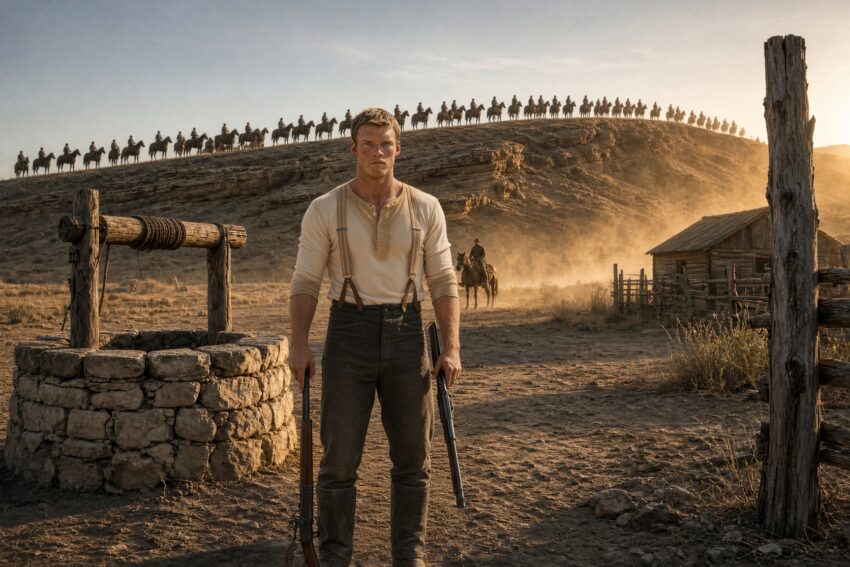
HE GAVE WATER TO AN APACHE WOMAN — BY SUNRISE, 300 RIDERS WERE WAITING AT HIS FENCE
Part 2 — The Woman Had Been Carrying a Message That Could Stop a War
The old warrior spoke slowly.
“My name is Naiche.”
Silas did not move.
Behind him, three hundred riders remained scattered across the ridges.
In front of him stood the woman he had given water to.
Naiche pointed toward her.
“Her name is Ayanna.”
The woman looked at Silas.
This time, she spoke English.
Not fluently.
Enough.
“You gave water when you did not know my name.”
Silas blinked.
“You speak English.”
“A little.”
“You could have told me yesterday.”
Ayanna’s expression barely changed.
“I did not know if you were safe.”
Fair.
Silas glanced toward the hundreds of riders.
“And today?”
Ayanna almost smiled.
“Today I brought witnesses.”
That did not make him feel better.
Why Three Hundred?
Silas finally asked the obvious question.
“Why are there enough men around my land to start a war?”
Naiche looked toward the ridges.
“Because many expected one.”
That answer landed differently.
Silas frowned.
Naiche continued.
“For six weeks, horses have disappeared from our camps.”
“Cattle disappeared from ranches.”
“Two water holes were poisoned.”
“A wagon was burned.”
“Three men died.”
Silas knew some of that.
Everyone in the valley did.
The newspapers called it renewed raiding.
Ranchers talked about forming armed patrols.
Army scouts had begun moving through the southern passes.
Naiche said:
“Each side says the other began.”
Silas folded his arms.
“And Ayanna?”
“She carried a message.”
“To whom?”
“To the people gathering at San Mateo Crossing.”
Silas knew the place.
Neutral ground near an old trading post.
Ranchers.
Territorial officers.
Apache representatives.
A meeting had been arranged for that morning.
Rumor said it might decide whether militia patrols entered the northern valleys.
Ayanna had been sent with names.
Dates.
Places.
Proof that some of the attacks blamed on Apache riders did not come from Apache camps at all.
Silas looked at her.
“What happened?”
Ayanna touched her ribs beneath the deerskin tunic.
Only then did Silas notice how stiffly she stood.
She had not only been thirsty.
She had been injured.
Yesterday, he had assumed exhaustion.
Now he saw the guarded movement.
Naiche answered:
“She was chased.”
“By who?”
Ayanna looked toward the southern horizon.
“Men with cattle brands cut from their saddles.”
Silas’s jaw tightened.
Men hiding who they rode for.
She Had Lost The Message
Not exactly.
Ayanna reached beneath the beaded strip at her throat.
Pulled out a small leather cord.
Empty.
Something had once hung there.
She said:
“Copper tube.”
Inside the tube had been a narrow strip of paper containing the names of three men willing to testify at San Mateo.
One was a Mexican drover.
One a former army scout.
One a white ranch hand.
All had seen livestock deliberately moved between Apache trails and settler properties.
False evidence.
Someone was manufacturing retaliation.
Ayanna had hidden the tube before reaching Silas’s fence.
She would not say where.
Not yet.
Silas looked at the riders.
“So all these men came because she was late?”
Naiche shook his head.
“They came because if Ayanna was [d.e.@.d], many believed meeting was trap.”
There it was.
Her survival meant more than one life.
If she disappeared while carrying peace terms, people would assume betrayal.
Retaliation would follow.
Then counter-retaliation.
Fear doing what fear did best.
Moving faster than facts.
Silas Asked Ayanna
“Why my well?”
She looked at him.
“Closest water.”
“That’s all?”
“Yes.”
Strange how disappointing simple answers can be.
No prophecy.
No destiny.
She was dying of thirst.
He had water.
That was it.
Then A Rider Came Hard From The West
One of Naiche’s scouts.
He spoke quickly.
Naiche’s expression darkened.
Silas could not understand.
Ayanna translated.
“San Mateo meeting delayed.”
“Why?”
“Two ranchers did not come.”
“Which?”
“Barrett.”
“Doyle.”
Silas knew both.
Men with large herds.
Loud voices.
And recently—
loud accusations about Apache thieves.
Ayanna continued.
“They say one of their barns burned last night.”
Naiche looked toward Silas.
“They blame us.”
Silas almost laughed.
“Of course they do.”
Then he remembered his own note.
7:38 PM.
Apache woman by the well. Injured. Gave water. Walked north.
He had written that before dark.
If Ayanna had been at his ranch—
and hundreds of Apache riders had been searching for her overnight—
then at least some accusations might not fit.
Maybe not enough.
But something.
Silas Went Inside
Naiche tensed.
Silas returned carrying his ledger.
Opened it.
Held it toward Ayanna.
She read slowly.
Then Naiche.
The old warrior looked confused.
Silas pointed at the clock entry.
“I write unusual things down.”
“Why?”
“Because memory lies when people get scared.”
Ayanna looked at him for a long moment.
Then:
“Keep book.”
“I planned to.”
“No.”
She pointed toward the riders.
“Keep it safe.”
The way she said it changed him.
“Why?”
“Because men who chased me may learn you saw me.”
Silas stared.
“I didn’t see who chased you.”
“No.”
“But you can prove where I was.”
There.
Timeline.
If someone tried claiming Ayanna had taken part in a raid far from Silas’s ranch at the same time—
his ledger mattered.
A Dust Cloud Appeared South
Not Apache.
Wagons.
Riders.
About twenty men.
Naiche’s warriors shifted.
Not charging.
Ready.
Silas stepped forward.
“Who?”
A rider beside Naiche answered:
“Barrett men.”
Silas swore under his breath.
The approaching group stopped near the southern fence.
At the front rode Gideon Barrett.
Heavy beard.
Gray hat.
Rifle across his saddle.
He shouted:
“Vance!”
Silas walked toward the fence.
“You’re surrounded by raiders!”
Silas glanced behind him.
Then back.
“They haven’t raided anything.”
Barrett’s face hardened.
“They burned Doyle’s barn and stole twelve horses.”
Naiche said something quietly.
Ayanna translated.
“Our riders did not leave the northern ridges last night.”
Barrett laughed.
“And I’m supposed to believe her?”
Silas answered:
“No.”
Barrett looked at him.
Silas raised the ledger.
“You can believe the clock.”
Barrett Did Not Like That
“What are you talking about?”
Silas opened the book.
“At 7:38 yesterday evening, Ayanna was at my well.”
“She left north.”
Barrett shouted:
“Who the hell is Ayanna?”
The woman stepped forward.
Barrett’s expression changed.
He knew her.
That was interesting.
Ayanna saw it too.
“You know me.”
Barrett recovered quickly.
“I’ve seen you around trading posts.”
Ayanna stared.
“No.”
Silence.
Then:
“You saw me three nights ago.”
Barrett’s men shifted uneasily.
Silas looked between them.
“Where?”
Ayanna answered:
“Dry Salt Canyon.”
Naiche’s face hardened.
Ayanna continued.
“I saw Barrett with men moving stolen horses.”
Barrett laughed.
“Liar.”
“Maybe,” Silas said.
Everyone looked at him.
He continued:
“But you recognized her before anyone gave her name.”
Barrett went still.
Exactly.
Silas had said Ayanna only after Barrett asked who she was.
Yet Barrett reacted before her identity was explained.
Small mistake.
Important.
Barrett Changed Tactics
“This woman is wanted for horse theft.”
“By whom?”
“The livestock association.”
Silas asked:
“Any warrant?”
Barrett said nothing.
“Any sheriff?”
Nothing.
“Any brand record?”
Barrett’s jaw tightened.
“You think writing in a book makes you judge?”
“No.”
Silas closed the ledger.
“It makes me a man who remembers what happened before everyone started shouting.”
Ayanna Suddenly Looked Toward Barrett’s Second Rider
Tall man.
Brown coat.
Blue scarf.
Her expression changed.
She whispered something.
Naiche stiffened.
Silas asked:
“What?”
Ayanna pointed.
“That man chased me.”
The rider’s hand moved toward his weapon.
Naiche’s warriors shifted across every ridge.
Three hundred men.
One motion.
The sound of leather and horses seemed to roll around the valley.
Silas raised both hands.
“No.”
He looked at Naiche.
“No one shoots.”
Then at Barrett.
“You either.”
Barrett looked terrified now.
Good.
Terrified men made bad decisions.
Silas stepped between them.
“Everybody waits.”
Barrett snapped:
“For what?”
Silas looked toward the road.
“The sheriff.”
Barrett laughed.
“You think law is coming out here?”
Silas nodded.
“Yes.”
“How?”
Silas pointed toward a lone horse approaching from the east.
A rider.
Badge catching morning light.
Sheriff Abel Mercer.
And behind him—
three wagons from San Mateo Crossing.
The meeting had not been canceled.
It had moved.
Straight to Silas Vance’s homestead.
Sheriff Mercer Dismounted
Looked at the ridges.
Looked at Barrett.
Looked at Silas.
Then sighed.
“I leave town for one night.”
Silas held up the ledger.
“Good morning.”
Mercer stared.
“What happened?”
Silas looked around.
“That depends on who tells it first.”
The sheriff nodded.
“Then nobody tells it first.”
Good answer.
Witnesses separated.
Weapons lowered.
Names recorded.
Timeline built.
Facts before fear.
The Man In The Blue Scarf Ran
That was his mistake.
While Sheriff Mercer questioned Barrett, the blue-scarfed rider turned his horse.
Bolted south.
Three Apache riders moved.
Mercer shouted:
“No!”
Silas shouted too.
They stopped.
Instead, two deputies rode after the man.
Law first.
The rider made it less than a mile before his horse stumbled in loose gravel.
He fell.
No dramatic gunfight.
No blood.
He was brought back.
His name:
Elias Crowe.
Hired hand.
Worked for Barrett six months.
Inside his saddlebag—
a copper tube.
Ayanna’s.
The entire yard fell silent.
Barrett stared at Crowe.
Crowe stared at Barrett.
Sheriff Mercer took the tube.
Opened it.
Inside was the message Ayanna had been carrying.
And another paper.
One that did not belong there.
A handwritten list of ranches.
Prices.
Debts.
Water access.
Silas saw his own name halfway down.
VANCE — isolated — western spring — pressure after autumn.
He looked at Barrett.
“What is this?”
Barrett said nothing.
Sheriff Mercer read the next line.
If Apache retaliation begins, values fall thirty percent.
Now everyone understood.
This was not only about stolen horses.
Someone was using conflict to make land cheaper.
And Silas’s lonely little homestead—
with its reliable well—
was already on the list.
Part 3 — Silas’s Land Had Been Chosen Before Ayanna Ever Reached His Well
Sheriff Mercer kept everyone at the ranch until noon.
Nobody liked it.
Good.
People who wanted immediate action were exactly the people who needed to wait.
The Copper Tube
Ayanna’s original message contained three names.
Mateo Ruiz.
Daniel Cross.
Thomas Bell.
All willing to testify.
All had seen livestock moved deliberately to create false trails.
The second paper in Crowe’s saddlebag was more dangerous.
A property list.
Eleven ranches.
Four Mexican-owned farms.
Two trading posts.
Three water parcels.
Each had notes.
Debt.
Distance from law enforcement.
Water reliability.
Expected sale price after “pressure.”
Silas’s ranch was one.
So was Barrett’s.
That surprised everyone.
Including Barrett.
Barrett Grabbed For The Paper
Mercer pulled it away.
“What?”
Barrett stared.
“My ranch is there.”
Silas almost laughed.
“You didn’t know?”
“No.”
Ayanna studied him.
For the first time, her certainty shifted.
Maybe Barrett was involved.
Maybe not fully.
Again:
Specific guilt.
Crowe Refused To Talk
At first.
Then Sheriff Mercer asked one question.
“Who gave you the list?”
Crowe stared.
No answer.
Mercer nodded.
“Fine.”
Then:
“Who told you Ayanna had the copper tube?”
Crowe’s face changed.
Small.
Enough.
Someone inside the San Mateo planning circle knew Ayanna’s route.
That meant the leak was closer than they thought.
Barrett’s Role Was Different
He admitted something reluctantly.
He had purchased six horses the previous month from a broker named Nathan Voss.
Cheap.
Too cheap.
Two later turned out to carry altered brands.
Barrett did not report it.
Why?
Because admitting he bought stolen stock would damage his standing.
So when horses disappeared from his own range, he blamed Apache raiders publicly.
Easier.
Silas stared.
“You knew the story was incomplete.”
Barrett snapped:
“I knew I’d made one bad purchase.”
“And decided that made everyone else guilty.”
Silence.
Barrett had not necessarily built the scheme.
But he fed it.
Nathan Voss
Everyone knew the name.
Land broker.
Loan holder.
Freight investor.
Polite.
Educated.
Rarely carried a weapon.
Owned no giant ranch himself.
Instead, he owned pieces of other people’s problems.
Notes.
Mortgages.
Transport contracts.
Water rights.
Sheriff Mercer frowned.
“He’s at San Mateo.”
Ayanna looked toward Naiche.
Naiche’s face hardened.
Voss had helped organize the peace meeting.
Of course.
Why?
Silas asked.
Mercer answered.
“If the meeting fails, land values drop.”
“If patrols expand, freight contracts rise.”
“If ranchers default, note holders acquire property.”
Silas looked at the list.
“And if the meeting succeeds?”
Mercer folded it.
“Somebody loses money.”
The Three Witnesses
They had not arrived.
All three were missing.
That changed the mood.
Not [d.e.@.d] necessarily.
Missing.
Silas looked toward Ayanna.
She already knew what he was thinking.
“If Crowe had tube…”
“Yes.”
“He knew names.”
“Yes.”
Naiche stood.
The warriors on the ridges stirred.
Silas stepped toward him.
“No.”
Naiche looked at him.
“Three men gone.”
“I know.”
“You say wait.”
“Yes.”
Naiche’s eyes hardened.
“Why?”
“Because if Voss wants a war, three hundred riders moving south gives him one.”
Silence.
Naiche looked toward Ayanna.
She nodded.
Reluctantly.
They Split The Search
Not by race.
By geography.
Sheriff deputies checked roads.
Apache trackers searched ravines and high ground.
Ranchers checked barns and wells.
Silas joined Ayanna and Saye—
one of Naiche’s senior trackers.
Barrett insisted on coming.
Silas did not trust him.
That made him useful to keep visible.
First Witness: Mateo Ruiz
Found alive.
Locked inside an abandoned sheep shed ten miles east.
Bruised.
Dehydrated.
No graphic injury.
He identified Crowe as one of the men who took him.
Crowe had help.
Two others.
One worked for Voss Freight.
Mateo had seen them moving stolen cattle.
Second: Daniel Cross
Also alive.
He had escaped before capture.
Hid at a mission outpost.
He arrived by evening under deputy escort.
Third: Thomas Bell
Missing.
His horse found near Dry Salt Canyon.
No body.
No clear tracks after rainless wind.
Ayanna found something others missed.
A boot heel mark under stone.
Then another.
Thomas had walked away from the horse.
Voluntarily?
Forced?
Unknown.
They followed until night.
Silas And Ayanna Talked
First time without hundreds of witnesses.
She rode beside him.
“You live alone.”
“Yes.”
“Why?”
“People ask questions.”
Ayanna looked amused.
“You ask many.”
“That’s different.”
“How?”
“I’m charming.”
She actually laughed.
First time.
Silas noticed.
Dangerous.
His Wife
Ayanna asked about a photograph tucked inside his ledger.
Silas’s late wife, Miriam.
Passed away five years earlier during childbirth.
The baby too.
Afterward, Silas sold half the herd.
Stopped going into town unless necessary.
Moved farther into himself.
Ayanna listened.
Then:
“You write things because afraid forget?”
Silas considered.
“Yes.”
Her expression softened.
“Good reason.”
Ayanna’s Height
People had stared at her all her life.
She hated it.
Silas had noticed.
Obviously.
But he had not commented.
That mattered to her.
She told him later.
“Most men see tall woman, speak first about tall.”
Silas shrugged.
“You looked thirsty.”
That mattered more.
Thomas Bell Was Found At Dawn
Alive.
He had hidden inside an abandoned charcoal pit.
He had escaped two men.
One named Crowe.
The other—
Barrett’s foreman.
Barrett went white.
His foreman, James Pike, had worked for him nine years.
Barrett looked genuinely sick.
Again:
The scheme had inserted itself inside businesses whose owners believed they controlled them.
Pike Was Arrested
At Barrett’s ranch.
He confessed faster than Crowe.
Voss paid him.
First for information.
Then for arranging “losses.”
Which ranches were overleveraged?
Which wells were failing?
Who carried insurance?
Which owners had no adult sons nearby?
Cold mathematics.
Silas Asked
“Why my land?”
Pike looked at him.
“Water.”
Of course.
Silas’s western spring stayed reliable even in drought.
Voss wanted it as a freight stop.
Rail survey rumored nearby.
Silas had refused three purchase inquiries without knowing they were connected.
So pressure was planned for autumn.
The note in Crowe’s saddlebag was not speculation.
It was schedule.
The Plan For War
Not full war.
That was the horror.
Voss did not necessarily want hundreds [d.e.@.d].
He wanted enough instability.
Enough fear.
Enough burnt barns.
Enough stolen horses.
Enough rumors.
Enough patrols.
Enough headlines.
Enough people deciding isolated land was no longer worth keeping.
Economic violence wearing frontier conflict as disguise.
Sheriff Mercer Asked Barrett
“Did you know?”
Barrett answered:
“No.”
Then:
“Not all.”
Important.
He knew some horses he bought were questionable.
He encouraged rumors because they protected his reputation.
He hired Pike without watching what Pike became.
He did not know the full land scheme.
Guilty of his portion.
Not everything.
The Evidence Needed Voss
Paper linked him indirectly.
Employees.
Companies.
Loans.
No direct order yet.
They needed records.
Voss knew.
By morning, he had disappeared from San Mateo.
Ayanna Said
“He will go where paper is.”
Silas frowned.
“What?”
“Men like him trust paper more than men.”
She was right.
Voss’s office.
Land records.
Loan books.
Contracts.
If he fled, he would take or destroy what could expose him.
Sheriff Mercer organized a lawful search.
Silas went because his land was on the list.
Ayanna went because the missing horses and false raids involved her people.
Naiche did not send three hundred warriors.
He sent four.
Lesson learned.
Voss’s Office Was Empty
Desk cleared.
Safe open.
Fire in stove.
Too much fire for summer.
Mercer pulled burning papers out with a poker.
Silas stomped them.
Ayanna carried water.
Several survived.
One page listed:
Vance Spring Acquisition — Phase III.
Another:
Northern instability index.
Another:
Barrett public statements useful. Continue amplification.
Barrett read that and nearly broke a chair.
He had been manipulated through his own prejudice.
Useful.
That word hurt him.
Then Silas Found A Familiar Handwriting
Not Voss.
His late wife’s.
Miriam.
On an old note.
He stared.
Impossible.
Five years earlier.
Before any recent conflict.
The note read:
Mr. Voss, Silas will not sell the spring. Stop approaching me privately.
Silas’s hands began shaking.
Ayanna noticed.
“What?”
He could barely speak.
“Voss knew Miriam.”
The scheme was older than he thought.
Maybe much older.
On the back, Voss had written:
Widowhood may change position.
Silas stopped breathing.
Miriam had passed in childbirth months later.
Natural.
Doctor present.
No reason to suspect anything else.
Still, Voss had written the word widowhood before she passed.
Silas’s mind raced toward the darkest conclusion.
Ayanna stopped him.
“No.”
He looked at her.
She pointed at his ledger.
“Fear rewrites memory.”
His own rule.
Evidence first.
Silas closed his eyes.
She was right.
Again.
The note proved Voss anticipated the possibility of Silas being alone someday.
Cruel.
Opportunistic.
Not foul play.
Not without more.
Silas hated the restraint.
Needed it.
Then Sheriff Mercer Opened A Hidden Drawer
Inside:
Mortgage assignments.
Land surveys.
Letters.
And one sealed envelope.
Marked:
In event of Voss absence — deliver to Territorial Bank, Santa Fe.
Mercer opened it under witness.
Inside was a transfer plan.
If instability reached “operational threshold,” Voss-controlled companies would purchase sixteen distressed properties.
Silas’s included.
Barrett’s too.
Two belonged to Apache-linked trading families.
Four Mexican farms.
The scheme had never been Apache versus settler.
It was predators versus everyone frightened enough to sell.
One More Name Appeared
At the bottom.
Military liaison: Captain Harlan Creed.
Sheriff Mercer went silent.
Captain Creed commanded the patrol expected to “restore order” if San Mateo failed.
A military officer.
Now the case was bigger than Voss.
And somewhere south—
Voss was riding toward the very man who could give him soldiers.
Part 4 — Silas Rode Into San Mateo With Ayanna Beside Him
Captain Harlan Creed arrived at San Mateo with forty soldiers.
Officially:
To keep peace.
Unofficially?
Nobody knew yet.
That distinction mattered.
The surviving records showed payments to a “military liaison.”
Could be Creed.
Could be someone using his name.
Sheriff Mercer refused to accuse him publicly before verifying.
Silas agreed.
Naiche hated waiting.
Ayanna insisted.
“We accuse wrong man, Voss wins.”
Exactly.
Creed Met Them At The Crossing
Tall.
Forty.
Union veteran.
Scar beneath one eye.
He looked at the evidence.
Then at the accusation.
His face hardened.
“I’ve never taken a dollar from Nathan Voss.”
Mercer asked:
“Do you recognize this code?”
Creed stared.
Then laughed without humor.
“Yes.”
Not his code.
Quartermaster code.
The initials HC belonged to:
Henry Cole.
Civilian procurement officer attached to Creed’s command.
Not Harlan Creed.
Again:
Initials.
Assumptions.
Danger.
Henry Cole Was Missing
Of course.
His office showed falsified feed invoices.
Payments from Voss Freight.
Supply wagons billed for routes never traveled.
Cole had been profiting from heightened patrol activity.
More conflict meant more supplies.
More horses.
More freight.
More invoices.
Voss supplied the civilian side.
Cole supplied military demand.
Creed Was Furious
Wanted immediate arrest.
Mercer said:
“Find him first.”
Good.
The San Mateo Meeting Finally Happened
Not ceremonially.
No dramatic treaty.
A dusty trading hall.
Representatives.
Ranchers.
Apache leaders.
Mexican farmers.
Army.
Territorial officials.
Arguments.
Accusations.
Translation delays.
Exactly what real negotiation looks like.
Silas sat near the back.
Ayanna near Naiche.
Then someone asked her to speak.
She stood.
Everyone looked.
At first because of her height.
Then because of what she said.
Ayanna’s Testimony
She described the hidden horse movements.
False trails.
The men who chased her.
The copper tube.
Silas’s well.
Then she said:
“One man gave me water before asking which people I belonged to.”
Silas hated everyone looking at him.
Ayanna continued:
“That should be ordinary.”
Silence.
“It was not.”
Then:
“If we decide guilt by group, men like Voss do not need to hide well.”
“They only need to hide behind what we already fear.”
That became the clearest sentence of the entire meeting.
Barrett Spoke Too
Unexpected.
He admitted publicly:
“I blamed Apache riders before I knew who took my stock.”
People murmured.
He continued:
“I did it because it was easier than admitting I bought stolen horses.”
“I helped spread a lie because the lie protected my pride.”
That cost him.
Good.
Naiche’s Responsibility
He did not escape either.
Months earlier, two young Apache riders retaliated against a ranch after horses disappeared.
They burned fencing.
No one killed.
Still wrong.
Naiche had disciplined them internally but never informed settlers.
Why?
Fear they would use it as justification for broader retaliation.
Understandable.
Also contributed to distrust.
He admitted it.
Specific acts.
Specific people.
No clean heroes.
Temporary Agreement
Before anyone rode armed in retaliation:
Report theft.
Wait for trackers.
Share brand information.
Neutral witnesses where possible.
No military patrol enters Apache camps without authorization except immediate danger.
No Apache war party crosses ranch settlements based solely on rumor.
Water access disputes documented separately from theft claims.
Boring.
Beautiful.
Henry Cole Was Found
At a rail camp.
With money.
Records.
No Voss.
He confessed partially.
Voss paid him to exaggerate threat assessments and approve unnecessary supply orders.
He denied knowing about staged raids.
Maybe true.
Evidence showed he knew patrol need was inflated.
Enough.
Nathan Voss Was Still Missing
For eleven days.
Then Silas found him.
Accidentally.
Of course.
At The Western Spring
Silas returned home after the meeting.
Ayanna had gone with Naiche.
The three hundred riders dispersed.
The homestead became silent again.
Too silent.
Silas checked the well.
Horses.
Fence.
Then saw smoke near the western spring.
One man.
Campfire.
Horse tied nearby.
Nathan Voss.
Sitting as though waiting.
Silas approached with rifle lowered.
“Why here?”
Voss smiled.
“Because you were always the difficult property.”
Silas stopped.
Voss looked terrible.
Dusty.
Unshaven.
Still oddly composed.
Voss Offered Him Money
Twenty thousand dollars.
More than Silas’s land was worth several times over.
“Sell.”
Silas stared.
“Now?”
“Especially now.”
“Why?”
“Because everyone knows the spring matters.”
There it was.
Even exposed, Voss still thought in acquisition.
Silas almost admired the consistency.
“No.”
Voss sighed.
“You people always make morality expensive.”
Silas frowned.
“You people?”
“Men who own little and treat every acre as sacred.”
“You treat every acre as price.”
“Everything has price.”
Silas looked at the spring.
“No.”
Voss smiled.
“That is why you will die poor.”
“Probably.”
Voss Denied Ordering Violence
He admitted:
Buying distressed notes.
Using rumors.
Paying informants.
Manipulating freight demand.
Encouraging Barrett’s public accusations.
Funding men who moved stolen stock.
But he claimed he never ordered anyone killed.
Crowe and Pike acted beyond instructions.
Maybe.
Investigators would decide.
Silas asked:
“Why were you waiting here?”
Voss looked toward the water.
“Because Cole was supposed to meet me.”
Henry Cole was already in custody.
Voss did not know.
Good.
Silas Kept Him Talking
Not heroically.
Carefully.
He had no way to arrest Voss alone safely.
Then Voss noticed hoofbeats.
One rider.
Ayanna.
She had returned.
Why?
She had come because Naiche wanted Silas’s original ledger copied for the hearing record.
She saw Voss.
Stopped.
Voss’s hand moved toward his coat.
Silas raised the rifle.
“Don’t.”
Voss looked between them.
Then laughed.
“The towering woman and the lonely rancher.”
Ayanna’s face went cold.
“Name.”
“What?”
“My name is Ayanna.”
Voss smiled.
“Of course.”
She continued:
“You made money because people use names less than categories.”
“Apache.”
“Settler.”
“Widow.”
“Mexican.”
“Raider.”
“Savage.”
“Victim.”
“You sell stories before land.”
Voss stared.
Then:
“You think very highly of yourself.”
“No.”
Ayanna pointed toward Silas.
“He wrote what happened.”
Then toward herself.
“I carried names.”
“Names are bad for men like you.”
Sheriff Mercer Arrived
With two deputies.
Ayanna had seen his tracks on the road and flagged him.
Voss did not resist.
Smart.
He was arrested alive.
Records mattered more than revenge.
The Trial
Months later.
Not every accusation proved.
Important.
Voss was convicted on conspiracy, livestock fraud, fraudulent land transactions, bribery-related counts, and document destruction.
Evidence did not conclusively tie him to every burned barn or every violent act committed by hired men.
Crowe and Pike received separate convictions.
Henry Cole too.
Some accomplices were acquitted.
Some cooperated.
The network dissolved.
Silas Asked About Miriam
Investigators reviewed Voss’s old correspondence.
No evidence he caused her death.
None.
She died from childbirth complications.
The note about “widowhood may change position” was exactly what it looked like:
A predatory businessman planning for future opportunity.
Ugly.
Not murder.
Silas felt relief.
Then guilt for ever wondering.
Ayanna told him:
“Wondering is not accusing.”
Good distinction.
The Ranches
Several fraudulent land transfers reversed.
Others too old or legally complicated.
Compensation where possible.
Silas kept his spring.
Barrett kept much of his land but paid penalties and restitution related to stolen stock purchases.
He became quieter.
No miracle conversion.
Just a man who had learned public certainty could be expensive.
The Three Hundred Riders Became A Story
Naturally.
People said:
An Apache princess drank from a cowboy’s well.
At sunrise, three hundred warriors came to reward him.
False.
No princess.
No reward.
No magical debt.
They came because Ayanna was missing and the peace meeting was collapsing.
Silas corrected anyone who asked.
Eventually nobody asked him.
Good.
Ayanna Kept Visiting
For practical reasons.
At first.
Water agreements.
Witness statements.
Livestock tracking.
Then less practical reasons.
Coffee.
Conversation.
Silence.
Silas noticed.
Pretended not to.
She did too.
One Evening
She sat on his porch.
The sun dropped behind the ridges.
Silas handed her water.
Not a tin dipper.
A tin cup.
She drank.
Then asked:
“You write today?”
He nodded toward the ledger.
“What?”
“Fence repaired.”
“Horse lame.”
“Barrett sent apology letter.”
Ayanna smiled.
“Nothing unusual?”
Silas looked at her.
Then wrote:
7:18 PM — Ayanna returned. Stayed for supper.
She read over his shoulder.
“Unusual?”
“Yes.”
“Why?”
Silas closed the book.
“Because I hoped you would.”
For once, Ayanna had no answer immediately.
That pleased him far too much.
Part 5 — Silas Asked Her To Stay Only After The Valley No Longer Needed Her To
A year passed.
Then two.
The peace agreement survived badly.
Which is to say—
it survived.
Disputes still happened.
Horses still wandered.
Men still lied.
But fewer groups rode out based entirely on rumor.
That mattered.
Ayanna Became One Of The People Who Checked Claims
Not because she was mystical.
Because she was good.
Tracks.
Water.
Memory.
Languages.
She could move between groups without pretending they were the same.
That made her valuable.
Also exhausted.
Silas’s Ranch Changed
He repaired more.
Planted cottonwoods near the spring.
Bought twelve additional cattle.
Started riding into town again.
Not because Ayanna “healed” him.
He hated that version.
Grief does not disappear because a new person arrives.
Miriam remained in photographs.
In stories.
In the west room he eventually stopped keeping closed.
Ayanna never asked him to erase her.
That mattered.
Ayanna Asked About Miriam Once
“Beautiful?”
Silas looked at the photograph.
“Yes.”
“Kind?”
“Usually.”
Ayanna smiled.
“Usually?”
“She threw a coffee cup at me once.”
“Why?”
“I deserved it.”
“Good woman.”
Silas laughed.
Silas Asked About Ayanna’s Past
No husband.
No children.
She had been promised once.
Refused.
Why?
The man wanted her father’s access to trade routes.
Different story.
Same old problem.
She told Silas:
“He talked about me as path.”
Not person.
Silas understood.
Naiche Did Not Arrange Anything
Important.
He noticed.
Of course.
One afternoon he told Silas:
“You look at daughter.”
Silas nearly dropped a saddle.
“She’s your daughter?”
Naiche stared.
Silas had known Ayanna was close kin, but not exact relation.
She had never said.
Naiche sighed.
“Now you know.”
Silas muttered:
“This day keeps improving.”
Naiche continued:
“You ask her.”
“That sounds threatening.”
“No.”
Then:
“If she says no, you stop.”
Silas nodded.
“Obviously.”
Naiche studied him.
Then:
“Good.”
Apparently that was the entire fatherly conversation.
Silas Waited Another Six Months
Partly fear.
Partly respect.
Partly stupidity.
Ayanna finally asked:
“You waiting for winter?”
“For what?”
“To ask question.”
Silas stared.
She smiled.
“Tracks easy.”
“What tracks?”
“Yours.”
He sighed.
No privacy with trackers.
He Asked Beside The Well
Of course.
Where else?
The battered tin cup still hung on a wire hook.
Dented now.
Silas kept it anyway.
Ayanna came for supper.
Before entering, he said:
“Wait.”
She frowned.
He took the tin cup.
Dipped water.
Held it toward her.
Ayanna stared.
“This is bad proposal already.”
Silas laughed.
“Probably.”
She drank.
Handed it back.
Then:
“Ask.”
Silas took a breath.
“I don’t need you to stay because I’m lonely.”
Ayanna raised an eyebrow.
“Good.”
“I am lonely sometimes.”
“Better truth.”
He nodded.
“I don’t need peace agreement.”
“Good.”
“I don’t need Naiche to owe me anything.”
“He doesn’t.”
“Excellent.”
Ayanna smiled.
Silas continued:
“I want you here because when something happens, I want to tell you before I write it down.”
That quieted her.
Then:
“And because when you leave, the house sounds wrong.”
Ayanna looked toward the porch.
The well.
The ridge.
Then at him.
“Marriage?”
“Yes.”
“My name stays.”
“Yes.”
“My work stays.”
“Yes.”
“I travel.”
“Yes.”
“My people remain mine.”
“Yes.”
“Your land remains yours?”
Silas thought.
“Ours if you want.”
“No.”
He blinked.
Ayanna continued:
“Not because marriage.”
“Later decide.”
He smiled.
“Fair.”
Then she held out her hand.
“Yes.”
No army.
No witnesses.
No chief.
Just water.
Their Wedding Was Small
Naiche.
Several relatives.
Sheriff Mercer.
Mateo Ruiz.
Even Gideon Barrett stood far in the back.
Silas noticed.
Did not object.
Barrett approached afterward.
“I owe you an apology.”
Silas said:
“Yes.”
Barrett almost smiled.
Then apologized.
No friendship.
Enough.
The Famous Three Hundred
Not invited.
Thank heaven.
Ayanna Moved In
Not smoothly.
She hated Silas’s habit of recording trivial events.
He hated her habit of leaving tools in places that made sense only to her.
She thought chairs were too low.
He built one taller.
She accused him of making a throne.
He shaved the legs down an inch.
Marriage.
Their First Child
A daughter.
Miriam Ayanna Vance.
Ayanna chose Miriam.
Silas cried.
Denied it.
Naiche saw.
Said nothing.
Second child:
Thomas Naiche Vance.
Names became bridges.
Not ownership.
Silas Kept The Ledger
Every year.
One page eventually became famous in the family.
August 14, 1878 — Ayanna gave birth to daughter. Both alive. I forgot how to breathe for several minutes.
Ayanna added beneath:
He was useless.
Different handwriting.
Same page.
Nathan Voss Died In Prison
Years later.
Silas felt almost nothing.
The scheme had once occupied his whole imagination.
Then life got larger.
That was healthier.
Henry Cole Cooperated
Served time.
Later wrote testimony explaining how supply contracts rewarded increased military activity.
His records became part of reforms.
No heroic redemption.
Just useful accountability.
The Water Rights
Silas and Ayanna created a written agreement.
Ranch use.
Traveler use.
Emergency drought access for nearby families.
No exclusive transfer without joint approval.
Publicly recorded.
Copies in three places.
Ayanna insisted.
Silas approved.
Men who profit from confusion hate duplicate records.
The Valley Remembered Differently
Children later asked why the agreement existed.
Adults told the story.
Sometimes badly.
Ayanna corrected:
“No three hundred warriors came to thank cowboy.”
They came because she was missing.
They were afraid.
They expected betrayal.
Silas’s well became important because one small act created a fact everyone could agree on:
At a specific time—
Ayanna was alive.
At a specific place—
Silas saw her.
He wrote it down.
That timeline helped break a lie.
Silas Asked Years Later
“Why did you come back after the first hearing?”
Ayanna looked confused.
“Work.”
“After work.”
She knew what he meant.
She smiled.
“Water.”
He stared.
“You had water.”
“Yes.”
“Then?”
She thought.
“You did not ask me to be grateful.”
That answer stayed with him.
People often turn kindness into debt.
Silas had not.
He gave water.
Expected nothing.
That made returning feel like choice.
Naiche Grew Old
On his final visit, he sat beside the well.
Looked toward Ayanna and the children.
Then at Silas.
“One cup.”
Silas nodded.
“That was all.”
Naiche smiled.
“No.”
Silas frowned.
“What?”
“One choice.”
Different.
Naiche died the following winter.
Ayanna mourned.
Silas did not try to fix it.
He simply stayed near.
He had learned.
Part 6 — Three Hundred Warriors Had Come Because Everyone Was Afraid
Silas Vance lived to seventy-nine.
Ayanna to eighty-four.
The homestead lasted longer than both.
So did the well.
The Ledger Survived
Leather cracked.
Ink faded.
Pages full of ordinary life.
Weather.
Cattle.
Births.
Passings.
Arguments.
Repairs.
Visitors.
Then the famous entry:
Apache woman by the well. Injured. Gave water. Walked north.
7:38 PM.
One sentence.
That sentence eventually appeared in a territorial hearing archive because it helped establish Ayanna’s movements on the night several crimes were falsely attributed to Apache riders.
Historians loved it.
Silas would have hated that.
One Researcher Asked Ayanna
“Were there really three hundred warriors?”
She answered:
“Approximately.”
“How many exactly?”
“Ask Silas.”
Silas said:
“I stopped counting.”
The researcher looked disappointed.
Good.
Why So Many?
Because multiple Apache groups had gathered for the San Mateo negotiations.
Ayanna was one of the messengers linking them.
When she vanished, rumor moved faster than information.
Some believed settlers had ambushed her.
Some believed the meeting was a trap.
Some prepared to withdraw.
Others prepared to strike back.
Naiche sent riders searching.
More joined.
By dawn, the search converged around Silas’s valley.
Not invasion.
Not reward procession.
Fear.
Three hundred armed men who did not know what had happened.
That was more dangerous than hatred sometimes.
Silas’s Greatest Contribution Was Not Water
Ayanna said this often.
Water kept her alive physically.
Yes.
But Silas also did something strange for a frontier rancher.
He recorded time.
Then resisted changing his memory after armed men arrived.
He did not decide:
I must have seen something else.
Maybe she was threatening.
Maybe she stole.
Maybe I should say what my neighbors expect.
He trusted the boring line he wrote before fear arrived.
That mattered.
The Battered Tin Cup
Their granddaughter found it after Silas died.
Dented.
Tarnished.
She asked:
“This?”
Ayanna nodded.
“Grandfather gave you water with this?”
“Yes.”
“Why keep it?”
“Your grandfather.”
“What about him?”
“He kept everything.”
Fair.
Miriam’s Photograph Remained Too
Ayanna never moved it.
Silas’s first wife.
The child who died with her had no photograph.
Only a name in the family Bible.
Ayanna added her own children beneath.
No erasure.
A family can grow without editing previous grief out of the record.
Their Daughter Asked
“Were you jealous of her?”
Ayanna thought.
“Sometimes.”
The daughter looked surprised.
“Why admit?”
“Because a person gone cannot defend herself.”
Then:
“Jealousy not shame if you do not make it rule house.”
That was Ayanna.
Precise even in old age.
Gideon Barrett Changed
Some.
He never became a saint.
Still proud.
Still difficult.
But he stopped making wild accusations without evidence.
That sounds small.
It was not.
Years later, when a horse disappeared, one ranch hand said:
“Apache took it.”
Barrett replied:
“Show me track.”
The horse was found two days later tangled near a wash.
No theft.
No posse.
Nothing happened.
Beautiful.
Sheriff Mercer Retired
His successor kept the joint tracking process.
Eventually formalized.
More written records.
Fewer armed rumors.
Not zero.
Enough.
Silas’s Children Learned The Rule
If something unusual happens:
Write it before people tell you what it meant.
Time.
Place.
What you actually saw.
Not interpretation.
Silas taught them.
Ayanna improved it:
“And write what you do not know.”
That part mattered more.
Silas’s Last Morning
He woke before sunrise.
Old habit.
Ayanna beside him.
He wanted outside.
She complained.
Still helped.
They sat near the well.
Same ridges.
No riders.
Silas looked north.
“Remember?”
Ayanna smiled.
“Too many horses.”
“I thought I was [d.e.@.d].”
“You looked foolish.”
“I was wearing one boot.”
“That too.”
He laughed weakly.
Then:
“Were you scared?”
Ayanna thought.
“Yes.”
“Of me?”
“At first.”
“Then?”
“Of what men would make story from me disappearing.”
Silas nodded.
He understood.
Then:
“If I hadn’t given water?”
Ayanna looked at him.
“I find another way.”
“Maybe.”
“Yes.”
“Confident.”
“Always.”
He smiled.
Good.
Then:
“You know why I did?”
She looked at him.
“Why?”
“You were thirsty.”
Ayanna nodded.
Exactly.
No destiny.
No reward.
No army.
A thirsty stranger.
Water.
Silas Died That Afternoon
At home.
Ayanna held his hand.
Ledger beside the bed.
His final entry unfinished.
Sunrise clear. Ayanna—
Nothing after.
She never completed it.
Some sentences belong to the person who started them.
Ayanna Lived Five More Years
She ran the land with her children.
Continued water work.
Told the story only when forced.
She hated the title people gave it:
The Cowboy Who Saved the Apache Giantess.
“Giantess” irritated her.
So did “saved.”
She corrected:
“He gave water.”
That was all.
A Journalist Asked
“But without him, you might have died.”
“Yes.”
“So he saved you.”
“Maybe.”
“Why resist word?”
Ayanna looked at him.
“Because then story becomes about what he became after.”
“Husband.”
“Important rancher.”
“White man who prevented war.”
She shook her head.
“He did not know any of that.”
“He helped before story had reward.”
That was the point.
Silas Did Not Prevent The War Alone
Neither did Ayanna.
Neither did Naiche.
Neither did Sheriff Mercer.
The larger conflict remained real.
Historical forces did not disappear because one valley exposed one fraud scheme.
But in that particular moment—
one manufactured escalation failed.
One meeting survived.
One network collapsed.
Several retaliatory attacks never happened.
That mattered without becoming mythology.
The Three Hundred Men
None owed Silas their lives.
They did not become his personal army.
They did not kneel.
They did not gift him horses or gold.
They simply learned something before leaving:
The rancher at the well had helped Ayanna without knowing who she was.
That became a fact carried through several camps.
Later it made negotiation slightly easier.
Trust rarely arrives whole.
Sometimes it begins as:
That one man did not let her die.
Small.
Useful.
Ayanna’s Final Winter
Her granddaughter Lena sat beside her.
Asked:
“Grandmother, why did they fear you?”
Ayanna frowned.
“Who?”
“The settlers.”
“Some feared Apache.”
“Some feared tall woman.”
The girl laughed.
“Some feared what?”
“What they imagined.”
Ayanna continued:
“Fear likes empty space.”
“If people do not know, they fill.”
“With worst?”
“Often.”
“Then what stops it?”
Ayanna looked toward Silas’s old ledger.
“Facts help.”
The Ledger’s Last Page
Ayanna had written only a handful of entries herself.
One after Silas died:
Silas gone. Well still running.
Another months later:
First rain.
Then:
Mara’s son born. Loud.
Ordinary.
That was grief continuing alongside life.
Her Last Conversation
Lena asked:
“Did you love Grandfather because he saved you?”
Ayanna looked offended.
“No.”
“Why then?”
“Later.”
“What later?”
“Everything after.”
She smiled.
“He gave water because I needed.”
“I loved him because he did not spend rest of life demanding payment for it.”
There.
That was enough.
Ayanna died in spring.
The Homestead Marker
Years later, descendants placed a modest plaque near the well.
Not:
HERE A COWBOY SAVED AN APACHE PRINCESS.
Not:
HERE THREE HUNDRED WARRIORS SURRENDERED.
Instead:
AT THIS WELL, IN 1873, SILAS VANCE GAVE WATER TO AYANNA, AN APACHE MESSENGER TRAVELING TO THE SAN MATEO NEGOTIATIONS. HER SURVIVAL AND THE RECORD OF HER PRESENCE HELPED EXPOSE A LIVESTOCK AND LAND-FRAUD NETWORK THAT PROFITED FROM CONFLICT IN THE VALLEY.
Then beneath:
HE DID NOT KNOW WHO SHE WAS.
That final line mattered most.
What The Legend Got Wrong
People wanted Ayanna to be some hidden princess.
She wasn’t.
They wanted three hundred warriors to arrive as a dramatic reward.
They didn’t.
They wanted Silas’s kindness to earn him status.
Gold.
Land.
Marriage.
It earned none of those automatically.
Ayanna later loved him.
That was separate.
Choice.
Time.
Life after crisis.
What Actually Happened
A woman reached a homestead dying of thirst.
A man had water.
He gave some.
Then she left.
Hours later, hundreds of riders appeared because her disappearance threatened to become proof of betrayal before anyone knew the facts.
Silas could not stop three hundred warriors by force.
He had one rifle.
One ranch.
One well.
What he did have was a sentence written in a ledger before fear arrived:
Apache woman by the well. Injured. Gave water. Walked north.
A time.
A fact.
A witness.
That simple record helped anchor everything else.
The Real Danger
Not the riders.
Not first.
The real danger was how quickly everyone already knew what the riders meant.
Settlers saw Apache silhouettes and imagined attack.
Apache families saw a missing messenger and imagined murder.
Ranchers saw lost horses and imagined raiders.
Army suppliers saw instability and imagined profit.
Nathan Voss understood that.
He built a business inside assumptions nobody bothered to check.
He did not need to make everyone hate everyone.
Only enough people.
For long enough.
And The Real Ending
By sunrise, Silas Vance stood alone in his yard believing three hundred warriors had come for him.
They had not.
They had come for Ayanna.
For answers.
For proof she was alive.
For reassurance that a meeting had not already become a betrayal.
Silas watched the ridges fill.
Considered his rifle.
Then remembered:
A living man still had choices.
A [d.e.@.d] man had none.
So he kept his hands visible.
Waited.
Listened.
And when accusation arrived—
he opened his ledger.
That was how the valley began moving away from blood.
Not because Silas was fearless.
Not because Ayanna was royalty.
Not because three hundred warriors suddenly trusted one rancher.
Because a few people stopped long enough to separate what they knew from what fear had already told them.
Years later, one of Silas’s grandchildren asked Ayanna:
“Was Grandfather brave when all those warriors surrounded him?”
Ayanna smiled.
“No.”
The child frowned.
“He wasn’t?”
“He was afraid.”
“Then what made him brave?”
Ayanna looked toward the well.
“Nothing.”
The child looked confused.
Ayanna continued:
“He did not need to stop being afraid.”
“He only needed fear not to choose for him.”
Then she touched the old tin cup hanging beside the timber post.
“And the day before, he had already made the choice that mattered.”
A stranger stood beside his fence.
She was thirsty.
He had water.
So he gave her some.
Everything else came afterward.
THE END.
Disclaimer: This story is a work of fiction created solely for entertainment purposes. All characters, names, locations, and events are products of the author’s imagination or used fictitiously. Any resemblance to real persons, living or deceased, or actual historical events is entirely coincidental.