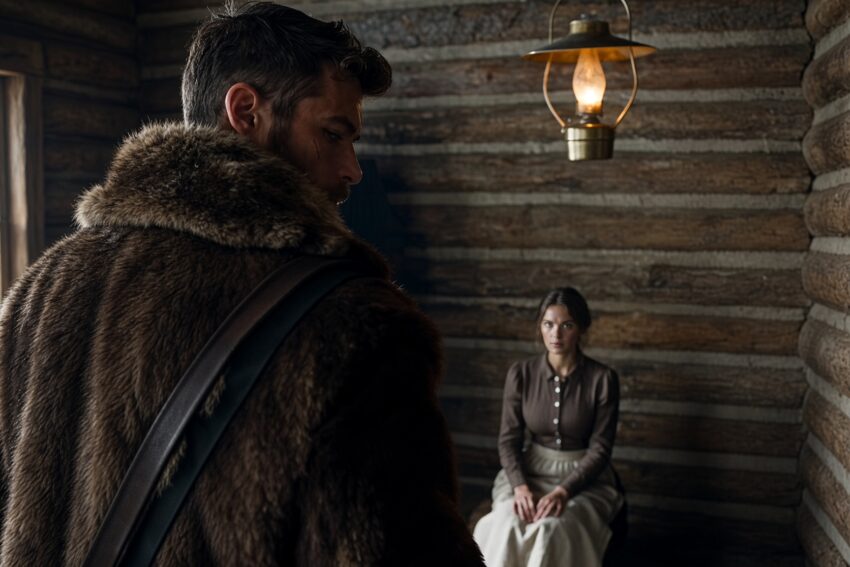
Forty pounds of flour. Twelve pounds of salted beef. A tin of black coffee. Two heavy wool blankets.
Her Father Traded Her for Winter Supplies, but the Mountain Man’s Hidden Child Revealed Why He Had Been Waiting for Her.
The first rifle shot shattered Colter Stone’s kitchen window before Clara had finished asking why a little girl hiding beneath his floorboards knew her name.
Colter threw Clara flat behind the cast-iron stove, shielded the trembling child with his broad frame, and took a lead graze across the meat of his shoulder while a harsh voice shouted from the snow outside, “Vance wants the woman breathing!”
Only then did Clara understand that the formidable mountain man had not carried her into the high timber because he had bargained for her, but because someone far worse had been hunting her long before her father ever offered her away.
Six days earlier, Clara Thorne had believed cold and starvation were the bitterest trials a woman could endure.
She was twenty-one years old, gaunt from missed meals, sitting on an overturned timber crate inside Tobias Vance’s remote trading post while ice crept across the glass panes and her father pleaded for credit.
Martin Thorne stood at the counter with both palms spread flat over the gouged oak planks.
“Just enough to carry us through until the high trapping opens.”
Vance did not even pretend to weigh the request.
“You already owe forty-five dollars on my books.”
“I’ll square it.”
“You swore that back in September.”
“The season went against me.”
“The card tables went against you.”
A few rough-handed teamsters chuckled into their collars.
Martin’s neck flushed a dark, angry red.
Clara kept her chin down.
She had learned years ago that humiliation burned out faster when a person gave it nothing to feed on.
Her mother had p.a.s.s.e.d a.w.a.y when Clara was twelve.
Her two brothers, Luke and Caleb, were said to have followed within three seasons.
Caleb had been carried off by the winter lung fever.
Luke had vanished during the high spring torrents, and Martin had ridden back from the swollen river with a single waterlogged boot, a torn mackinaw, and a silence so absolute that nobody in the settlement dared question the empty stone cairn on the hillside.
After that, Martin trapped less, gambled away whatever silver touched his palm, and let the small homestead slide into ruin.
By late November, the flour bin was empty, the firewood was down to wet bark, and there was nothing left inside the drafty cabin to barter.
Vance crossed his thick arms over his wool vest.
“No coin. No pelts. No supplies.”
Martin turned his eyes slowly toward Clara.
She knew that look.
She had seen it when he sold her mother’s treadle wheel.
When he traded away Caleb’s rifle.
When he felled the last orchard timber to burn for heat.
Now, nothing remained under his roof except her.
Before Martin could speak the thought aloud, the heavy post door swung inward beneath a hard gust of mountain wind.
The man who entered had to duck his head to clear the rough-hewn lintel.
Every low murmur in the room cut off instantly.
Colter Stone was impossible to mistake.
He stood nearly a head taller than any settler in the territory, wrapped in oil-tanned buckskin beneath an immense buffalo-fur coat, with a heavy repeating rifle resting casually under one forearm and a prime bundle of winter pelts over his shoulder.
A jagged white line crossed the left side of his weather-hardened face from temple to jaw.
His beard was dark and thick.
His eyes were cold as slate.
Frontier rumors had turned him into something monstrous.
Men claimed he had k.i.l.l.e.d three claim-jumpers with his bare hands near Bozeman and that women in town ought to step off the boardwalk when his pack string came through.
Clara had never heard his voice.
Colter crossed the plank floor and dropped the bundle of prime silver-fox and beaver hides onto the counter.
“Flour. Salted beef. Black coffee. Lead shot. Powder. Splitter’s maul.”
Vance’s face smoothed out at once.
He bowed to only two powers in the territory: hard silver and high-grade fur.
Martin looked from the glossy pelts to Colter’s broad shoulders, and a desperate calculation lit his hollow eyes.
“A solitary man like you must find it mighty quiet up on the timberline.”
Colter gave him not a word.
Martin edged closer.
“My daughter’s stout.”
Clara stared down at the split pine beneath her feet.
“Quiet, too.”
Colter did not turn his head.
“Knows how to work.”
Vance’s thin lips tightened.
Even the hardened storekeeper could read the trade Martin was shaping.
Martin swallowed hard.
Then he laid it out.
“Take her.”
The room fell so quiet that Clara could hear the dry snow scouring the outer timber walls.
Martin forced a cracked chuckle.
“Take her for the winter or take her for good. Makes no difference to me. Just settle enough provisions to keep my hearth going.”
A miner near the wood stove muttered, “Martin, for shame.”
Martin turned on him with bared teeth.
“You offering to fill my skillet?”
The miner turned his face toward the wall.
Clara did not weep.
Tears wasted water.
Tears burned up marrow.
And she had not tasted solid food in three days.
She looked instead at the stacked canvas sacks against the north wall.
Sixty pounds of flour could keep a man breathing for months if he stretched it with water.
Fifteen pounds of salted beef could keep the freeze from hollowing his frame.
Coffee could be traded for cornmeal.
Heavy wool blankets could be bartered for salt and tallow.
She understood, with a strange and chilling calm, the cold mathematics her father was running.
Then Colter turned his gaze toward her.
She braced herself for the degrading inspection men gave working mules.
Teeth.
Hips.
Shoulders.
Instead, his grey eyes stopped upon her frayed moccasins, where split seams exposed bare skin to the room’s draft.
Then her blue-chilled fingertips.
Then the sharp shadows beneath her cheekbones.
A hard stillness settled over his features.
He turned back to Vance.
“Sixty pounds of flour.”
Martin drew a sharp, trembling breath.
“Fifteen pounds of salted beef.”
Vance watched him closely.
“Black coffee.”
Colter reached into his heavy coat.
“Four heavy wool blankets.”
He laid a thick gold coin onto the oak counter with a dull, heavy ring.
“Deliver those to him.”
Martin sagged against the rail in naked relief.
Colter added, “My pelts clear my own list.”
Vance looked at the coin, then up at Colter’s unreadable face.
“No paper?”
“No.”
Martin frowned, stepping forward.
“What do you mean, no paper?”
Colter’s eyes shifted down onto him.
“You asked for winter supplies.”
“I said take the girl.”
“I heard what you said.”
“Then we ought to have something in writing.”
Colter’s voice dropped to a low, flat rumble.
“No.”
Martin pulled back.
There were men who sounded dangerous when they raised their voices.
Colter Stone sounded lethal when he lowered his.
Vance slid the heavy coin across the timber into his drawer.
“Your business is your own.”
Colter looked over at Clara.
“Come.”
She got to her feet.
Her knees shook so violently she nearly went down on the planks.
Not a single man in the room moved an inch to steady her.
Colter did not touch her arm.
That restraint unsettled her almost more than if he had gripped her by force.
She walked past her father.
Martin was already running his filthy hands over the flour sack, testing its weight.
Clara paused once at the heavy door.
Some small, foolish part of her hoped he might speak her name.
He never looked up.
She stepped out into the biting wind without looking back.
Colter’s mount was an immense draft gelding bred to break trails through drift snow.
He lifted Clara onto the saddle cantle as effortlessly as if she were a sack of meal, but his gloves touched only her bootheel and the thick wool of her sleeve.
Then he swung his heavy frame up in front of her.
“Keep a grip on the leather.”
She took hold of the saddle iron.
Never him.
She would not touch him.
They turned north into the deep spruce timber while the outpost faded into the white squall behind them.
For hours, the wagon road narrowed into a pack trail, swallowed whole by the snow.
The biting wind cut straight through the seams of Clara’s homespun dress, and as Colter rode in grim silence, she wondered if he was merely biding his time until darkness fell.
She knew what women were bartered for in the border settlements, and the quiet landscape made her fears run wild.
When Colter suddenly pulled the draft horse to a halt beneath a thick grove of red hemlocks, Clara felt the blood drain straight from her heart.
He swung his boot out of the stirrup and dropped into the drifts.
She stopped breathing.
His heavy winter boots crunched through the snow toward the flank of the horse.
Clara clutched the cantle with white knuckles, determined she would not cry out.
Colter reached behind the pack frame and loosened two heavy rawhide straps.
She flinched.
He shook out an immense, thick buffalo robe lined with dark wool.
He stepped close and draped the heavy fur around her trembling shoulders.
“Wrap it close.”
Clara looked at him, stunned.
The hide was still warm from the pack and the horse’s flank.
Colter tucked the stiff fringe around her knees, his gaze never once straying toward her body.
“You’ll lose your toes to the frost before we make the ridge.”
She managed to whisper, “Why do you care?”
His hands paused against the leather.
For an instant, something deep and guarded flickered behind his slate eyes.
“Because you’re freezing.”
He climbed back into the saddle.
That was all he said.
And somehow, that quiet answer terrified Clara more than cruelty ever could.
Cruelty was familiar.
Kindness carried a price she did not know how to tally.
At dusk, a cabin emerged from the timber, built square against a high granite bluff where snow drifted halfway up the rear logs.
It was far sturdier than Clara had pictured.
Two rooms.
A broad stone hearth.
A tight pole barn.
A split-pine woodpile stacked as straight as a surveyor’s line.
No trash.
No broken bottles.
None of the squalor she expected from the violent recluse of town rumors.
Colter carried the packs inside, struck matches to the wall lamps, and pointed toward a back room.
“You sleep in there.”
Clara looked through the door frame.
A rope bed with a straw tick.
Two clean wool blankets.
A washstand with a dry towel.
A cedar peg for a cloak.
She turned to face him.
“Where will you sleep?”
“Out here by the hearth.”
“On what?”
“Floorboards.”
She stared at him, bewildered.
“You paid a heavy price for me.”
Colter set an iron kettle over the stove top.
“I gave supplies to your father.”
“It amounts to the same thing.”
“No.”
She waited for him to finish the thought.
He used a hunting knife to slice dried beef into the kettle.
The rich scent of tallow and wild onion hit Clara’s empty belly like a fist.
Colter added water, diced potatoes, and coarse salt.
Then he spoke without turning.
“He bartered his own shame. He didn’t sell your soul.”
She could not grasp the words.
Before she could speak, a muffled scraping sound came from beneath the floor.
Clara froze.
Colter’s knife stopped over the cutting timber.
Another distinct tap.
Then a small, muffled voice drifted through the floor cracks.
“Colter?”
Colter shut his eyes for a long heartbeat.
Not in anger.
In weary resignation.
He walked across the room, dragged back a heavy grizzly hide, and hauled up a square cedar trapdoor.
Warm lamplight spilled down into a shallow earthen root cellar.
A little girl climbed slowly up the timber ladder.
She was roughly six years old, lean but well-fed, with thick brown hair braided loosely down her back and serious grey eyes that seemed far too old for her small face.
She clutched a patched cloth doll tightly against her chest.
The child looked at Clara.
Her eyes went wide, and an expression of pure, breathless hope washed over her face.
“Is she the kin Papa said would come if he was g.o.n.e?”
Clara could not draw a breath.
Colter stood rigid as stone.
The child took two running steps across the pine boards.
“Aunt Clara?”
The cabin seemed to tilt on its foundation.
The iron stove.
The winter wind.
The bearded mountain man.
All of it faded away.
Clara heard only that single, unbelievable word.
“Aunt?”
Colter spoke the girl’s name with gentle caution.
“June.”
The child threw both arms around Clara’s waist, burying her face into her apron.
Clara looked down at the child’s dark braids, her fingers trembling in the air.
She looked up at Colter.
“Whose child is this?”
He did not speak immediately.
Clara’s voice cracked, rising sharp.
“Whose child is she?”
Colter looked her squarely in the eyes.
“Luke Thorne’s.”
The brother Clara had grieved over an empty stone cairn seven years ago had left a daughter behind.
And if the girl was telling the truth, Luke had told her Clara would come for her.
Clara had no memory of backing away.
One second the girl’s arms were wrapped around her waist, and the next Clara was pressed against the timber table, her hands clutching its edge until her knuckles turned white.
“He lived?”
June looked toward Colter.
Colter answered in her place.
“He did.”
The past tense landed like a hammer.
Clara shook her head violently.
“No.”
“Clara.”
“No!”
“Your brother pulled clear of that river.”
“My father buried his coat in the dirt!”
“Your father buried a rag to cover his own lies.”
She could still hear Martin’s dry, raspy voice from seven summers ago.
The river swallowed him whole. Nothing left to drag ashore.
Clara had cried until her chest ached that night.
She had scratched Luke’s name into a slab of cedar and planted it beside Caleb’s grave.
She had spent seven long winters believing the brother who had carried her across the mud, who had slipped her dry apples from the winter bin, who had bruised his knuckles defending her name, had d.r.o.w.n.e.d in muddy torrents.
“You knew him?” she whispered.
Colter nodded slowly.
“Six years.”
“Where?”
“Up here in the high timber. Trapping the ridges. Sometimes south near Bannack.”
“Why did he stay away?”
Colter glanced down at June.
The little girl had gone quiet, watching the adults with wide, knowing eyes.
Clara dropped her voice, trembling with rage.
“Why?”
“Because Martin swore that if Luke ever showed his face along the creek, you would be the one to suffer for it.”
The color left Clara’s cheeks.
“What are you saying?”
Colter drew out a chair.
Clara would not sit.
He sat instead, making himself look smaller, less threatening in the low lamplight.
“Luke didn’t wash down that river,” Colter said.
“He left after breaking a chair over your father’s shoulders.”
Clara remembered the violent shouting that night long ago.
The shattered timber in the yard.
Luke’s bruised jaw at sunrise.
Martin staring at the floorboards, refusing to meet his son’s eyes.
“What were they fighting over?”
“Land.”
A dry, bitter laugh escaped her throat.
“We had no land. We were scraping rocks.”
“Martin didn’t own land,” Colter said.
He rose, walked to a high shelf, and took down a locked iron dispatch box.
He set it onto the pine table between them.
“Your mother did.”
Clara stared at the rusted metal.
“She came into the Montana Territory with a patent inherited from her father,” Colter said evenly. “One hundred and sixty deeded acres in Elk Basin, including the deep cold spring that feeds the lower creek.”
Clara knew the Elk Basin country—high, rich grazing timber and the only level pass through the mountains toward the western freight trail.
“What did that have to do with Luke?”
“Your mother never signed that deed over to Martin.”
“She was his wedded wife.”
“The paper stayed hers.”
Clara stared at the box.
Colter continued.
“When she passed, the acreage went straight to her children.”
“Luke and me.”
“And Caleb, until the lung fever took him.”
Her throat went dry as dust.
“Why would my father bury that?”
Colter’s hard look gave her the truth without words.
Money.
It was always money.
“Tobias Vance wanted Elk Basin,” Colter said.
“The creek?”
“The rail route. The surveyor teams have run two lines across that northern ridge. If the steel tracks cut through that gap, whoever holds the patent holds the water rights, the freight station, the timber, and every acre on either flank.”
Clara felt the floor drop beneath her feet. She sank into the pine chair.
“Vance told Martin the title was flawed,” Colter said. “Offered to buy it out for a handful of silver.”
“Could Martin sign it over?”
“Not legally. Not without the signatures of Margaret’s living blood.”
“Luke refused.”
“He told Vance to go to hell.”
“And me?”
“You were barely thirteen.”
Memories came rushing back like cold water.
Vance riding out to their homestead that dry August.
Martin ordering her to walk down to the creek and stay there.
Luke shouting through the log walls.
The sound of a heavy blow.
The puzzle had been lying before her for seven years; she had just been too young to assemble the pieces.
“What happened at the river?”
Colter’s jaw worked beneath his beard.
“Luke told Martin he was riding into the territory clerk’s office to register the original patent.”
A sick nausea rose in Clara’s throat.
“And Martin threatened him with me.”
“Yes.”
“How can you know that?”
“Luke told me himself.”
“What did Martin say?”
Colter looked toward June again.
Clara realized the child had absorbed more than enough misery.
She knelt beside the little girl.
“June, are you hungry?”
The child nodded timidly.
“Colter has beef stew on the stove.”
“He puts too much salt in it,” the girl murmured.
Colter let out a soft grunt.
A ghost of a smile touched Clara’s lips despite the knot in her chest.
“Can you set out three tin bowls for us?”
June took the chore seriously.
She carried the bowls to the rough table one by one.
While the child was occupied, Colter leaned forward, speaking in a low whisper.
“Martin told Luke that if he filed that claim, he would barter you off to Vance the hour you turned eighteen and witness whatever forged paper Vance laid on the table.”
Clara’s stomach turned over.
“He said that to his own flesh?”
“He told Luke that accidents happen to stubborn girls whose families cross powerful men.”
The warmth of the iron hearth seemed to vanish completely.
“So Luke ran.”
“He calculated that if Martin and Vance believed he had d.r.o.w.n.e.d, Vance would stop hunting him.”
“Why didn’t he take me with him?”
“He was seventeen years old, shot through the hip, penniless, and running from two bounty men Vance had put on his trail.”
Colter unconsciously touched the jagged scar along his cheekbone.
“I ran into him a year later on the outskirts of Bannack.”
“How?”
“He tried to make off with my pack horse.”
Clara blinked through her tears.
The corner of Colter’s mouth gave a faint twitch.
“He did a miserable job of it.”
For the first time since leaving the trading post, a rough laugh slipped from Clara’s throat.
“That was Luke.”
“Claimed he was only borrowing the beast.”
“That was definitely Luke.”
June scrambled onto her bench.
“My papa could borrow anything he set his eyes on.”
Colter looked at her gently.
“Eat your stew.”
The girl dipped her spoon.
Clara watched June’s small hand.
She held the iron spoon with her thumb braced high against the neck—the exact, odd habit Luke had carried since childhood.
A bloodline mark no court of law could dispute.
The tears finally broke.
One fell straight into Clara’s lap.
She wiped it away with angry haste.
June saw it.
Without a word, the child slid down from the bench, crossed the room, and placed her rag doll in Clara’s lap.
Clara broke down entirely.
She pulled the little girl against her chest and wept for Luke twice over.
Once for the boy she thought had died in the river when she was thirteen.
And once for the man who had lived six hard years beyond her reach.
Colter stood up quietly and stepped across to the dark window, giving her the gift of space.
Later, when June had fallen asleep under the heavy quilt in the back room, Clara sat back at the table.
The iron box remained open.
“How did Luke p.a.s.s?”
Colter did not dress the wound with gentle words.
“A rifle ball.”
“Vance?”
“Two of his hired men.”
Clara clenched her fists.
“When?”
“Three months back.”
“You were beside him?”
“I was.”
“Tell me.”
Colter stared into the hearth flames.
“Luke dug up an unfiled county copy in Helena proving the Elk Basin patent had never legally transferred to Martin or Vance. He also secured ledgers showing payments Vance made to falsify probate marks on three other homesteads where the owners had disappeared.”
Clara felt her blood run cold.
“He was bringing the documents up to this cabin when they cut us off at the gorge.”
“How many were there?”
“Four rifles.”
“And you two?”
“Just the two of us.”
“Luke?”
Colter met her eyes.
“Took lead in the first volley.”
She closed her eyes against the dark.
“Did he suffer through it?”
“No.”
The word came instantly, firm and sure.
Clara knew it might be mercy rather than truth, but she took it into her heart anyway.
“And the rumors in town? That you k.i.l.l.e.d a man with your bare hands in Helena?”
“One of the four broke through our line and fled south. I tracked him into a saloon in Helena two weeks later.”
“What happened?”
“I marched him to the territory marshal’s office.”
Clara stared.
“That was the whole matter?”
“He drew a hidden boot knife on the deputy.”
Colter’s jaw tightened until the scar turned white.
“I stepped between them.”
“With your bare hands?”
“I did.”
“Did he d.i.e?”
“Three mornings later.”
There it was.
The dark myth that had kept the territory in fear.
Not a lie, but the truth stripped of everything that gave it honor.
Clara looked toward the door where June was sleeping.
“You took the girl.”
“Luke asked it of me with his last breath.”
“Why you?”
“Her mother p.a.s.s.e.d two winters back. I was the only man within fifty miles he trusted to hold a rifle straight.”
A faint, tired smile touched her mouth.
Then she remembered the child’s words.
“He told her I would come.”
Colter reached into the iron box.
He lifted out three folded letters, a surveyor’s map, an old tally book, and a silver-filigree hair comb Clara recognized instantly.
Her mother’s comb.
She touched the tarnished silver with trembling fingers.
“Where did he find this?”
“Luke slipped back into your old cabin after Martin abandoned the place last spring.”
She took the topmost letter.
Across the folded paper, her name was inked in bold, hurried strokes.
CLARA.
Luke’s handwriting.
Wider, rougher than she remembered, but unmistakably his.
She held it against her palms, not ready to break the seal.
“Why were you standing in Vance’s trading post that morning?”
Colter kept his eyes on the fire.
Clara looked up.
“You knew.”
“I knew Martin was backed against the wall.”
A flare of anger rose in her chest.
“You knew my father might try to barter me away.”
“I knew he had run out of flour and credit.”
“And you stood there and waited for him to offer me like a steer?”
“I waited for him to ask Vance for winter provisions.”
“You could have ridden out to our shanty.”
“And told you what? That the brother you buried is d.e.a.d for real this time? That your father conspired with the trader who murdered him? That I had a child you never knew existed hidden in my cellar?”
“Put like that, it sounds reckless.”
“It was reckless.”
She stood up, her voice rising.
“You let me believe you bought me!”
“For three hours on the trail.”
“Three hours was an eternity!”
Colter rose to his full height.
“I know.”
“No, you don’t!”
Her voice shook with the residue of terror.
“I sat on that horse wondering when you were going to turn around and demand what your gold paid for!”
Pain crossed Colter’s face.
Not anger.
Not insulted pride.
Pure, gutting shame.
“I should have told you the minute we cleared the post yard.”
“You should never have let me believe it at all.”
“You’re right.”
His ready admission disarmed her completely.
Martin had always made excuses.
Vance had always twisted words into traps.
Colter Stone simply took the blame when it belonged on his shoulders.
Clara looked toward the dark floorboards.
“Why make the trade in front of them at all?”
“Because if I challenged Martin in Vance’s presence, Vance would have known instantly that I had come for Luke’s sister.”
“Vance watched you haul me away regardless.”
“He saw a rough mountain man taking in a starving woman from a ruined drunk.”
Colter’s voice turned hard as flint.
“Men of Vance’s breed understand possession. They don’t understand rescue.”
Clara hated the logic because it was unassailable.
“If Vance believed I took you for common chores, he’d take his time.”
“Waiting for what?”
“For me to let my guard down.”
A spruce knot popped sharply inside the stove.
Clara looked at the frosted window.
Black night pressed against the glass.
“Will he come?”
“He will.”
“When?”
Colter glanced at the repeating rifle resting on the pegs above the mantel.
“Before he thinks you have time to learn the truth.”
The answer arrived less than an hour later.
The first rifle shot blew the kitchen window into shards of flying glass.
Colter moved before the sound had even finished rolling across the clearing.
He swept the lantern dark with his sleeve, shoved Clara down behind the cast-iron stove, and lunged across the floor toward the bedroom as splintered timber showered the room.
A second heavy slug tore through the chinking.
June screamed from the back room.
Colter threw himself over the child’s bed.
A third shot ripped through his buckskin coat, carving a raw crimson furrow across his shoulder.
Clara saw the dark stain spread.
A cold, absolute calm took hold of her fear.
From the snow outside, a rough voice shouted, “Vance wants the woman breathing!”
Another voice answered, “Which one?”
Cruel laughter followed.
Clara reached for Colter’s spare rifle leaning by the woodbox.
Colter caught her wrist in the dark.
“Can you handle a lever?”
“Luke taught me before Martin bartered his gun away.”
Colter released his grip.
“Don’t waste lead.”
That was the whole instruction.
She crawled to the splintered sill while Colter shifted to the rear firing slot.
The pale moonlight reflected off the drifts, revealing five men spreading around the woodpile and the corral.
One carried a pitch-soaked pine torch.
“They’re firing the stable!” Clara hissed.
Colter leveled his barrel and fired. A man shouted, and rifle fire erupted from three sides.
June came crawling out of the back room on her hands and knees.
Clara caught the little girl by the waist.
“Into the cellar!”
The girl shook her head frantically.
“Colter said cellar only when the iron rings!”
“What iron?”
Colter fired his last round through the slit, seized the heavy iron stove poker, and struck the iron rim of the hearth plate three times.
CLANG. CLANG. CLANG.
At the signal, June yanked the trapdoor wide.
Colter had prepared for this siege long before tonight.
“Get down!” he ordered.
“What about you?” Clara demanded.
“Move!”
Clara despised commands.
Her father had used orders like chains to break her spirit.
From Colter, it was the sound of a man putting his flesh between her and a bullet.
She hurried June down the cedar rungs.
Pungent woodsmoke began curling under the outer door.
The dry shakes of the stable roof caught, illuminating the yard in orange flame.
Colter fired one last warning shot through the smoke, snatched the iron dispatch box from the table, and dropped into the cellar opening.
“Down.”
He slammed the cedar door shut and dropped the timber bar into place.
Pitch-black darkness swallowed them.
June took Clara’s hand in the dark.
“This way to the trench.”
Of course there was an escape trench.
Colter Stone lived as though peace were only a brief lull between wars.
They crawled through the narrow, frozen earth ditch while timber timbers crackled and popped above their heads.
Colter brought up the rear, his breathing heavy as b.l.o.o.d soaked through the left arm of his coat.
The trench opened into a steep, timbered draw forty yards behind the homestead.
The biting night air hit their faces.
They scrambled up through a thick barrier of fir branches.
Looking back from the crest, Clara watched orange flames devour the cabin roof while a tracker shouted down below, “The place is empty! They’re in the timber!”
Colter leaned heavily against a pine trunk, his face pale under his dark beard.
Clara touched his shoulder.
Her fingers came back dark and wet.
“You took lead.”
“Just grazed the meat.”
“You’re losing b.l.o.o.d.”
“So do badgers. Doesn’t mean they stop fighting.”
“Sit down on that log.”
Colter looked at her through the dark.
“That sounded like an order.”
“It was.”
For a fleeting second, despite the burning homestead behind them, the corner of his scarred lip twitched.
Then he sank onto the fallen pine.
Clara ripped a wide strip from her linen apron, packed the tear with clean snow to check the flow, and bound the linen tight around his shoulder.
June whispered from the shadows, “Papa said Aunt Clara was fierce.”
“Luke said that?”
“All the time.”
Clara let out a breath that was half laugh, half sob. In the freezing night, the timber draw felt warmer than it had any right to be.
A shout echoed from the ridge above the cabin.
Colter’s eyes hardened.
“We move.”
“Where can we go in this drift?”
“Old trapping shack. Three miles north along the rim.”
“Can you make that distance?”
“Cabin’s gone,” he said simply. “We freeze if we stand here.”
Clara looked back at the fire consuming the cabin roof.
The shelter where she had expected to be mistreated was turning to ash before her eyes.
And to her surprise, grief tightened in her chest.
Not because it was a fine house.
Because for six days, it had nearly become a home.
They reached the abandoned trapper’s shack just as the eastern sky turned the color of bruised iron.
It was nothing more than four cedar walls and a rusted stove pipe, but Colter found dry pitch-pine under the bunk, and Clara cleaned his wound while June curled beneath the buffalo robe.
“Vance will figure we took the south trail to town,” Clara said, tending the small flame.
“He’ll throw riders across the freight road.”
“Then how do we bring this to an end?”
Colter looked at the iron box resting on the dirt floor.
“We hand him what he’s looking for.”
Clara stared at him.
“Give him the patent?”
“Not the court papers.”
He nodded toward the rag doll June was holding in her sleep.
“The piece Luke hid where no gunman would think to pry.”
June stirred and woke at the words.
“No,” the child whispered, pulling the doll against her ribs.
Colter’s rough features softened.
“Your papa told you a day might come when we had to show it.”
June clutched the faded cloth.
Clara knelt beside the bunk.
“What is inside the doll, June?”
The little girl’s chin trembled.
“Papa’s secret.”
Clara did not try to pull it away.
“Will you show me?”
After a long silence, June nodded slowly.
Beneath the doll’s left arm, a seam had been closed with coarse, uneven stitches.
Clara cut the thread with Colter’s blade.
Inside the wool stuffing lay a folded square of greased oilskin.
She spread it flat across her knee.
The territory seal showed clear in the gray morning light.
Signatures.
And behind it, a second folded document.
Colter exhaled slowly.
“Luke found the original territory grant.”
Clara read the names line by line.
Her mother, Margaret Thorne, had never deeded away an inch of Elk Basin.
At her passing, full title passed directly to Luke and Clara.
A later addendum showed that Luke had legally conveyed his share to June before his final ride.
Tobias Vance held nothing.
Martin Thorne held nothing.
Clara turned to the second page.
It was a sworn deposition signed by the deputy county clerk.
It laid out in precise detail how Tobias Vance had paid gold to alter the territory registry and forge Martin Thorne’s mark across the title.
And at the foot of the parchment was a final signature.
A witness.
Martin Thorne.
Clara stopped breathing.
“My father signed this.”
Colter leaned over her shoulder.
The ink was dated four months earlier.
Martin had known.
He had confessed the forgery to the clerk.
“He was going to testify against Vance,” Clara whispered, her mind spinning.
Colter’s brow furrowed.
“Then why did he offer you across the counter?”
Clara saw it clearly before Colter did.
“He wasn’t selling me into servitude.”
She remembered Martin shouting across the post.
She had heard only cold greed because she had expected nothing else from him.
Now the terrifying truth broke through.
“He knew Vance’s scouts were watching him,” Clara said, her voice shaking. “If Father knew Luke was gone, and that Vance’s men had k.i.l.l.e.d him… he knew I was the last signature left.”
Colter went completely still.
Clara went on.
“Martin knew Vance would arrange an accident for me the minute the snow locked the roads.”
“Martin never sent word to Luke about this paper.”
“He was terrified.”
Clara remembered her father’s eyes when he looked at her across the sacks of meal.
It had not been cold greed.
It had been sheer, desperate terror.
June whispered from the bunk, “Is Grandpa evil?”
Clara looked down at the little girl.
“Sometimes people do wrong for so long that one decent act cannot make them whole.”
June thought about that for a second.
“Did he do a decent act?”
Clara folded the oilskin carefully.
“I think we are about to find out.”
They did not follow the main road down the valley.
Colter guided them south through the thick hemlock draws, across an iced-over creek, and down an old timber skid that brought them behind the blacksmith’s yard at Vance’s settlement.
By midday, thick flakes were falling again.
They crested the rise above the trading post just as the shadows lengthened.
Two horses stood tied to the front hitching rail.
One was Vance’s heavy bay.
The other was an old pack mule Clara recognized instantly.
Her father’s mule.
Colter checked his rifle breech.
“Stay with June in the shed.”
“No.”
“Clara.”
“No!”
Her jaw was set as firm as granite.
“You bought my father’s choice, remember? Not mine.”
A quiet look of respect crossed Colter’s eyes.
He gave a single nod.
“Walk in my shadow.”
“I can do that.”
They stepped quietly through the rear storage door.
Muffled voices drifted through the timber partition.
Vance’s voice came first, sharp and vicious.
“You should have stuck to your card games, Martin.”
Then Martin’s broken rasp.
“You should have left my boy out of the ground.”
Clara halted in her tracks.
Colter’s hand rested gently on her arm.
They listened through the cedar cracks.
Vance let out a dry, mocking laugh.
“Your boy tried to steal land that belongs to the railroad.”
“My boy carried proof of what you forged.”
“And now your daughter holds it.”
Martin made no reply.
The sound of a heavy fist striking flesh echoed through the room.
Clara flinched.
Vance sneered, “You think Stone carried her off to keep her safe? He dragged her into the mountains like a piece of livestock.”
Another blow landed.
“He tucked her away where my riders couldn’t miss her.”
Colter’s eyes narrowed.
Vance’s trackers had known where to look.
A heavy silence followed.
Then Martin let out a wet, wheezing laugh.
“You still don’t know Colter Stone.”
“What’s that supposed to mean?”
“He never keeps what matters where greedy men look.”
Colter glanced at Clara.
Martin had just warned them without knowing they were ten feet away.
Vance barked, “Where did she take the oilskin?”
Martin spat blood onto the floor. “Somewhere your bloody hands won’t touch.”
The metallic click of a revolver hammer cocking broke the room.
Clara moved before Colter could catch her sleeve.
She kicked the partition door open.
“Put it on the counter, Vance!”
Vance spun around, gun in hand.
Martin was bound to a heavy oak chair beside the cold stove, blood running from his split lip.
For the first time in Clara’s memory, her father looked at her with pure, unvarnished relief.
Then his eyes drifted down to June, who stepped out behind Colter.
Martin’s weathered face crumbled.
“Luke’s girl…”
June tucked herself behind Colter’s leg.
Vance leveled the pistol at Clara’s chest.
Colter raised his repeating rifle faster.
The hammer locked with a deafening click.
Nobody in the room dared draw breath.
Clara stepped across the floorboards, holding the oilskin papers high in her right hand.
Vance’s eyes locked onto the seal.
“Hand those here.”
“No.”
“Your father traded you for sixty pounds of meal, girl.”
Martin bowed his gray head.
Clara looked straight at Vance.
“He bartered his own shame. He didn’t sell me.”
Colter looked down at her. She had taken his words and forged them into iron.
Vance gave a cold, nervous grin.
“You think a scrap of parchment keeps you breathing?”
“The original doesn’t,” Clara said, laying the papers flat on the counter. “The territory copies do.”
Vance’s grin vanished.
Colter had dispatched Luke’s preliminary evidence to the federal land registrar in Helena weeks before.
The missing grant from June’s doll was the final seal.
And all Clara needed was a witness.
Footsteps crunched heavily in the snow outside.
Lantern light flooded through the front panes as Sheriff Silas Ward stepped through the door, flanked by three armed deputies and the territory clerk.
Vance’s face twisted into sheer panic.
He swung his revolver toward June.
Colter fired.
The heavy bullet shattered Vance’s wrist.
The pistol flew across the boards, firing wild into the ceiling.
Martin lunged sideways, chair and all, slamming his weight into Vance’s knees and sending the trader crashing into the flour barrels.
Deputies swarmed the floor, pinning Vance in the spilled meal.
The struggle ended almost quietly once the law filled the room.
Vance was shackled, his hired men were rounded up over the following weeks, and the territorial court reopened land ledgers stretching across five counties.
Martin Thorne survived his beating.
Clara visited him three afternoons later in the physician’s back quarters.
He sat on the edge of the cot, his hands trembling as he stared at the bare floor.
“You knew Luke had lived,” she said quietly.
“For nearly a year before the end.”
The truth stung like salt in an open cut.
“You never sent word to me.”
“He made me swear on his life. He knew Vance would watch you.”
“You chose his silence over my life.”
Martin shook his head, staring at his boots.
“I chose fear. I was a coward, Clara.”
It was the most honest word she had ever heard him utter.
“Why did you put your name to the clerk’s paper?”
“Because Luke stood over me with the truth and made me see what kind of wretch I had become.”
Martin looked toward the window.
“When Stone walked into Vance’s post, I knew the scar from Luke’s description. I knew who he was.”
“You knew Colter would take the trade?”
“I gambled that he would understand the play.”
Clara’s jaw tightened.
“You made it look foul. You made me look like an animal.”
“I had to make Vance believe it was a trade, or he would have shot us both before sundown.”
“It was still a cruel thing to do.”
“I know.”
Martin looked up, his eyes wet.
“I ain’t asking you to forgive me, Clara.”
“Good.”
“I spent your whole life earning your hatred.”
She turned toward the door.
Martin called out softly, “Clara.”
She paused at the sill.
“For what it’s worth… my heart nearly burst with relief when Colter put that coin down.”
She looked back over her shoulder.
“That relief is worth less than sixty pounds of flour.”
Martin nodded slowly, accepting the blow.
“That’s fair.”
She walked out into the winter sunlight.
Forgiveness was not a debt she owed simply because an old man had finally spoken the truth.
Spring broke late across the high ridges.
Colter rebuilt the cabin.
He did not raise the timbers alone.
Clara refused to stay behind in town.
So did June.
By late April, the three of them had set fresh ponderosa logs upon the stone foundation.
The new homestead featured a deeper root cellar, a wide kitchen window that caught the morning sun, and separate bunks for Clara and June.
Colter still slept rolled in his buffalo robe across the main hearth.
On a mild evening in May, Clara found him mending a harness by the corral gate.
“You know,” she said, leaning against the cedar post, “most men who supposedly buy a woman make far more demands.”
Colter did not look up from his leather stitch.
“I thought that business was settled.”
“It was.”
“Then why bring it up?”
“Because you’ve slept on hard timber for six months.”
“I have a wool blanket.”
“So did I when my father offered me away.”
Colter’s awl stopped mid-stitch.
Clara sat down on the cedar rail beside him.
Down by the creek, June’s laughter drifted on the breeze as she chased water bugs along the shale.
“Luke trusted you,” Clara said softly.
Colter gave a slow nod.
“So does June.”
Another nod.
“And so do I.”
He lifted his head, his slate eyes meeting hers.
The white scar that had once looked so terrifying across the counter had simply become part of the man she knew.
“That sounds like dangerous ground,” he said.
“It probably is.”
She smiled.
Colter did not smile.
Not yet.
“I won’t have gratitude taken for something else, Clara.”
“It isn’t gratitude.”
“Clara—”
She reached out and took his scarred, calloused hand.
He looked down at their joined fingers.
“I spent twenty-one years being told what men wanted from me,” she said, her voice steady and clear.
“My father wanted my labor.”
“Vance wanted my inheritance.”
“The settlement wanted my silence.”
Her fingers tightened around his.
“You were the first man who ever gave me a choice before asking what I would give in return.”
Colter looked up into her face.
“So I am choosing.”
He waited in silence.
Clara leaned in and kissed his weathered cheek.
Briefly.
Gently.
Long enough to make the massive mountain man look more unsettled than he had under gunfire.
June’s shout rang out from the creek.
“Did you do it yet?”
Clara pulled back, laughing.
Colter shut his eyes.
“She has been crouched behind that willow tree for twenty minutes.”
June bounded out of the brush, grinning from ear to ear.
Clara laughed until her ribs ached.
That summer, the territorial court confirmed the Elk Basin patent.
Half the acreage belonged to Clara.
Half belonged to June.
Martin Thorne held no claim to a single foot of timber.
Neither did Colter.
When Clara told him the court had cleared the title, he merely grunted and asked if she wanted the north fence extended.
They married in September under the spruce trees.
Not because the winter demanded it.
Not because the land required it.
Not because a father, a trader, or a dead brother’s letter had arranged it.
Clara married Colter Stone because for the first time in her life, the choice belonged entirely to her.
After the quiet vows, the territory marshal handed Clara the yellowed ledger slip from Vance’s old store.
It recorded sixty pounds of flour, fifteen pounds of salted beef, black coffee, and four blankets, paid in full by Colter Stone.
Beneath the tally, a single line written in Colter’s hand stated that no person, labor, or debt had been transferred.
“Colter refused to let Vance write your name on that page from the very start,” the marshal told her.
Clara looked across the grass.
Colter was standing beside June beneath the tall pines, adjusting the stirrup on the draft horse.
The terrifying mountain man everyone had warned her against.
The man who had laid down gold for supplies, but refused to purchase a human soul.
The man who had looked upon a starving woman and seen not a trade, but someone who needed enough warmth to choose her own road.
Clara folded the receipt and tucked it into her pocket.
Then she walked across the sunlit yard toward him.
In later years, folk in the territory still whispered that Colter Stone had once bought a woman for flour, salted beef, coffee, and blankets.
Whenever Clara heard the tale, she shook her head.
“No,” she would tell them. “He never bought me.”
And when they asked what the mountain man had truly paid for on that freezing December morning, Clara gave the same answer:
“Time.”
Time for a father to face his sins, time for a little girl’s secret to reach the light, time for the law to catch up with greed, and time for Clara to learn that shelter was not ownership.
On the night before their wedding, Colter had given Clara the final letter Luke had left behind, with strict orders that it should only be opened if she chose of her own will to stay.
The last sentence was brief.
If my sister ever comes to care for you, Colter, don’t you dare take the credit for it; because Clara has never done a single thing in this life just because a Thorne told her to.
Clara had read it twice through tears, then laughed out loud.
Luke, gone from the earth and still refusing to let any man steer her life.
She laid the letter beside her mother’s silver comb on the mantle.
Outside, Colter was splitting cedar firewood.
June was bossing him about the height of the woodpile.
The evening sun was turning the high mountain crags into molten gold.
Clara stepped onto the porch and looked out across the valley.
Nothing here belonged to the tragedy she had feared.
Not the little girl calling her aunt.
Not the husband who asked her leave before touching her hand.
Not the deed bearing her own name.
The strangest truth of all was that the darkest day of Clara Thorne’s life had begun with her father calculating her value in winter rations.
Sixty pounds of flour.
Fifteen pounds of salted beef.
Coffee.
Four blankets.
It had taken a hard year to learn what no merchant’s ledger could ever record.
Her father had not set her worth.
Tobias Vance had not set it.
Colter Stone had never even tried.
And that was why, when Clara finally chose where her life belonged, she chose the mountain giant who had been terrifying enough to drive away everyone who sought to cage her, and gentle enough never to close a hand around her.
DISCLAIMER: This story is a work of fiction created solely for entertainment purposes. The characters, organizations, dialogue, and incidents portrayed in this narrative are entirely fictional. Any resemblance to actual persons, living or d.e.a.d, real historical figures, or actual events is completely coincidental.