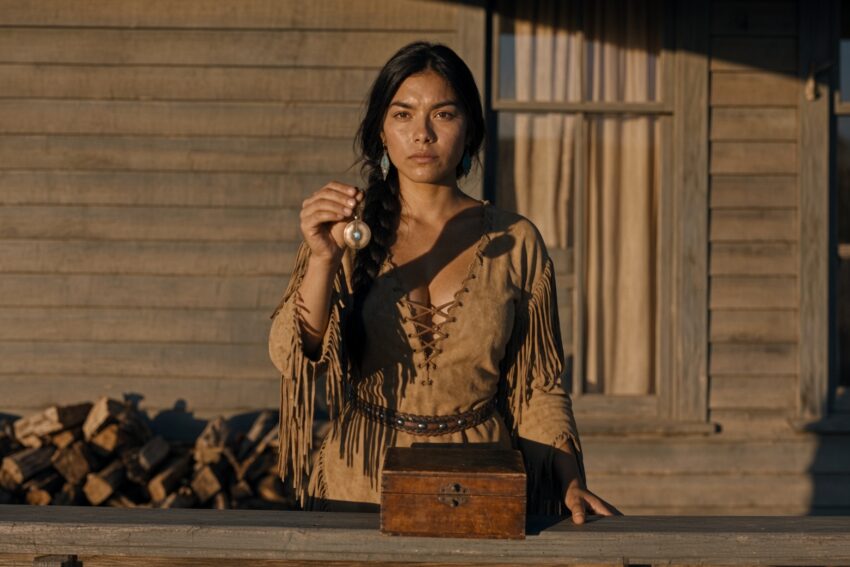
The Woman Who Came With Over 300 Apache Riders Asked Why Cole Harlan’s Mother Had Been Buried Under Another Family’s Name
PART ONE — THE NECKLACE BENEATH THE FLOOR
The riders showed up just after noon, when the Arizona heat had turned the distance white and shaky.
Cole Harlan was fixing a broken gate on the south pasture when his ranch hand, Owen Bell, came running from the rise.
“Cole.”
Something in Owen’s voice made him drop the hammer.
“What?”
“You better come see.”
Cole climbed the hill expecting cattle thieves, a brush fire, maybe soldiers from the territorial road patrol.
Instead, he saw riders.
Hundreds of them.
They stretched across the valley in a long, quiet line, horses walking under a haze of dust. At first Cole could not count them. Then he stopped trying.
Three hundred, maybe more.
Later he would learn there were a little over three hundred.
Apache men and women rode among pack horses carrying blankets, cooking pots, bundles, and children. This was no raiding party. It looked more like an entire community on the move.
Yet the sight still sent every ranch hand within shouting distance reaching for a rifle.
Cole turned sharply.
“Put them down.”
Owen stared at him.
“There’s hundreds.”
“And if they meant to k.i.l.l us, Owen, those rifles wouldn’t change much.”
That silenced him.
The riders stopped a hundred yards from the ranch house.
One woman continued alone.
She was perhaps twenty-five, maybe a little older, riding a chestnut mare with a scar down its left shoulder. Her black hair was tied low beneath a plain scarf. She wore no ceremonial ornament Cole could recognize, only a weathered riding coat, soft boots, and the look of someone who had crossed too much country to waste words.
She stopped before him.
“You are Harlan?”
“Cole Harlan.”
Her gaze moved across his face.
Not suspiciously.
Searchingly.
“I expected your father.”
“He’s d.e.@.d.”
Something changed in her expression.
“When?”
“Eight years ago.”
The woman looked toward the ranch house, then toward the dry willows lining the wash.
“My name is Tala.”
Cole nodded once.
“You brought a lot of people to ask after a d.e.@.d man.”
“They are not here for him.”
“Then why are they here?”
Tala reached beneath her coat.
Owen lifted his rifle.
Cole shoved the barrel downward.
She drew out a necklace.
Silver.
Turquoise.
Three flat stones set in hammered metal.
The center stone had a tiny crack running diagonally through it.
Cole forgot the riders.
Forgot the heat.
Forgot Owen breathing behind him.
His mother had worn that necklace every week of his childhood.
She wore it the day she taught him to read his first full sentence from a church pamphlet.
She wore it the morning she packed biscuits for his father before a cattle drive.
She wore it the last evening Cole ever saw her alive.
He had been nine.
“Where did you get that?”
Tala looked at the necklace.
“Buried beneath my grandmother’s house.”
“That was my mother’s.”
“I know.”
The answer struck harder than denial would have.
Cole stepped forward.
“How?”
“My grandmother p.a.s.s.e.d last winter. Before she was g.o.n.e, she told me there was something beneath one floor stone. She said if anyone named Harlan still lived near the old willow bend, I was to bring it here.”
Cole glanced toward the dry creek.
His father had purchased the ranch beside that bend thirty-one years earlier.
“What was your grandmother’s name?”
“Naichela.”
He searched his memory.
Nothing.
“My father never mentioned her.”
“I do not think he would have.”
Tala untied a leather pouch from her saddle and gave it to him.
Inside was a small cedar box darkened with age.
Cole opened it.
The necklace lay on top.
Beneath it were two folded letters and a photograph.
The photograph made his knees feel weak.
Two women stood before an adobe wall.
One was Tala’s grandmother, younger by decades, with the same steady eyes.
The other was Margaret Harlan.
Cole’s mother.
They had their arms linked together.
They were smiling.
Not politely.
Not like strangers forced into a photograph.
Like friends.
Cole heard his father’s voice from twenty years earlier.
Your mother never went near those camps.
She was afraid of them.
She should have listened to me.
Cole looked at Tala.
“My father said she never knew any Apache families.”
Tala’s mouth tightened.
“Your father said many things.”
Cole opened the first letter.
The writing was unmistakable.
Margaret’s long loops.
Her habit of pressing too hard on capital letters.
Cole had not seen that hand since childhood.
He read.
Naichela,
If I am right, the county records have been changed. Not only ours. Yours. The Romero family’s. The Barrows parcel. Perhaps more.
I found the original survey descriptions in Amos Vale’s storage ledger. Someone has moved boundaries on paper while leaving the old markers buried in the ground.
Thomas knows I found them.
I am afraid of what he will do if he realizes how much I understand.
I am not afraid of your people.
I am afraid of the men in town who smile at me in church.
Cole stopped.
Thomas.
His father.
He looked up.
“Did my mother come to your village?”
Tala nodded.
“One night.”
“When?”
“Twenty years ago.”
“And then?”
Tala hesitated.
Behind her, the riders remained spread across the valley, strangely patient.
“She left before sunrise with my grandmother.”
“Where?”
Tala handed him the second letter.
Three words were written across the front.
FOR MY SON.
Cole stared at them.
The world narrowed to that envelope.
He broke the seal.
Inside were only four lines.
Cole,
If you ever read this, your father has already made me disappear.
Do not hate him before you know why.
Go to the grave marked Anna Bell at San Miguel Mission.
Take Naichela with you if she still lives.
Your mother.
Cole read it twice.
Then a third time.
Owen said quietly, “Anna Bell?”
Cole knew the name.
Everyone near Willow Bend did.
Anna Bell had supposedly been a fever victim buried at the abandoned mission twenty miles east.
He had passed the grave as a boy.
Once, his father had made him take off his hat beside it.
Cole looked at Tala.
“You knew about the grave?”
“My grandmother did.”
“Why didn’t she come herself?”
“She could not return there.”
“Why?”
Tala looked beyond him toward the ranch.
“Because the last time she came near your land, your father fired over her horse and told her if she returned, he would have her arrested for stealing your mother’s necklace.”
Cole felt anger rise.
“Maybe she did steal it.”
Tala did not flinch.
“Then ride with me to the grave and prove it.”
He hated the calmness of that answer.
It left him nowhere to hide.
Before he could respond, another rider broke from the distant line and approached.
An older Apache man with gray at his temples stopped beside Tala.
They exchanged a few words Cole did not understand.
Tala’s eyes changed.
“What?”
She turned toward the west road.
“A rider is coming from town.”
Within minutes, a horseman appeared through the dust.
Deputy Caleb Voss.
Cole knew him well enough to dislike him.
Voss rode beneath Sheriff Amos Vale, the same Amos Vale named in Margaret’s letter.
The deputy stopped at the sight of the Apache gathering.
His face drained.
“What in God’s name is this?”
“No trouble,” Cole said.
Voss ignored him and looked at Tala.
“You people need to clear off Harlan land.”
Tala said nothing.
Voss pointed toward the valley.
“You heard me.”
Cole stepped between them.
“They’re my guests.”
Voss laughed once.
“Since when?”
“Since now.”
That surprised Owen almost as much as it surprised Voss.
The deputy leaned closer.
“You don’t know what you’re inviting.”
Cole thought of the photograph.
The letter.
His father’s name.
“I’m beginning to think I don’t know much of anything.”
Voss’s eyes dropped to the cedar box in Cole’s hand.
For one instant, the deputy’s entire face changed.
Recognition.
Fear.
Then it vanished.
But Cole had seen it.
“What’s wrong, Caleb?”
“Nothing.”
“You’ve seen this box.”
“No.”
“You looked at it like a rattlesnake.”
Voss turned his horse.
“Sheriff Vale needs to hear about this.”
Tala spoke for the first time since his arrival.
“Why?”
Voss looked back.
“Because people who dig up old things sometimes find trouble attached.”
He rode away.
Cole watched the dust trail disappear.
Then he looked down at the cedar box.
The first small question had been answered.
His mother had known Tala’s grandmother.
But now a larger one had taken its place.
Why was a deputy afraid of a box buried for twenty years?
And why had Margaret Harlan written that her own husband had made her disappear?
That evening, Cole stood at his mother’s old bedroom window while hundreds of Apache travelers camped beyond his pasture fence.
For the first time in his life, the ranch did not feel inherited.
It felt occupied by ghosts.
At dawn, he saddled his horse.
Tala was already waiting.
“San Miguel?” she asked.
Cole touched the necklace beneath his shirt.
“San Miguel.”
Neither of them saw Owen Bell ride west toward town.
PART TWO — THE GRAVE WITH THE WRONG NAME
San Miguel Mission had been abandoned before Cole was born.
The roof had collapsed on one side. Wind had eaten the wooden doors gray. A broken bell hung crooked in the square tower and moved without ringing whenever the desert gusts came hard from the south.
Cole and Tala reached it before noon.
Only three riders had come with them: the gray-haired man named Taza, Tala’s younger cousin Loni, and a widowed ranch worker from Cole’s place named Miguel Serrano, who had refused to let Cole ride toward a twenty-year-old mystery without another man who knew the country.
“Anna Bell is there,” Miguel said, pointing toward the graveyard.
A dozen markers stood behind a low stone wall.
One was newer than the rest.
ANNA BELL
1847–1876
Cole dismounted.
Tala stayed in the saddle.
“You coming?”
“Soon.”
“What are you waiting for?”
Her eyes remained on the grave.
“My grandmother hated this place.”
That was answer enough.
Cole walked toward the marker.
He had stood there once before, holding his father’s hand.
He had been eight, maybe younger.
Thomas Harlan had removed his hat and stared at the ground.
Cole had asked who Anna Bell was.
His father had answered, Someone who deserved better.
Cole had forgotten that moment.
Now it returned whole.
The wind.
His father’s rough hand.
The smell of horse sweat.
The grave.
Someone who deserved better.
Cole turned sharply.
Tala had finally dismounted.
“What did your grandmother say was buried here?”
“She never told me.”
“So we dig?”
Taza spoke quietly to Tala.
She nodded.
“He says we should look first.”
“For what?”
Taza walked beyond the marker and knelt beside the grave.
He scraped away dirt with a short blade.
A stone appeared beneath the sand.
Not a grave stone.
A survey stone.
Miguel crouched beside him.
“Well, I’ll be damned.”
A cross and number had been carved into the surface.
Miguel brushed it clean.
“County boundary marker.”
Cole stared.
“What’s it doing under a grave?”
Miguel stood.
“Better question is who buried a grave over a survey marker.”
That was the first payoff.
Margaret had not sent Cole to San Miguel only to find a body.
She had sent him to a boundary.
Tala walked around the marker, studying the ground.
“My grandmother said men changed the land without moving the mountains.”
Cole looked at the number carved into the stone.
“Can you read that?”
Miguel nodded.
“Survey designation. Old style.”
“Meaning?”
“Meaning if this is where I think it is, your south fence is nearly four miles too far east.”
Cole went still.
“That would put half my grazing land—”
“Outside the parcel your father bought.”
Tala finished the thought.
For years Cole had defended Harlan Ranch against neighboring claims.
He had cursed small farmers who complained that his cattle crossed their land.
He had driven off families who insisted his fence was wrong.
Once, he had nearly punched an old Mexican shepherd for calling Thomas Harlan a thief.
Now a stone beneath a grave suggested the old man had been telling the truth.
A hoof struck rock outside the wall.
Loni whistled sharply.
Six riders appeared from the western trail.
Sheriff Amos Vale led them.
He was sixty-three and still carried himself like a man who believed no door had the right to remain closed to him.
Owen Bell rode behind him.
Cole looked at Owen.
The ranch hand would not meet his eyes.
Vale stopped.
“You boys planning to rob the d.e.@.d?”
Miguel muttered, “Could ask you the same.”
Vale heard him.
“What was that?”
Cole stepped forward.
“Why is a survey marker under this grave?”
Vale glanced at the stone.
His expression did not change.
“Old country’s full of markers.”
“My mother wrote about altered county surveys.”
That changed him.
Only slightly.
But enough.
“Your mother was sick near the end.”
“She wasn’t sick.”
“She was frightened, confused.”
“Of you?”
Vale’s eyes hardened.
Tala came through the gate.
Vale’s deputies shifted in their saddles.
Cole noticed.
Not because Tala threatened them.
Because her presence frightened them.
Vale pointed toward the grave.
“That woman’s people have no business here.”
Tala answered evenly.
“My grandmother put that woman in the ground.”
Silence.
Cole turned.
“What?”
Tala’s voice lowered.
“She told me only once. Your mother was brought here injured.”
“How?”
“She had fallen from a horse.”
Vale said quickly, “That’s enough.”
Everyone looked at him.
Too quickly.
Too sharply.
Tala saw it too.
“You knew.”
Vale dismounted.
“I knew Margaret Harlan had an accident.”
“You told the county she left her husband.”
“I told the county what Thomas told me.”
“Then why is she buried as Anna Bell?”
Vale looked at Cole.
For the first time, the sheriff seemed tired.
“Because your father asked me to bury the matter.”
Cole moved before he knew he had.
Miguel caught his arm.
“Easy.”
“My father asked you to hide my mother’s grave?”
Vale’s hand hovered near his belt, not drawing, only reminding.
“Yes.”
“Why?”
“Because if people knew where she d.i.e.d, they would ask who she was with.”
Cole looked at Tala.
“And?”
Vale’s jaw tightened.
“She was with Naichela.”
There it was.
The old story cracked open.
Not enough to reveal what lay inside.
Enough to show it had always been false.
Cole said, “Open the grave.”
Vale stared at him.
“No.”
“Then I will.”
“You disturb that grave and I’ll arrest you.”
“For what?”
“For grave desecration.”
Miguel laughed without humor.
“That county law didn’t trouble you when you put the wrong name on it.”
Vale’s face reddened.
Cole stepped close.
“You’ve spent twenty years protecting something. I want to know what.”
Vale spoke softly.
“You think truth is always useful because you haven’t lived with enough of it.”
Then he turned to his deputies.
“Ride back.”
Cole blinked.
“You’re leaving?”
Vale looked at the survey stone.
“You already found more than Thomas ever wanted you to.”
“Who moved the boundaries?”
Vale mounted.
“Ask your father.”
“He’s d.e.@.d.”
“Then ask the books he left behind.”
The sheriff rode away.
Owen lingered.
“Cole—”
“You told him.”
“I thought there might be trouble.”
“There is now.”
Owen swallowed and followed the others.
Tala watched him go.
“You trust that man?”
“Yesterday I did.”
They did not open the grave.
Not yet.
Instead, Cole returned to the ranch and did something his father had forbidden throughout his childhood.
He opened Thomas Harlan’s locked desk.
The key had hung unnoticed on the same nail in the pantry for eight years.
Inside were tax receipts, cattle accounts, letters from livestock buyers, and an old ledger with Sheriff Vale’s name written on the first page.
Amos Vale Survey & Freight, 1873.
Cole carried it to the kitchen table.
Tala sat across from him.
Outside, children from her traveling group carried water with several Harlan ranch hands. No one had ordered the cooperation. It had simply begun when one of Cole’s wells developed a broken pump rod.
Miguel opened the ledger.
“Here.”
Payments.
Small at first.
Then larger.
T. Harlan — boundary adjustment.
H. Barrows — clerical correction.
County office — filing expense.
Romero parcel — transfer.
Tala pointed to another mark.
“What is that symbol?”
Cole knew it.
His father had branded every calf on Harlan Ranch with a forked-H.
The ledger contained the same mark beside six land transfers.
“They used the ranch brand to mark completed deals.”
Tala sat back.
“Your mother discovered this.”
“Looks that way.”
Cole turned pages faster.
Then stopped.
One entry carried no payment.
Naichela — Willow Bend water passage.
Beside it, Thomas had written:
REFUSED.
Below that:
M.H. objects.
Margaret Harlan objects.
Cole’s throat tightened.
The central conflict was no longer simply about a woman who was g.o.n.e.
It was about water.
Willow Bend sat over the only dependable shallow wells for miles in dry years.
If Thomas and Vale had altered boundaries, they had not merely stolen pasture.
They had controlled who reached water.
Tala touched the page.
“My grandmother said your mother argued with a man at the crossing.”
“Thomas?”
“She never gave me the name.”
Cole looked out the window toward the Apache camp.
“Why bring more than three hundred people?”
Tala was quiet for a moment.
Then she answered.
“Because the springs east of Black Mesa are failing. Families from three separate groups are moving south for winter grazing and safer water.”
Cole frowned.
“You want access across my ranch.”
“We want access across land that may never have been yours.”
That landed harder than accusation.
Cole pushed away from the table.
“So that’s why you came.”
“I came because of the necklace.”
“You also came because you needed something.”
“Yes.”
“You might have mentioned that.”
“You might have believed I invented the necklace to force you.”
He could not deny it.
Their first real alliance cracked before it had formed.
That night, Cole walked the pasture alone.
At the water trough he found a boy from Tala’s group trying to repair a loose strap on a small bay pony.
Cole almost kept walking.
Then the boy’s rope snapped.
The pony jerked loose.
Cole caught it by the halter.
The boy stared at him.
“Thanks.”
His English was clear.
Cole handed him the rope.
“What’s your name?”
“Ben.”
Cole smiled despite himself.
“Not what I expected.”
Ben grinned.
“My mother says Americans hear one Apache name and immediately hurt themselves trying to say it.”
Cole laughed.
It surprised both of them.
The boy showed him how the saddle strap had torn.
Cole brought leather from the barn and repaired it.
A small thing.
No mystery.
No revelation.
But when he returned the saddle, Tala stood near the fence watching.
Something in her expression had softened.
Not trust.
Perhaps the beginning of it.
The next morning, Sheriff Vale returned alone.
No deputies.
No badge on his coat.
He entered the ranch house carrying a rolled map.
“I came to tell the truth,” he said.
Cole did not invite him to sit.
“You’ve had twenty years.”
“I spent twenty years hoping you’d never need it.”
Tala entered behind Cole.
Vale looked at her.
“Your grandmother was right to hate me.”
Tala said nothing.
Vale spread the map on the table.
It showed Willow Bend before the Harlan fences.
Several handwritten routes cut across what Cole had always considered private land.
Water passage.
Seasonal grazing corridor.
Romero stock trail.
Naichela family access.
Cole stared.
“My father stole all of this?”
“No.”
Vale looked him in the eye.
“I did.”
That was the mid-story re-hook.
And then he made it worse.
“Your father helped me.”
PART THREE — WHAT THOMAS HARLAN BURIED
Amos Vale told the story while thunder gathered over the western hills.
He did not ask forgiveness.
Perhaps he knew better.
Thirty years earlier, before becoming sheriff, Vale had worked as a surveyor and freight contractor. Territorial land records were chaotic then—old Mexican grants, new homestead claims, military maps, handwritten agreements, grazing customs no clerk in Prescott cared to understand.
Vale discovered how easy it was to move ownership with ink.
Not miles.
Sometimes only half a mile.
Sometimes enough to include a spring.
A road.
A stand of timber.
Thomas Harlan had arrived with cattle, ambition, and debt.
Together, they altered six parcels.
Three changes benefited Thomas.
Two benefited Vale’s freight business.
One gave Willow Bend’s best dry-season well to Harlan Ranch.
“What about my mother?” Cole asked.
Vale looked toward the window.
“She figured it out.”
“How?”
“She kept your father’s books.”
Cole almost laughed.
Of course.
Margaret had known numbers better than Thomas ever had.
“She compared tax acreage with cattle grazing maps,” Vale continued. “Then she found my old freight ledger in your barn.”
“The one Tala brought evidence of?”
Vale nodded.
“She confronted Thomas.”
“And he threatened her.”
“No.”
Cole narrowed his eyes.
Vale said, “He begged her.”
That was not the answer Cole expected.
“Begged?”
“Your father had convinced himself he was stealing for you.”
Cole’s anger rose.
“Don’t.”
“I’m not defending him. I’m telling you the lie he told himself.”
Vale folded his hands.
“The ranch was failing. You were sick that winter. Your mother had nearly d.i.e.d giving birth to your sister before the baby was g.o.n.e. Thomas believed if the ranch collapsed, his family would collapse with it.”
“So he took other people’s land.”
“Yes.”
“And water.”
“Yes.”
“And my mother found out.”
“Yes.”
Tala asked, “What happened the night she left?”
Vale looked at her for a long moment.
“She rode to Naichela.”
Cole leaned forward.
“Why?”
“Because Margaret intended to expose us.”
A hard rain began tapping the roof.
Vale continued.
“She had copied the original survey numbers. She wanted Naichela to help her locate the buried markers. After that she planned to ride to the territorial land office.”
“Then why didn’t she?”
Vale’s eyes lowered.
“Because Thomas followed her.”
Cole’s hands closed into fists.
“Did he k.i.l.l her?”
“No.”
“Did you?”
“No.”
“Then who did?”
“No one meant to.”
The words struck like a slap.
Vale inhaled.
“Thomas confronted her near San Miguel. They argued. Margaret mounted. Thomas grabbed the bridle. The horse reared.”
Tala’s face went pale.
Vale looked at her.
“Your grandmother saw it.”
Cole understood before he wanted to.
“She fell.”
Vale nodded.
“Broke her ribs. Something inside. She was alive for hours.”
Cole pushed back from the table.
He could not stay seated.
“Why not bring a doctor?”
“We tried.”
“You buried her under another name.”
“She asked us to.”
Cole stopped.
That was impossible.
“No.”
Vale reached inside his coat.
Tala tensed.
He withdrew a folded page.
“I kept this.”
The paper was browned and cracked.
Margaret’s handwriting covered both sides.
Cole read.
Thomas,
I do not know if I will live until morning.
I know you followed because you feared losing everything.
You have already lost me.
Do not make Cole lose the truth too.
Restore what you took.
Do not let Amos turn my d.e.@.th into another excuse for silence.
If I d.i.e here, bury me under another name until Naichela and her family can leave safely. Men in town already blame Apache families whenever fear needs a face.
Do not let my d.e.@.th become a weapon against people who tried to save me.
Tell Cole when he is old enough to understand that love does not make wrongdoing clean.
It only makes truth harder.
Cole sat down slowly.
For twenty years he had believed his mother abandoned him.
For eight years he had hated his father for refusing to explain.
Now he understood the terrible shape of the truth.
Thomas had not murdered Margaret.
But his greed had chased her into the desert.
His fear had helped end her.
And then, for reasons tangled between shame and protection, he had obeyed her final request badly.
He had hidden the grave.
But never restored the land.
Tala said quietly, “My grandmother never told me this.”
Vale looked at her.
“She hated Thomas for keeping the stolen acres. She hated me more. But she honored Margaret’s request because soldiers and settlers nearby were already furious about missing cattle. One rumor could have brought armed men to her camp.”
Tala turned away.
Her grandmother had not merely hidden evidence.
She had protected her own family.
Another old event changed shape.
What looked like fear had been responsibility.
Cole looked at Vale.
“Why keep this letter?”
“Because I was a coward.”
“You became sheriff.”
“Cowards often like badges. Makes fear look official.”
It was the first time Cole had ever heard Amos Vale condemn himself.
Outside, shouting erupted.
Miguel burst through the door.
“Cole.”
“What?”
“Men at the north fence.”
“Whose?”
“Owen’s with them.”
Cole stood.
Twenty armed ranchers and settlers waited near the willow bend.
Owen Bell rode in front beside Henry Barrows, whose family held land north of Harlan Ranch.
Barrows raised a folded newspaper notice.
“We heard Harlan means to hand the crossing over.”
Cole looked at Owen.
“You’ve been busy.”
Owen’s jaw tightened.
“I’m protecting the ranch.”
“From what?”
“From losing everything your father built.”
The words hit differently now.
Cole looked at the old fence.
The same logic.
Different man.
Barrows called out.
“My father paid for our parcel. If Vale falsified boundaries, every ranch in the valley could be challenged.”
Vale came out behind Cole.
“That may be exactly what happens.”
The settlers muttered.
One man shouted, “You expect us to believe you?”
Vale removed his badge and held it up.
“No. I expect the records to.”
He dropped the badge into the dust.
Every voice stopped.
Tala approached with Taza and several riders.
Most of the Apache group remained back.
Cole noticed the restraint.
More than three hundred riders could have turned that standoff into panic.
Tala brought fewer than ten.
She did not want theater.
She wanted an answer.
Barrows pointed at her.
“What do they want?”
Tala answered.
“Water passage.”
“That’s Harlan land.”
Cole said, “Maybe not.”
Owen looked betrayed.
“You’re giving it away?”
“No.”
Cole walked to the old gate.
He touched the weathered forked-H burned into the post.
“This mark was put here by my father.”
He looked at the men.
“All my life, I thought it meant the land inside belonged to us.”
Then he pulled the post free.
The soil around it was rotten from years of flooding.
It fell harder than he expected.
“Turns out some of it never did.”
Barrows shook his head.
“So what? You tear down every fence in the territory because d.e.@.d men cheated each other?”
“No.”
“Then what?”
“We find the original lines.”
“And if they ruin us?”
Cole thought of Margaret’s letter.
Love does not make wrongdoing clean.
“It isn’t the truth ruining us.”
Owen dismounted.
“You don’t understand what your father sacrificed.”
Cole looked at him.
“I understand exactly what he sacrificed.”
Owen’s face changed.
Perhaps he knew then there was no argument strong enough.
But Barrows did.
“My cattle need that well.”
“So do theirs.”
“There isn’t enough for everyone.”
Tala stepped forward.
“That may be true.”
Everyone looked at her.
She continued.
“We are not asking to stay forever. We need passage and winter access. We can help deepen the eastern well and repair the old stone catchment near the mission.”
Barrows scoffed.
“You expect us to trust that?”
Taza spoke.
Tala translated.
“He says trust is unnecessary. Write terms.”
Miguel smiled faintly.
“Smartest thing anybody’s said today.”
The confrontation changed.
Not friendship.
Negotiation.
The next three hours were harder than a gunfight could have been.
Men argued acreage.
Families named old crossings.
Miguel produced Spanish copies of early property descriptions kept by his uncle.
Vale identified which county pages had been altered.
Tala insisted that two old routes remain open even if the Harlan parcel legally survived.
Barrows demanded guaranteed cattle access to the western trough.
No one got everything.
Which was perhaps why the agreement began to look real.
Then Owen disappeared.
Cole noticed at sundown.
So did the old ledger.
The room went quiet.
“He took it,” Miguel said.
Vale swore.
“Where would he go?”
Cole already knew.
“County records office.”
They rode through the rain.
By the time they reached town, smoke was coming from the rear of the courthouse.
Owen had not taken the ledger to preserve history.
He had taken it to destroy the chain connecting the altered maps.
Cole found him inside the records room trying to pull burning papers from a cabinet.
Not feeding the fire.
Saving them.
“Owen!”
Owen turned, coughing.
“Back door was open when I got here!”
Cole froze.
Someone had beaten them to it.
A figure crashed through the side window.
Vale ran outside.
Miguel followed.
Cole dragged Owen out through the hall.
Rain beat sparks from the roof.
Vale returned holding Deputy Caleb Voss by the collar.
Voss was bleeding from the forehead.
He laughed weakly.
“You fools were going to reopen every claim in the valley.”
Vale shoved him against the wall.
“You set the fire?”
“You taught me what records are worth.”
There it was.
The final living piece of Vale’s old corruption.
Not a grand conspiracy.
A deputy who had learned the lesson too well.
Voss had quietly purchased disputed parcels through relatives. If old boundaries were restored, his holdings would shrink.
He had recognized the cedar box because Naichela had shown it to Vale years ago during one failed attempt to force a confession.
Cole looked at Owen.
“I thought you took the ledger.”
“I did.”
“Why?”
Owen handed it to him.
“Because I knew Voss would come for it.”
Cole stared.
“You could’ve said something.”
Owen wiped rain from his face.
“You weren’t exactly listening to me.”
Fair enough.
By midnight, the fire was out.
Half the county records survived.
Enough originals remained to expose the changes.
But one final decision still belonged to Cole.
He could contest everything.
Delay for years.
Keep the Harlan fences in place while courts argued.
Or he could recognize the old survey provision voluntarily.
At dawn, standing before the ruined courthouse, he signed the temporary restoration order.
Willow Bend passage reopened.
The eastern boundary returned to the original marker.
Several hundred acres left Harlan Ranch overnight.
Miguel looked at the document.
“That’s going to hurt.”
Cole watched Tala sign beside him as representative for her traveling families.
“It should.”
That afternoon, he rode with her to San Miguel.
This time, they opened Anna Bell’s grave.
Inside the coffin, beneath what remained of a plain wool shawl, lay a wedding ring engraved with two initials.
M.H.
Margaret Harlan.
Cole knelt in the dust.
Tala waited beside him.
He expected anger.
Instead, what came was grief so old it felt like something living had finally been allowed to rest.
PART FOUR — THE GATE LEFT OPEN
Margaret Harlan was buried again three days later.
This time beneath her own name.
No large crowd came.
Cole did not want one.
Tala stood beside him.
So did Taza, Miguel, Owen, Amos Vale, and several families whose land claims had been altered decades earlier.
Sheriff Vale—former Sheriff Vale now—placed his badge at the base of the marker.
Cole noticed but said nothing.
Some things did not need ceremony.
Afterward, Tala remained beside the grave.
“My grandmother wanted to come back here,” she said.
“Why didn’t she?”
“She said she did not know whether she wanted to forgive your father or strike him with a shovel.”
Cole laughed unexpectedly.
“So she stayed away?”
“For twenty years.”
“Sounds sensible.”
Tala smiled.
It was the first time Cole had seen her smile without caution.
The riders stayed near Willow Bend for six weeks.
Not because Cole invited them to remain permanently.
Not because old wrongs disappeared.
Because winter came early.
And because the eastern well collapsed.
Repairing it became the first real test of everything they had signed.
Apache riders worked beside ranch hands lowering stone into the shaft. Miguel rebuilt the pulley frame. Owen organized cattle rotations so herds would not trample the camp’s water area. Taza argued constantly with Barrows about whose animals drank too long.
Ben became a regular nuisance in Cole’s barn.
One morning Cole found the boy attempting to saddle the meanest mare on the property.
“You trying to d.i.e?”
Ben looked offended.
“She likes me.”
The mare tried to bite him.
Cole folded his arms.
“Clearly.”
Tala, watching from the doorway, laughed.
Those weeks mattered more than the signed agreement.
Trust did not arrive in one grand moment.
It came in buckets.
Fence repairs.
Shared coffee.
Arguments over grazing schedules.
A broken wagon axle repaired by men who had insulted one another the week before.
One evening Barrows brought venison to Tala’s camp and claimed he had “too much.”
No one embarrassed him by pointing out that the old miser had never had too much of anything.
The territorial review came in January.
It confirmed what Vale had confessed.
Three Harlan boundary changes were illegal.
Two neighboring titles were corrected.
One disputed parcel remained unresolved because the original claimant’s descendants could not be located.
Cole lost nearly a quarter of his grazing land.
He also lost forty-eight cattle during a hard winter.
The bank offered to refinance at punishing interest.
For the first time, he understood the fear that had driven his father.
Not excused it.
Understood it.
That distinction became important.
Late one night, Cole sat alone with Thomas Harlan’s ledger.
He nearly burned it.
Instead, he took it to the mission and placed it in a metal box beside copies of the restored survey maps.
History was dangerous when hidden.
More dangerous when destroyed.
Amos Vale came by the ranch twice that spring.
Cole turned him away the first time.
The second time he let him repair a fence.
They spoke very little.
On the third visit, Vale asked if Cole would ride to Margaret’s grave with him.
“No.”
Vale nodded.
“I understand.”
Cole looked at the old man.
“I didn’t say never.”
That was as close to forgiveness as either of them could honestly manage.
Tala left in early spring.
Her families moved south and west in smaller groups.
The day before she rode out, she brought Cole the turquoise necklace.
He shook his head.
“Keep it.”
“It was your mother’s.”
“My mother gave it to your grandmother.”
Tala looked surprised.
“How do you know?”
Cole had found one final note tucked into the lining of the cedar box.
Two sentences.
Naichela, keep this until the day my son is ready to know me as I truly was, not as Thomas remembers me.
If that day comes, let him decide where it belongs.
Cole told Tala.
She considered the necklace.
Then she removed the chain.
“What are you doing?”
She separated the cracked center stone from the setting.
Cole stared.
“You’re breaking it.”
“It was already broken.”
She handed him the cracked turquoise.
“I keep the silver and the two stones my grandmother carried.”
She closed his hand around the center piece.
“You keep the part your mother left for you.”
Cole smiled.
“Seems unfair.”
“Most good agreements feel slightly unfair to everyone.”
He laughed.
“That sounds like Taza.”
“It is.”
She mounted.
Cole looked past her toward the old gate.
The one carrying his father’s forked-H brand had never been put back.
The opening remained.
Cattle were guided elsewhere now.
Travelers used the passage.
“Will you come back?” he asked.
Tala studied him.
“To the ranch?”
“To the crossing.”
A small distinction.
An important one.
“Yes.”
Then she rode away.
Two summers passed.
Willow Bend changed.
Not dramatically.
That would have been too simple.
Some settlers still complained about reopened routes.
Some Apache families refused to trust county promises.
Barrows still accused everyone of watering livestock too long.
Vale never wore a badge again.
Deputy Voss was convicted of destroying public records and fraud connected to disputed parcels.
Owen became Cole’s foreman.
Miguel bought twenty acres returned to his mother’s family and built a small house there.
Cole nearly lost the ranch anyway.
The bank came within a month of foreclosure after drought killed the grass.
What saved him was not hidden gold, a secret inheritance, or a miraculous fortune.
It was a cattle arrangement with Barrows, three smaller ranchers, and several Apache horse breeders who needed winter feed and had stock Cole could train and resell.
The same crossing his father had tried to control became the reason the ranch survived.
That irony was not lost on him.
Three years after Tala first arrived, Cole stood beside the old gate opening at sundown.
He was thirty-seven now.
The cracked turquoise rested in a simple silver setting around his neck.
A line of riders appeared in the distance.
Far fewer this time.
Maybe thirty.
Ben rode near the front.
He was taller.
Still reckless.
Behind him came Taza.
And beside Taza rode Tala.
Cole did not walk out to meet them.
He stayed at the opening.
Tala stopped before him.
Her eyes went to the empty space where the branded gate once stood.
“You never rebuilt it.”
“No.”
“Cattle get through?”
“Sometimes.”
“That trouble you?”
“Sometimes.”
She looked at the turquoise at his throat.
“You kept it.”
“Sometimes.”
Tala smiled.
Behind her, Ben called out, “You two planning to talk all night? We’ve been riding since morning.”
Cole shouted back, “Water trough’s where it was.”
Ben kicked his horse forward.
The others followed.
No one asked permission.
No one needed to.
Tala remained.
For a while neither spoke.
Then she said, “My grandmother used to say a boundary is useful only when everyone knows why it exists.”
“My father would’ve hated that.”
“Yes.”
Cole looked toward the willows.
“My mother would’ve liked it.”
Tala’s expression softened.
“Yes.”
The ranch behind him was smaller than the one Thomas Harlan had left.
Smaller acreage.
Fewer cattle.
Less certainty.
But it was finally his in a way it had never been before.
Not because every acre belonged to him.
Because he knew which ones did.
He touched the cracked turquoise once.
Twenty-three years earlier, Margaret Harlan had worn the necklace while standing in a house ruled by secrets.
Twenty years later, that same necklace had returned with more than three hundred riders and broken open everything Cole believed about his family.
Now only one piece remained with him.
The broken piece.
The honest piece.
Behind them, water splashed into the old trough while travelers laughed with ranch hands under the willows.
Tala nudged her horse through the opening.
Cole walked beside her.
And for the first time since Thomas Harlan planted the forked-H gatepost there, Willow Bend had no gate at all.
This is a work of fiction found circulating online and is intended for entertainment purposes only. Names, characters, places, tribes, and events are products of the story. Any resemblance to actual persons, living or otherwise, or to real families, communities, or historical incidents is purely coincidental.