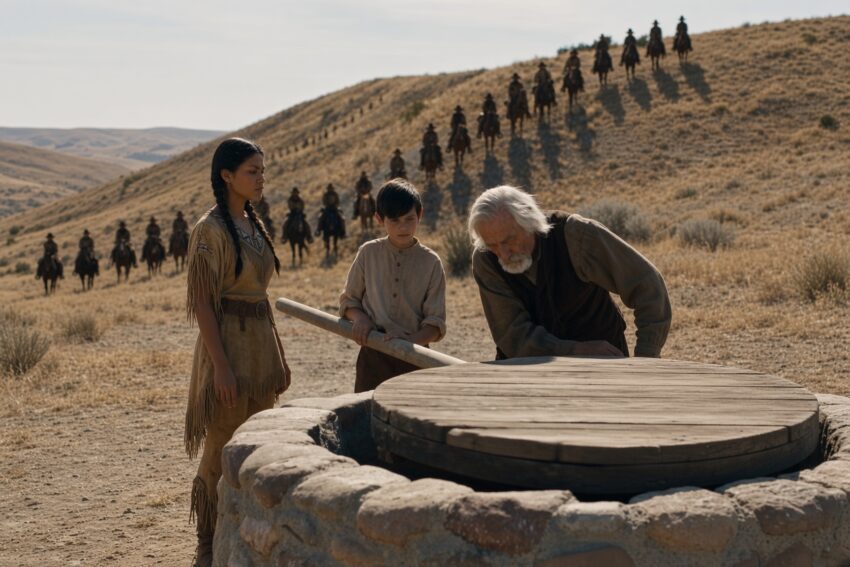
Three Hundred Apache Riders Filled the Hills Above Silas Vance’s Well—But the Woman Beside It Had Come for More Than Water
PART ONE — THE MARK IN THE STONE
Silas Vance noticed the silence before he noticed the riders.
At noon, his cattle should have been crowding the trough below the stone well, shoving horns against ribs and muddying the ground with impatient hooves. Instead, nearly eighty head stood scattered across the dry valley, every animal facing north.
Not one was drinking.
Silas lowered the bucket in his hands.
The September sun burned white over the Arizona Territory, flattening every shadow until the mesquite trees looked painted onto the earth. For three months there had been almost no rain. The grass had gone brittle. Two springs farther east had already failed.
If Silas’s well failed too, the Vance ranch would not survive the winter.
Then he looked toward the hills.
His first thought was that the ridge had changed color.
His second was that the dark shapes were moving.
Riders covered the northern rise.
Not twenty.
Not fifty.
Hundreds.
One line stretched along the crest. Another waited halfway down the slope. More horses stood in the dry creek bed where cottonwoods had died years before.
Silas counted until counting became foolish.
Close to three hundred Apache riders surrounded the valley.
His ranch hand, seventeen-year-old Ben Carter, came running from the corral.
“Silas.”
“I see them.”
“Should I get the rifles?”
Silas stared at the hills.
“No.”
Ben looked at him as though he had misheard.
“No?”
“If they came to kill us, two rifles won’t improve our prospects.”
Then Silas realized something stranger.
Almost none of the riders were watching the ranch house.
They were watching the well.
More precisely, they were watching one woman sitting alone beside it.
She had arrived perhaps twenty minutes earlier while Silas had been checking a broken fence on the southern pasture. Her horse, a dark bay mare, stood untethered nearby. The woman sat on one of the old foundation stones, running her fingers over the weathered surface as if reading words Silas could not see.
She appeared to be in her late twenties, maybe thirty. Her long black hair was braided down her back. Dust marked the hem of her riding dress and leggings. A turquoise pendant rested against her chest.
She did not seem frightened.
Three hundred armed riders waited behind her, yet she looked less like someone protected by an army than someone carrying a burden alone.
Silas walked toward her.
Ben followed.
Silas stopped him with one hand.
“Stay by the trough.”
The woman looked up when Silas approached.
“You are Silas Vance?”
Her English was careful but fluent.
Silas stopped six feet away.
“I am.”
“My name is Dyani.”
She glanced toward the well.
“You use this water for your cattle.”
“And for everything else.”
“How deep?”
“Forty-two feet when my grandfather dug it. Maybe thirty-eight now.”
Dyani studied him.
“Your grandfather did not dig this well.”
Silas almost laughed, but the riders on the hills made laughter seem unwise.
“He did. Samuel Vance. Forty years ago.”
“He reopened it.”
“That is not the story I was raised with.”
“No.”
Something in the way she said it unsettled him more than accusation would have.
Dyani rose.
Behind her, hundreds of riders remained motionless.
She placed her palm against one of the stones.
“This was here before your grandfather fenced the valley.”
Silas frowned.
“My grandfather came here in 1849. There was no ranch.”
“I did not say there was a ranch.”
She moved around the circular wall, touching stone after stone.
Silas followed.
He had known those rocks all his life. As a child, he had climbed them. At ten, he had dropped his father’s pocketknife into the shaft and spent three miserable days expecting punishment. At twenty-one, he had rebuilt part of the wooden frame after lightning struck the old cottonwood beside it.
Dyani stopped.
“There.”
On the western side, beneath mineral stains and forty years of dust, was a shallow carving.
Silas had seen it thousands of times.
He had always thought it was damage from a chisel.
Dyani removed the turquoise pendant from around her neck.
Its shape matched the carving almost exactly.
Silas’s stomach tightened.
“What is that?”
“A marker.”
“For water?”
“For an agreement.”
Movement began on the hill.
Five older riders descended slowly.
Silas heard Ben inhale behind him.
Dyani did not turn.
One elder carried a long stripped pole. Another held a leather-wrapped bundle against his chest.
The oldest man dismounted and looked directly at Silas.
“My uncle called your grandfather friend,” he said.
Silas glanced at Dyani.
She translated only one word he did not understand, though the elder’s English needed little help.
Silas looked back at the man.
“What was his name?”
“Chato.”
The name meant nothing to him.
That frightened him.
Dyani pointed to the well.
“We need to lower the pole.”
Silas hesitated.
The well was his life.
Every calf, every horse, every fence post, every dollar he owed the bank depended on the water below those stones.
Yet three hundred riders had not crossed miles of dry country to poison a well they apparently believed partly theirs.
“Do it.”
The elders tied rope to the pole.
They lowered it into the shaft.
Ten feet.
Twenty.
Then it struck something with a hollow knock.
Silas stepped closer.
“That can’t be right.”
He had lowered buckets down that shaft every day for years. There should have been open water below.
The men shifted the pole sideways.
Something scraped.
After several minutes, they hooked a hidden wooden panel built into the wall.
The panel rose slowly, black with age.
Behind it was a narrow compartment.
Silas forgot the riders.
Forgot Ben.
Forgot even the drought.
Dyani unwrapped the leather bundle.
Inside lay an iron key darkened with rust and a photograph mounted on thick card.
She handed the photograph to Silas.
His grandfather stood beside the well.
Samuel Vance was younger than Silas had ever seen him, maybe thirty-five, with his beard trimmed short and his hat pushed back.
Beside him stood an Apache woman.
One hand rested on the stones.
The other held the same turquoise pendant Dyani wore.
Dyani touched the woman’s face.
“My great-grandmother. Her name was Nalin.”
Silas looked at her.
“You knew about this photograph?”
“My family had another copy.”
“Then why come now?”
Her expression changed.
“Because now the water is disappearing.”
The words landed harder than the discovery.
Silas looked down the shaft.
“You think the well is failing?”
“I know wells north of here have failed. I know two streams that once lasted through summer no longer reach our camps. And I know men with survey chains were seen six miles east of your fence.”
“Railroad?”
“No.”
“Who?”
“A cattle company.”
Silas’s jaw tightened.
He knew immediately which one.
Morrow & Pike had been buying dry ranches for two years, then somehow finding enough water to expand enormous herds across abandoned grazing land.
Silas had rejected their offer three times.
Dyani turned the photograph over.
There, in Samuel Vance’s faded handwriting, were two lines.
THE WATER BELONGS TO BOTH FAMILIES.
IF I BREAK THIS PROMISE, MY GRANDSON MUST MAKE IT RIGHT.
Silas read the second line twice.
Then a third time.
Ben moved closer despite Silas’s earlier order.
“What does it mean?”
Silas looked at the hidden compartment.
The iron key.
The riders.
Dyani.
“I don’t know.”
The oldest elder spoke quietly.
Dyani’s face tightened before she translated.
“He says your grandfather knew a day might come when someone would try to own what could not belong to one man.”
Silas looked toward the northern hills.
“Why bring three hundred riders?”
Dyani met his eyes.
“Because last week, one of our wells was filled with stones.”
Silas felt the first cold sensation of the day.
“By who?”
“We don’t know.”
“That doesn’t answer my question.”
“Yes, it does.”
She glanced at the riders.
“Some believe your family broke the agreement.”
“And you?”
“I came here before they decided what to do about it.”
That was when Silas understood.
The riders were not there to protect Dyani.
They were waiting for her judgment.
He opened his hand.
The rusty key lay in his palm.
“What does it open?”
Dyani looked toward the ranch house.
“Your grandfather left us one instruction.”
“What instruction?”
“If the well was threatened, find the Vance grandson.”
Her eyes returned to the key.
“And ask him what his family hid beneath the floor.”
PART TWO — THE ROOM SAMUEL VANCE NEVER SPOKE OF
Silas had torn up half the floor of his grandfather’s old room by sundown.
The room had been locked for years, not because it contained treasure but because it contained grief.
Samuel Vance had died there.
Silas’s father, Thomas, had left the room untouched afterward and refused to discuss nearly anything about Samuel’s early years in the territory.
Whenever Silas asked how the ranch had begun, his father gave the same answer.
“Hard ground. Harder work.”
That had been enough when Silas was a boy.
It was not enough with three hundred Apache riders camped beyond his pasture.
Dyani stood in the doorway while Silas pried up another warped plank.
“You are certain?”
“My great-grandmother wrote that the key belonged beneath Samuel Vance’s roof.”
“That leaves several hundred square feet.”
Dyani almost smiled.
“You complain a great deal for a man whose house we are not burning.”
Silas looked up.
“Was that discussed?”
“By two men.”
His expression changed.
Dyani’s smile disappeared.
“I told you because I want you to understand the cost of waiting.”
That silenced him.
Outside, smoke rose from cooking fires spread across the creek bed. Most of the riders had withdrawn from the ridge after Dyani spoke with the elders, but they had not left the valley.
Neither had the question.
Silas struck something metal beneath a plank beside the bed.
He froze.
Together, he and Dyani pulled up the wood.
A narrow iron box lay between the floor joists.
The rusty key opened it.
Inside were letters tied with rawhide, a hand-drawn map, and a ledger.
No deed.
No fortune.
Just paper.
Silas felt an absurd flash of disappointment.
Then Dyani opened the map.
The Vance ranch was sketched in dark ink, but its boundary did not follow the fences Silas knew.
A broad corridor ran north from the well through the valley and into the hills.
Beside it Samuel had written:
WATER ROAD — NEVER TO BE FENCED.
Silas stared.
“My father fenced that.”
“When?”
“Before I was born.”
Dyani looked at him.
“So your grandfather made an agreement, and your father closed the path.”
“Maybe he never knew.”
“You said the room remained untouched.”
Silas looked at the box.
Dyani did not need to finish the thought.
One of the letters was addressed to Thomas Vance.
Silas’s father.
The seal had been broken.
Silas sat heavily on the floor.
Thomas had known.
Dyani crouched across from him.
“Open it.”
Silas unfolded the brittle paper.
The letter was twenty-seven years old.
Samuel’s handwriting grew shakier toward the end.
Thomas,
What we built here was possible because Nalin’s people showed me the spring beneath the limestone after my first well failed. I promised her family that no fence would close the route to water and that Vance cattle would never take enough to leave their horses dry.
The ranch exists because of that promise.
Do not confuse a courthouse filing with ownership of the earth beneath it.
Silas stopped reading.
Dyani watched him.
“Continue.”
His jaw worked.
He read the remaining lines.
If pressure comes from the east, trust no buyer who asks about the lower creek before asking about the house. There is more beneath this valley than cattle water.
Silas looked up.
“Pressure from the east.”
“Morrow & Pike?”
“Maybe.”
A rider appeared outside.
He spoke rapidly to Dyani.
She stood.
“What happened?”
“Two men were caught near the north spring.”
“Whose men?”
“We don’t know.”
Silas reached for his gun belt.
Dyani’s gaze dropped to it.
“You bring that, everyone who sees you will think you expect violence.”
“I do expect violence.”
“Then surprise them.”
Silas left the revolver on the bed.
They rode north with six Apache riders and Ben trailing despite being ordered to stay behind.
The captured men were waiting near a dry wash.
Silas recognized one immediately.
Eli Mercer worked for Morrow & Pike.
The other man wore no company mark, but his boots were too fine for a drifting cowhand.
A coil of blasting fuse lay beside them.
So did two empty sacks that smelled of limestone powder.
Dyani picked up the fuse.
“You filled our well.”
Mercer shook his head.
“No.”
One of the riders struck him across the mouth.
Dyani snapped something in Apache, sharp enough that the rider stepped back.
Then she faced Mercer again.
“Who did?”
Mercer spat blood into the dust.
“I don’t know.”
Silas crouched.
“You’re carrying fuse beside a spring my grandfather warned about in a letter.”
Mercer looked at him.
That flicker was enough.
“You knew about the letter?”
“No.”
“You knew about the spring.”
Mercer’s silence answered.
Silas stood.
Dyani watched him.
“What will you do?”
Silas expected her to demand punishment.
Instead she waited.
He realized another choice was being measured.
Not by three hundred riders this time.
By her.
“Take their horses,” Silas said. “Give them water. Then send them east on foot.”
One rider laughed.
Mercer did not.
“You can’t do that.”
Silas looked toward the dry horizon.
“You’re right. I could do worse.”
By nightfall, the two men were walking east.
It felt like a victory.
It lasted less than an hour.
A telegram arrived at the ranch from the territorial bank in San Marcos.
Ben had ridden to collect it.
He handed the paper to Silas under the lantern light.
PAYMENT DEFAULT NOTICE. NOTE TRANSFERRED THIS DATE TO MORROW & PIKE LIVESTOCK COMPANY. BALANCE DUE WITHIN TEN DAYS.
Silas read it twice.
Dyani stood across the table.
“They bought your debt.”
“Yes.”
“Can they take the ranch?”
“If I don’t pay.”
“How much?”
“More than I have.”
Outside, voices carried from the Apache camp.
Silas folded the telegram.
He finally understood why Morrow & Pike had kept offering to buy him out.
They had not wanted his cattle.
They wanted the valley.
The next morning brought another surprise.
Dyani helped Silas inspect the old northern fence.
He expected tension after the debt notice.
Instead, for the first time, they spoke about something ordinary.
Her bay mare kept nudging Silas’s shoulder whenever he stopped.
“She likes you,” Dyani said.
“She wants the apple in my pocket.”
“She has excellent judgment.”
Silas gave the mare half.
Dyani held out her hand.
“For the horse?”
“For me.”
He gave her the other half.
She smiled.
It was a small thing.
But after a day of threats, hidden boxes, and three hundred armed men, that smile felt like proof the valley still belonged to living people rather than old promises.
Then they reached the fence.
A section had been cut.
Beyond it, fresh wagon tracks led toward a narrow ravine.
Dyani crouched beside them.
“Four wagons.”
“Heavy.”
“Going in.”
“Not coming out.”
They followed the tracks.
Inside the ravine, beneath canvas covers, were drilling tools, steel pipe, and crates marked for Morrow & Pike.
A man stepped from behind a wagon.
Silas recognized him from town.
Calvin Pike.
Part owner of the company.
Pike was in his forties, neat even in dust, with a trimmed mustache and a gray coat too expensive for ranch work.
He looked at Silas as though they had met by appointment.
“I wondered how long it would take.”
Silas stared at the equipment.
“You’ve been drilling on my land.”
Pike glanced at Dyani.
“Your land?”
The question was deliberate.
Silas’s hands tightened.
Pike continued.
“I have county permits for mineral exploration.”
“This isn’t mineral equipment.”
“No?”
“You’re drilling for water.”
Pike smiled slightly.
“Water is often found near useful minerals.”
Dyani looked at the pipes.
“You blocked wells north of here.”
Pike’s expression did not change.
“I don’t know who you are.”
“Yes, you do.”
For the first time, something slipped in his face.
Recognition.
Small, but unmistakable.
Dyani saw it too.
“You’ve seen me before.”
Pike looked away.
Silas stepped between them.
“Where?”
Pike sighed.
“This performance is unnecessary. Your ranch is insolvent, Vance. Ten days from now it becomes company property. Those people on your ridge cannot change a bank note.”
Dyani’s voice went quiet.
“Perhaps not.”
She touched the turquoise pendant.
“But we may change what the bank believes you bought.”
That night they opened every remaining letter in Samuel’s box.
Near midnight, Silas found the one that changed everything.
It was not written by Samuel.
It was written by Nalin.
And it was addressed to Calvin Pike’s father.
PART THREE — WHAT THE WELL HAD BEEN HIDING
The letter began without greeting.
You took Samuel’s map and made another.
Silas read the line aloud.
Dyani stopped breathing for a moment.
The lantern flame moved between them.
Nalin’s letter described a meeting in 1858 between Samuel Vance, Nalin’s family, and a young surveyor named Edward Pike.
The agreement had been simple in principle.
The Vance family could maintain the well and graze the southern valley.
Nalin’s family retained permanent access to the water corridor and northern springs.
Edward Pike had been hired to draw boundaries both sides could carry to the territorial recorder.
But the map filed at the courthouse was not the map they approved.
The water corridor vanished.
The Vance claim expanded north.
Samuel discovered the fraud years later.
By then, violence in the region had made travel dangerous, records were scattered, and Edward Pike had left the territory.
Silas lowered the letter.
“So my grandfather didn’t steal the land.”
“No,” Dyani said.
He felt relief.
Then she continued.
“But he learned it had been stolen.”
The relief vanished.
“He tried to correct it.”
“Did he?”
Silas looked at the letters.
Samuel had protested.
Samuel had written warnings.
Samuel had hidden evidence.
But there was no proof he had ever gone to the courthouse.
No proof he had surrendered the benefit his ranch received.
Dyani understood his silence.
“He was not innocent because he felt guilty.”
Silas’s temper rose.
“He kept the water open.”
“Until your father fenced it.”
“My father is dead.”
“And mine is not.”
The words stopped him.
Dyani looked toward the window.
“My father believes your family knew from the beginning.”
“Does he?”
“Yes.”
“Is he one of the elders?”
“No.”
“Where is he?”
“With the riders.”
Silas stood.
“You let me spend two days with three hundred men surrounding my ranch and never told me your father was among them?”
“You never asked which man was my father.”
“That is a poor excuse.”
“Yes.”
The answer surprised him.
Dyani folded her arms.
“I did not tell you because he did not want you judging me by him.”
“And what does he want?”
“The valley returned.”
“All of it?”
“Yes.”
Silas laughed without humor.
“Then why are we searching for agreements?”
“Because I disagree with him.”
That was the first time Silas understood Dyani had something to lose too.
Not merely reputation.
Family.
Standing.
Trust.
Perhaps her place among the people waiting on the hills.
“You came here to find another answer.”
“I came here hoping your grandfather had left one.”
“And if he didn’t?”
Dyani looked at him.
“Then I would have to choose whether justice means removing you from the home you were born in.”
Before Silas could answer, hoofbeats approached.
Ben burst into the yard.
“Men from town.”
“How many?”
“Twenty or more. Pike’s with them. Deputy too.”
The confrontation began at sunrise.
Calvin Pike arrived with a county deputy, two bank representatives, and fifteen armed company riders.
Across the valley, Apache riders descended from the hills.
No one fired.
That made it worse.
Two groups faced one another near the stone well while Silas stood between them.
Deputy Warren unfolded a paper.
“Silas Vance, complaint has been made that armed Indians are occupying private property and unlawfully detaining company equipment.”
Silas looked at Pike.
“Equipment hidden behind a cut fence.”
Pike shrugged.
“Boundary mistake.”
Dyani’s father stepped forward from the Apache line.
Silas recognized him as one of the men who had watched silently the first day.
His name was Keme.
He was broad-shouldered, gray at the temples, and looked at Silas with none of Dyani’s patience.
“This valley is not Pike’s to measure.”
Deputy Warren’s hand hovered near his revolver.
Silas moved between them.
“Put your hand down.”
The deputy stared.
“You giving orders now?”
“I’m preventing you from doing something stupid.”
Pike stepped forward.
“This is simple. Vance owes the company money. His note matures in nine days. These people have no recorded claim.”
Dyani held up Nalin’s letter.
“We have evidence your father falsified the map.”
For the first time, Pike’s composure cracked.
“My father is dead.”
“So is the man he cheated.”
“That proves nothing.”
Silas watched him.
Pike was right about one thing.
A letter was not a county record.
Keme spoke to Dyani.
She answered.
Their exchange grew sharp.
Silas did not understand the words, but he understood the disagreement.
Finally Dyani turned to him.
“My father says we should remove the drilling equipment now.”
Pike’s riders shifted.
Silas saw hands move toward rifles.
This was how valleys became graveyards.
Not because anyone planned a war.
Because one frightened man moved half a second too quickly.
Silas walked to the well.
He picked up the old iron key.
Then he remembered something.
The hidden wooden panel had not contained only the compartment.
When the elders raised it, Silas had noticed a second iron ring farther down.
At the time, everyone had been staring at the photograph.
He leaned over the shaft.
“Dyani.”
She joined him.
“There was another ring.”
Within twenty minutes, ropes had been rigged.
The deputy protested.
Pike demanded they stop.
Keme said nothing.
The wooden cover rose again.
Silas climbed partway down the stone shaft with a lantern tied to his belt.
Behind the first compartment, the wall narrowed.
There, beneath mineral deposits, was a second plank.
He pulled it loose.
Cold air touched his face.
Behind the stones was a natural limestone chamber.
And inside it, protected from decades of heat, were wooden survey stakes.
Each bore carved initials.
S.V.
N.
E.P.
Samuel Vance.
Nalin.
Edward Pike.
Silas brought them up one by one.
Dyani examined the first.
Then Keme.
Then Deputy Warren.
Pike said nothing.
The stakes matched points on Samuel’s original map.
But there was more.
One stake had been cut in half.
On the back, someone had carved a second set of measurements.
The altered measurements matched the county boundary Pike’s father had filed.
Deputy Warren’s face changed.
“This could be evidence.”
Pike finally spoke.
“Of what? A forty-year-old disagreement?”
Dyani looked at him.
“Of why your company knew exactly where to drill.”
Silence spread.
Silas suddenly remembered Mercer’s reaction when the northern spring was mentioned.
Samuel’s warning.
Ask why a buyer wants the lower creek before he asks about the house.
“What is beneath the valley?” Silas asked.
Pike did not answer.
Silas grabbed one of the drilling logs from the wagon.
Numbers filled the page.
He did not understand all of them, but one note was clear.
ARTESIAN PRESSURE STRONG. MAIN LIMESTONE BASIN EXTENDS NORTHWEST. ESTIMATED CAPACITY EXCEEDS ALL SURFACE SPRINGS.
Dyani read over his shoulder.
Her eyes widened.
Silas understood.
The stone well was not the prize.
The aquifer beneath the valley was.
Morrow & Pike planned to control the main underground water source feeding both Silas’s ranch and the Apache springs to the north.
Their purchase of failing ranches had not been luck.
They had known which wells would weaken first.
“You’ve been drilling into the basin,” Silas said.
Pike remained calm, but now it required effort.
“Development is not theft.”
“You lowered the water.”
“That cannot be proven.”
Dyani looked at the blasting fuse lying on one wagon.
“Then why destroy the smaller wells?”
Pike’s gaze flicked toward his own men.
A mistake.
One rider lowered his eyes.
Silas saw it.
So did Deputy Warren.
The deputy stepped toward the man.
“You know something?”
The rider swallowed.
Pike said, “Don’t answer.”
The deputy turned.
“That sounded like an answer.”
The company rider looked at the Apache line, then at Silas.
“I was paid to haul rock north.”
Pike’s face hardened.
“Careful.”
The rider kept talking.
“We blocked two shallow wells so Pike could buy grazing leases cheap. Mercer handled the third.”
The valley changed in that instant.
Not with gunfire.
Not with a charge.
With one frightened employee deciding silence was no longer worth his wages.
Pike reached for his revolver.
Silas moved first, striking his wrist aside.
The gun discharged into the dirt.
Every rifle in the valley came up.
Dyani shouted.
Keme shouted louder.
Silas held Pike against the stones while Deputy Warren tore the revolver from his hand.
No second shot came.
For several terrible seconds, three hundred riders and fifteen company men aimed weapons at one another.
Then Keme lowered his hand.
The Apache rifles lowered.
One by one, Pike’s men did the same.
It should have ended there.
It did not.
Keme walked to Silas.
“The company will leave.”
“Yes.”
“But your fence remains.”
Silas understood.
Pike’s crime did not erase his family’s benefit from the falsified map.
The hardest choice had survived the villain.
Keme pointed north.
“That land was taken.”
Silas looked at Dyani.
She did not rescue him.
She waited.
Silas turned toward the valley his family had called theirs for nearly forty years.
Then he looked at the original map.
“I won’t defend a boundary built on a lie.”
Ben stared at him.
“Silas…”
Silas kept going.
“But I won’t agree that correcting one wrong requires another family to disappear.”
Keme’s jaw tightened.
Silas handed him Samuel’s map.
“The water corridor opens today. The northern pasture goes back to your families. The house, barns, and southern grazing remain with Vance.”
Keme said nothing.
“And the underground basin,” Silas added, “belongs to neither of us alone.”
Pike laughed bitterly from the deputy’s custody.
“You cannot own water that way.”
Silas looked at him.
“Maybe that’s the problem.”
PART FOUR — THE ROAD BACK TO WATER
Calvin Pike did not leave the valley in chains that morning.
Territorial justice moved more slowly than anger.
Deputy Warren took Pike, the drilling records, the survey stakes, and the testimony of three company employees to San Marcos.
Two weeks later, a judge froze every Morrow & Pike claim involving the valley.
By then, Silas’s debt had become the smaller problem.
The larger one was deciding what came next.
Keme did not accept Silas’s proposal immediately.
Neither did several Apache families whose access to the valley had been cut off for decades.
Some wanted the entire northern claim restored.
Others cared more about the springs and seasonal passage than fences drawn by distant officials.
Dyani spent days moving between camps, translating not merely words but intentions.
Silas learned quickly that “the Apache riders” had never been one opinion.
One elder wanted settlement before winter.
Another believed any written agreement with settlers would eventually be broken.
A younger rancher from Dyani’s community argued that shared grazing could work if cattle numbers were limited.
Keme distrusted all of it.
“You ask paper to repair what paper damaged,” he told Silas one evening.
They sat beside the well without rifles.
Silas looked at the stones.
“No. I ask people to repair it.”
Keme studied him.
“That is slower.”
“Yes.”
For the first time, the older man smiled.
“Then perhaps you understand something.”
The first agreement was not signed in a courthouse.
It was practiced.
Silas ordered Ben and the ranch hands to pull down the northern fence.
Dyani’s cousins helped.
For three days they removed posts that Thomas Vance had driven into the ground before Silas was born.
No ceremony.
No speeches.
Just hard work.
On the second afternoon, Keme arrived with two wagons.
Silas expected another argument.
Instead Keme unloaded cedar posts.
Silas frowned.
“We’re taking a fence down.”
“These are for another fence.”
“Where?”
Keme pointed toward the southern cattle pasture.
“Your herd keeps wandering into the creek.”
Silas almost smiled.
“You came to help me build a fence?”
“I came to keep your foolish cattle from ruining the bank.”
It was the first joke Keme ever made to him.
Silas laughed.
Keme did not.
But Dyani did enough for both of them.
The relationship between Silas and Dyani changed more slowly.
They had trusted each other under pressure because they needed to.
Trust after danger was harder.
Dyani still believed Silas sometimes defended his family before examining the truth.
Silas still resented how much she had withheld during those first days.
They argued over grazing numbers.
They argued over where horses could cross during calving season.
They argued about whether the old Vance barn sat partly inside the original water corridor.
Once, Silas told her she was the most stubborn person he had ever met.
She replied, “You only think that because mirrors are expensive.”
He laughed despite himself.
A week later, she brought him half an apple without explanation.
He understood anyway.
That winter, the rains came late.
Not enough to erase the drought.
Enough to change the smell of the earth.
The reopened water road became visible again as families traveled south to the well.
At first Silas found the movement strange.
He had grown up believing every rider approaching the ranch needed permission.
Now children watered horses where his cattle drank.
Women filled containers beside ranch hands repairing troughs.
Arguments still happened.
So did suspicion.
One morning, Ben accused two young Apache riders of cutting a gate rope.
By noon, Silas discovered one of his own calves had chewed it loose.
Ben apologized.
The two riders made him replace the rope while they watched.
That evening they ate at the same fire.
Nothing miraculous happened.
Which was why Silas began to believe the arrangement might last.
In February, a territorial surveyor arrived with copies of courthouse records recovered during the investigation.
Edward Pike’s original field notebook had been found among company papers.
It confirmed Nalin’s accusation.
The filed boundary had been altered.
But the notebook contained one more surprise.
Samuel Vance had discovered the fraud in 1862.
And he had tried to surrender the stolen northern acreage.
The territorial recorder refused the correction during a period of administrative chaos and told Samuel to return later.
He never did.
Silas read that entry in silence.
For months he had carried anger toward his grandfather.
Not because Samuel had made the original mistake.
Because he had learned the truth and failed to finish correcting it.
Now the truth became more complicated.
Samuel had tried.
Once.
Then apparently stopped.
Dyani found Silas alone by the well that evening.
“You look disappointed.”
“I thought learning he tried would make me feel better.”
“Does it?”
“No.”
“Good.”
Silas looked at her.
She sat on the stone wall.
“One attempt does not erase forty years,” she said. “But failure does not erase the attempt either.”
Silas folded the survey copy.
“You always have an answer?”
“No. Sometimes I have apples.”
She handed him one.
By spring, the territorial court approved a new boundary agreement negotiated by both communities.
The northern pasture and water corridor were formally removed from the Vance claim.
The ranch retained its house, barns, southern grazing, and enough land for a smaller herd.
The underground basin was placed under a joint water compact limiting commercial drilling and guaranteeing access to the northern communities and the Vance homestead.
It was imperfect.
Everyone knew it.
But it was written by people who had argued over every line instead of by one surveyor working in secret.
Silas sold nearly a third of his cattle to reduce pressure on the well.
It hurt.
Those cattle represented years of work and the only inheritance he had ever expected.
But the sale paid most of the remaining bank debt after the court voided Morrow & Pike’s purchase of the note.
Ben asked him if he regretted it.
Silas watched the smaller herd moving through spring grass.
“Ask me when the well still has water in twenty years.”
Three months later, Keme came to the ranch house carrying the old photograph.
Silas had forgotten Dyani’s family still possessed it.
Samuel and Nalin stood beside the well, both young, neither knowing what their promise would become.
Keme handed Silas the picture.
“This belongs here.”
Silas shook his head.
“It belongs to your family.”
Keme removed something else from his coat.
A second copy.
“We kept ours.”
Silas took the photograph.
For a moment, neither man spoke.
Then Keme looked toward the well.
“My mother remembered Nalin.”
Silas turned.
“She did?”
“She said Nalin complained Samuel talked too much.”
Silas stared.
Then he laughed.
“My father said the same thing about him.”
Keme’s mouth moved slightly.
“Perhaps that part of history is reliable.”
By the following summer, the valley no longer looked the way it had when three hundred riders filled the hills.
The northern fence was gone.
A narrower cattle barrier protected the creek.
The drilling wagons had been removed months earlier.
Grass returned along places where hooves once crowded against blocked paths.
And beside the stone well stood a new wooden marker.
Not a monument.
A sign.
Two languages were carved into it.
The wording had taken six arguments, three rewrites, and one entire afternoon during which Keme threatened to throw Silas’s draft into the fire.
In the end it said simply:
WATER ROAD.
KEEP OPEN.
One evening, Silas rode home from checking cattle and found Dyani sitting beside the well.
For an instant, the sight carried him back to the first day.
One woman.
Hundreds of riders.
A turquoise pendant against sun-warmed stone.
Only now the hills were empty.
Her horse grazed nearby.
Silas dismounted.
“You planning to surround the ranch again?”
“Not today.”
“Tomorrow?”
“I have not decided.”
He sat beside her.
Children’s voices drifted from farther north where several families had stopped during a journey through the valley.
Dyani touched the old carving in the stone.
“You know what my great-grandmother believed this meant?”
“An agreement.”
“That is what I told you.”
“So you lied?”
“I simplified.”
Silas sighed.
“Of course.”
She smiled.
“The shape was used by her family to mark a place where water was shared under obligation. Not given. Not owned. Shared.”
Silas looked at the matching pendant around her neck.
“Why did she give Samuel the same mark?”
“She didn’t.”
Dyani removed the pendant.
“She gave it to his wife.”
Silas turned sharply.
“My grandmother?”
Dyani nodded.
“That is why there were two families in the promise. Not Samuel and Nalin.”
Silas stared at the carving.
For months he had assumed the agreement belonged to two individuals powerful enough to shape everyone who came after them.
He had been wrong again.
It had been meant to survive them.
Dyani held out the pendant.
Silas did not take it.
“That belongs to you.”
“Yes.”
She closed her hand around it.
“But the mark belongs here.”
The sun lowered behind the western ridge.
Silas looked into the well.
Water reflected far below, dark and steady.
Once, the stones had meant inheritance.
Then they had meant guilt.
Then proof.
Now, when riders approached from the north, Silas no longer counted them before deciding whether to reach for a rifle.
He looked first to see who needed water.
Dyani stood and walked toward her horse.
Silas remained beside the old carving.
Forty years earlier, Samuel Vance had written that his grandson might someday have to make the promise right.
Silas finally understood that making it right had never meant returning everything to the way it had been.
That world was gone.
The harder task was building something neither family had possessed before.
He ran his fingers across the shallow turquoise-shaped mark.
Then he heard Dyani behind him.
“Silas.”
He turned.
She nodded toward the trough.
A small Apache boy was struggling with the heavy pump handle while Ben pretended not to notice, waiting to see if the boy would ask for help.
Silas smiled.
He crossed the yard, took hold of the handle beside the child, and together they pushed it down.
Cold water rushed into the trough.
The sound carried across the valley.
This time, when the cattle lifted their heads, they were not staring toward three hundred riders on the hills.
They were only waiting their turn.
DISCLAIMER:
This story is a work of fiction discovered in circulation on the internet and is intended solely for creative and entertainment purposes. All characters, names, dialogue, entities, and incidents depicted herein are products of the author’s imagination or are used fictitiously. Any resemblance to actual persons, living or deceased, real-world ranches, historical events, or genuine geographical locations is entirely coincidental.