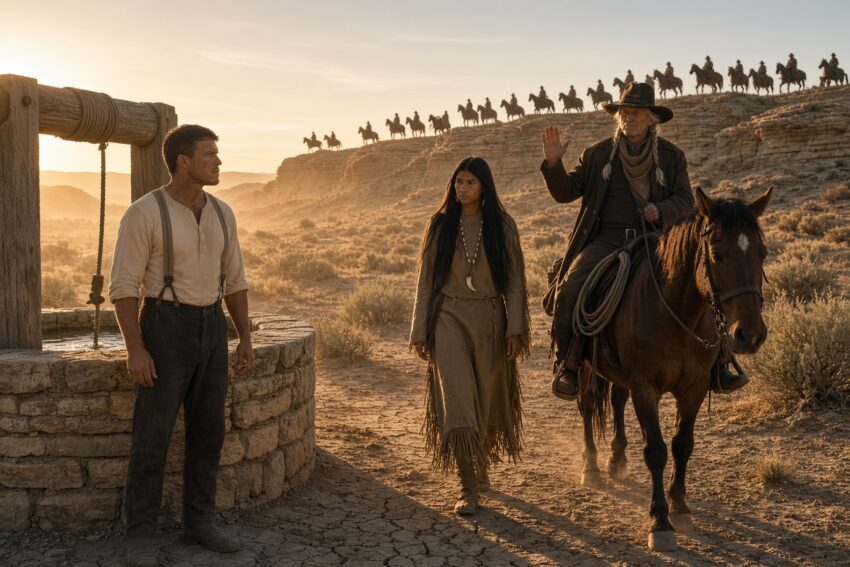
PART 2 — THE THREE HUNDRED WARRIORS HAD NOT COME FOR SILAS. THEY HAD COME FOR HIS WELL.
The old warrior looked at Silas.
Then pointed toward the towering woman approaching through the opened ranks.
His voice was low.
“She says you gave water.”
Silas glanced at the woman.
Then back at him.
“One cup.”
The old man’s face did not change.
“To her.”
“Yes.”
“While she bled.”
“Yes.”
“Without asking payment.”
“Yes.”
The warrior studied him for several seconds.
Then said:
“That is why you are still standing.”
Silas’s stomach tightened.
Not exactly comforting.
The woman reached the yard.
Up close, she looked worse than she had the day before.
A fresh bandage crossed her left shoulder.
Dust darkened the hem of her deerskin dress.
But she stood straight.
Strong.
Her eyes fixed on Silas with the same unsettling calm.
The old warrior spoke.
“This is Naya.”
Silas nodded.
“Naya.”
She understood the name.
Maybe more.
Her gaze moved toward the well.
Then toward the dry creek beyond the homestead.
She said something to the older man.
He translated.
“She says men followed her yesterday.”
Silas’s eyes narrowed.
“What men?”
“White men.”
That description was useless.
Half the territory fit it.
Then Naya reached beneath her belt.
She removed a folded piece of paper.
Dirty.
Torn.
Blood on one corner.
She handed it to Silas.
He opened it.
Survey markings.
Property lines.
Water symbols.
A stamp from the county land office.
And one name repeated across several parcels:
BELLROSE CATTLE & LAND COMPANY
Silas knew Bellrose.
Everyone within a hundred miles did.
They bought distressed ranches.
Water rights.
Grazing permits.
Sometimes honestly.
Sometimes too quickly.
Silas pointed toward one mark.
“That’s my north boundary.”
The old warrior nodded.
“Not only yours.”
Silas looked again.
The survey showed an underground spring line running beneath his well and continuing north toward Apache-used land.
Then south into Bellrose-controlled acreage.
Naya spoke again.
The old warrior translated:
“Men say all water belongs to Bellrose now.”
Silas almost laughed.
“That’s nonsense.”
The old man’s eyes hardened.
“Men with papers say many things.”
Good point.
Silas looked toward the ridges.
Three hundred warriors.
Still waiting.
“If you came to ask about water, you could have sent five men.”
The old warrior answered:
“We did.”
Silas went still.
“When?”
“Four days ago.”
“What happened?”
“Two returned.”
There.
The valley changed.
Not peaceful anymore.
“What happened to the others?”
The warrior looked east.
“Found [d.e.@.d] near Bellrose fence.”
Silas’s jaw tightened.
“Who k.i.l.l.e.d them?”
“We do not know.”
Good.
Not accusation yet.
Then:
“But Bellrose men say Apache k.i.l.l.e.d Bellrose riders.”
Of course.
Two deaths on one side.
Two on another.
Enough to start a war if someone wanted one.
Silas looked at Naya.
“What were you doing yesterday?”
She answered before the old warrior translated.
“Watching.”
Her English was rough but clear.
Silas blinked.
“You speak English.”
“Some.”
The old warrior almost smiled.
Apparently he had enjoyed translating unnecessarily.
Naya pointed toward the paper.
“I took this.”
“From where?”
“Bellrose camp.”
There.
That explained injury.
Silas folded the survey slowly.
“You stole it?”
Naya’s mouth tightened.
“They stole water first.”
Fair.
The old warrior introduced himself at last.
Taza.
Naya’s maternal uncle.
Not a “chief” in the simple way outsiders used the word, but an older leader whose authority came partly from age, partly from family, partly from people choosing to follow him.
Silas appreciated that explanation later.
At the time, he mostly appreciated that nobody had shot him.
Taza pointed toward the well.
“We need water today.”
Silas looked at three hundred riders.
Then at his small windlass.
“If all of them drink here, my well drops.”
Taza nodded.
“We know.”
Silas expected demand.
Instead Taza asked:
“How much can you give?”
There.
A question.
Silas calculated.
Horses first?
People?
Storage barrels?
He had two cisterns.
Some water in cattle troughs.
“If I stop watering my east pasture today, maybe forty barrels before sundown without risking the well.”
Taza looked toward Naya.
They spoke.
Then:
“Twenty.”
Silas frowned.
“You asked for less.”
“We do not need your death tomorrow for our thirst today.”
That sentence stayed with him.
The warriors came down in groups.
Not three hundred at once.
Ten.
Twenty.
Filled skins.
Watered horses carefully.
No one entered the cabin.
No one touched cattle.
One boy offered Silas dried meat.
Silas accepted.
Exchange.
Not debt.
Good.
By midday, the valley looked less like a siege and more like an enormous temporary camp.
Still terrifying.
But ordered.
Then Naya found Silas’s ledger.
It sat open near the cabin door.
Her eyes moved to yesterday’s entry.
7:38 PM — Apache woman by the well. Injured. Gave water. Walked north.
She pointed.
“You write time?”
“Yes.”
“Every day?”
“Most.”
“Why?”
“Because memory lies when frightened.”
Naya stared at him.
Then smiled.
First time.
Small.
“You may be useful.”
Silas laughed.
“Wonderful.”
That afternoon, usefulness became important.
A rider appeared from the south.
White flag tied to rifle.
Bellrose man.
Young.
Nervous.
He stopped far from the homestead when he saw the Apache camp.
Taza sent two men.
Silas joined.
The rider introduced himself as Owen Pike.
Foreman.
He carried a written notice.
Silas read it.
Illegal armed occupation of Bellrose-recognized water property.
Interesting.
“My well is on my deed.”
Pike answered:
“Bellrose purchased senior spring rights.”
“From whom?”
“County registration.”
“Show me.”
“I don’t carry it.”
Convenient.
Then:
“You’re harboring raiders.”
Silas looked toward Taza.
“No.”
“They’re watering horses.”
Pike laughed nervously.
“Three hundred?”
“Yes.”
“Looks like an army.”
“Then you should be relieved they’re only thirsty.”
Pike did not laugh.
He delivered second message.
Any interference with Bellrose water operations would result in:
Eviction.
Livestock seizure.
Criminal charges.
Silas read it twice.
Then:
“Eviction from my own deeded land?”
“Water default can affect property claim.”
That sounded wrong.
Not impossible in territory with overlapping filings.
But wrong enough to verify.
Silas asked:
“When did Bellrose file?”
Pike hesitated.
“Last month.”
Silas’s eyebrows rose.
“I’ve owned this place eleven years.”
“Senior water claim.”
“From before your purchase.”
“Whose?”
Pike had no answer.
There.
Naya watched him.
Then pointed toward Silas’s ledger again.
“What time men came yesterday?”
“No men came.”
She frowned.
“Bellrose says you met scouts.”
“I didn’t.”
“When?”
“Yesterday afternoon.”
“No.”
Naya’s expression sharpened.
She explained.
Bellrose had told county riders that three Apache scouts threatened Silas’s homestead around sunset.
That incident supposedly justified armed patrols.
But Silas’s ledger recorded ordinary work.
Fence repairs.
Horse feed.
Naya at well.
No attack.
More importantly:
At 7:38, Naya left north.
If Bellrose’s statement placed her group attacking Silas at 7:30?
Impossible.
She had arrived alone and injured earlier.
Silas had seen nobody else.
His ledger was mundane.
That made it useful.
Not created for court.
No reason to lie.
Taza asked:
“You will say this?”
“To whom?”
“Marshal.”
“Judge.”
“Anyone who listens.”
Silas looked toward Pike.
Then the hundreds of people who had become pawns inside someone else’s paperwork.
“Yes.”
Pike went pale.
There.
He knew something.
Silas saw.
“What?”
“Nothing.”
“No.”
“You recognized something.”
Pike swallowed.
Then:
“I’m just foreman.”
“Good.”
“Then you may still have time to decide what kind.”
Pike looked toward riders.
Then whispered:
“Bellrose has men coming tomorrow.”
“How many?”
“Sixty.”
“Army?”
“Private guards.”
“Purpose?”
He looked at Taza.
“Clear the valley.”
There.
Clear.
Not negotiate.
Not verify.
Clear.
Three hundred Apache warriors had arrived first.
If sixty Bellrose gunmen rode in and shots started, the territory would call it an uprising.
Then soldiers.
Then removals.
Then Bellrose bought abandoned land.
Silas understood.
Naya had understood earlier.
That was why she stole survey.
Taza said:
“We stay.”
Silas said:
“No.”
Every face turned.
He continued:
“If you stay in fighting positions, Bellrose gets exactly the picture they want.”
Taza’s eyes narrowed.
“You tell us to leave water?”
“No.”
“I’m telling you to change what tomorrow looks like.”
“How?”
Silas thought.
Then looked at his ledger.
“Witnesses.”
Not warriors.
Witnesses.
Paper.
County men.
Mission pastor maybe.
Nearby ranchers.
Anyone Bellrose could not easily rewrite as combatant.
Taza stared.
“You think paper stops bullets.”
“No.”
“I think bullets make paper easier for liars.”
That got his attention.
Silas sent riders in four directions.
Not Apache riders only.
Owen Pike went south.
Why trust him?
They did not.
But he volunteered.
He would bring Territorial Marshal Daniel Reed from San Marcos.
Another rider went to Father Abel’s mission.
One to rancher Luis Ortega.
One toward county survey office.
By dusk, three hundred warriors moved off ridgelines.
Not away.
Into low ground behind cottonwoods.
Visible enough not to look hidden.
Far enough not to appear encircling the homestead.
Weapons remained.
Of course.
But not pointed.
The visual story changed.
Important.
That night Silas sat beside fire.
Naya opposite.
She spoke more English than before.
“Why help?”
“Yesterday?”
“Yes.”
“You looked thirsty.”
“No.”
“Now.”
Silas looked toward dark camp.
Then:
“Because I know what it looks like when someone turns a neighbor into a story before taking his land.”
Naya studied him.
“Your land taken?”
“Not mine.”
“My brother’s.”
There.
Silas had not spoken about Ezra in years.
A predecessor company bought Ezra’s ranch after a disputed tax lien.
The papers were probably legal.
Maybe.
Ezra died two years later, broken by the bottle.
Silas never proved wrongdoing.
Still.
He learned paperwork can destroy a man slowly.
Naya nodded.
No sympathy performance.
Just understanding.
Then she asked:
“You afraid?”
“Yes.”
“Of us?”
“Some.”
She smiled.
Honest.
“Bellrose?”
“Yes.”
“Losing ranch?”
“Yes.”
Then:
“Of being wrong.”
Naya’s smile disappeared.
Silas continued:
“If I decide too quickly that Bellrose did everything, I become useful to someone else too.”
She nodded.
Good.
That was the rule.
Evidence first.
Tomorrow would test it.
PART 3 — BELLROSE ARRIVED WITH SIXTY ARMED MEN AND A COUNTY ORDER THAT HAD THE WRONG DATE
At sunrise the next day, dust appeared south.
Sixty riders.
Exactly as Pike said.
At their front rode Gideon Bellrose.
Owner.
Forty-eight.
White linen shirt beneath black vest.
Silver watch chain.
Smile too easy.
Beside him:
Deputy Sheriff Malcolm Rusk.
And a county clerk Silas recognized as Henry Pell.
Good.
Official appearance.
That was the point.
Taza’s people remained where arranged.
Not surrounding.
Watching.
Bellrose riders stopped beyond fence.
Gideon dismounted.
“Mr. Vance.”
“Bellrose.”
His eyes moved toward Apache camp.
“You’ve created quite a problem.”
Silas almost laughed.
“My well seems popular.”
“This is not a joke.”
“No.”
“It isn’t.”
Bellrose handed him folded document.
County injunction.
Ordering Silas to cease unauthorized withdrawal from Bellrose Spring Reserve.
Silas read.
Then stopped.
Date:
Three days earlier.
Before Naya stole survey.
Before Bellrose could know Apache intended to come.
Interesting.
More:
The injunction claimed Silas had already allowed “organized hostile parties” to draw water.
Three days earlier.
But three days earlier no one had been there.
Silas looked at Henry Pell.
“You filed this?”
The clerk swallowed.
“Judge authorized.”
“When?”
“The date says.”
Silas held paper up.
“Three days ago I was alone.”
Pell looked at Bellrose.
There.
Bad.
Silas went into cabin.
Returned with ledger.
Opened to date.
Three days earlier:
Repaired west trough. Branded calf 17. No visitors. Wind east.
Next day:
Fence post split. Rain clouds north. No rain.
Yesterday:
Naya.
His life was boring enough to become evidence.
Bellrose smiled.
“A man can write whatever he wants.”
“True.”
Then another voice:
“Not after I watched him write it.”
Luis Ortega rode into yard.
Rancher.
Neighbor in frontier terms—two days away.
He had visited Silas three days earlier to trade horses.
Silas had forgotten to note him?
Wait.
He looked.
Actually line lower on page:
Luis left before noon. Took bay mare. Owes $6.
Luis grinned.
“I still owe six.”
Good.
Witness.
Father Abel arrived shortly after.
Then two freight drivers.
Then Owen Pike.
Then, finally, Marshal Daniel Reed with four deputies.
Bellrose’s smile thinned.
This was becoming inconvenient.
Good.
Marshal Reed read injunction.
Then:
“Where is Judge Morrison’s seal?”
Pell froze.
There was county stamp.
Not judge’s personal seal.
“Clerk copy.”
Reed asked:
“Original?”
“At courthouse.”
“Good.”
“We verify.”
Bellrose interrupted:
“Marshal, armed Apache are trespassing on private water property.”
Taza stepped forward slowly.
Interpreter beside him though his English was decent.
“This water has served our people before his company existed.”
Bellrose laughed.
“Tradition isn’t title.”
Taza answered:
“Then show title.”
Good.
Bellrose produced survey.
Silas compared it with Naya’s stolen copy.
Same base map.
Different markings.
Interesting.
The one Bellrose displayed showed spring head entirely on Bellrose parcel.
Naya’s version showed underground water line crossing multiple parcels and traditional use routes.
Which was official?
Unknown.
Marshal Reed took both.
“Who prepared?”
Bellrose:
“Territorial surveyor Amos Vale.”
Naya’s copy bore same initials.
But different dates.
One month apart.
Reed frowned.
“Where is Vale?”
Bellrose said:
“California.”
Pike looked up sharply.
There.
Again.
“What?” Reed asked.
Pike swallowed.
“He’s not in California.”
Bellrose turned.
“Careful.”
Marshal Reed stepped between.
“Talk.”
Pike continued:
“Vale is at Bellrose north camp.”
Silence.
There.
Living surveyor hidden nearby while company claimed he left territory.
Why?
Reed sent two deputies and Taza allowed two of his men to guide.
Bellrose objected.
Ignored.
Good.
Then Reed examined injunction date again.
“Mr. Pell.”
“Yes?”
“Did you personally enter this?”
Pell’s face went gray.
“Yes.”
“When?”
Silence.
“Yesterday.”
There.
Backdated.
Bellrose closed eyes.
Tiny.
Enough.
“Why?”
Pell looked terrified.
“Judge told me.”
“Which judge?”
“Morrison.”
“Did he?”
Pell started crying.
“No.”
There.
Not judge.
“Who?”
Pell looked at Bellrose.
No answer needed.
But Reed still demanded.
“Say it.”
“Mr. Bellrose.”
There.
Bellrose laughed.
“You’re taking word of frightened clerk over mine?”
“No.”
Marshal Reed answered.
“I’m taking clerk’s statement as one piece.”
Good.
Then:
“And we’ll verify.”
Same rule.
The riders returned three hours later.
With Amos Vale.
Alive.
Bruised.
Not prisoner exactly.
But not free.
He looked exhausted.
Marshal Reed gave water.
Then asked:
“Did you prepare both surveys?”
Vale looked at Bellrose.
Then Silas.
Then Taza.
“Yes.”
Why different?
First map:
Accurate preliminary hydrology.
Second:
Modified parcel claim requested by Bellrose.
Vale initially refused.
Then Bellrose withheld payment and threatened to expose unrelated debt.
He changed map.
Still illegal perhaps.
Not mystical.
Pressure.
“Who owns spring?” Reed asked.
Vale answered carefully.
“No one owns underground water simply from this map.”
“There are surface rights.”
“Well rights.”
“Usage claims.”
“Treaty issues.”
“County records.”
“It requires legal determination.”
Good.
Complex.
Not simple winner.
Then:
“Did Bellrose have exclusive right?”
“No.”
There.
Enough for immediate stand-down.
Bellrose’s private guards shifted.
Some nervous.
Sixty armed men.
Three hundred Apache nearby.
Marshal Reed had only four deputies.
Danger.
Bellrose knew.
He smiled.
“Suppose I enforce my rights anyway?”
Silas felt valley tighten.
Taza’s people watched.
Rifles.
Hands.
All it would take was one fool.
Marshal Reed said:
“Then you’re not enforcing law.”
“You’re starting a gunfight while title is disputed.”
Bellrose’s smile remained.
“Can you stop me?”
Reed looked at sixty men.
Then toward three hundred warriors.
“No.”
Honest.
“Maybe not.”
Then:
“But I can name exactly who began it.”
That mattered.
Because Bellrose’s plan depended on ambiguity.
Apache attack.
Hostile raid.
Necessary defense.
If witnesses, clerk, surveyor, priest, ranchers, and marshal all recorded Bellrose initiating violence?
Political story changed.
Army response changed.
Investors changed.
Insurance changed.
Law changed.
Paper again.
One of Bellrose’s guards lowered rifle.
Then another.
They were paid.
Not suicidal.
Bellrose turned.
“What are you doing?”
The guard answered:
“I was hired to protect cattle.”
“Not start war.”
There.
Good.
Others followed.
Private army evaporated when narrative did.
Bellrose saw.
For first time, fear.
He pointed at Silas.
“This isn’t over.”
Silas nodded.
“I know.”
No dramatic threat.
Because he did know.
Land cases last.
And men like Bellrose survive one bad morning.
The real fight had only moved.
PART 4 — SILAS’S WELL WAS NOT THE TREASURE. THE TREASURE WAS THE WATER MAP BELLROSE HAD BEEN HIDING FROM EVERYONE.
Marshal Reed suspended Bellrose’s claimed exclusive water enforcement pending territorial review.
Not final ruling.
Important.
Apache families could draw emergency water under temporary agreement.
Silas retained ranch access.
Bellrose retained his lawful parcels.
No one “won” all water.
Good.
Then records investigation began.
That was where deeper scheme emerged.
Bellrose had purchased nine ranches in six years.
Five through tax distress.
Two through mortgage default.
One after family left following violence.
One through ordinary sale.
No single pattern automatically criminal.
But water maps showed something else.
Every purchased parcel sat along same underground spring system.
Bellrose was assembling control.
Not necessarily illegal by itself.
Then falsified survey.
Backdated injunction.
Threats.
Missing riders.
Different.
The two Apache men found [d.e.@.d] near Bellrose fence?
Ballistics showed one bullet from rifle type used by Bellrose guards.
Not proof which person.
The other man had no bullet wound.
Fall from horse.
Again.
Not simple massacre.
Then two Bellrose riders k.i.l.l.e.d days earlier?
One died from arrow.
One gunshot.
Could have been Apache.
Could be staged.
Taza refused certainty.
Good.
He ordered internal inquiry among his people.
That surprised Silas.
“Why?”
“Because truth cannot be only weapon pointed outward.”
There.
Excellent.
Three days later, a young Apache man named Sani admitted firing arrow at Bellrose rider.
Why?
He believed rider had k.i.l.l.e.d his cousin.
Retaliation.
No order from Taza.
Sani had acted alone with another man.
The gunshot victim?
Unknown.
Sani said he did not shoot.
Now story complicated further.
There had been real retaliation.
Bellrose had exploited it.
Both.
Taza brought Sani to Marshal Reed under negotiated terms.
Not surrender of people to hostile authority blindly.
Witnessed process.
Interpreter.
Legal counsel arranged through mission advocate.
Frontier imperfect.
Still better.
Sani eventually received sentence for manslaughter under territorial court after evidence.
Taza accepted outcome reluctantly.
Why include?
Because justice loses credibility if only one side’s wrongdoing counts.
Silas respected him more afterward.
The Bellrose rider k.i.l.l.e.d by gunshot became key mystery.
Bullet recovered.
Rifle caliber matched a repeating rifle owned by Bellrose security captain, Wade Mercer.
Not unique.
But Mercer claimed rifle stolen the week before.
No report filed.
Interesting.
A stable boy testified he saw Mercer take same rifle night of killing.
There.
Possible staged death.
Why take his own rider’s life?
To create stronger case for retaliation.
Mercer confessed after immunity deal.
He had been ordered by Bellrose manager—not Gideon directly, he claimed—to eliminate the injured rider after an altercation and blame Apache.
Horrific.
But motive:
Create pressure for military intervention.
Did Gideon order?
No direct evidence yet.
Manager Caleb Crane did.
Crane disappeared.
Of course.
Naya became central witness.
Not because she was symbolic.
Because she had watched Bellrose camp.
For weeks.
Why?
Her cousin one of the fallen men.
She wanted proof before retaliation.
She had seen surveyor Vale held.
Seen Crane meeting county clerk.
Seen route maps.
Then stole one.
Crane’s men chased her.
Shot grazed shoulder.
She reached Silas’s well by accident.
One cup of water.
That was how entire case surfaced.
Silas asked her one evening:
“Why didn’t you tell Taza everything earlier?”
Naya looked toward fire.
“I wanted certainty.”
“You stole map.”
“Yes.”
“Dangerous way to get certainty.”
She smiled.
“So is asking three hundred angry men to wait.”
Fair.
Their friendship grew.
Slow.
Not because he saved her.
He gave water.
That was all.
She corrected him whenever he called her “princess” jokingly after learning Taza’s family status.
“I am not princess.”
“I know.”
“Then stop.”
“Fine.”
He stopped.
Good.
Silas learned she was twenty-eight.
Widowed.
Her husband had passed from illness three winters earlier.
No tragic warrior cliché.
Life.
She had one son, Toma, living with grandmother farther north.
Silas had assumed no child.
He felt foolish.
Good.
People have lives beyond dramatic entrance.
Naya learned Silas had been engaged once.
Woman named Ruth.
She left for Tucson because ranch isolation crushed her.
Silas had told himself he preferred loneliness.
Maybe partly.
Maybe defense.
Naya said:
“You chose loneliness after she chose city.”
Silas frowned.
“Sounds accusatory.”
“It is observation.”
“You’re becoming irritating.”
She smiled.
Progress.
The territorial hearing lasted months.
Bellrose attorneys argued exclusive rights through an 1848 filing.
Apache advocates argued longstanding use predating American county records.
Silas’s deed protected well but not unlimited diversion.
Other ranchers had claims.
Complex.
The eventual settlement did something no one expected:
Shared water district.
Not modern perfect institution.
But written compact.
Specific withdrawal limits.
Emergency drought access.
No exclusive Bellrose control.
Apache communities recognized usage corridors at designated springs.
Ranchers retained wells.
Monitoring by mixed committee.
Messy.
Useful.
Gideon Bellrose?
Fraud charges for backdated injunction and coercion.
Survey falsification conspiracy.
Bribery.
He denied knowledge of staged killing.
Evidence linked manager Crane more directly.
Bellrose was convicted of bribery and fraud.
Not murder.
Some wanted more.
Evidence did not support more beyond reasonable doubt.
Good.
He lost company control after investors forced sale.
Not ruined overnight.
But power narrowed.
Crane was captured in New Mexico a year later.
He admitted ordering staged violence.
Claimed Gideon implied:
“Create conditions.”
Not explicit kill.
Could not prove.
History remained uncomfortable.
No neat final villain confession.
Fine.
County clerk Pell testified.
Kept job?
No.
Removed.
Later worked as bookkeeper.
Fear explained his act.
Did not erase it.
Good.
Surveyor Vale lost license temporarily, later reinstated after cooperation and restitution.
Again.
Not everyone destroyed.
Proportionate.
The three hundred warriors eventually left Silas’s valley.
Not in defeat.
Not victory.
After compact signed.
Taza came to well one last time.
He dipped water himself.
Drank.
Then handed the cup to Silas.
“You charged nothing first day.”
Silas smiled.
“Still don’t.”
Taza shook his head.
“Water cannot always be gift.”
“Sometimes it must be agreement.”
There.
Exactly.
Good intentions do not replace systems.
Silas understood.
PART 5 — NAYA RETURNED TO THE WELL ALONE TWO YEARS LATER, AND THIS TIME SHE WAS NOT BLEEDING.
Two years passed.
The homestead survived.
Silas repaired east fence.
Added larger cistern.
Shared water district funded second community well farther north.
Not charity.
Joint project.
Apache labor.
Rancher money.
Territorial grant.
Everyone argued about cost.
Healthy.
Silas’s ledger grew.
Still boring.
April 3 — Windmill belt broke.
April 4 — Repaired. Lost wrench.
April 7 — Taza’s nephew brought salt. Overcharged me.
April 9 — Found wrench in feed bin.
Then:
May 12 — Naya returned. Alone.
That entry had more words below.
He crossed some out.
Good.
She arrived near sunset.
No army.
One horse.
Blue blanket.
Her son Toma rode behind her.
Nine years old.
Curious.
Serious.
He stared at Silas.
“You are water man?”
Silas looked at Naya.
She was trying not to laugh.
“Apparently.”
Toma nodded.
“My mother says you write everything.”
“Most things.”
“Write me.”
Silas opened ledger.
Toma arrived. Asked to be written. Bossy.
Boy read slowly.
Then frowned.
“What is bossy?”
Naya laughed.
Good.
They stayed three days.
Not because crisis.
Trading.
Visiting.
Water committee meeting.
Ordinary.
That mattered.
Naya helped Silas repair fence badly.
He told her.
She threatened to leave.
Stayed.
Toma learned to throw horseshoes.
Lost.
Accused Silas of cheating.
Probably inherited confidence.
On final night, Naya asked:
“Why no wife?”
Silas looked toward her.
“Why ask now?”
“Because Toma asks why you eat terrible biscuits.”
Fair.
“My biscuits are acceptable.”
“No.”
“They are structural material.”
Silas laughed.
Then:
“No wife because I stopped trying.”
“Why?”
“Easier.”
“Is easier same as better?”
“No.”
There.
He asked:
“Why no husband?”
Naya looked toward fire.
“I had one.”
“I know.”
“After him?”
“No.”
“Why?”
“Same answer.”
Easier.
They both smiled.
Dangerous.
Nothing happened that night.
Good.
No instant romance.
She left next morning.
Silas wrote:
May 15 — Naya and Toma left north. Biscuits insulted repeatedly.
Then beneath:
Hope they return.
He stared at line.
Did not cross it out.
Progress.
They did.
Again.
Then Silas traveled north himself.
First time.
Taza’s community did not treat him as hero.
Good.
Some distrusted him.
Fair.
Some remembered Bellrose.
Some remembered only water.
Children stared at his beard.
Toma dragged him everywhere.
Silas learned how little he understood.
Names.
Kinship.
Trade routes.
Politics within community.
Arguments.
People.
Not one unified “tribe” moving as legend.
Real life.
Better.
He also learned Naya held no royal title.
She was respected because she was good scout, translator, and negotiator.
Her height made outsiders invent stories.
She hated that.
Silas stopped calling her giant even in his head eventually.
Mostly.
Three years after first meeting, Silas asked her:
“Would you live here?”
Naya stared.
“That is poor proposal.”
“I didn’t propose.”
“Good.”
“Would you?”
“Why?”
“Because I like you here.”
She considered.
Then:
“I like north too.”
“Then don’t choose one.”
There.
Maybe.
They built life between places.
Seasonal.
Not Naya abandoning community to become ranch wife.
Not Silas abandoning homestead entirely.
Months south.
Months north.
Toma attending mission school part of year and learning from family rest.
Complicated.
Real.
Marriage came later.
Five years after water cup.
Silas asked better.
“Would you choose me if neither of us had to move?”
Naya smiled.
“Better.”
“Is that yes?”
“Ask properly.”
He sighed.
“Will you marry me?”
“Yes.”
Then:
“Your biscuits still bad.”
Marriage founded on honesty.
Good.
Taza attended.
So did Marshal Reed.
Luis Ortega.
Owen Pike, who had left Bellrose and started his own small freight business.
Surveyor Vale sent letter.
County clerk Pell did not attend.
Fine.
Not every repaired relationship needs reunion.
The wedding was small.
No three hundred warriors.
Toma complained.
He wanted spectacle.
Naya told him to get married himself one day.
He was fourteen.
Horrified.
Excellent.
PART 6 — YEARS LATER, PEOPLE SAID THREE HUNDRED APACHE WARRIORS SURROUNDED SILAS’S HOMESTEAD BECAUSE HE GAVE ONE WOMAN WATER. THE TRUTH WAS BETTER.
Silas lived to seventy-eight.
Long enough to see rail line reach south valley.
Long enough to see Bellrose name disappear from most signs.
Long enough to see shared water compact renewed three times.
Each renewal harder than first.
Good.
Agreements need maintenance.
Drought came again.
Of course.
Bad one.
People tested compact.
Ranchers wanted priority.
Apache families argued historic use.
Town needed supply.
Old resentments returned.
Silas sat at committee table and said:
“If agreement only works when water is plenty, it isn’t an agreement.”
Good.
They rationed.
Everyone unhappy.
That meant maybe fair enough.
Naya became one of longest-serving water representatives.
Not because Silas.
Because capable.
She argued with everyone.
Especially Silas.
One meeting lasted nine hours.
Toma later said marriage should ban spouses from public committees together.
Wise.
Toma grew.
Became interpreter and later legal clerk.
Why?
He watched papers nearly start war.
He wanted to understand them.
He learned territorial law.
Spanish land records.
Community oral histories.
Survey methods.
Not all perfectly recognized by institutions.
He pushed.
Some reforms came.
One day he found original 1848 Bellrose claim.
It was not fraudulent entirely.
There had been real spring usage by a predecessor ranch.
But claim covered a smaller area than Bellrose later asserted.
There.
Historical truth.
Again.
Bellrose built fraud around a kernel of legitimacy.
Common.
Toma published finding.
Silas laughed.
“So nobody gets clean legend.”
“Correct.”
“Annoying.”
“Yes.”
Good.
Owen Pike eventually admitted something.
He had known Bellrose was planning armed clearance earlier than he told them.
Why wait?
Fear of job.
Family.
Debt.
He apologized to Taza.
Taza asked:
“Why me?”
Pike said:
“Because your people would have died.”
Taza answered:
“Your men too.”
There.
Shared consequence.
Pike spent rest of career transporting water equipment during drought.
Not redemption theater.
Useful work.
Marshal Reed became judge later.
At first water compact dispute, he recused because prior involvement.
Good.
Procedure.
Another judge ruled.
Silas approved even when decision went partly against his homestead.
Why?
Because fairness that only feels fair when winning is useless.
Gideon Bellrose died in a hotel in St. Louis.
Years after prison term and business collapse.
No dramatic revenge.
He had rebuilt some wealth.
People complained that villains should end poorer.
Life disagrees.
Silas said:
“He lost ability to decide our water.”
“Enough.”
Good.
Caleb Crane died in prison.
No one celebrated.
Naya’s cousin’s family received restitution from seized company assets.
Not enough.
Money never equals life.
Still something.
The original well remained.
Silas deepened it once.
Then stopped using it heavily after second district well opened.
Why?
Water table.
Sustainability.
He laughed at word when young engineer used it.
Then adopted.
Old men can learn.
At sixty-five, Silas found first ledger.
The one with:
7:38 PM — Apache woman by the well. Injured. Gave water. Walked north.
Naya read it.
Then looked at him.
“That is all?”
“What else should I write?”
“You met future wife.”
“I didn’t know.”
“You should have sensed destiny.”
“I sensed you needed water.”
She rolled eyes.
Good.
He wrote beneath old line years later:
Correction: she returned with approximately three hundred relatives, friends, fighters, negotiators, children of someone, and at least six men who never stopped staring at my chickens.
Naya hit him with cloth.
Good.
Toma read it later.
“Three hundred relatives?”
“Your stepfather exaggerates.”
Silas protested.
“Now I exaggerate?”
“Yes.”
“History has changed.”
“Good.”
The popular story spread.
Travelers told:
A lonely rancher gave a giant Apache woman water.
At dawn three hundred warriors surrounded him to reward his kindness.
Some versions said they gave him gold.
False.
Some said Naya was a chief’s daughter promised to him.
Very false.
Naya hated that one most.
Some said Silas married her that week.
Five years off.
Some said warriors protected homestead forever.
No.
They left after crisis.
People love simple debt:
He gives water.
They give protection.
But Naya corrected:
“I owed him nothing.”
Silas always agreed.
That was important.
He gave water because thirsty person stood at fence.
Not investment.
If kindness requires repayment, it is trade.
Trade fine.
But different.
At seventy, Naya spoke to schoolchildren near new district well.
Teacher asked:
“What lesson should children learn?”
Everyone expected:
Be kind to strangers.
True.
But Naya said:
“Write things down.”
Silas laughed from back.
Teacher looked confused.
Naya continued:
“He wrote what happened before he knew it mattered.”
“That made lie harder.”
Then:
“And ask who benefits when people tell you to hate quickly.”
There.
Better.
Silas added:
“Also give water.”
Children laughed.
Good.
Both.
When Taza passed, hundreds gathered.
Not three hundred exactly.
Silas did not count.
Naya asked:
“Why not ledger?”
“Some things don’t need numbers.”
She looked surprised.
Growth.
Naya outlived Silas by four years.
His passing was quiet.
Heart stopped during sleep.
No shootout.
No final enemy.
He had spent enough life expecting trouble.
Peaceful end suited him.
On bedside table:
Ledger.
Last entry:
Fence south needs repair. Naya says wait until morning. She is probably right.
She laughed and cried when reading.
Of course.
They laid Silas to rest near cottonwoods, not far from well.
Stone read:
SILAS VANCE
HE LISTENED BEFORE HE FIRED.
Toma chose line.
Naya approved.
Because that was more important than water cup.
At dawn with three hundred armed people on ridges, Silas had reached toward rifle.
Then stopped.
A living man still had choices.
A [d.e.@.d] man had none.
That choice made everything after possible.
When Naya passed, she was laid beside him.
Her stone:
NAYA
SHE CARRIED THE MAP HOME.
Simple.
No princess.
No giant.
No exotic title.
Just name.
Action.
Good.
The water district later became county institution.
Imperfect.
Changed names.
Rules.
Representation fought over.
But original compact displayed in archive.
Beside it:
Silas’s ledger page.
Naya’s stolen survey.
Backdated injunction.
Vale’s corrected map.
Pell’s statement.
Marshal Reed’s temporary order.
Taza’s mark.
Many pieces.
No single hero.
One historian asked Toma, old now:
“Did the three hundred warriors come because your mother was important?”
He answered:
“Partly.”
“Because she was injured?”
“Partly.”
“Because Silas helped her?”
“Partly.”
“Then why?”
Toma smiled.
“Water.”
There.
Most frontier conflicts become less romantic when resource named.
Also more understandable.
Water.
Land.
Fear.
Documents.
Retaliation.
Power.
Then people.
The historian asked:
“Was Silas afraid?”
“Yes.”
“How do you know?”
“He wrote later.”
“What?”
Toma opened ledger.
A line written the night after first confrontation:
Today I learned three hundred silent men are louder than gunfire.
Then next:
Also learned silence does not always mean attack.
Good.
That became story’s real lesson.
People see armed riders and call army.
See lone rancher and call victim.
See Apache woman and invent mystery.
See land company and assume law.
See official seal and assume truth.
But appearances are only first draft.
The work is asking:
Who owns what?
Who used water first?
Which record came when?
Who altered map?
Who fired?
Who did not?
Who benefits if everyone panics?
That work is slower.
Less dramatic.
It also prevents graves.
And what of the tin cup?
Naya kept it.
Stole it, actually.
Years later Silas complained.
“You took my best cup.”
“You gave.”
“I gave water.”
“Cup came with it.”
“No.”
“Too late.”
It hung in their kitchen for decades.
Toma inherited.
Eventually donated to archive.
Label:
Battered tin cup used at Vance Homestead, date uncertain. Associated by family tradition with first meeting of Silas Vance and Naya.
Good.
“Family tradition.”
Not certainty.
Silas would approve.
People still repeated headline:
HE GAVE WATER TO A D.Y.I.N.G APACHE WOMAN—BY SUNRISE, 300 WARRIORS SURROUNDED HIS RANCH.
Fine.
It got attention.
But if Silas had been alive, he would have corrected two parts.
First:
“She had a name.”
Naya.
Second:
“They did not surround me because I gave her water.”
They surrounded a well because powerful men were trying to turn thirst into ownership and fear into war.
The water only explained why, when they arrived, Silas was given enough trust to speak before anyone fired.
One cup did not buy protection.
It bought nothing.
That was why it mattered.
It was simply water given to someone who needed it.
And because no debt came attached, a stranger remembered the man who gave it.
Then, when paper lies, armed fear, and hidden profit gathered around the same valley—
they were able to begin with one fact neither side needed to argue about.
The day before, Naya had been thirsty.
Silas had water.
He shared it.
Everything else had to be proved.
And that was exactly what saved them.
THE END.
Disclaimer: This story is a work of fictional folklore gathered from frontier legends across the internet, published strictly for entertainment purposes. All characters, names, events, and incidents are products of creative storytelling or used fictitiously. Any resemblance to actual persons, living or deceased, or real historical events is entirely coincidental.