I’d always believed bad behavior eventually sent you a bill.
I just never expected my sister to make billing our seventy-nine-year-old mother the reason I finally started believing it.
To understand what Chloe did, you have to understand the specific wreckage of that year.
Six months into chemotherapy, some days I could barely make it from the bed to the bathroom.
The distance was roughly twenty-two feet.
I know the distance because I spent hours measuring the hardwood planks with my eyes while lying flat on my stomach, waiting for the floor to stop spinning.
My ridiculous coping mechanism was narrating the bad moments like a third-tier cable sports announcer.
It was the only thing that kept me from crying in front of my ten-year-old boy, so I leaned into it hard.
“Dana is off the mattress,” I’d whisper, gripping the painted doorframe with white knuckles. “She has reached the hallway rug. Incredible form from the underdog. The judges are weeping.”
My son Liam would yell from down the hall, “She’s slowing down at the linen closet!”
“The crowd has turned hostile,” I’d wheeze back.
“The crowd wants waffles!”
“The crowd is ten years old and fully capable of pouring its own generic cornflakes.”
He’d grin at that, leaning against the banister with a comic book rolled up in his back pocket.
He was ten, and at ten there is nothing more intoxicating than being told you are capable of operating independently in an adult world.
He’d been saving every stray coin he found in a massive glass jar sitting on his bedroom dresser.
It was one of those old industrial pretzel jars, thick and heavy, with a blue plastic screw top.
His dream was a twenty-four-inch mountain bike with front suspension and knobby trail tires.
He counted those coins every single Saturday night before bed.
He knew the running total down to the exact nickel.
That was our entire universe that autumn.
A sick mother trying not to look sick.
A little boy saving change for two wheels and a bell.
And an endless stream of terrible jokes told specifically to keep the terror from settling into the furniture.
So when Chloe moved into my spare bedroom, I was grateful.
I need you to understand that completely.
I wasn’t just relieved; I was profoundly, tearfully grateful.
Her long-term boyfriend, Craig, had systematically drained their joint accounts over eighteen months, packed his belongings into a rented trailer while she was at work, and vanished into another state.
He left behind two unpaid utility notices, a lease she couldn’t carry, and a car payment that was three weeks overdue.
Chloe showed up on my porch on a drizzly Tuesday evening with two scuffed floral suitcases and eyes swollen from crying.
I opened the front door, pulled her into the foyer, and told her she could stay as long as she needed.
I couldn’t climb the stairs without my heart hammering in my throat.
I couldn’t drive myself home from the oncology clinic after an infusion.
And our mother lived exactly three houses down the street in the small yellow bungalow she’d refused to leave after Dad died.
Mom was seventy-nine, had severe rheumatoid arthritis in both hands, and treated asking for assistance like a direct violation of federal law.
“You worry about getting your white blood cells back where they belong,” Chloe told me that first Sunday, unpacking her sweaters into the guest closet. “I’ll handle Mom. I’ll handle the house. I’ll handle everything.”
“Are you sure?” I asked, leaning against the doorframe, wrapped in an oversized wool cardigan. “It’s a lot, Chloe. Mom isn’t easy when she’s having a flare-up.”
“Dana, please. She lives ninety yards away. It’s not like I’m commuting across state lines.”
“She thinks taking an aspirin is giving up,” I warned her. “She thinks admitting she can’t open a jar of peaches is a moral defeat.”
Chloe laughed.
It was a warm, bright laugh—the easy, capable sound from the years before Craig had hollowed her out.
“I know how to manage Mom,” Chloe said, patting my shoulder. “Trust me.”
And I did trust her.
That’s the detail that kept me awake at three in the morning for months afterward.
My sister had always been the organized one, the person who bought specialized label makers and color-coded file folders for tax returns.
She was the sibling who stepped in, took over the clipboard, and made problems disappear.
If you had asked anyone in our family to name the most competent, reliable person we knew, Chloe’s name would have come out of our mouths before the sentence even finished.
So I let go.
I let go of the gnawing, sharp-edged worry about Mom that had kept my stomach in knots since my diagnosis.
I closed my eyes and let myself be sick.
The first sign that something had soured in the house came on a Sunday afternoon in October.
Mom was sitting at the kitchen table with a mug of chamomile tea, her hands wrapped around the ceramic to draw out the heat.
Out of nowhere, without looking up from her mug, she said, “Nobody manages me, you know. Just for the record.”
Chloe was by the stove, pouring boiling water into a French press.
She turned, leaned down, and kissed the crown of Mom’s gray head.
“See?” Chloe said to me, smiling. “Total independence. She manages herself.”
Mom didn’t smile back.
I noticed that, but only in the way you notice a shadow passing across a window.
I assumed it was her usual stubborn pride, the old woman who hated being checked on.
I laughed, ate my dry toast, and went back to bed before the afternoon nausea set in.
Then came the afternoon that tore the whole facade down to the studs.
It was a Thursday, roughly forty-eight hours after my fourth round of cisplatin.
I was deep in what Liam and I called “overtime.”
Overtime was the window when the anti-nausea meds wore off and the room felt like the deck of a shrimp boat in a gale.
I was lying on my side, staring at the baseboards, focusing on breathing through my nose.
Liam appeared in the bedroom doorway.
He didn’t make a sound, but I felt the draft from the hallway shift.
“Mom?”
“Unless the roof has collapsed,” I whispered, keeping my skull completely motionless, “Dana is currently unavailable for comment.”
“It’s not the roof.”
He walked in, his sneakers squeaking faintly on the floorboards, and stopped at the side of the mattress.
He was shifting his weight from foot to foot, rubbing the hem of his graphic tee between his thumb and forefinger.
It was a nervous habit he’d developed the week I lost my hair.
“What’s going on, buddy?” I asked, cracking one eye open.
“Why does Grandma have to pay Aunt Chloe?”
The room seemed to pause its tilting for a second.
“Pay her for what?”
“For helping.”
I pushed myself up onto one elbow, my stomach protesting immediately. “Helping with what, Liam?”
“With the hallway light.”
He looked down at his socks.
“Grandma was walking to the bathroom at her house,” Liam said, his voice dropping into that quiet, careful cadence kids use when they know an adult is about to get angry. “Her hands were hurting real bad. The knobby parts on her fingers were red. She asked Aunt Chloe to reach up and flip off the high switch in the corridor because her shoulder was locked up.”
“And?”
“And Aunt Chloe held out her hand and said, ‘Ten dollars.’”
I blinked against the dim light filtering through the blinds.
“Liam, Aunt Chloe was joking. She was teasing her.”
“She wasn’t joking, Mom.”
“How do you know she wasn’t joking?”
“Because Grandma pulled out her little coin purse and said she only had five dollars left until she went to the bank on Friday.”
Liam swallowed hard.
“And Aunt Chloe said, ‘Then you can leave the light on, or you can stretch and get it yourself,’ and she sat back down on the sofa and looked at her phone.”
The silence in the bedroom was suddenly heavy.
“Did Grandma leave it on?” I asked.
“No,” Liam whispered. “Grandma tried to reach it. She had to use the handle of the broom from the pantry. It took her three tries because the broom was heavy, and when she finally hit the switch, she sat down on the bottom step and rubbed her wrist for ten minutes.”
I lay very still for five long seconds.
Then I swung my legs over the edge of the bed.
The room spun violently to the left, but I gripped the mattress edge until my knuckles turned yellow.
I didn’t bother with slippers.
I walked down the stairs in my bare feet, one hand braced against the wall, my jaw clenched so hard my molars ached.
I want to be completely honest about what was going through my head on those stairs.
I was not thinking, my sister is a predator.
I was thinking, there is a logical, harmless explanation for this, and Liam is ten and misunderstood a sarcastic comment, and Chloe will laugh and clear it up, and I will feel stupid for getting my blood pressure up.
That was the depth of my conditioning.
I had spent thirty-eight years viewing my sister as the adult in the room.
My brain was physically incapable of processing the idea that she had crossed a line that vile.
When I reached the living room, Chloe was sitting cross-legged on the sofa, scrolling through a boutique clothing site on her tablet.
Mom was sitting in the corner armchair with a wool afghan draped over her lap, looking out the front window at the street.
“Hey,” I said, leaning against the doorframe to keep from swaying.
Chloe looked up, her expression smooth and neutral. “Dana, what are you doing out of bed? You look like a ghost.”
“Liam just told me something strange,” I said, keeping my tone light, almost conversational. “He said you charged Mom ten dollars to turn off a light switch.”
Chloe didn’t drop the tablet.
She didn’t freeze.
She simply exhaled a short, mildly annoyed puff of air.
“He shouldn’t be repeating things he hears when he’s lurking around corners,” she said.
“Is it true?”
She lowered the tablet to her lap, folding her hands over the screen with the calm, practiced patience of a corporate HR representative explaining a benefits reduction.
“It’s a behavioral system, Dana. Don’t make it sound dramatic.”
“A behavioral system?” My voice sounded thin, reedy.
“Mom was slipping into learned helplessness,” Chloe said, sitting up straight. “I spent an entire evening reading geriatric psychology journals last month. When older people feel their faculties slipping, their instinct is to outsource every minor task to whoever is closest. If you let them do it, their cognitive and physical functions decline at three times the normal rate.”
She gestured toward Mom, who remained entirely motionless in the armchair.
“If I do everything for her, she stops moving,” Chloe continued smoothly. “The fee isn’t about the money. It’s an incentive structure. It creates a cognitive barrier. It forces her to evaluate whether she genuinely cannot perform the task, or if she’s just being lazy.”
I stood there, listening to words like incentive structure and cognitive barrier, feeling the cold air from the floorboards seep into the soles of my feet.
It sounded, on the surface, almost clinical.
That was Chloe’s specific gift.
She could wrap cruelty in three syllables of jargon and present it as philanthropy.
From the armchair, Mom spoke up.
Her voice was barely above a whisper.
“Sometimes I just don’t have the cash on me, Chloe.”
“And when you don’t have it, you find a way to do it yourself,” Chloe replied without missing a beat, smiling warmly at her. “And look at you. You reached the switch. Your mobility is better for it.”
Mom looked at me then.
Her eyes were sunken, dark with exhaustion, but her jaw had that familiar, stubborn set.
“That was very specifically worded,” Mom said dryly.
I wanted to laugh, but my stomach burned.
I looked at Chloe. “We don’t charge our mother to exist in this house.”
“She doesn’t exist in this house, Dana, she lives down the street,” Chloe snapped, her tone sharpening just a fraction. “And I am the one spending six hours a day walking back and forth while you’re asleep. You don’t see the day-to-day wear. You don’t see how demanding it gets.”
“I’m asleep because I have poisonous chemicals dripping into my subclavian vein every three weeks!”
“And nobody is blaming you for that!” Chloe shot back, her hands flying up in an exaggerated gesture of surrender. “I am taking care of both of you! But if I don’t set boundaries, this entire family will consume me alive, just like Craig did!”
There it was.
The Craig card.
The universal get-out-of-jail-free token she had played in every argument since August.
My head throbbed. The room was starting to tilt again, the nausea surging upward from my gut like black water.
I couldn’t maintain the fight.
My body simply gave out.
I had to grab the door trim with both hands to keep my knees from buckling.
Mom was out of her chair instantly, moving across the rug with that slow, shuffling gait, reaching for my elbow.
“Sit,” Mom ordered, her voice firm. “Sit down right now, Dana.”
Chloe sighed, shaking her head. “See? This is exactly why you shouldn’t be downstairs. You’re turning a routine caretaking protocol into an emotional crisis.”
I sank down onto the second step of the staircase, resting my forehead against the cool wooden banister.
From the top of the landing, Liam watched us through the spindles, his small face unreadable.
“Dana,” I mumbled into the wood, “concedes the match due to complete system failure.”
Liam whispered down, “Aunt Chloe takes round one on points.”
Chloe picked up her tablet again. “Go back to bed, Dana. I’ll make Mom some soup.”
I went back upstairs.
I hated myself for it, but I went.
Because when you are fighting for your life against your own cells, you learn very quickly that you only have a finite bucket of energy each day.
If you spend it on a screaming match in the hallway, you don’t have enough left to digest food, or keep your balance, or hold your child’s hand while he does his fifth-grade fractions.
Chloe knew that.
She knew the exact mathematical limits of my endurance, and she used them like a moat.
For the next ten days, I tried to convince myself that it had been an isolated incident—a stressed-out woman trying an idiotic, callous experiment in tough love.
Then came the following Tuesday.
It was ten in the morning.
The house was cold because the furnace had clicked off, and I had shuffled down to the kitchen to find a clean glass for water.
I heard the sound before I saw her.
It was a wet, dragging scrape against the hallway runner, followed by the heavy, shuddering intake of breath.
I stopped at the corner of the pantry.
Mom was on the linoleum in the back utility room.
She was dragging a heavy plastic laundry basket heaped with damp bath towels toward the washing machine.
Her right hand was clamped onto the plastic rim, the knuckles swollen into pale, shiny knots.
Her entire upper torso was leaning sideways at a thirty-degree angle, her slippers sliding on the smooth floor as she tried to gain traction.
“Mom,” I said.
She jumped as if a flare had gone off in the room.
The basket slipped from her fingers and thudded against the baseboard.
“Dana,” she gasped, pressing one hand against her apron. “Good heavens. You shouldn’t sneak up on people like that.”
“What are you doing?”
“The towels were souring,” she said, looking everywhere except at my face. “They needed washing.”
“Where is Chloe?”
“She went to the grocery store.”
“Mom, the grocery store is four minutes away. You know you can’t drag wet towels. Your wrist was swollen yesterday.”
“It’s good for my grip strength,” she said, repeating the line like a child reciting a catechism.
I walked over, picked up the basket with both hands—nearly dropping it myself as my lower back screamed—and shoved it against the dryer.
“How much for the laundry, Mom?”
She didn’t answer.
She picked up an empty bottle of detergent and examined the label as if she’d never seen English text before.
“Mom. Look at me.”
She slowly set the bottle down.
Her shoulders seemed to cave inward, the small, proud frame shrinking into the faded floral cotton of her blouse.
“She calls it an assistance tariff,” Mom murmured.
“An assistance tariff.”
“Yes.”
“How much?”
“Ten dollars if the basket is already by the machine,” Mom whispered, her voice cracking slightly at the edges. “Twenty if she has to carry it down from the second floor.”
I leaned my hip against the dryer.
The room felt suddenly ice-cold.
“She has surge pricing,” I said, the words slipping out before I could stop them.
“Dana, please don’t.”
“What about water? When you’re thirsty?”
“Ten dollars.”
“A meal?”
“Ten if it’s heated up. Fifteen if she chops vegetables.”
I felt a cold sweat breaking out across my upper lip.
“What about when you need help getting into the tub? When your knees locked up two weeks ago?”
Mom looked down at the linoleum.
She reached out and adjusted the hem of her cardigan, her fingers trembling so violently she couldn’t catch the fabric.
“Thirty,” she whispered.
The word hung in the laundry room like poison gas.
Thirty dollars.
To help our seventy-nine-year-old mother lower her frail, arthritic body into warm water without slipping and cracking her skull against the porcelain.
“I’m going to kill her,” I said.
My voice wasn’t loud.
It was flat, completely devoid of inflection.
“No, you’re not,” Mom said, stepping forward and grabbing both of my wrists.
Her grip was weak, the deformed joints unable to close completely around my arms, but she held on with everything she had left.
“You are not going to say a word to her, Dana. Look at you. You haven’t kept down a solid meal since Sunday. You look like you’re going to faint right now.”
“Mom, she is robbing you!”
“She isn’t robbing me, she’s… she’s angry,” Mom pleaded, her eyes welling with tears she refused to let spill over. “Craig took forty thousand dollars from her, Dana. Every cent she had saved since she was twenty-five. She has nothing. She’s humiliated. She feels like a failure because she’s thirty-eight and living in her sick sister’s back room.”
“That doesn’t give her the right to shake down an old woman for grocery money!”
“It isn’t grocery money to her. It’s… it’s her trying to feel like she’s working. Like she has a job. Like she isn’t a charity case.”
“And you’re paying it?”
Mom looked away toward the small window above the utility sink.
“I had eight hundred dollars in my emergency checking account,” she whispered. “From Dad’s small life insurance policy. And my monthly pension check. I had a little cushion.”
“Had?”
“I have sixty-two dollars left, Dana.”
My breath caught in my throat.
“She took your whole cushion?”
“I gave it to her,” Mom insisted, her stubbornness flaring back up like a dying ember. “Nobody took it. I handed it to her. Because every time she took the ten dollars, she smiled at me. She wasn’t angry for an hour. She sat with me on the porch and drank coffee and talked about when she was little. If ten dollars buys two hours where my daughter doesn’t look at me like I’m an anchor dragging her down, then it’s worth ten dollars.”
I stood there in that cold utility room, staring at my mother, feeling a level of heartbreak that made the cancer feel like a minor inconvenience.
She wasn’t being fooled.
She had known what Chloe was doing from the very first bill.
She was paying a toll to be loved by her own child.
Before I could speak, the back door clicked open.
Chloe walked into the mudroom, carrying two brown paper grocery bags.
She stopped when she saw the two of us standing by the dryer.
Her eyes flicked from my face to Mom’s, then down to the laundry basket.
The air in the room shifted instantly.
“Well,” Chloe said, setting the bags on the utility table with a deliberate rustle. “This looks like an ambush.”
“Mom has sixty-two dollars left to her name,” I said.
Chloe’s expression tightened.
That micro-flicker passed over her features—the instant recalculation of a driver who just felt the tires lose traction on black ice.
Then she smoothed it over with a long, theatrical sigh.
“Did you tell her the context, Mom?” Chloe asked, turning toward her with an air of wounded professionalism. “Or did you just let her believe I’m some kind of monster?”
“I told her the truth,” Mom said quietly.
“No, you told her the numbers without the principle,” Chloe countered, stepping into the kitchen proper. “Dana, Mom’s pension check is eight hundred and forty dollars a month. If she were in an assisted living facility, the base rate for a private room with level-one mobility assistance is four thousand two hundred dollars a month. I looked it up. I have the brochures in my room.”
She leaned against the counter, crossing her arms.
“I am providing twenty-four-hour on-call residential care,” Chloe continued, her voice rising in steady, modulated indignation. “I have sacrificed my entire job search to be here. I haven’t submitted a single resume in three weeks because every time I sit down at my laptop, someone needs their compression socks pulled up or their tea reheated. The fact that Mom contributes a token fraction of her discretionary income to cover my incidental expenses is not only fair, it’s standard practice in elder mediation.”
I listened to her, and for the first time in my life, I felt the insurance claims adjuster part of my brain take the wheel.
I had spent twenty years reviewing fraudulent claims for a regional casualty insurer.
I had spent twenty years sitting across desks from contractors who padded roof damage, drivers who staged rear-end collisions, and business owners who burned down storage sheds for the policy limits.
They all had the exact same voice.
They didn’t sound like criminals.
They sounded like reasonable people explaining an unfortunate necessity.
They used words like standard practice and mitigation and incidental expenses.
“You’re living here rent-free, Chloe,” I said, keeping my voice utterly level. “You don’t pay for heat. You don’t pay for water. You don’t pay for the groceries in those bags—I bought those with my disability check.”
“I’m doing physical labor!”
“You charged her ten dollars to turn off a light switch.”
Chloe’s face flushed pink. “That was a communication boundary!”
“You charged her thirty dollars to help her into the bathtub.”
“Because she refused to install the grab bars Aunt Carol bought her!” Chloe yelled, her composure finally cracking. “She refused because she’s vain! She doesn’t want her bathroom looking like an old age home! So if she wants personal concierge service instead of basic safety equipment, there is a cost associated with that vanity!”
Mom flinched.
The word vanity hit her like an open palm.
I took one step forward. “Pack your things.”
Chloe froze.
“What?”
“Pack your suitcases,” I said. “Get out of my house.”
Chloe looked at me, and then a slow, terrible smile touched the corners of her mouth.
It wasn’t an angry smile.
It was the smile of someone who held all the cards and knew the other player had an empty hand.
“And who is going to drive you to the clinic on Friday, Dana?” she asked softly.
The kitchen went dead quiet.
“Who is going to pick Liam up from track practice when you’re vomiting into a plastic bucket in the master bathroom?” Chloe asked, taking a step toward me. “Who is going to sit with Mom when her hip locks up and she can’t get off the toilet at two in the morning? You?”
She looked down at my trembling hands.
“You can barely hold a coffee cup, Dana. You want to throw me out? Go ahead. Call a cab for me right now. But you’d better call one for Mom’s hospice assessment while you’re at it, because you can’t lift her, and she can’t lift you, and Liam is ten years old.”
The cruelty of it was breathtaking in its precision.
She wasn’t just taking Mom’s money.
She was using my illness as the padlock on the door.
She knew that every time I looked at her, I saw my own physical failure reflected back at me.
I couldn’t protect our mother because my own body had mutinied.
Mom stepped between us, her voice shaking with terror. “Stop it. Both of you, stop it right now. Chloe, go upstairs. Dana, sit down before you fall.”
Chloe held my gaze for three more seconds, then grabbed her handbag from the counter, spun around, and walked out the front door, letting the screen slam behind her.
I sat down on the kitchen chair.
I didn’t cry.
I was too sick to cry, and tears required hydration I couldn’t afford to waste.
Instead, I sat there and watched the dust motes drift through the sunlight above the kitchen table.
Liam came down the stairs fifteen minutes later.
He didn’t ask what happened.
He walked over to the refrigerator, pulled out the pitcher of water, filled a glass, and set it carefully in front of me.
Then he reached into his pocket, pulled out a shiny nickel, and laid it beside the glass.
“What’s this for, Liam?” I whispered.
“For you,” he said, looking at me with those serious, dark eyes. “In case Aunt Chloe comes back and tries to charge you for the water.”
I reached out, pulled my ten-year-old son into my chest, and held him until my ribs ached.
That night, after Liam was asleep and the house had settled into the creaking silence of midnight, I climbed out of bed and went down to the kitchen.
I took a green spiral notebook from the junk drawer—the kind with the narrow college ruling that I used to use when I did field assessments on suspicious house fires.
I sat down at the table under the single pendant light with a blue ballpoint pen.
I didn’t have the strength to throw Chloe out into the street.
Not yet.
If I threw her out tonight, she would go straight to our extended family with a tale of woe, spinning herself as the saintly caregiver discarded by an ungrateful, chemo-addled sister.
Aunt Carol would take her in.
Cousin Ben would send her money.
Uncle Mike would call me to lecture me about family solidarity.
Chloe had spent three months carefully curating her image as the martyr of the family.
She had laid the groundwork with terrifying skill.
If I attacked her with emotion, she would win.
In insurance, you never attack a fraudster with outrage.
Outrage is noisy. Outrage looks unhinged in a courtroom.
You defeat fraud with dates, times, receipts, and corroborating witnesses.
I opened the notebook to the first page and wrote at the top:
SUBJECT: CHLOE CARTER – CARE CLAIMS AUDIT.
Then I began writing down every single date I could remember.
Every doctor’s appointment.
Every prescription run.
Every time Mom had mentioned needing five dollars for the weekend.
The green notebook became my shadow.
Over the next three weeks, I watched my sister with the cold, detached precision of an investigator reviewing surveillance footage.
And what I saw was a masterclass in psychological grifting.
Chloe had two distinct operational modes.
Mode A was the Public Martyr.
Whenever family came to the house, Chloe transformed into a combination of Mother Teresa and a high-efficiency nurse.
Aunt Carol dropped by on a Saturday afternoon with a casserole of chicken and wild rice.
Carol was Mom’s younger sister—seventy-three, soft-hearted, easily moved to tears, and perpetually convinced that everyone in the world meant well.
The moment Carol’s Honda pulled into the gravel driveway, Chloe went into motion.
She rushed to the living room, fluffed the bolster behind Mom’s spine, and smoothed the blanket over her knees.
When Mom reached out to pick up her own teacup, Chloe swooped across the rug like an eagle protecting an eyrie.
“Let me get that, Mom,” Chloe cooed, her voice dripping with tender, solicitous concern. “Your fingers are stiff today. Don’t risk spilling the hot water on your lap.”
Carol stood in the doorway, clutching her Pyrex dish, her eyes glistening behind her bifocals.
“Oh, Chloe,” Carol breathed, setting the casserole on the sideboard and pressing a hand to her chest. “Look at you. You are an absolute angel. A saint on earth. I don’t know how you bear the load.”
Chloe let out a soft, courageous sigh—the kind that conveyed enormous, unspoken suffering carried without complaint.
“It’s hard, Aunt Carol,” Chloe said, looking down with modest grace. “I won’t lie to you. There are nights I cry myself to sleep from the sheer exhaustion. But what choice do I have? She’s my mother. Dana is fighting for her life upstairs. If I don’t stand in the gap, who will?”
Carol crossed the room and wrapped Chloe in a smothering hug.
“You’re a hero, honey. An absolute hero.”
I sat on the sofa, sipping cold ginger ale, watching the performance with my teeth pressed together so hard I could taste copper.
Forty-five minutes later, Carol kissed Mom goodbye, praised Chloe three more times, and drove away.
I counted the seconds.
Under sixty seconds after the front door latched, Mom cleared her throat from the armchair.
“Chloe, honey? Would you mind bringing my blue cardigan from the hall peg? There’s a draft from the window.”
Chloe didn’t even look up from her smartphone.
She was already back on the sofa, her legs tucked under her, scrolling through social media.
“You know the rule, Mom,” Chloe said, her voice completely flat, drained of every ounce of the saintly warmth she’d had two minutes earlier.
Mom froze.
She looked over at me, her face flushing with deep, burning humiliation.
“Never mind,” Mom whispered, her hands gripping the armrests. “I’m fine. Never mind.”
“No,” I said, starting to stand up.
“Dana, sit down,” Mom begged, her voice frantic. “Please. It’s fine. I don’t need it.”
I got up anyway, my vision swimming with black dots, walked to the hall, grabbed the blue sweater, and draped it over Mom’s shoulders.
Mom caught my wrist, her eyes pleading with me not to start a war.
That “never mind” was worse than the invoices.
The invoices were theft.
The “never mind” was the sound of a seventy-nine-year-old woman who had been conditioned to believe that her basic physical comfort was an imposition that carried a price tag she couldn’t afford.
Later that evening, Liam climbed onto the stool next to the kitchen counter where I had my green notebook open.
“What are you writing, Mom?”
“Evidence, Liam.”
“Like a detective?”
“Like an insurance adjuster,” I said. “Which is basically a detective who is very boring and cares about spreadsheets.”
Liam traced the spiral binding with his finger.
“Aunt Chloe is bad at math,” he remarked offhandedly.
I stopped writing. “What makes you say that?”
“Well, she charged Grandma twenty dollars for the laundry on Tuesday, but on Friday she charged her twenty-five for the exact same basket.”
I pulled the notebook toward me. “Did she give a reason?”
“She said there was heavy denim in it,” Liam said matter-of-factly. “And on Wednesday, she told Grandma the doctor ride was fifty dollars.”
My pen hovered over the paper.
“Which doctor ride?”
“The one to the foot doctor,” Liam said. “At ten in the morning.”
I looked at my son. “Liam, Aunt Carol drove Grandma to the podiatrist on Wednesday. I remember because Carol bought you that giant chocolate bar with the almonds on the way back.”
Liam nodded vigorously. “Yeah! The dark chocolate one. Carol drove her. But Aunt Chloe gave Grandma an invoice on yellow paper that afternoon anyway.”
A cold, electric shock ran down my spine.
Double-dipping.
In the insurance world, double-dipping is where amateur grifters cross the line into federal wire fraud.
They submit a claim to State Farm for hail damage, and then they submit the exact same claim to Allstate, hoping neither company checks the central database.
Chloe wasn’t just shaking down Mom for actual chores.
She was billing her for chores she hadn’t even performed.
“Liam,” I said, keeping my voice utterly calm. “Do you know where that yellow paper is?”
“Grandma keeps them in the bottom of the sideboard,” he whispered. “Under the old holiday napkins. She hides them so you won’t see them and get your blood pressure up.”
I patted his head. “Go finish your reading homework, buddy.”
The moment he left the kitchen, I went to the dining room sideboard.
I opened the left-hand drawer.
Tucked beneath a stack of embroidered linen napkins from Thanksgiving 1998 was a neat, thick pile of folded papers.
Some were yellow legal pad sheets.
Some were printed on white cardstock.
All of them were written in Chloe’s precise, rounded cursive, or typed in bold, sans-serif font.
Oct 12: Hallway transit support – $10.00.
Oct 14: Prescription pickup (Walgreens) – $25.00.
Oct 17: Podiatrist transport & waiting room monitoring – $50.00.
Oct 19: Evening meal prep & cleanup – $20.00.
Oct 22: Bathing assistance & floor drying – $30.00.
At the bottom of the latest sheet, dated two days prior, was a typed line that made my breath catch in my throat:
CURRENT BALANCE OUTSTANDING: $3,760.00.
Three thousand, seven hundred and sixty dollars.
Mom’s entire remaining life savings was sixty-two dollars.
Chloe was keeping a ledger of imaginary debt.
She was compiling a balance sheet against an elderly woman who had nowhere else to go, creating an artificial deficit that she could use to leverage whatever she wanted down the road.
Mom’s car.
Mom’s jewelry.
Mom’s share of the house.
I took photographs of every single slip with my phone.
Then I put them back under the napkins, exactly as I had found them.
I didn’t confront her.
I didn’t yell.
Because the calendar on the kitchen wall had a red circle around the second Saturday of November.
Mom’s seventy-ninth birthday.
We had missed her actual birthdate three weeks earlier because I had been hospitalized with a neutropenic fever, so we had rescheduled the family gathering for the second week of November.
The entire family was coming.
Aunt Carol.
Cousin Ben, who worked in commercial logistics and had a mind like an accountant.
Uncle Mike, my father’s older brother, who was seventy-six, loud, opinionated, and fiercely protective of Dad’s memory.
Chloe had already spent a week talking about the party.
She had told everyone she was “curating a special celebration” for Mom.
I knew exactly what that meant.
She was going to hold court at the head of the table, accept the adoration of the extended family, and cement her status as the indispensable, long-suffering savior of the Carter family.
I spent the four days leading up to that Saturday moving with agonizing slowness.
I couldn’t afford to collapse before the dinner.
I rested twelve hours a day.
I drank nutritional shakes that tasted like chalk and vitamins.
On Friday, I took the last of my savings for that month—money I should have kept for my own prescriptions—and went to the supermarket while Chloe was at the gym.
I bought a small standing rib roast.
I bought five pounds of Yukon gold potatoes.
I bought three cartons of heavy cream and fresh lemons for a homemade lemon meringue pie—Mom’s absolute favorite, the dessert my father used to buy her from the bakery in town every anniversary.
And on Saturday morning, I walked two blocks to the local corner florist and bought a massive, bursting bunch of yellow tulips.
Yellow tulips had been Mom’s flower since she was a girl in Pennsylvania.
She hadn’t had fresh flowers in her home in nearly four years, ever since Dad died, because she considered buying cut flowers for oneself an unforgivable indulgence for a widow on a fixed income.
I spent four hours cooking that afternoon.
I sat on a wooden barstool in front of the stove, chopping potatoes when the dizziness subsided, resting my head against the range hood when the heat made my vision swim.
Chloe stayed upstairs in her bedroom until five-fifteen, flat-ironing her hair and trying on three different sweaters.
By six o’clock, the house was packed.
The living room smelled of roasting garlic, cedar firewood, and Aunt Carol’s gardenia perfume.
Uncle Mike arrived first, wearing his good wool blazer that smelled of mothballs and tobacco, barking greetings and immediately claiming the leather wingback chair by the fireplace.
Cousin Ben brought three bottles of dry red wine, his sharp, analytical eyes scanning the room as he kicked off his boots in the foyer.
Aunt Carol came in carrying a basket of warm yeast rolls wrapped in a red gingham towel, immediately making a beeline for Chloe.
“Look at this spread!” Carol declared, wrapping Chloe in a fragrant embrace. “Look at what you’ve done for your mother, Chloe. You’ve outdone yourself, sweetheart.”
Chloe smiled, smoothing down her cream-colored cashmere sweater—a sweater I had never seen before, with the boutique tags cut off in the guest room wastebasket that morning.
“It was nothing, Aunt Carol,” Chloe said softly, her hand resting on Mom’s shoulder. “Mom deserves the world tonight. I just wanted her to feel cherished.”
Mom sat in the dining room chair, wearing her good navy dress with the lace collar Dad had bought her for their fortieth anniversary.
Her hands rested on the white tablecloth, lightly touching the petals of the yellow tulips in the glass vase before her.
She hadn’t moved the flowers an inch since I set them down.
She just kept grazing the velvety yellow tips with her swollen forefinger, a tiny, quiet smile tucked into the corners of her mouth.
Cousin Ben poured wine around the table.
“Seriously, Chloe,” Ben said, raising his glass as we all settled into our chairs. “We all know what you’ve been carrying. Dana fighting through treatment, Aunt Evelyn getting older… most people would have folded after the stuff with Craig. You stepped up. You’re the glue holding this family together.”
Uncle Mike thumped his fist on the table, making the silverware ring.
“Damn right,” Mike boomed. “Your father would be proud of you, Chloe. That’s Carter blood right there. You look after your own.”
Chloe looked down at her plate, offering a masterclass in performative modesty.
She let out the sigh.
The brave, trembling, exhausted sigh that made everyone at the table feel a surge of protective sympathy.
“Thank you, Uncle Mike,” she murmured. “Some days… well, some days are really, really hard. The physical lifting alone… but you don’t think about the strain. You just do it because love isn’t a feeling, it’s a commitment.”
Aunt Carol dabbed at the corner of her eye with a paper napkin.
I sat across the table, watching my sister.
Beside me, Liam was sitting perfectly upright on his chair, his feet dangling four inches above the hardwood, his hands folded neatly in his lap.
We exchanged a single glance.
The look I gave him was clear: Wait.
Let them eat.
Let Mom taste the roast beef.
Let her eat a warm yeast roll with real butter.
Let her have twenty minutes of pure, uninterrupted dignity at her own birthday table.
We ate.
Uncle Mike launched into an excruciatingly detailed story about a carburetor he had rebuilt in 1984, which slowly evolved into an argument with Ben about municipal property taxes.
Mom ate half a slice of roast, chewed slowly, and laughed at Mike’s jokes—a real, full laugh that made the crow’s feet around her eyes crinkle like paper.
For half an hour, the room felt like a family.
It felt like the years before cancer, before Craig, before the invoices.
Then the plates were cleared, and I brought out the lemon meringue pie, the toasted peaks of egg white golden-brown under the chandelier light.
Mom blew out the single yellow candle with a weak, fluttering breath, and everyone clapped.
Chloe leaned in, kissed Mom’s cheek for the camera on Ben’s phone, and said, “Happy seventy-ninth, Mom. Here’s to many more years of us taking care of you.”
That was the line.
That was the specific, arrogant flourish that broke the seal.
Liam pushed his chair back.
The wooden legs screeched against the floorboards.
He stood up, tall and skinny in his button-down flannel shirt, clearing his throat with theatrical formality.
“Excuse me,” Liam announced.
The table went quiet.
Uncle Mike grinned, setting his wine glass down. “Well, look here. The man of the house has something to say.”
Aunt Carol beamed, clasping her hands under her chin. “Oh, sweet boy. Go ahead, Liam!”
Chloe smiled that indulgent, maternal smile she reserved for company. “A toast, sweetheart? Go right ahead.”
Liam didn’t raise a glass.
He reached down between his knees, beneath the white overhang of the tablecloth, and his small arms strained as he hoisted something heavy from the floor.
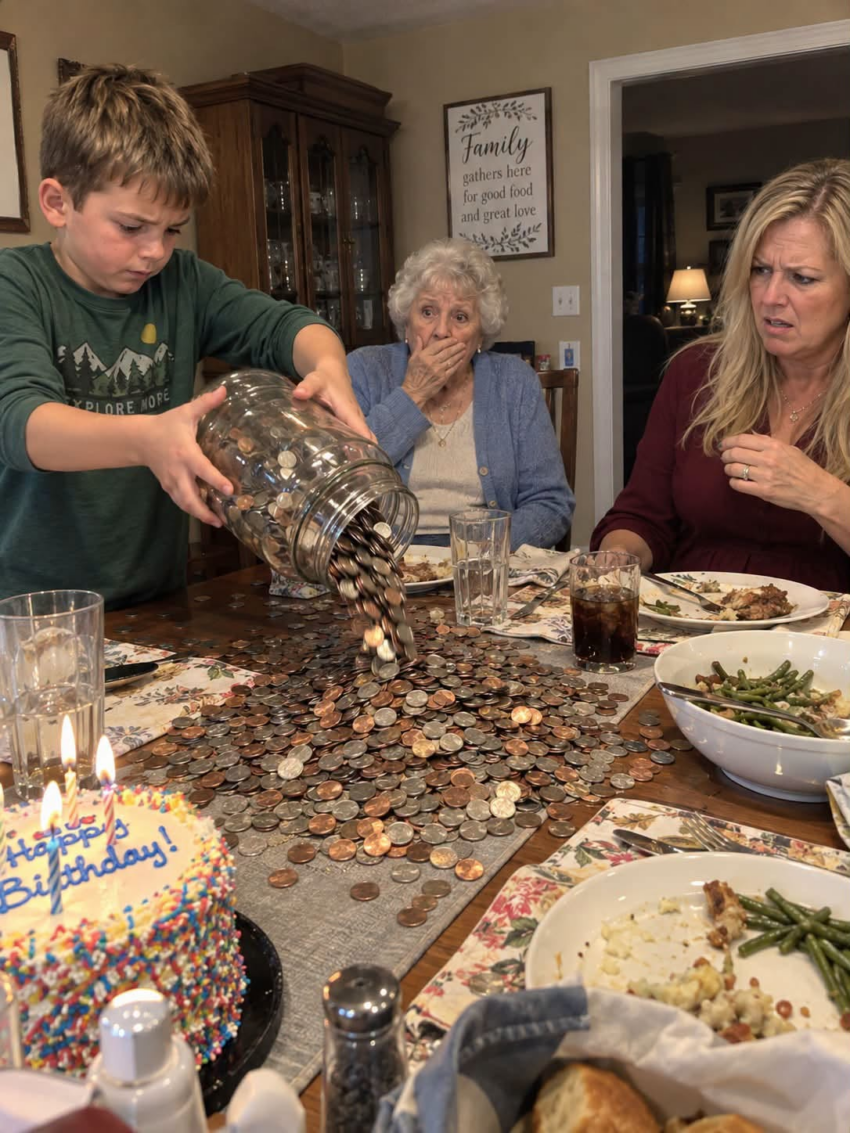
It was the pretzel jar.
The giant, blue-lidded glass jug, crammed to the brim with quarters, nickels, dimes, and crumpled five-dollar bills.
It weighed at least fifteen pounds.
He slammed it onto the oak table with a concussive thud that made the water glasses jump.
“Liam?” I said, feigning mild surprise.
“What in the world is that, honey?” Aunt Carol asked, leaning forward with a chuckle.
“It’s my bike fund,” Liam said clearly.
Chloe’s smile wavered for a split second, her eyes darting to the glass jar, then to my face.
“Liam,” Chloe said, her voice dropping an octave, tightening around the edges. “This is Grandma’s birthday. Put your toys away.”
“It’s not a toy,” Liam said.
He unscrewed the blue plastic lid with two sharp twists.
Then, before anyone at the table could process what he was doing, Liam grabbed the bottom of the heavy glass jar, hoisted it into the air, and tipped it upside down directly over Chloe’s dessert plate.
The sound was deafening.
It wasn’t a gentle clatter.
It was an absolute, thundering avalanche of metal.
Hundreds upon hundreds of silver coins cascaded across Chloe’s plate, smashing into the china, bouncing over the rim, spraying across the linen tablecloth, ricocheting off wine glasses, rolling into the butter dish, and clattering onto the floorboards in every direction.
A stray quarter struck Chloe’s forehead with a sharp clink.
She shrieked, shoving her chair back so violently it slammed into the radiator behind her.
“What the hell is wrong with you?!” Chloe screamed, brushing quarters off her lap in a panic. “Are you out of your mind?!”
“Liam!” Aunt Carol gasped, her hands flying to her cheeks.
Uncle Mike sat frozen, a forkful of pie suspended two inches from his open mouth.
Liam set the empty glass jar down on the table with absolute composure.
“It’s for you, Aunt Chloe,” Liam said, his voice ringing through the shocked silence of the dining room.
Chloe stared at him, her chest heaving, her pristine cream sweater dusted with coin grime and powdered sugar.
“For me?” she hissed. “What are you talking about?!”
“It’s payment,” Liam said simply. “Because you helped cut Grandma’s pie. And you helped carry the water glasses from the sink. And you like getting money for helping.”
He gestured to the shiny mountain of silver covering her place setting.
“That’s three hundred and twelve dollars,” Liam added helpfully. “You can turn off a lot of hallway lights for that.”
The silence that followed was terrifying.
You could hear the grandfather clock ticking in the hall, three rooms away.
A single quarter was still spinning on the hardwood near Ben’s shoe, clicking slower and slower until it fell flat with a final, metallic slap.
Chloe’s face had drained of all color.
“He’s… he’s just being a brat,” Chloe stammered, looking frantically around the table. “He doesn’t know what he’s saying. Dana, control your child!”
Liam didn’t flinch.
He reached into his back jeans pocket, pulled out a tri-folded piece of white cardstock, and laid it flat on the tablecloth right beside the pile of coins.
Chloe lunged across the table.
She didn’t reach for it casually; she made a desperate, clawing dive for the paper.
Liam snatched it back with lightning reflexes, tucking it firmly behind his spine.
“Liam!” Chloe barked, her voice shrill, the mask completely slipping off to reveal the jagged panic underneath. “Give that to me right now! That is private personal property! Give it to me!”
She was halfway over the table, her hand knocking over an empty water goblet.
Aunt Carol looked utterly bewildered. “Chloe, what is going on? What is that paper?”
“It’s nothing!” Chloe yelled, her eyes wild. “He went through my bedroom! He’s stealing from me!”
“I didn’t go through your bedroom,” Liam said, standing his ground. “You gave it to Grandma yesterday afternoon. I was sitting under the kitchen table tying my sneaker. You threw it in her lap and told her she had forty-eight hours to figure out where she was getting the rest of it.”
Mom covered her face with both hands.
Her shoulders began to shake, small, silent sobs wracking her frail back.
Uncle Mike slowly set his fork down.
His bushy gray eyebrows drew together into a dangerous, dark line.
“Evelyn,” Mike said, his voice low and heavy as a gravel truck. “What is the boy talking about?”
Mom couldn’t answer.
She just kept her face buried in her hands, her silver hair catching the chandelier light.
I held out my hand across the table toward my son.
“Liam,” I said calmly. “The paper, please.”
“Dana, don’t you dare,” Chloe warned, her voice trembling with pure venom. “If you read that, you are violating my privacy in front of our family. This is between me and Mom. It’s an adult matter.”
“You brought it into my house, Chloe,” I said. “And you’re living on my floor. Liam. Hand it to me.”
Liam placed the folded cardstock in my palm.
I unfolded it slowly.
The paper was crisp.
At the very top, typed in bold, twelve-point Arial font, centered perfectly:
CARTER FAMILY CARE SERVICES – BALANCE DUE.
I looked up at my family.
Aunt Carol was staring at me with her mouth open.
Cousin Ben had stopped breathing, his eyes fixed on the sheet.
Uncle Mike looked like he was about to rip an engine block in half with his bare hands.
“I’m going to read this aloud,” I said, my voice steady, carrying that flat, clinical cadence I used when reciting an insurance investigator’s findings to a room full of skeptical lawyers. “Because Chloe has worked so hard for us, and I think her contributions deserve full transparency.”
“Dana, stop!” Chloe lunged again, but Cousin Ben reached out with one long arm and firmly caught her by the wrist, pressing her back into her chair.
“Sit down, Chloe,” Ben said, his voice eerily quiet. “Let her read it.”
I looked down at the paper.
“Item one,” I read. “October second: Hallway light switch suppression. Fee: ten dollars.”
Carol whispered, “What?”
“Item two: October third: Glass of ice water delivered to porch. Fee: ten dollars.”
“Shut up,” Chloe hissed, her face burning crimson now. “Just shut up!”
“Item three: October sixth: Retrieval of dropped cardigan from linoleum. Fee: ten dollars.”
“Dana, please,” Aunt Carol whimpered, looking like she was going to be sick.
“Item four: October ninth: Morning bathing and transfer assistance. Fee: thirty dollars.”
Uncle Mike’s chair screeched as he leaned his massive frame over the table. “She charged Evelyn to help her bathe?”
“Item five,” I continued, turning the page. “October twelfth: Laundry transfer, ground floor to basement, containing heavy denim textiles. Surcharge applied. Fee: twenty-five dollars.”
I skipped down the long, dense columns of dates, times, and line items.
Pages of them.
Weeks of cruelty codified into a neat corporate invoice.
I reached the bottom of the final page.
“Total balance accrued,” I read, pausing to look Chloe directly in the eyes. “Three thousand, seven hundred, and sixty dollars.”
The dining room descended into absolute, suffocating silence.
Mom was crying openly now, the sound tiny and pathetic in the quiet room.
Chloe sat pinned against the radiator, her chest rising and falling rapidly, her jaw working as she tried to assemble an argument from the wreckage.
“It’s an educational tool!” Chloe shouted suddenly, her voice cracking under the strain. “It’s not an enforceable debt! It was behavioral conditioning!”
“Behavioral conditioning?” Ben repeated, leaning over the table and pointing a finger at the sheet. “It has a payment routing number at the bottom, Chloe. You printed your Venmo handle on an invoice to your seventy-nine-year-old mother!”
“Because she insisted!” Chloe shrieked. “She wanted to pay her way! Ask her! She didn’t want to feel like a burden!”
Mom dropped her hands from her face.
Her cheeks were wet, her eyes bloodshot, but when she looked across the table at Chloe, the shame had evaporated.
In its place was a cold, dignified fury that I hadn’t seen in my mother since my father passed away.
“I did not insist, Chloe,” Mom said.
Her voice wasn’t loud, but it cut through the room like a razor through silk.
“You stood in my kitchen,” Mom said, her chin trembling slightly, “and you told me that if I couldn’t pay my share, you would have to move to Denver to find a job, and Dana would have to go to an oncology hospice facility because she couldn’t take care of both of us.”
The temperature in the room plummeted ten degrees.
Aunt Carol made a terrible, strangled sound in the back of her throat.
“Mom,” Chloe pleaded, her eyes widening in terror. “That was… that was a hypothetical conversation about our long-term options—”
“You told me,” Mom continued, ignoring her completely, “that Dad didn’t leave enough behind to make me useful to anyone. You told me that thirty dollars for a bath was cheaper than an orderly, and that I should be grateful my own blood was willing to touch my arthritic skin for that price.”
Uncle Mike rose from his chair.
He didn’t yell.
He stood up so fast that his blazer knocked his wine glass over, sending a pool of dark red liquid soaking into the linen tablecloth around Liam’s quarters.
“You said that to your mother?” Mike rumbled, his voice shaking with a rage so profound his hands were clenched into white-knuckled fists at his sides.
“Uncle Mike, you don’t understand the pressure I was under!” Chloe sobbed, the tears flowing freely now, but they were the frantic, self-pitying tears of a cornered animal. “Craig stole everything! I had nothing! I was desperate!”
I stood up from my chair.
I didn’t feel weak anymore.
The adrenaline had flooded my system, clearing the chemotherapy fog from my brain with the force of an arctic wind.
I walked over to the sideboard, opened the drawer, and pulled out the second stack of folded slips—the ones I had photographed three weeks earlier.
“Let’s talk about desperation, Chloe,” I said, laying the slips next to Liam’s pile of coins. “And let’s talk about math.”
Chloe looked at the new slips, and her eyes went completely vacant.
I picked up the first slip.
“October seventeenth,” I read. “Podiatrist transport and waiting room monitoring. Fifty dollars charged to Mom’s ledger.”
I looked at Aunt Carol.
“Carol. Where were you on the morning of October seventeenth?”
Carol blinked, her wet eyes darting to the ceiling as her mind raced back.
“I… I drove Evelyn to the foot doctor,” Carol whispered. “I picked her up at nine-thirty. We were there until eleven. I bought Liam a dark chocolate bar at the pharmacy drive-through on the way home.”
“And what did Chloe tell you that afternoon, Carol?” I asked gently.
Carol’s face transformed.
It was like watching a pane of safety glass shatter—a thousand tiny cracks spreading across her features all at once.
She reached for her handbag on the floor, her fingers fumbling with the clasp, pulling out her smartphone with trembling hands.
“She texted me,” Carol said, her voice hollow. “She texted me at two o’clock that day. She said… she said prescription costs for Dana’s anti-nausea meds were through the roof, and Mom needed special compression wraps that Medicare wouldn’t cover.”
Carol scrolled through her screen, her jaw slackening in horror.
“I sent her three hundred dollars through Zelle,” Carol whispered, looking up at Chloe with pure, unadulterated disgust. “Three hundred dollars. I took it out of my holiday travel fund because she said you were choosing between your pills and Mom’s comfort.”
Cousin Ben was already on his phone.
His thumbs were flying across the screen, his face lit by the pale blue glare of his bank application.
“October twenty-fourth,” Ben read aloud, his voice dangerously level. “Two hundred and fifty dollars sent to Chloe Carter. Note attached: ‘For Mom’s physical therapy co-pays.’ Did Mom have physical therapy on the twenty-fourth, Dana?”
“Mom hasn’t had physical therapy since August,” I replied.
Uncle Mike didn’t need a phone.
He reached into his breast pocket, pulled out his worn leather checkbook, and slapped it onto the table with a wet smack.
“One hundred and eighty dollars,” Mike growled. “Cash. Two weeks ago. She told me the alternator on her car died while she was rushing Evelyn to urgent care. Said she paid for the tow out of her own pocket and couldn’t buy groceries.”
I looked around the table.
The numbers were all there.
The timeline was complete.
The audit was closed.
“So here’s the actual balance sheet,” I said, leaning over the table and looking down at my sister. “You billed our mother out of her pension for services you didn’t perform. You double-billed Aunt Carol for trips she took herself. You extorted Ben and Mike using my cancer as an emotional lever. You took a total of one thousand, nine hundred, and forty dollars in direct cash transfers from our family over the last seventy days.”
Chloe looked from Carol, to Ben, to Mike, to Mom.
Every single face looking back at her was carved from stone.
There was no sympathy left in the room.
There were no excuses that could survive the sunlight of those receipts.
“You’re all disgusting,” Chloe spat, her voice dropping into a vicious, cornered growl. “You sit here in your comfortable houses with your pensions and your husbands and your careers, and you judge me! I gave up my life to come here! Craig ruined me! He took five years of my life and every dollar I had, and none of you cared! None of you asked how I was going to survive!”
“We gave you a home!” I shouted, my voice cracking with the sheer, burning fury of thirty-eight years of sisterhood betrayed. “I gave you a bed! I gave you food! We gave you love, Chloe! And you treated our mother like an ATM with arthritis!”
Chloe grabbed her purse from the back of her chair.
She shoved Ben’s hand away, scrambling to her feet, knocking her chair flat onto the floorboards with a violent crash.
“I’m leaving,” she snarled, wiping mascara from her cheeks with the back of her hand. “I don’t have to stay here and be interrogated by a bunch of hypocrites. I’m packing my bags tonight.”
“No,” I said.
The word was quiet, but it stopped her dead in her tracks near the dining room threshold.
Chloe turned, her eyes burning. “What do you mean, no? You going to lock me in the basement, Dana?”
“You are not packing your bags tonight,” I said, standing upright, holding onto the edge of the table. “It is nine o’clock on your mother’s birthday. It is raining outside. You have no money, your car has an empty tank, and I am not having the police called to my house because my sister is wandering down the highway like a vagrant.”
Aunt Carol looked at me, astonished. “Dana, after what she did? Let her walk!”
“No,” I said firmly. “We are not like her. We don’t discard people on the side of the road when they become inconvenient. That’s her system, not mine.”
I looked Chloe dead in the eyes.
“You have three days,” I told her. “Seventy-two hours to find an apartment, find a friend with a couch, or call Craig and beg him to take you back. But until Tuesday morning, you sleep in that spare room. And you will not say a single word to Mom. You will not look at her. You will not breathe in her direction.”
Chloe stared at me, her chest heaving, searching my face for any trace of the soft, sick sister she could manipulate.
She found none.
She spun on her heel, marched down the hall, and slammed the guest bedroom door so hard the framed family portraits in the corridor rattled on their nails.
For a long time, nobody moved.
Then Liam looked down at the tablecloth, where hundreds of quarters were still resting in puddles of spilled wine and lemon meringue crumbs.
He raised his hand politely, like a boy sitting in the fifth row of a social studies class.
“Mom?”
“Yes, Liam?”
“Can I have my quarters back now? I still need forty dollars for the suspension fork.”
Uncle Mike let out a sound that started as a wheeze, turned into a choke, and exploded into a massive, booming roar of laughter that shook his entire belly.
Ben covered his face, laughing into his palms until tears ran down his wrists.
Even Mom, through her drying tears, let out a wet, breathless chuckle, reaching out to pat Liam’s hand across the coins.
“We’ll wash them first, sweetheart,” Mom said softly. “They’ve got wine on them.”
Over the next three days, something extraordinary happened in our house.
Nobody planned it.
There was no family meeting, no tactical memo, no coordinated conspiracy.
The family simply adopted Chloe’s behavioral system and applied it exclusively to Chloe.
It began on Sunday morning.
Chloe came down the stairs at ten, her eyes puffy, dressed in sweatpants, carrying an empty travel mug.
Cousin Ben was sitting at the kitchen table with his laptop, having stayed the night on the living room pullout sofa to make sure Mom and I were safe.
Chloe walked to the counter, grabbed her car keys, and turned to Ben.
“My battery is dead,” she said, her voice flat and hostile. “The alternator finally went. I need a ride to the rental agency on Route 4.”
Ben slowly looked up from his screen.
He didn’t blink.
He extended his right arm across the counter, palm facing upward, fingers slightly curled.
“Ten dollars,” Ben said.
Chloe froze. “What?”
“Ten dollars,” Ben repeated evenly. “Route 4 is seven miles away. Fuel costs money. My time has commercial logistics value. Ten dollars, cash or electronic transfer.”
“Ben, I am your cousin!”
“And this is a transportation service,” he replied without a flicker of emotion. “Ten dollars, or you can start walking. It’s forty-eight degrees outside. Good for your cardiovascular independence.”
Chloe stared at him, her mouth opening and closing like a landed trout.
She reached into her purse, slammed a crumpled ten-dollar bill into his palm, and stomped out to his car.
That afternoon, she was upstairs packing cardboard boxes.
We heard her voice echo down the stairwell.
“Liam! Liam, come here for a second!”
Liam looked at me from the living room floor where he was building a Lego starfighter.
I gave him a slight nod.
He walked to the bottom of the stairs, looking up through the banister.
“Can you bring my phone charger up from the kitchen counter?” Chloe called down. “My back is killing me from lifting these boxes.”
Liam stood at the base of the stairs.
He raised his right hand, flattening his small palm toward the ceiling.
“Ten dollars,” Liam shouted up.
“Liam Carter!” Chloe shrieked from the landing. “I helped pay for your soccer cleats last spring!”
“The charger is downstairs,” Liam replied, his voice sweet, clear, and completely uncompromising. “And the stairs are steep. That’s a vertical transit surcharge. Ten dollars, Aunt Chloe. Or you can come get it yourself.”
There was a long, murderous silence from the top of the stairs.
Then the sound of heavy footsteps.
Chloe stomped down the stairs, her face dark with rage, grabbed the white cord from the counter, and glared at me where I lay on the sofa under my knitted blanket.
“You think this is funny?” she hissed.
I adjusted my pillow, taking a slow sip of peppermint tea.
“I think it’s an incentive structure,” I said mildly. “We’re building your cognitive boundaries. If you don’t learn how to carry your own cords, your self-reliance declines at three times the normal rate.”
“You’re monsters,” she spat. “Every single one of you.”
On Monday afternoon, Chloe came into the kitchen, looking pale and exhausted from packing three months of accumulated possessions into six cardboard cartons.
Mom was sitting by the window, calmly knitting a gray wool scarf.
Chloe walked to the sink, reached for a clean glass from the drying rack, and found it empty.
She looked at the Brita pitcher on the counter.
It was empty too.
She turned to Mom, her pride finally fraying around the edges.
“Is there any cold water in the fridge?”
Mom didn’t look up from her needles.
Click. Click. Click.
“Five dollars, dear,” Mom said gently.
Chloe dropped her hands to her sides. “Mom. Really? From you?”
Mom paused her knitting.
She adjusted her bifocals, looking over the rims at her youngest daughter with eyes that were entirely clear of guilt.
“You taught us the tariff system, Chloe,” Mom said, her voice soft, level, and utterly without malice. “You told me it was designed to show me that labor has value. Well, filling the pitcher requires carrying it to the tap, turning the handle, and waiting for the charcoal filter to drain. That’s labor. Five dollars. Or you can drink from the garden hose out back for free.”
Chloe stood there in the middle of the kitchen for sixty seconds, completely motionless.
She didn’t scream.
She didn’t throw anything.
She simply turned around, walked out the back door, and sat on the cold wooden steps in the gray November drizzle for an hour, staring at the gravel.
That night, after the house went dark, I sat down at the kitchen table with Mom.
We had all the records spread out under the pendant light.
My green notebook.
Aunt Carol’s bank screenshots.
Cousin Ben’s transfer confirmations.
Uncle Mike’s carbon copy checkbook slip.
And every single one of Chloe’s folded white and yellow invoices.
We weren’t guessing anymore.
We went line by line, date by date.
We eliminated anything that couldn’t be proved with a third-party witness or an electronic timestamp.
We didn’t include the fake rent.
We didn’t include the groceries.
We didn’t include the utilities or the streaming subscriptions or the wear-and-tear on my carpets.
We boiled it down to the cold, undeniable, forensic truth: the money that had left this family’s bank accounts under false pretenses.
When we finished adding the column, the final number sat at the bottom of a yellow legal pad in my handwriting:
$1,940.00.
Mom looked at the figure for a long time.
Then she reached into the pocket of her housecoat, pulled out a folded piece of printer paper, and handed it to me.
She had spent three hours that afternoon typing it on my old desktop computer in the den, using two fingers, her arthritic knuckles clicking against the plastic keys.
I unfolded it.
At the top, centered, in bold twenty-point font:
CHLOE CARTER – FINAL CARE SERVICES INVOICE.
I read through the items, and a slow, beautiful grin spread across my face.
“Mom,” I whispered. “This is ruthless.”
“Your father spent thirty years working for the municipal water board, Dana,” Mom said, smoothing down her lap. “He taught me how to itemize a bill when someone tries to steal from the reservoir. Let her have it.”
Tuesday morning was moving day.
The sky was the color of wet slate, and a cold November wind was whipping the dead maple leaves across the front porch.
At eight-thirty, Cousin Ben’s truck pulled into the driveway, followed immediately by Aunt Carol’s sedan and Uncle Mike’s old Buick.
They didn’t come to help her move.
They came to bear witness.
Chloe came down the stairs carrying her two floral suitcases, her winter coat zipped to the chin.
She had arranged to rent a basement studio forty miles away in Manchester, using the last of her credit card balance to put down the holding deposit.
She stopped at the bottom of the landing.
The entire family was assembled in the living room.
Carol was sitting on the loveseat, her handbag on her lap.
Ben was leaning against the mantle, his arms crossed over his chest.
Uncle Mike was standing by the foyer coat rack, broad and silent as an oak tree.
Liam was on the rug, his pretzel jar sitting between his sneakers, empty and shining.
Mom was in her armchair, her hands resting calmly on the armrests.
“What is this?” Chloe asked, her voice tight, defensive, exhausted. “A firing squad?”
Ben checked his watch. “Transition management. We’re providing residential oversight during your departure.”
Aunt Carol lifted her hand, palm out. “Ten dollars.”
Chloe rolled her eyes, a bitter sneer curling her lip. “Very witty. Can I please just get my boxes into the cab and leave?”
“Wait,” Mom said.
The word cut through the room like iron.
Chloe stopped, her fingers white where they gripped the handles of her suitcases.
Mom reached beside her cushion, picked up the sheet of paper she had typed the night before, and settled her glasses onto the bridge of her nose.
“Before you depart, Chloe,” Mom said, her voice clear and resonant, “we have to settle the family account.”
“I’m not paying you a dime,” Chloe snapped.
Mom ignored her completely, lifting the page to the light.
“Invoice for residential and domestic amenities provided to Chloe Carter,” Mom read. “Item one: Master guest bedroom occupancy, ninety days, utilities included. Market value: two thousand four hundred dollars.”
Chloe gasped. “You cannot bill me for rent!”
“Item two,” Mom continued, entirely unbothered. “High-speed wireless broadband and digital streaming access. Premium four-screen tier.”
Chloe swung her head toward me. “You’re charging me for Netflix?!”
“Three screens,” I replied from the sofa. “You had your phone, your tablet, and the guest room television running simultaneously. High bandwidth usage.”
“Item three,” Mom read on, her voice steady as a metronome. “Storage of six commercial containers in Dana’s garage for seventy days. Fifty dollars per month.”
“This is absurd!” Chloe yelled, dropping her suitcases onto the rug with a heavy thud. “This is complete nonsense! You can’t just make up numbers after the fact!”
Mom lowered the paper.
She looked at Chloe over the top of her gold frames, her eyes piercing and steady.
“That part,” Mom said softly, “was to show you what your system feels like when the person holding the pen doesn’t love you enough to let you get away with it.”
The room went completely still.
I stood up from the couch.
I walked across the rug, slowly, deliberately, until I was standing two feet from my sister.
I held out the yellow legal pad.
“This part,” I said, “is mine. And it isn’t a joke.”
Chloe looked down at the pad.
Her eyes tracked down the neat, single-spaced list.
Aunt Carol’s $300.
Ben’s $250.
Uncle Mike’s $180.
The verified pension withdrawals: $1,210.
Total: $1,940.00.
“Only the money you actually took,” I said. “Only the transfers we have bank receipts for. Not a penny of rent. Not a single kilowatt of electricity. Just the money you stole from your family while pretending to be our mother’s savior.”
Chloe stared at the number.
Her shoulders began to drop, the fight finally draining out of her frame, leaving her looking hollowed out, small, and infinitely tired.
“I don’t have nineteen hundred dollars, Dana,” she whispered. “You know I don’t.”
“I know you don’t.”
“Then what do you want from me?” she cried, her voice cracking. “Do you want me to go to jail? Do you want to call the police on your own sister?”
I looked at her.
I looked at the sister who used to share a bunk bed with me, the girl who used to help me catch fireflies in mayonnaise jars in Dad’s backyard, the woman who had let greed and bitterness turn her into a stranger who could charge her own mother for a drink of water.
“No,” I said. “I don’t want you in jail. Because in jail, the state feeds you, and you don’t learn a damn thing about what money means.”
I pointed across the room.
Across the rug, sitting on the floorboards with his legs crossed, Liam was watching us.
Beside him sat the empty pretzel jar.
“You’re going to pay it back,” I said. “Every single cent. Not all at once. You’re going to pay it back ten dollars at a time. Twenty dollars at a time. Exactly the way you extracted it from Mom.”
Chloe looked around the room.
Aunt Carol held up her smartphone, the screen displaying the Zelle transfer history.
Ben crossed his arms, his jaw set like concrete.
Uncle Mike stood by the door, unmoving.
There was no exit.
There was no Craig to blame, no cancer to hide behind, no administrative jargon to confuse the ledger.
Mom pointed at the empty jar beside Liam.
“Start with him,” Mom said quietly.
Chloe stood frozen for five long seconds.
Then, with fingers that shook so hard she could barely operate the zipper, she reached into her leather handbag.
She pulled out her slim wallet.
She opened the bill fold, reached inside, and pulled out two crisp twenty-dollar bills—the last cash she had left from her trip to the bank on Monday.
She walked across the living room rug.
Her heels clicked softly on the wood.
She stopped in front of my ten-year-old son.
She knelt down on one knee, her face turned away from the rest of the family, and placed the two twenty-dollar bills into Liam’s open palm.
“I will pay the rest,” Chloe whispered, her voice barely audible. “I will send it to Carol every Friday. Just… just give me time.”
Liam folded the two twenties into neat, tight squares.
He dropped them through the top of the giant pretzel jar.
Thump.
The bills landed softly on the glass bottom.
Liam looked up at his aunt with total, unblinking innocence.
“Do you want a receipt?” Liam asked.
Chloe let out a strangled, shuddering breath, stood up without answering, grabbed her two suitcases, and walked out of the front door into the rain.
The yellow cab was waiting by the curb.
We stood in the living room and watched through the window as the driver loaded her boxes into the trunk.
The car pulled away from the curb, its red taillights glowing in the mist, turning the corner at the end of the street and disappearing from our lives.
The house was completely quiet.
Uncle Mike walked over to the armchair, leaned down, and kissed the top of Mom’s head.
“Happy birthday, Evelyn,” he said gruffly.
“Thank you, Mike,” she replied.
It took fourteen months for Chloe to pay back the nineteen hundred and forty dollars.
She was helped along by Aunt Carol, who took it upon herself to establish a dedicated family group text titled BALANCE DUE – CARTER RECOVERY INITIATIVE.
Every Friday afternoon at precisely four o’clock, Carol posted an updated digital ledger showing the total received, the balance outstanding, and the date of the next scheduled payment.
Chloe never responded to the messages.
She never sent an emoji, never offered an explanation, never typed a word.
But every Friday morning, an electronic transfer of thirty-five or forty dollars landed in Carol’s account, which Carol immediately disbursed back to Mom, Ben, and Mike.
Chloe and I do not speak.
I won’t write an ending where we reconciled over coffee two years later and cried about our childhood.
We didn’t.
Some betrayals are not misunderstandings; they are structural fractures that permanently compromise the foundation of a house.
When someone shows you that they are capable of measuring your mother’s thirst in ten-dollar increments, you do not invite them back to the kitchen table.
You forgive them from a distance so the bitterness doesn’t rot your own marrow, and you bolt the door.
My scans began to clear that February.
The tumors in my lymph nodes shrank, then stabilized, then disappeared from the contrast imaging entirely.
By the following summer, my hair had grown back in thick, unruly curls that Liam told me made me look like an electric sheep.
I still get tired.
I still have mornings where my joints ache from the residual toxicity of the platinum drugs, and I still have to stop halfway down the stairs sometimes to let my heart catch up with my ribs.
Mom is eighty-one now.
Her hands are worse, the knuckles swollen like walnut shells, but she refuses to leave the yellow bungalow down the street.
We hired a licensed, bonded home health aide named Maria, who comes in three mornings a week to help with the laundry and the heavy cleaning.
We pay Maria thirty-five dollars an hour through an official agency account.
Mom doesn’t pay a dime of it; Ben, Carol, and I split the bill three ways, and nobody keeps a scorecard.
Liam got his mountain bike.
He bought it the following April—a bright cobalt-blue twenty-four-inch frame with aggressive off-road tires and an aluminum kickstand.
He rode it up and down Mom’s sidewalk until the tires were gray with street dust, ringing the bell every time he passed her porch window.
Just last week, on a warm Tuesday evening, we were all sitting in Mom’s living room after dinner.
Mom had her yellow tulips in a ceramic vase on the coffee table—fresh ones, which Liam buys her from the florist every other Saturday using his lawn-mowing money.
Mom leaned back in her armchair, her face tired after an afternoon of planting geraniums in her window boxes.
She looked up at the ceiling fixture, where the three bright bulbs were glaring into her eyes.
“Could somebody reach up and switch off that light?” Mom called out softly. “My shoulder is giving me a fit tonight.”
I set my book down, starting to get up from the sofa.
Before my feet hit the rug, Liam was already moving.
He sprinted across the room, leapt into the air, and slapped the brass wall plate, flicking the switch down into darkness with a loud, satisfying click.
The room plunged into the warm, amber glow of the table lamps.
Liam landed lightly on the hardwood, spun around on his sneakers, and marched over to Mom’s chair.
He stood before her, standing straight as a soldier, and thrust his open palm directly under her nose, his face deadpan.
“That’ll be ten dollars, Evelyn,” Liam said.
Mom looked at his palm.
Then she looked up into the grinning, freckled face of her ten-year-old grandson, threw her head back, and laughed until the tears ran down her cheeks.
Disclaimer: This story is a work of fiction created for entertainment purposes only. Any resemblance to real persons, living or deceased, or actual events is purely coincidental.