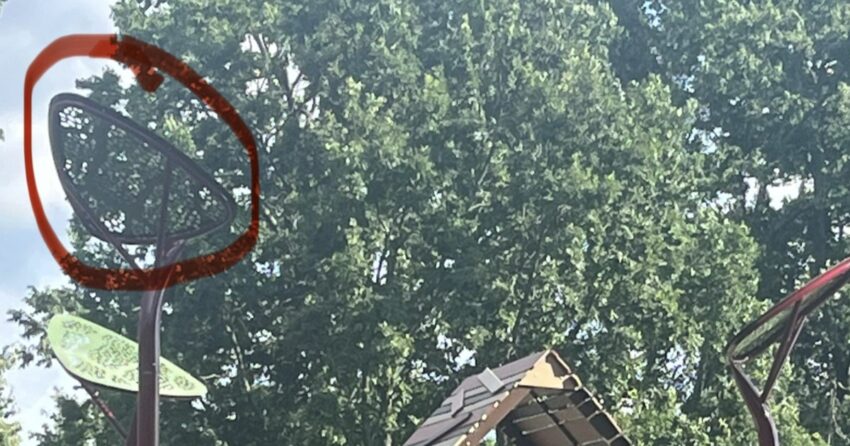
What those giant playground leaves actually are
You sit on a park bench with a cold drink sweating through the cup holder. Kids hammer the climbing wall. You tip your head back and there they are: two huge paddles on teal posts, punched full of holes, glowing orange and green against a washed-out sky. They look like tennis rackets that escaped a design studio. Or like someone scaled up a houseplant and forgot to stop.
Those structures are Solis Hue toppers from BCI Burke. Solis mounts to a single post. Solis XL spans two. Hue is the translucent insert version that turns noon sun into stained-glass puddles on the decks. They are not leftover sports gear. They are shade, sculpture, and a quiet sensory trick stacked on the same steel uprights that hold the rest of the playset.
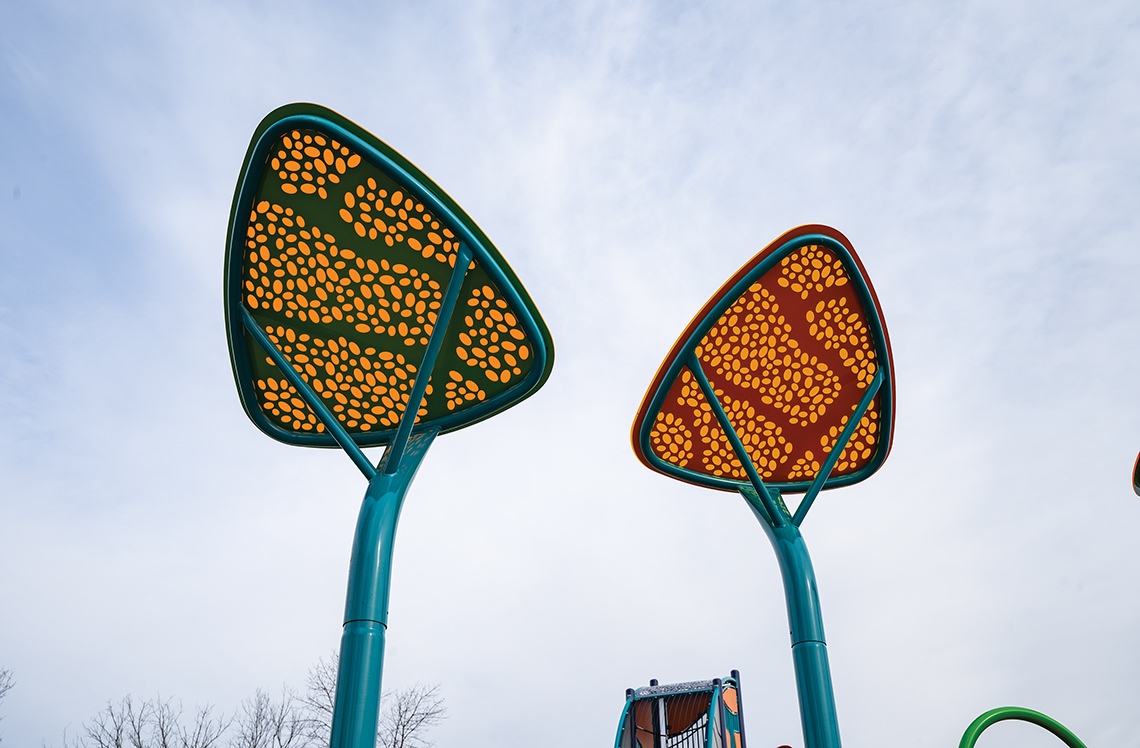
From below, Solis Hue toppers read like oversized leaves: perforated panels, colored inserts, and steel posts that throw moving light onto the decks.
Why parks started putting leaves in the air
Older playgrounds solved heat with fabric sails or flat plastic roofs. Sails catch wind like kites. Solid roofs bake the platforms and dump rain in one loud sheet. A perforated leaf lets air pass, breaks the sun into coins of light, and still knocks glare off the high-touch plastic.
Designers call the pattern dappled light. In Japanese it is komorebi: sun moving through leaves. Kids read depth from those moving patches. A platform that was just a platform becomes a ship deck at 11 a.m. and a forest floor at 3. No batteries. No speakers. Just the sun doing its daily arc.
Heat matters more than the pretty part. Dark rubber and plastic decks soak up midday sun. Children overheat faster than adults and they do not pause to put on sunscreen between the slide and the climber. Filtered shade keeps hands on the equipment longer. That is the unromantic reason cities write these toppers into spec sheets.
What the holes and the color actually do
The silhouette is botanical on purpose. The perforations are not decoration first. Wind goes through. Rain goes through. Bird droppings do not sit in a sagging fabric pocket. UV-stabilized polymer holds color longer than a cheap tarp.
Hue inserts sit behind or within those cutouts. Sun hits the top face. Soft color drops onto steps and slides. Emerald one hour, amber the next. The effect is closer to a church window than a carnival ride, which is the point. Stimulation without flicker.
Commercial specs versus what you can do in a backyard
Park systems use heavy galvanized posts, custom brackets, and panels rated for serious wind. Home playsets and patio pergolas do not need that budget. They need airflow, some UV break, and hardware that survives a Midwestern winter.
- Open area: Look for decorative outdoor panels with roughly half the surface open. Too solid and you get a sail. Too open and you get no shade.
- Material: UV-stable HDPE privacy screens or laser-cut aluminum with a powder coat. Skip indoor acrylic.
- Color layer: Outdoor-rated tinted polycarbonate behind the cutouts. Amber, leaf green, or a dusty cobalt all read well on wood decks.
- Hardware: 316 stainless eye straps, turnbuckles, and structural screws into solid timber or existing posts. Zinc hardware rusts and then stains the wood.
Do not copy a municipal height. Keep panels high enough that a swinging child cannot grab an edge, and low enough that the shadows actually land on the play surface instead of the neighbor’s fence.
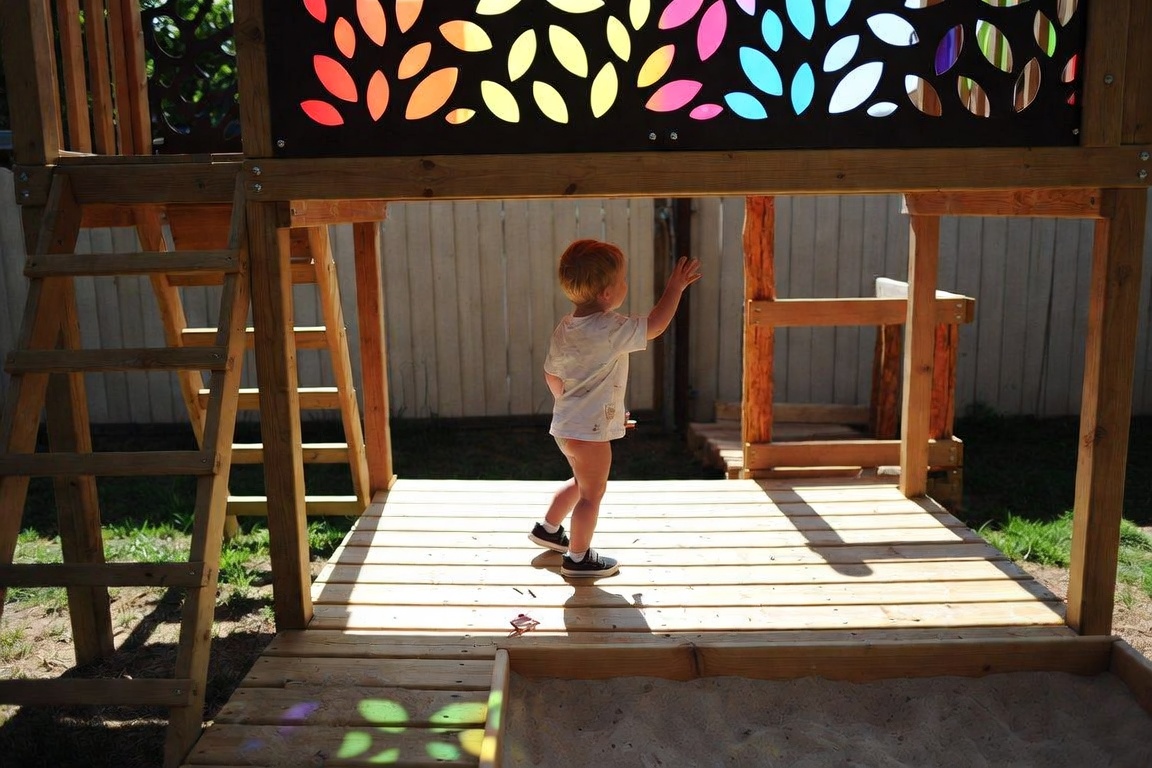
Colored coins of light on the deck are half the fun. Kids chase them the way they chase puddles after rain.
How to recreate filtered leaf canopy shade at home
Start with what you already have. A cedar playset with four corner posts is easier than a lone swing beam. A pergola over a sandbox works too. You are building a small canopy, not a second roof.
Step 1: Pick the span and the high points
Stand in the yard at the hour your kids actually play. Note where the sun hits the deck and where it already misses. You want the panel over the hot rectangle, not over the slide runout that already sits in tree shade.
Mark two or four attachment points. On timber posts, use structural screws and stainless eye straps. On a metal playset, use clamps rated for outdoor load, not zip ties dressed up as hardware.
Step 2: Choose a panel that breathes
Botanical cutouts photograph well and they are not the only option. Circles, seed shapes, even a simple grid will throw usable shadow. What you want is irregular edges so the light does not land in one hard stripe.
Have someone hold the panel overhead for sixty seconds on a bright day. If your arms cook, the open area is too small. If you barely notice a change on the boards, it is too thin.
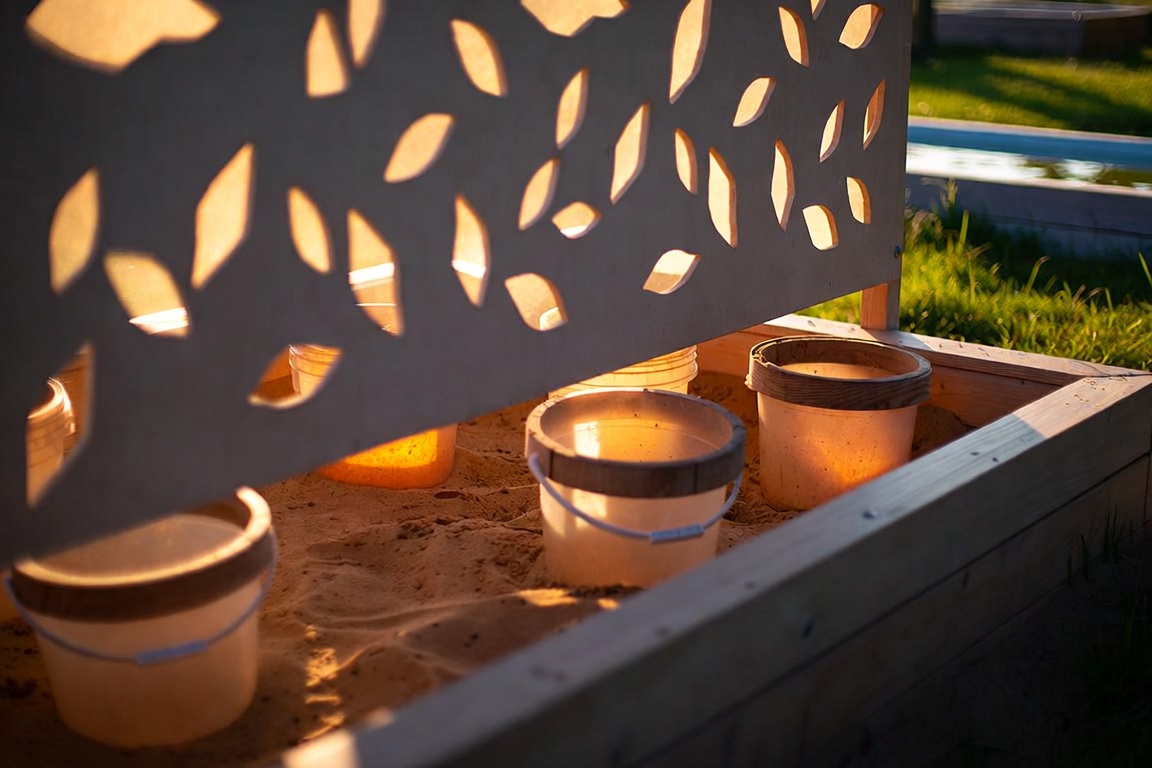
Openings let wind through. Color sits in the inserts. That pairing is the whole trick.
Step 3: Add the color layer
Fasten tinted polycarbonate behind the decorative face, not in front. The patterned panel takes the weather and the fingerprints. The tint does the glow. Leave a small air gap so heat does not cook the plastic against the cutouts.
One panel in amber over a sandbox is enough to test the idea. If the kids ignore it, you spent an afternoon and learned something. If they invent a game about “the gold spots,” you can add a second panel next season.
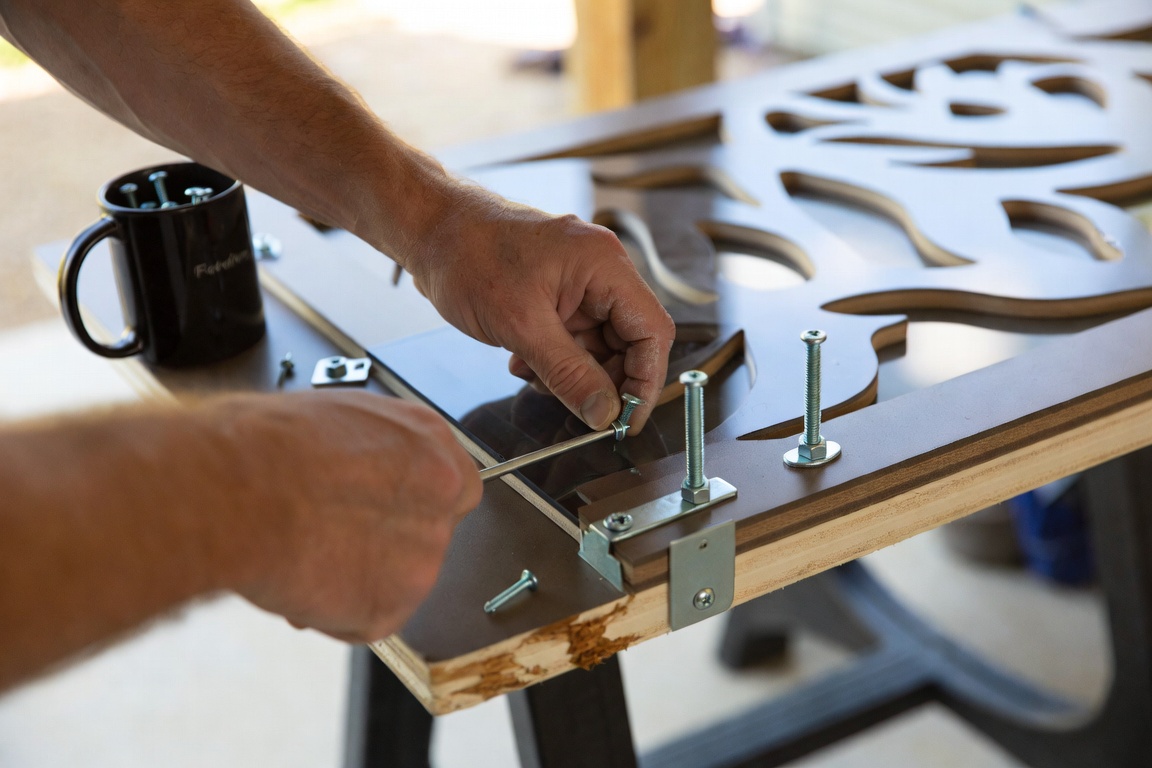
The backyard version is not a park spec sheet. It’s a panel, a tinted sheet, and hardware that will not rust by August.
Step 4: Tension like you mean it
Loose panels slap in a storm and teach every dog in the block to bark. Use turnbuckles. Recheck after the first hard wind. A quiet canopy is a tight canopy.
Keep edges smooth. No raw metal at kid height. No protruding screw tips on the underside of a beam. Run your palm along every reachable surface the way a seven-year-old will.
A spring checklist that actually gets done
Winter loosens bolts. Freeze-thaw works posts the way a wedge works a log. Before the first warm Saturday, do the unpretty work.
- Snug every post bolt and bracket screw. Replace anything that spun freely.
- Wash resin or HDPE with warm water and a plant-based dish soap on a soft mop. No scouring pads. No solvent that clouds the UV coat.
- Look at drainage holes. A clogged hole holds water, and standing water is how rust starts at a collar.
- Check the ground around footings. Soil heave is a quiet way to lean a post.
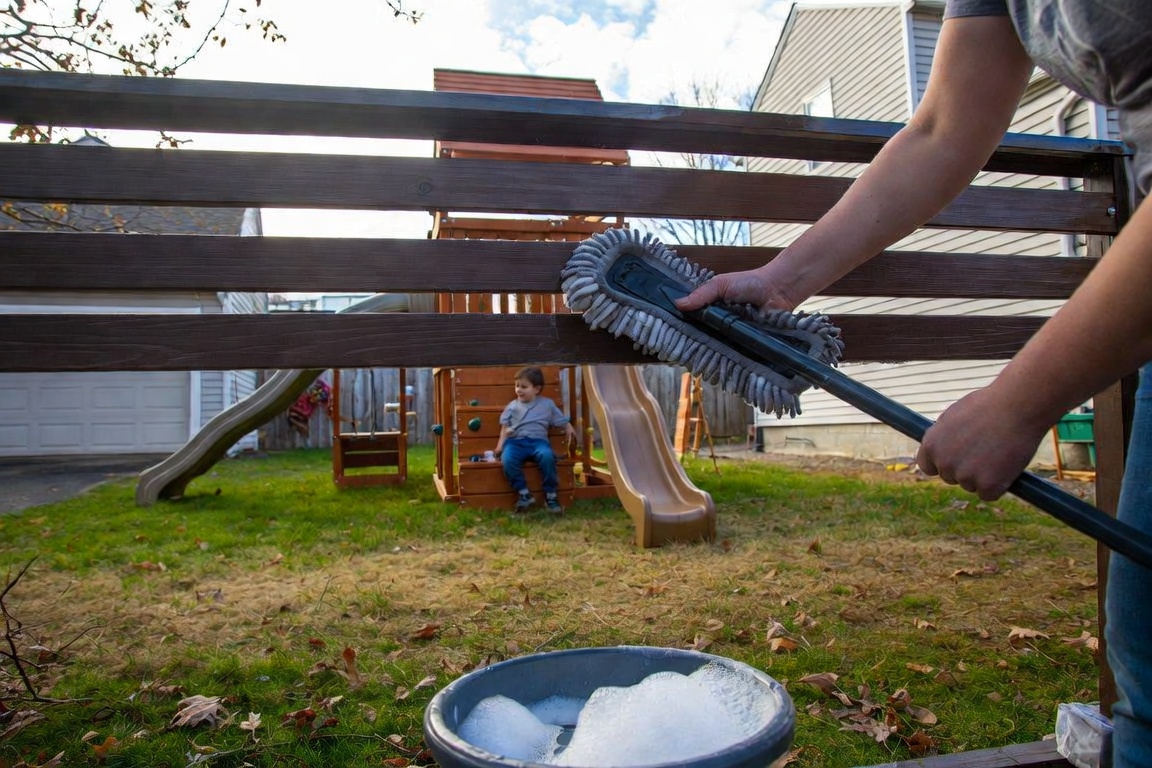
Spring check is unglamorous: soap, a soft mop, and a look at every bolt that froze and thawed all winter.
If a panel hazes after a few seasons, it is sun-worn. Replace the insert before you replace the whole frame. Color is the cheap part.
What to tell your kids when they ask
They will ask. They always ask about the giant leaves. You can say they are pretend trees that make the playground cooler. You can say they are windows for the sun. Both are true enough.
The longer answer is the one you keep for yourself. Play lasts longer when the deck is not a skillet. Imagination lasts longer when the light moves. Solis Hue toppers are one manufacturer’s version of that idea. Your backyard version can be smaller, quieter, and still throw the same gold coins across the boards at 2 p.m.
Next time you look up from that park bench, you will know why those paddles are up there. And if you go home and hang one perforated panel over the sandbox, you will know why the kids suddenly want to play outside until the shadows get long.