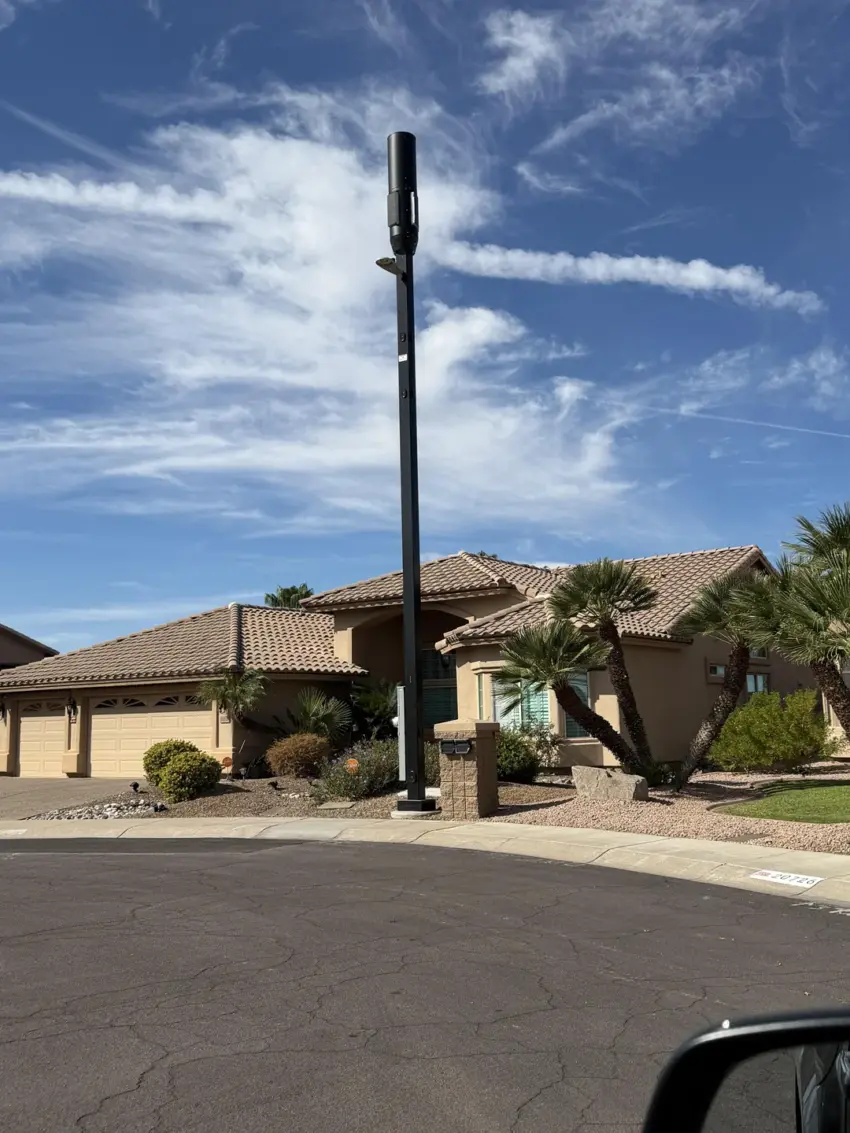
Imagine stepping out onto your front porch on a quiet Tuesday morning with a hot cup of lemon ginger tea, ready to admire your blooming hydrangeas, only to find a thirty-foot matte black steel column planted right at the edge of your lawn. It stands tall like an oversized street lamp without a lightbulb, capped with a sleek, mysterious cylindrical canister. You did not order it, you never signed a contract, and you certainly were not asked for permission.
That exact scenario recently played out in a viral neighborhood photo, leaving thousands of homeowners scratching their heads and checking their property deeds.
This giant pole just went up in my neighbor’s front yard
by
u/Particular-Pepper-69 in
whatisit
The Morning Surprise: Why a 5G Small Cell Pole in Your Front Yard Happens Overnight
The mysterious structure popping up on suburban curbs is known in the telecommunications industry as a 5G small cell pole or a Distributed Antenna System (DAS) node. For decades, wireless coverage relied on massive macro towers standing hundreds of feet high on distant ridges or industrial rooftops. Those monolithic towers broadcast low-frequency signals across miles, punching through walls and rolling over hills with ease.
Fifth-generation wireless technology operates on a completely different physical principle. To deliver lightning-fast data speeds and support smart city connectivity, carriers utilize high-frequency radio bands. While these frequencies carry vast amounts of data, their waves are short, fragile, and easily stopped by brick walls, double-pane windows, and dense tree canopies.
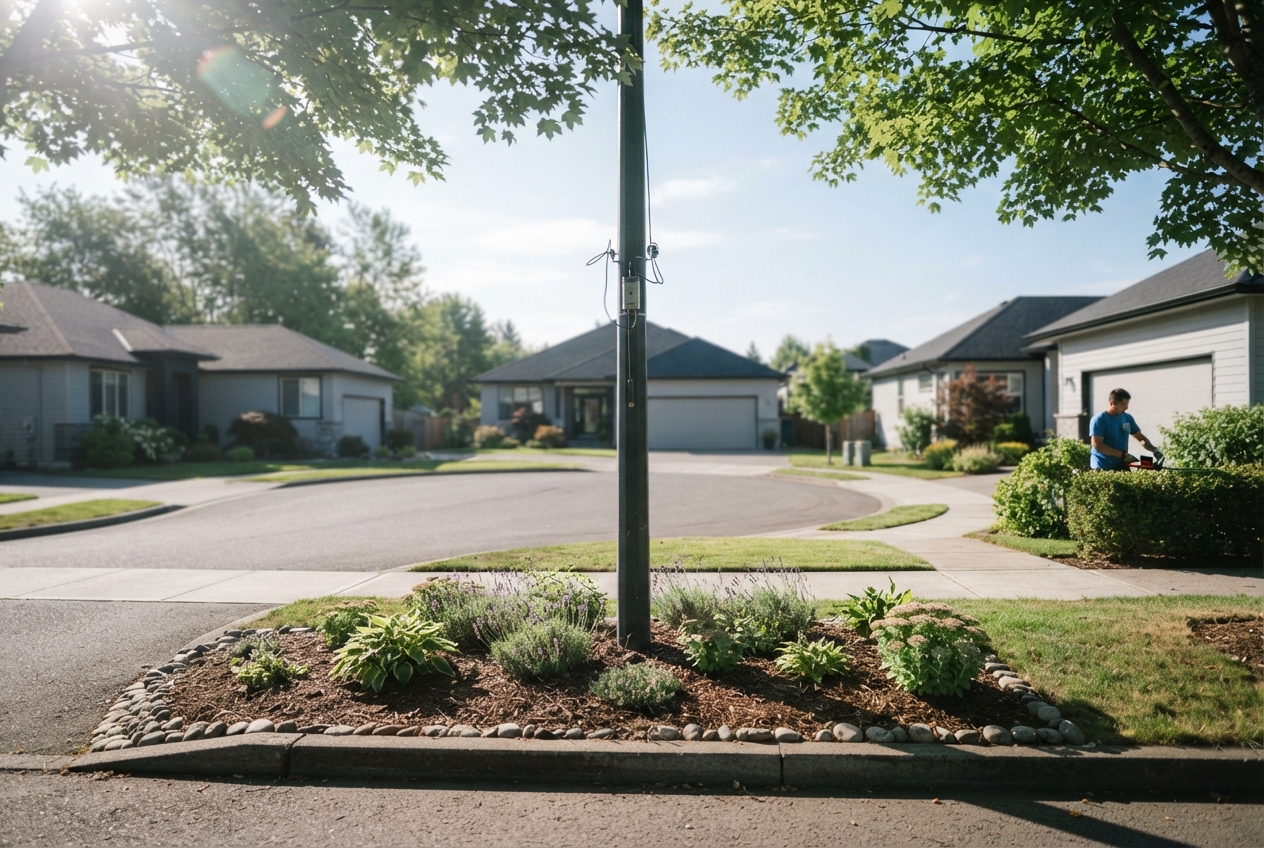
Modern small cell poles are designed to blend into neighborhood utility corridors, though their sudden appearance often catches homeowners off guard.
To keep connections steady, carriers must place thousands of mini-transmitters much closer to where people live, work, and stream. Instead of one giant tower miles away, neighborhoods now receive networks of compact poles spaced just several hundred feet apart along residential streets.
Utility Easements vs. Private Property: Who Actually Owns That Grass?
The most common reaction when a tall metal pole appears on a manicured lawn is sheer disbelief: How can a utility company build on my private land without asking?
The answer lies in the legal difference between your private yard and the municipal public right-of-way (ROW). When you purchase a home, your deed includes designated utility easements. In almost every suburban neighborhood, the city or township retains ownership or dedicated access to a strip of land running five to ten feet back from the street curb or sidewalk edge.
- The Public Right-of-Way: This zone allows the local government and approved utility providers to run water mains, natural gas lines, power cables, storm drains, and communication lines.
- Homeowner Maintenance Obligations: Even though the municipality owns the right-of-way easement, city ordinances typically require the adjacent homeowner to mow the grass, rake the leaves, and shovel the sidewalk across that strip.
- Permitted Construction: Because state and federal laws classify high-speed communications as essential public utilities, telecom providers can apply for municipal right-of-way permits and install poles without individual homeowner consent.

Checking your original property survey reveals where your private yard ends and the city’s public right-of-way begins.
“Many homeowners assume their property extends all the way to the curb asphalt. Pulling your official plat survey will quickly reveal where your boundary stops and the municipal easement begins.”
Why Your Phone Loses Bars Right Next to the Antenna (The Signal Donut)
One of the strangest quirks of living near a 5G small cell pole in your front yard is discovering that your mobile reception might not improve at all. In fact, people living directly beneath these nodes often report zero signal boost inside their living rooms.
This happens because radio antennas do not spray wireless energy straight down like a showerhead. Instead, telecom engineers design small cell antennas to project radio waves outward in a horizontal, slightly downward angle, resembling an open umbrella or an expanded donut. The area directly under the base of the mast sits in a dead coverage pocket—an engineering reality captured by the old proverb: the darkest place is directly under the candlestick.

Proximity to a neighborhood small cell does not always guarantee better cell reception if your phone connects to a different network carrier.
Network carrier exclusivity is another major factor. A pole installed on your street corner may belong exclusively to Verizon, AT&T, or T-Mobile. If that node broadcasts an AT&T signal and your smartphone operates on a different network, your device will ignore the nearby pole completely and continue searching for a distant tower.
Passive Income or Public Utility: Do Homeowners Get Paid?
Rumors frequently circulate online about property owners collecting thousands of dollars each month in cellular lease checks. While cell tower land leases are common on large rural acreages, commercial roofs, and private farmland, residential curbside poles work under completely different rules.
When a carrier places a small cell pole inside the municipal street easement, they pay permit and franchise fees directly to the local city or county government. Because the hardware does not sit on private, unencumbered land, the adjacent homeowner receives zero monthly rent or royalty payments.
Clever Yard Styling Fixes: Softening the Look of Street Utility Poles
If a utility pole has landed on your curbside, you do not have to let cold industrial steel ruin your home’s exterior charm. With thoughtful plant selection and creative garden bed design, you can soften the visual impact while respecting municipal utility codes.
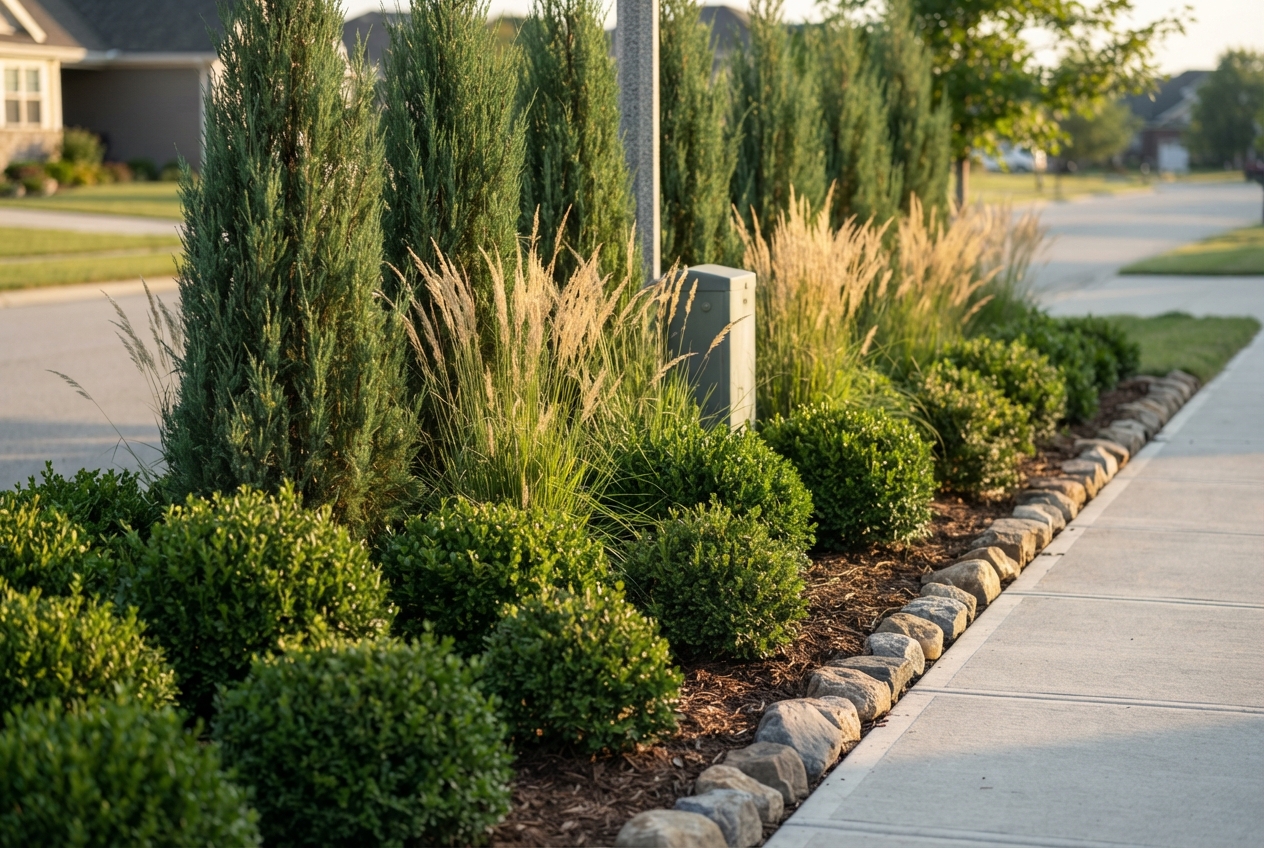
Tall, slender evergreens and ornamental grasses create an organic visual screen around utility fixtures while maintaining required maintenance clearances.
- Upright Columnar Evergreens: Slender varieties like Sky Pencil Holly, Italian Cypress, or Emerald Green Arborvitae grow vertically without spreading wide, creating a lush green backdrop that visually breaks up dark metal poles.
- Feather Reed Grasses: Varieties like Karl Foerster reach five to six feet tall by midsummer, offering breezy movement, golden seed heads, and dense texture that draws the eye away from utility fixtures.
- Layered Perennial Borders: Plant mounding shrubs like dwarf hydrangeas, boxwoods, and purple coneflowers around the perimeter of your yard to establish rich focal points near your walkway.
Utility Clearance Tip: Always call 811 before digging near curbside easements to locate buried fiber lines and power conduits. Maintain at least three to four feet of open space around equipment boxes so municipal technicians can access the pole without trimming your shrubs.
How to Check City Permits and Voice Neighborhood Concerns
While you cannot physically block an approved utility installation on city property, you have rights as an engaged resident. Local governments frequently establish aesthetic and zoning guidelines for small cell deployments.
Contact your local planning or public works department and ask to view the right-of-way permit for your street. Many municipalities require carriers to use “stealth poles” that mimic historic street lamps, match neighborhood paint colors, or combine telecom gear with existing streetlights rather than adding standalone posts. If a newly installed pole creates a sightline hazard for backing out of your driveway, request a safety inspection from the city traffic engineer.
Making Peace with Modern Neighborhood Infrastructure
Neighborhoods constantly adapt to changing technology, from the wooden telegraph poles of the nineteenth century to the green transformer boxes of modern subdivisions. Having a 5G small cell pole in your front yard can certainly feel like an uninvited guest on day one, but understanding property easements, managing your garden borders, and knowing your local zoning options puts you back in the driver’s seat of your home’s curb appeal.