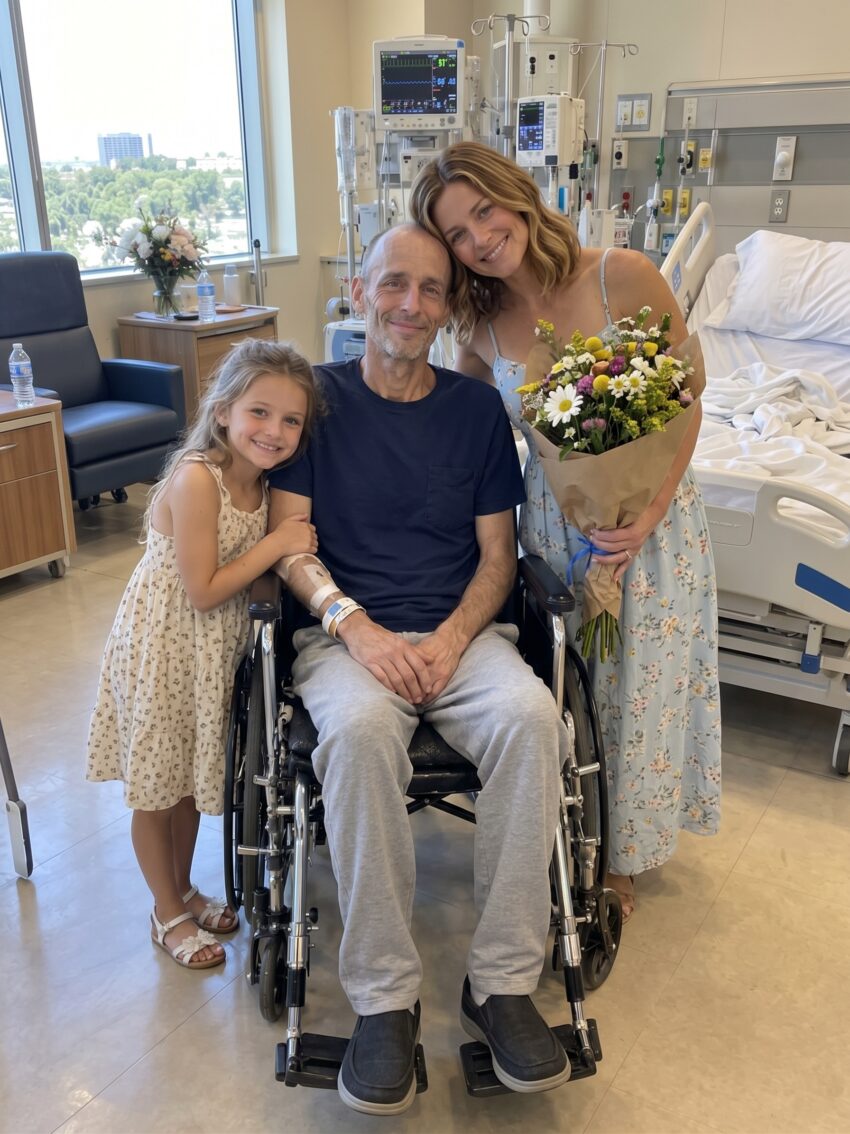
Mia walked into the kitchen exactly one year after her father’s funeral, carrying a small cardboard box in both hands like it might shatter.
I was at the stove stirring chicken noodle soup. It was a Tuesday. It was raining. The radio was on low, humming the same weather report it had been repeating all afternoon.
She’d been quiet for days.
Not sad-quiet, exactly. Waiting-quiet. The way kids get on Christmas Eve, or the night before the first day of school. She’d been hovering around me, following me from room to room, starting sentences and not finishing them.
I’d figured it was the anniversary. A full year since we laid Thomas in the ground. I’d been feeling it heavily too.
Yet now she was standing in the kitchen doorway in her purple socks with the box held out in front of her, and her face was so solemn it startled me.
“Dad told me to give this to you today,” she said softly.
I clicked off the burner.
“Before he died, he showed me where he hid it. In the back of his closet. Behind the winter boots.” She swallowed. “He made me promise not to touch it until today. Not even to peek. And I didn’t. I swear I didn’t.”
“Okay, baby,” I said gently. “Okay.”
“I’m supposed to tell you something too.”
She inhaled deeply. I could see her lips moving silently, practicing. Like she’d been rehearsing this for a whole year.
“You still have no idea why he chose you.”
The hair on my arms stood straight up.
I wiped my hands on the dish towel. I sat down at the wooden table. Mia set the box in front of me and stepped back, like it was hot.
It was an old shoebox, the lid fastened with a thick rubber band.
I snapped off the rubber band.
I lifted the lid.
And to explain what I saw inside, and why I screamed loud enough that the neighbors came over later to check on us, I have to go back. A long way back.
Several years ago, I lost my husband and my sweet girl in a sudden car accident.
My husband’s name was Sam. My daughter’s name was Josie. She was four years old.
Even now, there are moments of that day I can’t bring myself to mention. I’ve tried. In therapy. With my sister. Alone in the car with the stereo off. The words just catch somewhere in my throat, like a door slamming shut.
So I won’t recount those parts.
What I can tell you is the single thought that constantly nagged at me.
Josie had a stuffed rabbit named Mr. Bunny, and he went everywhere with her.
I mean everywhere. To the grocery store. To the pediatrician. Into the bathtub, which is why one of his ears was permanently stiff. To bed, of course, and to the breakfast table, where he had his own chair next to her cereal bowl. She wouldn’t touch anything green unless Mr. Bunny nibbled it first. He had a small gray felt nose and black button eyes and long floppy ears, and he’d been white once, a long time ago, but by the time Josie was four he was the shade of weak tea.
She named him herself, at eighteen months. Mr. Bunny. Never Bunny. Mister. She was very strict about the Mister.
After the wreck, the hospital handed me a clear plastic bag filled with her belongings. Her little pink sneakers. Her coat with the ladybug buttons. A hair clip shaped like a strawberry.
I dug through that bag twice.
No Mr. Bunny.
I asked the triage nurse. She didn’t know. I asked the police officer who stopped by the house. He said he’d look into it, and I could tell from his expression that he thought I was a broken woman who’d lost her mind over a toy.
Maybe I was.
Two weeks after the service, I drove out to the tow yard where they’d hauled our car. A mechanic in coveralls guided me out to it. He didn’t want to. He said, “Ma’am, I really don’t think you ought to see this.” I said, “I need to look for something.” He stared at me for a long time, then stepped aside and left me alone.
I searched that wreck for an hour. Under the seats. In the torn seams. In Josie’s car seat, which I couldn’t look at directly, so I searched it with my eyes half closed.
He wasn’t there.
I had lost my entire world. My husband. My baby. My house, eventually, because living inside it was unbearable. And yet some nights, I still lay awake wondering where that little stuffed rabbit had ended up.
It sounds trivial. I know it does.
But it wasn’t trivial to me. His absence became one more piece of her I couldn’t bring home. Like she’d taken him with her, wherever she went. Or like someone had ripped him away from her at the last moment, leaving her completely alone without him.
That was the thought I couldn’t bear. That she’d been terrified, at the very end, and he wasn’t there.
In the years that followed, I learned how to keep breathing without calling it moving on.
People always urge you to move on. They say it kindly. They say, You’re still young. They say, Sam would want you to be happy. They say, Have you thought about dating again?
I never remarried. I never had another child. I never even went on dates. My sister, Beth, set me up once, about three years after. I sat across from a pleasant man at an Italian restaurant and listened to him talk about his fantasy football draft, and halfway through the salad I excused myself to the restroom and drove straight home.
I sold the house and moved into a one-bedroom apartment across town. I kept one box of Josie’s keepsakes in the closet. Her drawings. Her baby blanket. The strawberry hair clip. I rarely opened it.
Eventually, I took a job as a housekeeper at St. Agnes Hospital.
I’d worked as a paralegal before. A good one. But I couldn’t face an office full of colleagues who knew. Who’d tilt their heads pityingly when they spoke to me. Who’d whisper that’s her when I walked past the copy machine.
At the hospital, nobody knew me. I wore a plain gray uniform, pushed a cart, and sanitized rooms. I emptied trash cans, changed linens, and scrubbed floors. I learned which nurses enjoyed chatting and which ones preferred silence. I learned the difference between the smell of a room where someone was recovering and a room where someone wasn’t.
The work was quiet and steady. Every day was identical. Fourth floor, then fifth, then the oncology ward in the afternoons.
For a long time, that quiet routine was all I wanted.
My coworker Marisol, who worked the same shift, used to say I cleaned like I was constantly apologizing to the room.
“You don’t have to be so gentle with the bed rails, mija,” she’d tell me. “They won’t break.”
“Everything breaks,” I’d say.
She’d watch me for a second. Then she’d split her sandwich with me and change the topic.
Then one afternoon I walked into Room 412 and met Thomas.
It was a Thursday in early spring. I knocked like always, announced “Housekeeping,” like always, and pushed my cleaning cart inside.
He was sitting up in bed, gazing out the window. Thin. Pale and gray around the edges, the way people look when they’ve fought illness for a long time. He had dark hair that was thinning on top, and a warm face that looked like it used to laugh easily. He was maybe forty. He had an IV port in one arm and an unfinished crossword in his lap.
He had terminal cancer. Pancreatic. I didn’t know that yet. I found out later from the chart posted by the door.
“Morning,” he said.
“Morning. I’ll be quick.”
“Take your time. I’m certainly not going anywhere.” He offered a faint smile. “Literally.”
I didn’t laugh. Most patients in the oncology ward cracked dark jokes like that, and I never quite knew if I was supposed to laugh.
He was a widower too. I learned that later on as well. His wife, Claire, had died while giving birth to their daughter. Complications. Severe blood pressure issues. She’d lived just long enough to cradle the newborn for about two minutes.
The baby’s name was Mia. She was five then. Five and three-quarters, she’d remind you, if you ever asked.
She arrived every afternoon at three-thirty, walked over from the elementary school across the street by one of the floor nurses, wearing a pink backpack that seemed bigger than her whole frame. It had a unicorn graphic on it with a missing plastic eye. It bounced against the backs of her calves as she walked.
She’d rush in, scramble up onto the mattress beside her father, and recount every single thing that had happened in class that day. Who cried at recess. What the class guinea pig ate. Which kid threw up during music period. Thomas would absorb every word with his eyes closed, smiling peacefully.
I began timing my cleaning of 412 so I’d always be there around three-thirty.
I didn’t analyze why. I simply did it.
One morning, a few weeks after I first met them, I arrived early and found Mia standing in the doorway clutching a hairbrush.
It was a Saturday. No school. Thomas had mentioned that she’d be spending the day with him while the neighbor who usually watched her attended a wedding.
Mia had the wildest tangle on her head I’d ever seen. Like a sparrow had nested there and fled in a panic.
Thomas was sitting propped up against his pillows, holding an elastic band, trying his best to help. His hands couldn’t stop trembling. The chemo treatments did that. He’d get the bristles halfway through her locks and his fingers would shake, the brush slipping out of his grip, while Mia winced silently without complaining.
“Sorry, sweetheart,” he murmured. “Daddy’s not much good at hair anymore.”
“It’s okay,” Mia said, using the quiet tone of a child who’d grown accustomed to saying it’s okay for a very long time.
I didn’t stop to think. I truly didn’t. I set down my spray bottle and stepped across the room.
“Hand that to me,” I said softly.
I held the brush before I’d even weighed the decision.
Thomas looked up, surprised. Mia stared at me with wide, hesitant eyes. She froze in place, as if I might change my mind and walk away if she shifted.
I loosened the knots slowly. From the ends up, just the way you’re supposed to. Exactly the way I had done for Josie each morning, while she squirmed around and Mr. Bunny looked on from the vanity counter. Then I separated Mia’s hair into three strands and braided it, neat and secure, down the center of her back. I wound the hair tie around the end twice.
When I finished, Mia reached up, touching it carefully with both hands. She traced it from the crown of her head down to the tip.
“Too tight?” I asked.
“No.” She turned around and beamed up at me. “Just right.”
And she gave me the sweetest smile.
That was all it took. A simple braid. Five minutes.
I had no clue how much it meant to her. I only knew she had completely stolen my heart before lunchtime.
The days rolled on.
I styled her hair every single afternoon. French braids, Dutch braids, twin braids, simple plaits. I even studied how to weave a fishtail braid from a phone tutorial during my break because she casually asked if I knew how.
I snuck her granola bars from the break room. The chocolate chip ones. She tucked the foil wrappers deep inside her backpack so the nursing staff wouldn’t see.
I quizzed her on spelling lists while Thomas rested after chemotherapy. Cat. Hat. Fish. Wish. She wrote wish with two h’s every single time, and without fail, I’d remind her, “Only one h, bug. One wish, one h.” She’d giggle as if that was the cleverest joke in the world.
I didn’t even realize I’d started calling her bug until Thomas pointed it out.
“Bug?” he teased one afternoon, lifting an eyebrow.
Heat flushed my cheeks. “Sorry. It just slipped—”
“No, I love it,” he replied warmly. “She loves it. She told me yesterday. She said, ‘Daddy, the cleaning lady calls me bug.’”
“I should probably stop.”
“Please don’t,” he whispered.
Before long, Mia was curling up in my lap during his infusions. She’d climb up while I took my fifteen-minute break in the vinyl armchair, settling in without asking, leaning against my chest to play puzzle games on my phone. And I welcomed her.
I held her close, and on certain afternoons I had to shut my eyes for a silent second because of how intensely it mirrored the piece of my life I had lost.
Marisol caught me in the hallway once, exiting 412 with wet eyes.
“Mija,” she cautioned softly. “Be careful.”
“I’m being careful.”
“No,” she said firmly. “You’re not. That man is slipping away. And that sweet girl is going to need a guardian. And you’re standing right in the center of the storm.”
I didn’t reply.
She was right. I just had no idea how prophetic her words were.
Thomas was harder to decipher.
He would observe me quietly from across the room. While I was braiding Mia’s hair, wiping down the medical stand, or checking her flashcards. A curious expression would settle over his features. Not cold. Just searching. As if I were a forgotten word resting on the tip of his tongue.
“What is it?” I asked him once.
He blinked, startled. “Hmm?”
“You’re watching me.”
“Nothing.” He gave a weary grin. “Just gratitude. And maybe the medication.”
I laughed softly. I assumed that was the whole story.
I assumed he was simply a dying father, overwhelmed with relief that someone took genuine care of his motherless daughter. That’s what I would have felt. That’s what any loving parent would feel.
Over time, Thomas and I formed our own quiet bond. Slower than my bond with Mia, but just as deep.
Mugs of tea at unusual hours. He struggled to rest, and sleep rarely found me either, so on my evening shifts I’d brew two cups of chamomile from the staff station and sit beside him while the hospital hummed in the background. We shared long, rambling talks about anything and everything. His former career before getting sick; he had taught high school chemistry, and he still carried passionate views regarding the periodic table. His late wife, Claire, and how her off-key singing in the shower echoed so loud the neighbors grumbled. My old paralegal career. The novels we loved. The distant places we always dreamed of visiting.
He possessed a wonderfully subtle humor. Not boisterous. Quietly sharp. The kind of wit that caught you completely off guard.
“What’s your favorite element?” he asked me one quiet night.
“I don’t have a favorite element.”
“Everybody has a favorite element.”
“Fine. Gold.”
He wrinkled his nose playfully. “Gold. Boring. Gold is the golden retriever of elements.”
“What’s yours, then?”
“Bismuth,” he answered instantly. “It forms these geometric crystals that resemble iridescent staircases. Rainbow staircases. Nobody ever pays attention to bismuth.”
“Maybe that’s why you’re drawn to it.”
He studied me for a prolonged pause over the rim of his mug.
“Perhaps,” he murmured.
One late evening in May, I opened up to him about Sam and Josie.
I have no idea what prompted it. We had been discussing Mia and her intense fear of thunderstorms, and I found myself saying, “Josie was terrified of thunder too,” before my brain could stop my mouth.
Thomas froze instantly.
“Josie,” he repeated quietly.
“My daughter.”
He didn’t pry. He simply waited with patient eyes.
So I let it out. Not the violent details of the crash, because I never speak of that. But the outline. That I once had a husband and a bright little girl. That an accident happened on Route 9 on a sunny Sunday afternoon while I waited at home for them to return from the park. That the telephone rang.
I told him about the clear plastic belongings bag from the ER. The tiny pink sneakers and the strawberry hair clip.
I held back the story of Mr. Bunny. I don’t know why. Perhaps it felt too trivial to mention to a dying man.
When I looked up, his eyes were brimming with tears. He quickly turned his face away toward the windowpane.
“I’m sorry,” he whispered, his voice thick and broken. “I’m so sorry. It’s just…” He trailed off. “That’s devastating to imagine. Especially as a father.”
I assumed he was thinking of Mia facing the world without him. I assumed that was what brought the tears.
“I know,” I replied softly. “I shouldn’t have brought that pain into your room—”
“No,” he insisted immediately. “No. I’m truly glad you shared that with me. Truly.”
He avoided meeting my eyes for the remainder of the shift.
When I entered his room the following morning, he was sound asleep. On his bedside tray rested a sheet of hospital notepad paper covered in handwriting, lines scratched out and rewritten until the ink was nearly solid black.
I didn’t inspect it. I turned the page face down to protect it from moisture while I sanitized the table.
I assumed it was a farewell letter meant for Mia.
As Thomas grew progressively weaker, the three of us began functioning like an authentic family unit.
I stopped pretending I was only dropping by to scrub floors. I came by on my scheduled days off. I brought Mia fresh coloring books and brought Thomas the Sunday puzzle section. We watched animated movies side by side, crowded together on that narrow medical bed with Mia nestled between us. Whenever nurses walked in, they’d beam at the scene, and Pat, a veteran nurse, remarked to me once, “Your little girl is an absolute darling.”
I didn’t correct her assumption.
I should have, perhaps. But I let it stay.
Then one afternoon in June, while Mia was still at school, Thomas reached out and caught my hand.
He had never touched me like that. His fingers felt icy and frail. Every small bone pressed against my skin.
“Marry me,” he said quietly.
I chuckled out loud. I truly laughed. I assumed the heavy painkillers were talking.
“Thomas, stop.”
“I’m entirely serious.”
“We’ve barely known each other.”
“We’ve shared three months.”
“Exactly. Just three months.”
“Three months is an eternity when your time is running out,” he said softly. “It’s like dog years.”
I tried gently pulling my hand away. He gripped tighter.
“I love you,” he said.
My breath caught.
“I know what that sounds like,” he continued urgently. “Dying patient. Hospital ward. Desperation. But I mean every word. I love you. And I refuse to lie to you—I am terrified. More terrified than I’ve ever been in my life.” His voice cracked slightly. “I have no family left. My parents are gone. Claire’s parents are in an assisted living facility in Florida and rarely recognize her photograph anymore. There is nobody else. And above all else, I need the peace of knowing Mia will be raised by someone who cherishes her.”
I stared down at our joined fingers.
By that point, I already loved her fiercely.
I loved her with a depth that frightened me. I loved how she penned wish with two h’s. I loved how she melted against my chest during difficult infusions. I loved the solid warmth of her sleeping in my lap. I loved that little girl more than I had dared to love anyone in years.
“I’m not demanding that you fall in love with me,” Thomas said softly. “I’m asking you to protect and love her. And I already see how deeply you do.”
I sat in silence for several minutes. The IV monitor pulsed rhythmically. Soft laughter drifted from the corridor.
I thought about Josie. The hollow crater she’d left behind, around which I had structured my solitary existence.
I thought about Mia, facing complete abandonment at six years old.
“Yes,” I answered.
We were married right there in Room 412 on a Saturday near the end of June.
The hospital chaplain, Father Ruiz, officiated the short ceremony. Pat and Marisol stood beside us as official witnesses. Marisol wept through the vows, honking into her handkerchief so loudly that Mia erupted into giggles.
I wore an ivory sundress I picked up that morning across the street. Thomas wore a pressed button-down layered over his hospital gown, a sight Mia found utterly hilarious. “Dad’s wearing a disguise,” she giggled in my ear.
Mia wore a yellow daisy-print dress. I had styled her hair into an intricate crown plait, weaving miniature white blossoms into the loops.
She held our hands throughout the entire exchange of vows. She never let go. Not once.
When Father Ruiz announced, “You may kiss the bride,” Thomas leaned over, prompting Mia to shriek, “EW!” so loudly that a passing nurse checked on the room.
We all collapsed into laughter. Thomas laughed until a coughing spell took hold, forcing me to support his shoulders while he clung to my arm, smiling through the raspy breaths.
I hadn’t heard that much joy fill a room in six years.
Before the ceremony, Thomas had finalized every legal document. An estate attorney visited the hospital twice to draft the paperwork. Thomas officially designated me as Mia’s legal guardian upon his passing. Everything was finalized and stamped.
“I needed to make sure it was settled,” he whispered that evening, after Mia drifted off to sleep curled up in the visitor’s armchair beneath my knit cardigan. “Just in case.”
“In case of what?”
“In case I didn’t survive until the wedding.”
I squeezed his fingers in the dim light.
“You made it,” I reassured him.
“I made it,” he whispered back, sounding as amazed as I was.
Two weeks later, he passed away.
It happened in the quiet dawn hours of a Wednesday. I had fallen asleep in the armchair next to his bed. Mia was staying at the house with the neighbor. Pat woke me with a gentle touch on my shoulder.
I understood before she uttered a single word.
I sat with him for hours. I held his hand until the warmth left his skin. I didn’t weep then. My thoughts were consumed with how to break the news to Mia.
When the time came, I gave her the gentle truth. I sat on her bed that afternoon beneath her ceiling of glow-in-the-dark stars and whispered, “Daddy passed away this morning, bug. He isn’t hurting anymore. He went to sleep peacefully and didn’t wake up.”
She studied my face for a long, quiet moment without crying.
“Are you staying with me?” she asked timidly.
“I am staying right here.”
“Okay,” she whispered.
Then she scrambled into my lap and wept until she physically threw up.
Mia and I relocated into his house permanently.
It was a cozy brick house on an unassuming street, shaded by a massive oak tree with an old tire swing Thomas had hung years before. The rooms were packed with his memory. His favorite mugs. His chemistry journals. His framed periodic posters. His winter jacket resting on the hallway peg.
The silence inside that home felt like a held breath.
That first year tested every ounce of strength we had.
I won’t sugarcoat the grief. There were nights Mia woke up screaming in panic, crying out for her dad, and I’d race down the corridor to crawl under the covers, holding her tight until her sobs quieted into sleep. There were mornings I charred the pancakes because my mind drifted out the window. There was a dark afternoon in November when grief pinned me to the bed, and Mia quietly brought me a bowl of dry flakes and an apple juice box, patting my hair softly.
“It’s okay, Mommy,” she told me.
It was the first time that word ever crossed her lips.
I didn’t correct her. I simply clutched her small hand.
We navigated our mourning together. Through ruined breakfasts, midnight terrors, and a quiet Christmas spent huddled together watching movies beneath a heavy quilt.
Gradually, we forged traditions uniquely ours.
Pancake Fridays, shaped into whatever creature Mia requested. A brontosaurus. A unicorn. Once, memorably, a batter portrait of her teacher, complete with chocolate morsel spectacles.
A nonsense car rhyme we recited each morning on the school commute. Originally set to “Twinkle, Twinkle, Little Star,” it mutated into an absurd ballad about a stray cat steering a city bus.
A nighttime habit of curling up on the sofa with our toes tangled under an afghan until nobody could tell whose feet were whose.
I returned to the hospital on part-time shifts. I picked her up at the bell every afternoon. I combed and braided her hair every single morning.
Without fail.
Then, exactly twelve months after the memorial service, she stepped into the kitchen holding that cardboard box.
And here we are again.
The steady rain drumming the glass. The soup cooling on the stove. Mia in her purple socks, keeping her distance as if the box might detonate. And me, wooden lid pulled back, staring downward.
Mr. Bunny rested inside the box.
A raw scream tore out of my throat before I could stifle it.
It wasn’t a choice; it ripped straight out from a cavernous void I didn’t realize I still carried. It was every scream I had swallowed at the emergency room, at the gravesite, and in the tow yard. Six agonizing years released in a single breath.
I recognized him in a heartbeat.
The plush fur was rubbed bare on his tummy where Josie clutched him every night. His left ear still bore the crooked blue thread I had hurriedly sewn at the kitchen table late one night when the seam split. I’d used baby blue cotton instead of white because that was all my sewing kit held. Josie had proudly labeled it his “fancy stitch.”
And written on his fabric tag in faded green marker were her shaky, uneven initials.
J.R.
She had printed them herself, biting her lower lip in fierce concentration. The letter J was completely reversed. It had always been backwards.
My lungs seized.
I lifted the rabbit with trembling hands and pressed him against my cheek. He smelled faintly of cedar and closet dust. Beneath that, there was nothing recognizable.
The scent of my baby girl was gone.
Six years. How could it possibly remain?
“I’m sorry!” Mia wailed, tears spilling over. “I’m sorry! I didn’t know! I never opened it, I swear!”
I forced my eyes upward.
Mia had retreated against the cabinets, visibly terrified by my sudden grief. Her cheeks were flushed red, hands raised defensively as if bracing for impact. A six-year-old child terrified by something she couldn’t comprehend.
Her distress snapped me back to reality instantly.
“Mia,” I urged, my voice shaking. “Mia, sweetie, look at me.”
She pressed harder against the woodwork.
“Mia. You didn’t do anything wrong. Not a single thing. Please hear me. Nothing is your fault.”
“Then why did you scream like that?”
I stared at the tattered rabbit cradled in my fingers.
“Because…” My voice cracked into pieces. “Because I have no idea how your daddy could have had this.”
I glanced back into the shoebox, and that’s when my eyes caught the envelope.
It lay flat on the bottom cardboard beneath where the toy had rested. A standard white envelope.
My name was scripted across the front in Thomas’s familiar slanted handwriting.
My hands shook violently as I slit the fold. Mia slid down to the linoleum, tucking her knees against her chest while watching me with wide eyes.
Three pages. Hospital stationery. I recognized the paper instantly. It was the exact draft I had seen on his bedside tray months ago, heavily rewritten and covered in corrections.
The letter I had flipped over to wipe the tabletop.
I began to read.
He wrote that he had witnessed the aftermath of the crash.
He was driving along Route 9 that terrible Sunday, returning home from visiting family in Pennsylvania. He was traveling less than a minute behind Sam’s car. He rounded the bend and came upon the collision. He slammed his brakes, phoned emergency services, and sprinted into the ditch.
Your husband had already slipped away, he wrote. I am so deeply sorry. I checked him. I need you to know I checked.
But your daughter was still holding on.
My breath stopped entirely. I set the letter flat upon the table, resting both palms over the paper, struggling to draw air.
Mia didn’t make a sound.
I picked up the sheets again.
I stayed right by her side. I couldn’t open the door. The metal frame was crushed shut, and moving her seemed dangerous. So I reached through the shattered glass, took her small hand, and talked to her continuously. I promised her help was en route. I told her how incredibly brave she was. I spoke to her about my own newborn girl, who was just eight weeks old, safe at home with her grandmother.
I believe she understood she was going. She remained so calm. She held this rabbit pressed against her chest through it all. Right to the very end.
Then she passed it into my hands.
She reached out through the broken window and whispered, “Make sure Mr. Bunny gets home to my mommy.”
And I gave her my sacred word he would.
Keeping that promise proved harder than I ever imagined.
I reread those words three times through blurred vision.
Make sure Mr. Bunny gets home to my mommy.
A suffocating wave knocked the breath out of me.
A deep, guttural sob ripped from my chest, an ancient sound I had never made before. It came from the deepest bedrock of my soul.
Josie had been thinking of me. In her final moments. Trapped inside that wreckage with her daddy gone, holding the hand of an unknown stranger through broken glass. Her last earthly concern was making sure her rabbit returned to me.
For six agonizing years, I had stared at ceilings wondering if she cried out in horror. If she felt abandoned. If she suffered alone.
She had not been alone.
And she was trying to reach me.
“Mom?” Mia whispered softly from the floorboards.
My heart shattered all over again.
It took long minutes before I could resume reading the trembling pages.
As the letter progressed, the penmanship grew shaky and jagged. He had clearly composed this section later, as the neuropathy worsened in his fingers.
I brought the rabbit to the memorial service intending to return him. I had him tucked inside my coat pocket. I stood silently at the rear of the sanctuary.
Yet watching you weep beside those two coffins completely paralyzed me. What could I possibly say? How does a stranger walk up to a grieving mother at her family’s funeral, hand her a worn toy, and confess that he was there and failed to save them?
So I walked away.
I convinced myself to wait. Just a few weeks. Until the raw shock dulled. I tracked down your mailing address. I drove down your street four times that first autumn. I couldn’t bring myself to stop the car.
Eventually you relocated, and your trail vanished. I convinced myself that was providence. That reopening that wound would only destroy you further.
Yet I carried that broken vow every single day. With each passing year, finding you felt more impossible. Then the sickness struck.
And suddenly, you walked straight into my hospital room.
I didn’t recognize you immediately. I had only glimpsed you from the back of that crowded church years prior, and grief had altered you. But then you shared your name. You spoke of Sam, and of Josie. And everything came rushing back.
I should have confessed everything that very night. I attempted it. I drafted this confession seven times over. Fear defeated me every time.
I foolishly waited for an ideal moment, until my deteriorating health ensured none would come.
So I hid the package away and instructed Mia to wait a full year. So the two of you could establish an unbreakable foundation first. Without this truth casting a shadow.
Forgive me. Please forgive me. I failed your daughter’s trust for far too long.
— Thomas
I folded the parchment with meticulous care. The careful way one handles porcelain to keep from smashing it against a wall.
I set the pages beside Mr. Bunny.
And that was when my sorrow twisted violently into rage.
I felt the shift physically. A heavy gear slamming into place within my ribs. One moment I was drowning in tears, and the next, a white-hot fury roared to life.
He knew.
He knew my identity from the beginning. Every afternoon I combed his child’s hair. Every midnight I brought warm tea to his bedside. Every afternoon we spent crowded together laughing at cartoons.
He knew.
He understood precisely what that toy represented. He sat there silently while I described the clear plastic belongings bag, the sneakers, the missing pieces, and he simply stared out the window with tears in his eyes without uttering a single word.
He married me. He stood before a chaplain in a button-down over his hospital gown, pledging vows while Mr. Bunny sat hidden in a closet just miles away.
He permitted me to move into his home. He allowed me to sleep feet away from that closet for twelve whole months.
And when death approached, he cowardly shifted his unfinished burden onto Mia. An innocent six-year-old child. The single soul in the universe upon whom I could never direct my rage.
Thomas selected the one person I was powerless to confront, and placed the bomb directly into her small hands.
Coward.
The accusation screamed through my mind.
Coward.
And there were answers I would never receive. Details only he possessed. Was Josie frightened? Did she cry? Did she leave any other message? How did her small voice sound? What words did she say about me?
He was in the dirt. There would never be a shouting match. There would never be an apology I could reject. There would never be a chance to scream at him the way he deserved.
There was only a faded rabbit that didn’t even retain my daughter’s scent.
“Are you mad at Dad?”
Mia’s tiny voice cut through the silence.
She remained curled up on the linoleum, her face red and streaked with tears. She had been observing every twitch of my jaw.
Could I lie to her?
Part of me wished I possessed the grace to smile softly and tell her everything was fine.
Yet that child deserved absolute truth. She had already suffered enough well-meaning deceit from adults trying to shield her. Daddy will pull through. The doctors are fixing it. I had no energy left for comfortable lies.
“Yes,” I admitted honestly. “I am.”
Her tiny face fell.
“Look at me, Mia,” I said quickly, getting up from the chair and dropping to my knees right beside her. “None of this is on you. Not an ounce of it. Do you hear me? You did precisely what your father asked. You guarded a secret for an entire year. Do you realize how extraordinary that is? Most grown adults couldn’t manage that.”
Her chin trembled despite my reassurance.
Then she voiced the raw terror she’d been carrying inside.
“Are you leaving me now?”
My heart stopped beating.
Here was a little girl who had already watched two parents vanish into graves. Her mother lost in infancy. Her father taken a year ago. And now she had watched her sole remaining protector break down in screams over a task her father assigned her. She was bracing for the worst.
At six years old, she was doing the cruel arithmetic of being left completely alone.
“No,” I told her fiercely. “No, no, absolutely not. Come here.”
She threw herself into my embrace right there on the kitchen floor. She clutched my shirt collar with both fists, holding on with desperate strength.
“I am never leaving you,” I whispered against her neck. “I’m not going anywhere. I am right here.”
I murmured the promise over and over into her curls until her shaking subsided.
Yet the questions inside my head refused to quiet down.
That haunting phrase echoed endlessly: You still have no idea why he chose you.
A bitter realization began poisoning my thoughts.
Thomas knew my history. He knew my child died in that collision. He held her hand as life slipped away.
He had carried six years of suffocating guilt. Perhaps he looked across that hospital room at a broken, solitary woman who had lost her only daughter, and viewed me as an easy exchange. I couldn’t save her child, so I will give her mine.
Perhaps our marriage was never about companionship or love. Perhaps I was merely an outstanding debt he sought to balance before meeting his maker.
And Mia was the payment.
Every memory of Thomas began curdling into suspicion. I reexamined every interaction: the prolonged stares, the tears when I mentioned Josie, his desperate proposal. Marry me. I’m not asking you to love me back. I’m asking you to love her.
I couldn’t discern where affection ended and guilt-driven manipulation began.
A bitter resentment tightened in my chest.
“I finally realize why your dad picked me,” I muttered bitterly toward the ceiling.
Mia pulled back, resting her chin on my collarbone.
“He didn’t, though,” she said matter-of-factly. “That’s the funny part.”
I looked into her eyes. “What do you mean?”
“Dad didn’t pick you,” she stated simply, as if explaining basic arithmetic. “I did.”
“Mia, sweetie,” I said, baffled. “I don’t understand.”
She leaned back on my knees, fidgeting with the seam of her pajama cuff—her nervous habit whenever she was processing big thoughts.
“It happened before the wedding,” she explained. “Before Dad even had a crush on you. You’d been fixing my tangles every afternoon. You sat with me whenever Dad was too sick to talk. And you shared your chocolate snacks.”
“I remember.”
“So one night after you left, I talked to Dad in bed.”
She met my gaze directly. Her young eyes were completely serious.
“I asked him, ‘Daddy, is this what having a mommy feels like?’”
The wind went completely out of me.
I cannot describe the sensation that washed over me. It felt like an impact to the ribs and an embrace at the exact same moment.
“He asked me what I meant,” Mia continued softly. “And I told him that you knew how to braid my hair without hurting. You remembered that I hate bread crusts and get scared of lightning. You stayed when things got scary. And you always showed up.”
She offered a tiny, innocent shrug.
“And you never left. You just kept staying.”
“What did your dad say?” I whispered, my throat tight.
“He didn’t talk for a long time. Then he asked how I’d feel if you stayed forever.” She smiled faintly. “And I told him I wanted you to be my mommy. I told him I picked you.”
Her eyes softened.
“And Dad smiled and said he picked you too.”
I pressed a shaking palm over my mouth.
The cold knot in my chest unraveled.
All afternoon, a toxic fear had whispered that Thomas engineered our marriage out of remorse. That he pawned off his daughter to settle a moral ledger with a grieving mother. That our bond, the bedtime routines, the breakfasts, the laughter, was built upon calculated guilt.
Yet Mia had claimed me long before any adult plans were formed.
Before the proposal. Before legal guardianships. Before paperwork existed.
She chose me in a sterile hospital ward with knots in her hair, standing motionless so I wouldn’t let go of the brush.
And I had chosen her in return. Not as a substitute for Josie. Not out of obligation to a dying man. But because she was Mia. Because she spelled wish with extra letters and screamed playfully at our wedding kiss.
Thomas’s deception walked beside our story, but it hadn’t created our love.
I didn’t instantly forgive Thomas on that kitchen floor.
I want to be clear about that. There was no magical wave of understanding that erased the deceit. The anger remained sharp. It still surfaces occasionally today.
He concealed Josie’s rabbit for six years. He drove past my home repeatedly without stepping onto the porch. He stood at an altar carrying a profound secret, and dumped the truth into the lap of a six-year-old child because he lacked the courage to face me.
Those choices were cowardly. Nothing could rewrite that reality.
Yet I no longer had to question Mia’s place in my life. She wasn’t a consolation prize delivered by guilt.
She selected me first.
And I reaffirmed that choice every single morning at dawn. With every comb of the brush.
We remained sitting on that linoleum floor for hours.
The soup grew cold. The afternoon downpour continued. The small radio shifted from news updates to classic tunes playing softly.
Eventually, Mia reached out and grazed the rabbit’s stiff ear. The one secured with uneven blue stitches.
“Who did he belong to?” she asked gently.
I took a steadying breath.
“His name is Mr. Bunny,” I explained. “Mister. You must always say Mister. She was very strict about that.”
Mia nodded respectfully.
“He belonged to my first little girl.”
Mia fell quiet, gently running a fingertip along the mended fabric.
“I knew you had a daughter once,” she whispered carefully. “Daddy mentioned her. But he never told me her name.”
A realization struck me like a cold wave: I had never uttered Josie’s name aloud in that house. For twelve months, I guarded her memory silently, terrified that speaking her name would somehow feel like a betrayal to Mia, or to Josie herself.
“Her name was Josie,” I said softly.
Mia repeated it in a hushed whisper, tasting the syllables.
“Josie.”
“Josie,” I confirmed, and the pronunciation felt lighter than I anticipated.
I shared how Josie carried the rabbit everywhere, including the tub, which caused the ear to stiffen permanently. How she loved the toy so fiercely the plush wore away on his stomach. How she carefully inked her initials on the cloth tag and reversed the J, refusing to let me correct the mistake.
“Why did she leave it?” Mia wondered.
“She declared it was a secret code just for him.”
Mia touched the backwards green letter with great reverence.
“That’s a brilliant code,” she whispered.
She leaned her head against my shoulder in contemplative silence.
Then came the question her heart truly needed answered.
“Are you still going to be my mommy?”
“Always.”
The vow left my lips before she could even draw another breath.
She relaxed against me instantly, all residual dread abandoning her small frame like air rushing from a balloon.
A moment passed before she studied the rabbit again, her voice hushed.
“Will you tell me more about Josie?”
And so I did.
I described how Josie sang horribly off-key during car rides, belt-screaming made-up lyrics at maximum volume with total confidence.
“Just like our stray cat bus song?” Mia giggled.
“Exactly like our cat bus song.”
I shared how Josie refused to touch vegetables until Mr. Bunny tasted them first, holding the plush snout to a piece of broccoli and waiting with intense focus to ensure he survived before taking a bite herself.
Mia laughed genuinely. A clear, happy sound that broke the gloom of the past few days.
“He was like her royal food taster,” she declared.
“He certainly was.”
I recounted Josie’s fourth birthday party, her obsession with the color orange, and her imaginary restaurant where every single meal cost “eleventy dollars.”
Mia stroked the stuffed rabbit tenderly throughout every story. Softly, over and over, as if comforting an old traveler who had finally completed an exhausting journey.
He had traversed a painfully long road.
Yet finally, he had returned home to me, just as Josie had instructed.
Late that night, after tucking Mia into bed, I sat alone in the living room with Mr. Bunny on my lap and read Thomas’s final words once more.
Every single page. Slowly tracing the words he had crossed out beneath heavy ink marks.
Near the bottom of the second page, scribbled faintly in the margin where I had overlooked it, rested an uncrossed sentence:
She said “my mommy” with the kind of love that made you sound like the safest sanctuary on earth.
I stared at those words for an eternity.
I had spent six years wondering if Josie cried for me in terror.
She hadn’t merely cried for me.
She had entrusted a piece of herself to find her way back to me.
And my perspective on Thomas softened slightly. I saw a man who had knelt beside crushed metal, holding a dying child’s hand when her own mother couldn’t be there. A man who returned home that evening to an infant daughter while mourning his own wife. A broken man who carried a child’s toy to a funeral and couldn’t bear the weight of walking up the aisle.
A man who preserved that promise through six years of solitary grief, single fatherhood, and terminal illness, unable to break his word yet terrified of the pain keeping it would cause.
He acted like a coward, yes. He should have confessed the truth immediately in Room 412.
Yet he was also the soul who stayed beside my little girl when she drew her final breath.
Learning to hold both those truths simultaneously is a difficult task. I am still working on it.
A few weeks later, on a crisp Saturday, I took Mia to the cemetery.
Not to Thomas’s plot. Not yet. I wasn’t ready to stand there.
We visited Josie’s resting place.
It sits beneath an ancient maple tree on a quiet knoll, with Sam beside her. I hadn’t visited in nearly a year, hiding behind the excuse of being too busy.
Mia held my hand firmly on the climb up the path, cradling Mr. Bunny in her other arm as she had requested.
Reaching the stone, she traced the carved letters with her fingers, sounding out the name slowly.
“Jo-sie Ann Reyes.”
“That’s her,” I murmured.
Mia paused, holding the rabbit forward so his button eyes faced the marker.
“He made it home,” she told the stone with solemn certainty. “My mommy has him now. He’s completely safe. You don’t have to worry anymore.”
My knees gave out, and I sank into the cool grass.
Mia dropped down beside me, leaning her head against my arm. We remained together on that quiet hill while autumn leaves drifted down around us.
Walking toward the car, she asked softly, “Can we visit my dad soon? Not today, but sometime?”
“Soon,” I assured her.
“Are you still angry with him?”
I considered the question honestly.
“A little,” I replied. “Considerably less than before.”
“Why less?”
I looked down at her braid, woven tight and neat down her back that morning.
“Because he honored his word in the end,” I said. “Even if it took him years, and even if he asked you to carry the final step.”
She smiled thoughtfully.
“I’m happy he asked me,” she said.
We visited Thomas’s grave the following month on a calm Sunday. Mia wore her yellow daisy dress, ignoring how short the hem had become.
I stood before his marker in extended silence.
Mia wandered off nearby to watch a rabbit dart into the brush.
And I finally held the conversation I had been denied.
I kept my voice low. I told him he should have trusted me with the truth. I conveyed the shock of opening that package before his daughter’s eyes. I told him that passing that burden to an innocent child was unfair. I confessed how many years I spent agonizing over whether Josie felt abandoned, while the proof of her peace sat inside his closet.
Then I voiced the second truth.
“Thank you for holding her through the dark,” I whispered. “Thank you for staying beside her when I couldn’t. You were there when she needed comfort.”
The wind rustled the pine needles above. Behind me, Mia’s laughter drifted across the grass.
“And thank you for Mia,” I added softly. “Even though she claimed me first.”
Full forgiveness didn’t arrive that day either. Perhaps it will never be absolute.
Yet I placed a vibrant bismuth crystal upon his headstone. Mia and I had chosen it together at a local mineral shop. Its iridescent tiers formed a miniature rainbow staircase.
Hardly anyone thinks of bismuth.
Mr. Bunny rests on the bookshelf inside Mia’s bedroom today.
I asked her where his permanent home should be, wondering if she wanted him tucked beneath her sheets or displayed in my room.
She deliberated for two days before deciding: “He needs to sit where he can watch over both of us.”
Now he rests between her nightstand and the hallway door, visible from the corridor, propped against her favorite storybooks. His crooked ear with the mismatched blue thread flops casually over one eye.
Every night when I tuck Mia into bed, she offers a quiet farewell to the shelf.
“Goodnight, Mister Bunny.”
She never forgets the Mister.
Some evenings, she asks for another story about Josie. I share memories of Josie attempting to wash the family cat, her snowmen crafted with fruit faces, or the night she insisted on waving out the window so the moon wouldn’t feel isolated in the sky.
And frequently, after Mia falls asleep beneath her glowing ceiling stars, I linger in the hallway watching the two of them. Mia resting peacefully with her braid loosening against the pillow, and Mr. Bunny keeping quiet vigil from his perch.
I spent years believing a mother’s heart only possessed capacity for one great love. That once shattered, the empty space remained a permanent hollow that could never be filled.
I was wrong.
The original space never disappears. Josie remains entirely within me, irreplaceable and forever loved.
Yet the heart possesses an extraordinary capacity to build an entirely new wing right beside the old one. And if fortune smiles upon you, a little girl with tangled hair and an open heart will step through the doorway and make it her home forever.
Mr. Bunny traversed a long, complicated road to reach us.
And so did I.