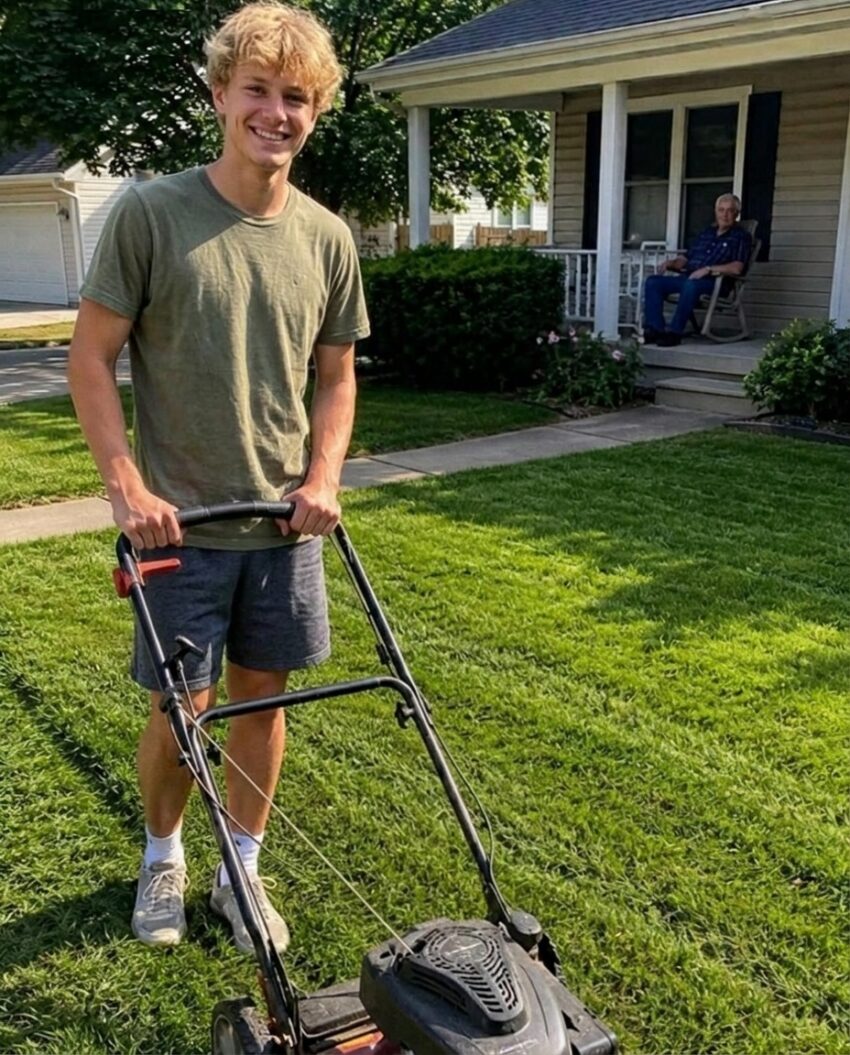
For four years, my son Liam mowed our elderly neighbor’s lawn every Saturday without ever asking for a single dollar.
Mr. Harris barely spoke to him.
I used to wonder why Liam kept going back.
There were no long conversations between them. No birthday presents. No obvious friendship that I could see. Most Saturdays, Liam would spend an hour or more cutting the grass, then stand near Mr. Harris’s porch for a few minutes before coming home.
When I asked what they talked about, Liam usually had the same answer.
“Nothing.”
I assumed their quiet routine was simply Liam being kind to an old man who couldn’t take care of his yard anymore.
I had no idea that Mr. Harris had been paying attention to my son all along.
Two weeks ago, Mr. Harris died.
At his funeral, I expected to see Liam sitting quietly in the back of the church.
Instead, an attorney walked straight toward him.
He stopped in front of my son and held out a thick envelope.
“Are you Liam?”
My son looked at me before answering.
“Yeah.”
The attorney nodded.
“I’m Daniel. I handled Mr. Harris’s estate.”
Liam stared at the envelope.
“What is this?”
“Something he left for you.”
Then Daniel said the words that would leave all of us stunned.
“He left very specific instructions for you.”
The Boy Who Noticed People
Raising Liam by myself taught me that there are some things you can explain to a child, and other things they simply learn by watching you.
His father left before Liam was born.
There wasn’t some dramatic goodbye.
There was no screaming argument in the driveway. No final speech about how he wasn’t ready to become a father.
He simply stopped answering.
By the time Liam was born, I had already accepted that every diaper, every fever, every school meeting, every broken toy and every late-night panic would be mine to handle.
I worried about what growing up without a father might do to him.
I shouldn’t have worried so much.
Liam became the kind of kid who noticed people.
He noticed things most people walked past.
If an older woman dropped something at the grocery store, Liam picked it up.
If someone struggled to carry a box, he offered to help.
He never made a big deal about it.
He simply paid attention.
And when he was fourteen, he noticed Mr. Harris.
The Man Across the Street
Mr. Harris lived directly across the street from us.
Most days, he sat in an old wooden chair on his porch with his hands resting over his stomach.
His wife, Margaret, had died several years earlier.
After that, he seemed to fold into himself.
He became quieter.
He spent more time alone.
He had two grown children, Aaron and Claire, but I rarely saw them. I assumed they lived far away or simply had lives of their own.
People in the neighborhood would wave when they passed.
Sometimes Mr. Harris waved back.
Most of the time, he simply sat there.
One Saturday morning, Liam was looking through our front window while I drank coffee in the kitchen.
“Mom.”
“What?”
“Mr. Harris can’t get his mower started.”
I glanced outside.
Mr. Harris was halfway down his driveway, leaning heavily on the mower handle.
He pulled the starter cord once.
Nothing.
He tried again.
Then he stopped and pressed a hand against his lower back.
“He’ll probably figure it out,” I said.
Liam kept watching.
A moment later, Mr. Harris tried to bend down.
He nearly lost his balance.
Liam immediately put down his cereal spoon.
“He’ll say no,” he said.
I looked at him.
“Then ask first.”
“He’ll say no.”
“Probably.”
Liam disappeared into the garage.
Five minutes later, he came back pushing our mower across the street.
I stood at the kitchen window, expecting Mr. Harris to tell him to go home.
Instead, the old man watched Liam for several seconds.
Then he pointed toward the side yard.
Liam nodded.
That was it.
There was no handshake.
No thank-you.
No agreement about money.
Just a boy, a mower and an old man who needed his grass cut.
From spring through fall, every Saturday morning for the next four years, Liam mowed Mr. Harris’s lawn.
He never got paid.
Not once.
I tried to convince him to let the old man give him at least twenty dollars.
Liam looked almost offended.
“Why?”
“Because you’re doing work.”
“So?”
“So people usually get paid for work.”
He shrugged.
“He can’t do it.”
That was apparently the end of the discussion.
Mr. Harris wasn’t much of a conversationalist.
Sometimes I would see Liam finish the lawn, wipe his forehead with the bottom of his shirt and stand near the porch.
Mr. Harris might say three words.
Liam might answer with two.
When Liam came home, I would ask:
“What did you two talk about?”
“Nothing.”
“You stood there for ten minutes.”
“Yeah.”
“What did he say?”
Liam would think about it.
“He said it’s hot.”
“And?”
“I said yeah.”
Apparently, that counted as a conversation between them.
Still, Liam never missed a Saturday unless we were out of town.
He went in the summer heat.
He went on cold October mornings.
He went when there was light rain.
He went during the week before final exams.
And he even went the morning after prom, when he looked like he hadn’t slept at all.
I once told him he could skip just one weekend.
He wouldn’t hear of it.
The lawn had to be done.
So he did it.
Every Saturday.
For four years.
I didn’t understand why it mattered so much to him.
I understood even less about what it meant to Mr. Harris.
The Phone Call
Two weeks ago, Mr. Harris died.
Aaron knocked on our door himself.
I recognized him from a few holiday visits, but we had never really spoken.
He looked exhausted.
“Liam?”
My son came downstairs when he heard his name.
Aaron swallowed.
“My dad passed last night.”
Liam didn’t respond immediately.
Then he asked one question.
“Was he alone?”
“No,” Aaron said. “Claire and I were there.”
Liam nodded once.
“Okay.”
Aaron looked almost confused by his reaction.
Then Liam asked:
“When’s the funeral?”
We went three days later.
The church was crowded.
Much more crowded than I expected.
Looking around the room, I realized something I hadn’t understood before.
Mr. Harris may have lived quietly, but he had known far more people than I had ever realized.
Aaron and Claire sat at the front.
Both were crying throughout most of the service.
Liam insisted on sitting in the last row.
“This is family stuff,” he whispered.
“You mattered to him too,” I told him.
Liam shook his head.
“Not like they did.”
I didn’t argue.
When the service ended, everyone stood.
People began moving toward the family.
Aaron hugged relatives.
Claire spoke quietly with friends.
Then I saw a man in a gray suit walking down the aisle.
He wasn’t looking at Aaron.
He wasn’t looking at Claire.
He was walking directly toward Liam.
“He Left Very Specific Instructions for You”
The man stopped in front of my son.
“Are you Liam?”
Liam glanced at me.
“Yeah.”
The attorney held out a thick envelope.
“I’m Daniel. I handled Mr. Harris’s estate.”
Liam stared at it.
“What is this?”
“Something he left for you.”
People nearby began turning to look.
Daniel handed the envelope to Liam.
“He left very specific instructions.”
Liam opened it.
Inside were four smaller envelopes.
Each one had handwriting across the front.
Saturday One.
Saturday Two.
Saturday Three.
Saturday Four.
Liam looked at Daniel.
“What’s in them?”
“I don’t know.”
Daniel pointed toward the envelopes.
“Your instructions are to open one each Saturday. In order.”
Aaron had noticed what was happening and walked over with Claire.
He stared at the envelopes.
“I’ve never seen those.”
Neither had Claire.
She looked at her brother.
Liam gave a short laugh.
It was such an unexpected sound at a funeral that I nudged him.
“Sorry,” he whispered.
Then he looked at the envelopes again.
“It’s just… that’s him.”
Aaron studied him for a moment.
Then, unexpectedly, he almost smiled.
“Yeah,” he said.
“It is.”
Saturday One
The following Saturday, Liam opened the first envelope at our kitchen table.
Aaron and Claire had both come over.
Inside was an address.
And one sentence.
Take Claire with you.
Claire stared at the address.
Her expression changed immediately.
“I know this place.”
It was a diner about twenty minutes away.
Claire hadn’t been there in years.
When we arrived, an older woman behind the counter looked up.
The moment she saw Claire, she froze.
“Oh, my goodness.”
Claire frowned.
Then the woman whispered:
“Ruth?”
Claire started crying before she even understood why.
Ruth came around the counter and hugged her.
“I haven’t seen you since your mother died.”
Claire held onto her.
After a moment, Ruth disappeared into the back.
She returned carrying a cardboard box.
“Your father brought this to me six months ago.”
Claire looked at her.
“What is it?”
Ruth set the box on the counter.
Inside were dozens of recipe cards.
Margaret’s handwriting covered every one.
Claire picked up the first card.
Then she made a sound like all the air had suddenly been knocked out of her.
“Cinnamon rolls.”
Ruth smiled sadly.
“Your mother’s Christmas recipe.”
Claire pressed the card against her chest.
“I thought these were gone.”
She sat in that diner and cried.
Later, in the parking lot, she told Liam that after her mother died, she stopped making Christmas breakfast.
Liam leaned against the car.
“Why?”
Claire looked down at the recipe card.
“The house didn’t smell right.”
She wiped her face.
“I know that sounds stupid.”
“It doesn’t,” Liam said.
Claire looked at him.
“Dad knew.”
It was the first time I understood that Mr. Harris had been thinking about his children long after they had stopped believing he was thinking about them.
Saturday Two
The second envelope was harder.
It said:
Take Aaron to Franklin Field. Bring the glove.
The old baseball glove had been included with Mr. Harris’s belongings for Aaron.
The moment Aaron saw it, his jaw tightened.
“No.”
Claire looked at him.
“Aaron.”
“No. I’m not doing some sentimental scavenger hunt.”
Liam remained quiet.
Aaron pointed at the glove.
“Do you know what makes this ridiculous?”
Liam shook his head.
“My son, Ben, played Little League at Franklin Field for five years.”
His voice sharpened.
“I invited Dad constantly.”
Claire spoke softly.
“I know.”
“He always had an excuse.”
Aaron looked toward the empty house across the street.
“Too tired. Too hot. Bad knees. Didn’t feel like crowds.”
Then he looked at Liam.
“Do you know what he could do?”
Liam said nothing.
“He could sit on that porch every Saturday watching you mow.”
Aaron’s voice broke.
“But he couldn’t come watch his own grandson play ball.”
Liam flinched.
Aaron immediately looked guilty.
“I’m not mad at you.”
“I know.”
“It’s just…”
He rubbed both hands over his face.
“I spent years thinking he didn’t care.”
Liam held out the glove.
“Then maybe you should come.”
Aaron stared at him.
For several seconds, nobody moved.
Finally, Aaron took the glove.
We drove to Franklin Field.
We searched for almost half an hour.
Then a groundskeeper waved us toward the concession stand.
He told us Mr. Harris had left an envelope in a sealed box months earlier.
Inside was a letter.
Aaron read the first few lines silently.
Then he sat down.
Claire looked at him.
“What?”
He handed her the letter.
Mr. Harris had written:
Aaron,
You asked me to come watch Ben play, and I kept telling you no.
You probably thought I didn’t care.
You deserved better than excuses.
Then came the part that made Aaron stop breathing for a moment.
After Margaret died, Mr. Harris had tried to sit in those bleachers.
He couldn’t do it.
He had made it to the gate once, then turned around.
But he hadn’t stayed away completely.
He had gone to three games.
He had parked beyond the outfield fence where Aaron couldn’t see him.
He watched Ben hit a double in one game.
He watched him strike out twice in another and throw his helmet into the dugout.
Mr. Harris even joked in the letter that Ben had inherited his temper from Aaron.
Then came the sentence that seemed to break something open in Aaron.
I should have walked closer.
He hadn’t known how.
He was sorry.
Aaron stopped reading.
Claire was crying.
He stared across the empty baseball field.
“He was here?”
Claire nodded.
Aaron laughed once.
Then he cried harder.
“Three games.”
He looked down at the glove.
“All those years, I thought he chose everybody else over us.”
Liam sat beside him.
“Maybe he didn’t know how to come back.”
Aaron looked at him.
“That’s not the same as trying.”
“No,” Liam said.
“It isn’t.”
For a moment, none of us said anything.
Then Liam looked at him.
“But I think maybe this was him admitting it.”
Aaron nodded slowly.
“Yeah.”
Saturday Three
The third Saturday belonged to Liam.
That surprised him.
Mr. Harris’s house felt strange without him.
The third envelope contained only a few words:
My house. Porch chair.
That was all.
Liam walked into the house and eventually sat in the faded wooden chair on the porch.
Nothing happened.
He leaned forward.
Then he felt along the frame.
“This is awkward,” he said.
“Check underneath,” I told him.
He reached beneath the seat.
His fingers touched tape.
He pulled out a small black notebook that had been fixed underneath the chair.
Liam opened it.
Almost every page had a date.
Saturdays.
Four years of Saturdays.
He started reading.
Boy came at 8:10. Too hot today. Told him to quit early. He ignored me.
Liam laughed.
He turned the page.
Rain. Thought he wouldn’t come. He came.
Another page.
Driving now. Parks too close to my mailbox.
Liam frowned.
“I did not.”
I smiled.
“You absolutely did.”
He kept reading.
Exams this week. Looks tired.
Another page.
Graduation next month. Hope he gets where he’s going.
Then:
Seemed upset today. Didn’t ask. Maybe should have.
Liam stopped smiling.
There were four years of entries.
Four years of Mr. Harris noticing him.
Every Saturday.
Every season.
Every little detail.
At the end, one sentence had been underlined.
Need to tell him thank you properly.
Liam slowly closed the notebook.
“He knew all that?”
His voice was quiet.
“I guess he did.”
“I thought he barely noticed me.”
Aaron and Claire came over later.
Liam showed them the notebook.
Aaron read several pages in silence.
Then he stopped.
He handed the notebook back.
“What?” Claire asked.
Aaron looked away.
One entry said:
Boy reminds me of Aaron at that age. Quiet. Stubborn. Better with his hands than words.
Aaron’s expression changed.
“Dad used to say that about me.”
Claire touched his shoulder.
Aaron wiped his eyes.
For a long moment, nobody spoke.
Then Liam said quietly:
“He remembered.”
Saturday Four
Saturday Four arrived.
This time, Liam, Aaron and Claire opened the final envelope together.
The instruction was simple:
My yard. Nine o’clock. Bring something to plant.
When we crossed the street, the lawn had already been cut.
A landscaping company had prepared the property for sale.
But one small section beside the porch had been left untouched.
Claire noticed it first.
Liam stopped at the curb.
For four years, he had crossed that street every Saturday with a job waiting for him.
Now there was nothing.
Claire arrived carrying a hydrangea.
“Mom’s favorite,” she said.
Aaron picked up the shovel.
“I guess I’m digging.”
Claire smiled faintly.
“You always hated yard work.”
“I still hate yard work.”
For once, nobody cried.
Aaron dug the hole.
Liam lowered the hydrangea into the ground.
I went across the street and filled a watering can.
We stood there together.
There was no final shocking revelation waiting for us.
Nobody discovered another secret.
There was no dramatic confession.
Just four people standing in a yard that had once belonged to a lonely man who apparently understood something about all of us.
Mr. Harris had never been good at saying what he felt.
So he gave us jobs.
Take your sister here.
Take your brother there.
Sit down.
Read this.
Plant something.
That was his language.
And somehow, after he was gone, we finally learned how to understand it.
“You Want the Chair?”
Before we left, Aaron walked to the porch.
He placed one hand on the old wooden chair.
Liam looked at it.
“Yeah?”
Aaron turned around.
“You want it?”
Liam stared at the chair.
“No.”
Aaron seemed surprised.
“I figured you might.”
Liam put his hands in his pockets.
“It belongs there.”
“The house is being sold.”
“I know.”
He looked toward the hydrangea.
Then back at the chair.
“Still belongs there.”
Aaron didn’t argue.
Neither did I.
The Next Saturday
A few months later, a moving truck pulled up across the street.
The new owners were a young couple with a little boy who looked about six.
The kid spent most of the morning racing across the front lawn while his parents carried boxes inside.
The hydrangea was still beside the porch.
The grass was beginning to grow long.
So was the old wooden chair.
Liam and I stood in our driveway watching them for a minute.
I looked at my son.
He looked at the lawn.
For four years, Saturdays had meant one thing.
Pushing our mower across the street.
Doing something for a man who rarely spoke.
Keeping a promise no one had asked him to make.
This time, Liam smiled.
Then he pushed our mower back into our own garage.
I looked at him.
He shrugged.
“Looks like they’ve got it from here.”
And somehow, that simple sentence made me realize what Mr. Harris had left behind.
It wasn’t the envelopes.
It wasn’t the notebook.
It wasn’t even the letters.
It was the lesson.
Liam had spent four years mowing an old man’s lawn because the man couldn’t do it himself.
Mr. Harris had spent those same four years quietly watching a teenage boy become a young man.
He had noticed Liam when Liam didn’t think anyone was paying attention.
He remembered him.
He appreciated him.
And when Mr. Harris knew he wouldn’t be around anymore, he made sure Liam understood that those Saturdays had mattered.
For four years, my son thought he was simply helping a lonely old neighbor.
At the end, he learned that the old man had been leaving something behind for him every Saturday too.
Not money.
Not a possession.
A memory.
A lesson.
And a reminder that kindness doesn’t always come with a thank-you.
Sometimes, you don’t know what your small act of kindness means to someone until years later.
Sometimes, the person you think you’re helping is quietly changing your life too.
Liam pushed the garage door closed.
Then he looked across the street one last time.
The hydrangea moved slightly in the breeze beside Mr. Harris’s porch.
The grass was no longer Liam’s responsibility.
The house belonged to someone else now.
But the four years he spent there would always belong to him.
And for the first time in four years, Saturday felt complete.