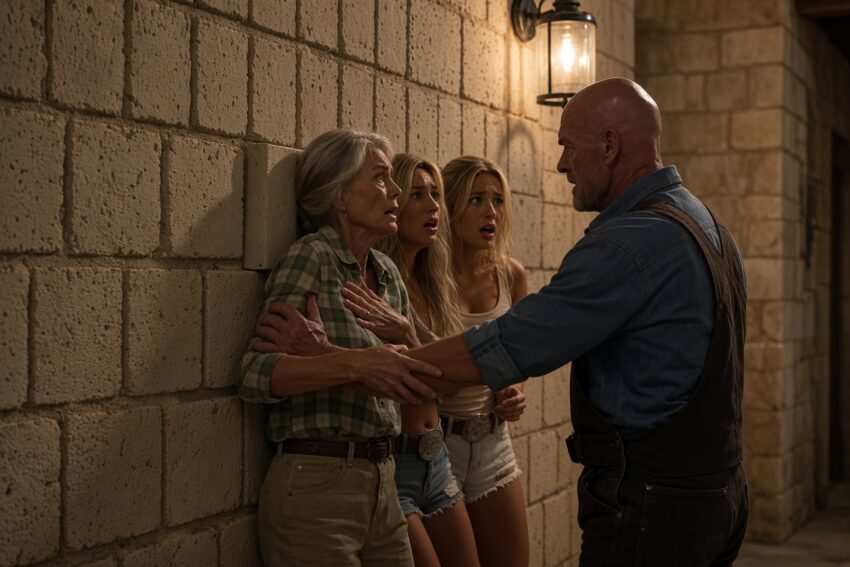
Thomas Hale pressed the red button to save the three women in his hallway, and the ranch answered by locking the world out and the past in.
PART 2:
THE HALL
The red button sat in a square of dull metal cut into the cinder block, the little door of the panel hanging open on one hinge.
Thomas Hale’s thumb found the dome.
It was warm from the wall. The wall was warm from the day.
Hannah’s hand was on his forearm. Her nails had dirt under them from the fence. Olivia was half behind Susan, one boot still on the runner, breathing like she had swallowed dust.
Outside, boots hit the stone steps.
Thomas pressed.
The click was small. The house was not.
A thud ran through the stone, then another, then a long metallic sigh that started under their feet and climbed the walls. Something heavy dropped in the doorframe. The timber door, already shut, seated deeper, as if the house had taken a breath and held it.
Hannah flinched. “Grandpa.”
“Stay against the wall,” Thomas said.
His voice was the same voice that had said get inside. Lower now. Closer.
A second sound followed the first. Shutters. Not window shutters a person could see from the porch. Panels inside the frames, sliding on tracks he had greased every spring for nineteen years and never told them about. The light in the hall changed. The bright rectangle under the door went thin, then gone. The lamp by the stairs buzzed and held.
Susan’s hand was flat on her chest. The plaid shirt stuck to her between the shoulder blades. “Thomas.”
“I know.”
From the porch, a man hit the door with his shoulder. The door did not give. It had a bar now, seated in pockets cut into the stone, and the bar was not something a shoulder could argue with.
Another hit. A voice, muffled. Then the scrape of a tool.
Thomas looked at the button. The red dome sat down in its collar. A small amber bulb beside it had come on. He had never liked that bulb. It meant the circuit had committed.
“What did you do?” Olivia said.
She was the one in the cut-off denim, hair stuck to her neck. She had come from the side yard when she heard him yell. She had not been at the fence. She had been in the truck with the salt blocks. Now she was in the hall with the rest of them, and the hall was no longer a hall that opened onto a ranch.
“Locked it,” Thomas said.
“Locked what?”
“The house. The well cap. The doors you know and the doors you don’t.”
Hannah’s eyes were wet and angry at the same time. “You said they found you. Who.”
He heard the first vehicle nose up to the porch. A brush guard tapped stone. The engine stayed running. They would not waste long on the door. They had seen the stone. They would look for glass, for a side entry, for the mudroom he used for boots.
Those were locking too.
He put his palm on the panel door and swung it shut over the button. The latch caught. It would not stop a determined man. It would stop a casual one, and right now casual was already gone.
“Downstairs,” he said. “Now. Not the cellar you use for jars. The other stairs.”
THE SHUTTERS
They moved because his hand moved them.
Susan first, because she had learned the order of his emergencies a long time ago, even when she did not know the name of this one. Hannah next. Olivia last, looking back at the door as if the door might explain itself.
The kitchen had gone dim. The west window was a gray slit where the inner panel had not fully seated. Thomas crossed to it and set his shoulder against the steel until it clicked home. Dust shook loose from the track. Outside, someone shouted. The word was short. He did not need it.
A radio crackled on the other side of the glass, close enough that the speaker’s breath came through.
“Front is seated. Side is seated. Checking the rear glass.”
Not police talk. Not the loose talk of men who expected a porch light and a scared rancher. Clipped. Practiced.
Thomas killed the kitchen lamp. The amber from the hall panel was enough.
Under the sink, behind the false board he had screwed in the year Hannah turned ten, there was a second switch. Not red. Black, industrial, with a guard. He flipped the guard and threw it.
In the walls, fans started. Not house fans. The low pull of vents he had run in pipe, painted to look like nothing. The air in the kitchen moved. It smelled like hot dust and the cedar he had packed around the filters.
“Grandpa, what’s happening?” Hannah said again, because the first time had not been answered.
He looked at her. Twenty-two. Her mother’s mouth. A smear of mascara she did not usually wear, because they had been going to town later and she had decided on the porch. The water bottle was gone. She must have dropped it at the fence.
“Men I owed a disappearance to,” he said. “They got tired of the desert being big.”
“That’s not an answer.”
“It’s the one I have while we’re walking.”
Olivia stared at the window panel. “You built this.”
“I built the part that keeps a door a door.”
“For how long?”
“Since before you were born.”
Susan made a sound that was not quite a laugh. “He told me it was for tornados.”
“It is also for tornados,” Thomas said.
A boom hit the mudroom door. The bar there was newer. He heard it take the blow and hold. Someone swore. A second blow, lower, at the latch. Then the crunch of a halligan biting wood. The wood was a skin. Behind it was plate.
They had maybe four minutes before somebody smart walked the foundation and found the vent cowling. Less, if they had brought plans. He did not think they had plans. He thought they had a tip and a grudge and three trucks.
THE STAIRS THEY DID NOT USE FOR JARS
The pantry door looked like a pantry door. Thomas pulled the cord for the bulb. Jars. Flour. The bin of dog food for a dog that had died in January. He slid the bin aside, knelt, and hooked two fingers into a gap in the floorboard that was not a gap unless you knew the measurement.
The board came up. Under it, a ring.
“Olivia, take the light from the nail.”
She did. The flashlight was heavy, the kind that could be a tool. She thumbed it on and aimed it down.
Concrete steps. Narrow. The smell of lime and old water.
“Single file,” Thomas said. “Susan, hand on the rail. It is iron and it will be cold.”
Hannah went second because she would not go first. He did not blame her. The first step always felt like a decision you could not walk back up from.
Above them, glass broke in the living room. The panel behind the glass rang. A man yelled that it was blocked. Another man told him to find the power.
The power was already on a transfer he had buried in the slab. Cutting the meter at the pole would darken the porch light and nothing else.
Thomas pulled the board back into place from below. The ring side had a bolt. He threw it. It would not survive a search with tools. It would survive a hurry.
The stairwell ate their footsteps.
Twelve steps. A landing. Eight more. At the bottom, a room the size of the kitchen, poured in place, with a ceiling low enough that Thomas ducked out of habit. A bench. A cabinet. Three cots folded against the wall. A map under plastic, taped at the corners. A crate of water. A radio that was not a family radio.
Olivia swept the light across it.
“You have a bunker.”
“I have a room that does not flood,” Thomas said. “Sit if you need to sit. Do not sit long.”
Susan sat. Her hands shook now that they were allowed to. She pressed them between her knees. “Are they going to shoot the door down.”
“They can try. The door is not the way in that works.”
Hannah stood in the middle of the concrete and turned a slow circle. The light caught the fine hair at her temple. “You said you have to press the button. Present tense. You already pressed it.”
“The button starts a sequence,” he said. “It does not ask me twice.”
THE ROOM UNDER THE HOUSE
He opened the cabinet.
Inside, laminated cards on a ring. A medical kit. A folder in a plastic sleeve, thick. He took the folder and put it on the bench without opening it. Hannah’s eyes went to it and stayed.
“Later,” he said.
“Now,” she said.
“Later, or we are still here when they find the pantry.”
He crossed to the north wall. A wheel valve, painted gray. He turned it. Water gurgled somewhere in pipe, then a pump kicked on, a sound like a throat clearing. In the corner, a stack light went from dark to green.
“That is the well on its own line,” he said. “If they cut us off up top, this still runs. Do not drink from the tap until I say. The first minute runs rusty.”
Olivia had the light on the map. “This is the ranch.”
“This is under the ranch.”
The lines were simple. House. Barn. Windmill. A dotted path heading west toward the old tank dam, then north to a culvert under the county road. He had drawn it himself. His lettering was worse than it had been at forty.
Susan looked at the cots. “You meant for us to sleep down here.”
“I meant for a night. Not a life.”
Above, something heavy dragged across the floor. They were in the kitchen. A boot heel. A man saying the pantry was just a pantry. Thomas listened to the pause after that sentence. The pause was the dangerous part.
He took a coil of rope from a hook and a small bag from the shelf. In the bag: a hand radio, batteries, cash in a band, a tin of matches, copies of keys that opened nothing on this property.
“Hannah. Olivia. If I tell you to go and I do not follow, you follow the map to the culvert. You do not come back for me. You do not come back for the house.”
Hannah’s mouth opened.
“That is the rule,” he said. “I am not debating it in a hole.”
She shut her mouth. The tears had stopped. That was worse, in a way. She was building a list of things she would ask when there was time, and the list was going to be long.
A new sound came through the ceiling. Not boots. A saw, or a grinder, starting and stopping. They had found the mudroom plate and decided metal was a suggestion.
“Time,” Thomas said.
THE TUBE
The west wall had a round hatch at knee height, the kind used in drainage, with a wheel in the center. He spun the wheel. The seal broke with a wet kiss of rubber. Air came out that smelled like caliche and cedar root.
“This is the tube,” he said. “It is not a metaphor. It is pipe. Four feet. You will crawl. There are joints every twenty. Do not rush the joints or you will catch a knee.”
Olivia stared into the dark circle. “How far.”
“To the windmill shed. Then we are outside again, on the far side of the ridge, if the doors up there did what I paid them to do.”
“If,” Susan said.
“If,” he said. “I have not run this with people in it since the inspector, and he was thinner than me and complained the whole way.”
He went in first with the flashlight in his teeth, the bag dragged by a strap. The pipe took his shoulders. He had measured for that. He had not measured for the way a body feels when it knows men are above it grinding at a door.
The metal was cool. His palms found the grit he had never fully washed out. Behind him, Susan’s breath. Then Hannah, who swore once, softly, when her hair caught a burr of weld. Then Olivia, who did not speak at all.
The first joint rang under his knee. He slowed.
“Count the joints,” he said back to them. “Six to the bend. The bend is left. After the bend, four more.”
His voice filled the pipe and came back smaller.
Hannah said, “If I throw up, I am throwing up on your boots.”
“Aim for the wall,” he said, and kept moving.
He thought of the button. The amber light. The sequence he had written on a card and taped inside the cabinet, in case his hands ever shook too hard to remember. Lock the shell. Isolate power. Open the tube. After nine minutes, if the second switch was not thrown at the windmill, the tube door behind them would seal and the vent fans would reverse, pulling smoke out instead of air in. He had built that for a fire. It would also work if someone put smoke in the house on purpose.
He had thrown the second switch in the kitchen. The nine minutes were not running. He told himself that twice.
At the bend, he had to turn on his side. The pipe popped. Somewhere above, faint as a radio in another room, a man shouted that he had found a floor seam.
“Faster,” Thomas said.
“We are crawling in a tube,” Olivia said. “This is the speed.”
She was right. He hated that she was right.
THE DARK
The last joint opened into a concrete box under the windmill shed. Thomas got his feet under him and reached back for Susan’s wrists. She came out gray-faced and upright. Hannah next, a scrape on her shin already beading. Olivia last, flashlight still in her hand, as if she had decided the light was her job now.
Above them, floorboards. The windmill’s rod worked in its sleeve, a slow clock. The pump was not running. He had killed the surface power. The rod still moved because the wind moved it. A dry squeak every few seconds.
He put a finger to his lips and climbed the short ladder. The hatch into the shed was a square of plywood with a rug nailed to it on the upper side, and the rug was always dirty because he was always dirty. He lifted it an inch.
Daylight. The smell of oiled chain and mouse. No boots.
He lifted it the rest of the way and got them up one by one. The shed was a shed. Tools. A coil of drip line. The door faced west, away from the house. Through the crack he could see the ridge and the pale grass and, far left, the dust still hanging where the trucks had come in.
Susan touched his back. “Are we out.”
“We are out of the pipe.”
He eased the door. Heat hit him, clean and huge. The sky was the same blue it had been at the fence. That felt like an insult. The pasture did not know it was a scene.
A black SUV sat near the front porch, driver’s door open. A second was by the barn. The third had gone around the north side, only its dust visible. Men in black vests moved between the porch and the truck. No masks. Faces ordinary and intent. One of them had a radio at his mouth. One had a long gun held down along his leg, not aimed, just there.
Thomas pulled the door almost shut.
“Four I can see,” he said. “There will be more.”
Hannah looked through the crack and made a small broken sound. “They’re just standing on your porch.”
“They think the house is the box,” he said. “We are going to let them keep thinking that while we are not in it.”
THE RIDGE
They went west first, in the cut of the ridge, bent low. The grass was dry enough to talk underfoot. He hated the sound. He put them in a line on the cattle trail where the ground was beaten quiet.
The windmill turned behind them. A blade ticked.
At the top of the ridge he made them stop and lie down. From here the house looked small and honest. Stone. Metal roof. The porch where Susan had wanted chairs and he had built chairs and then never sat in them long enough. A man on the steps was prying at the shutter track with a flat bar. Another was walking the foundation with his head down, reading the ground the way Thomas read it.
“They will find the shed,” Olivia said.
“Yes.”
“Then why are we near the shed.”
“Because the next cover is the tank dam, and the dam is two hundred yards of open grass if we stand up now.”
He watched the man at the foundation reach the southwest corner. The man stopped. He had seen the vent. He crouched. He spoke into his radio.
Thomas felt the old cold start in his wrists. Not fear exactly. The temperature of a plan meeting weather.
“When the one by the barn looks away, we go. Low. Do not run until I run.”
Hannah’s hand found the back of his overalls strap. She did not pull. She held on the way a person holds a rail.
The man by the barn turned to answer someone at the truck.
“Now.”
They moved.
The grass whipped their shins. A grasshopper burst up and was gone. Susan stumbled once and caught herself without a word, which was how he knew she was spending everything she had. Halfway, a shout went up behind them. Not at them. At the shed. Someone had opened the shed door.
Thomas did not look back until the dam’s concrete lip took them in.
Then he looked.
A man was at the shed, inside the door, sweeping the dark with a light. He had not seen the hatch yet. He would.
“Into the cut,” Thomas said.
The tank dam had a maintenance notch on the back side, full of tumbleweed and a nest of rattlesnake rumor. He kicked the weed aside. No snake. A miracle small enough to keep.
They dropped into the notch. The house disappeared. The sky narrowed to a slot.
Olivia was bleeding from the shin in a line, not a flood. She pressed it with her palm. “If this is the part where you tell us who they are, this is the part.”
Thomas wiped his mouth. Dust and salt.
“They call themselves a recovery detail,” he said. “No badge I recognize. A man named Harlan Voss runs the money. I knew him when the work was contracts and convoys and nobody asked what the crates were. I left. I took a book of names with me. Not a government book. Their book. Who got paid to look away while a well field burned and a road crew got buried in a slide they called weather.”
Susan closed her eyes. “You told me you drove trucks.”
“I drove trucks.”
“Thomas.”
“I drove trucks away from it,” he said. “And I kept the pages because I did not trust the ditch I threw the rest into. They have been looking in the desert because that is where I let them look. A fuel receipt finally had my old name on a ranch account. That is my fault. I got tired of cash.”
Hannah stared at him. The slot of sky sat on her hair. “So they are not police.”
“If they were, they would have come with paper and a megaphone. They came with three trucks and no plates I could read.”
“Then we call the real police.”
“We will,” he said. “From a place that is not this hole. And we will not call them with only my mouth. Mouths get edited.”
THE CULVERT
The dotted line on the map was a real ditch, then a real pipe under the county road.
They reached it as the sun tipped. The light went copper. Behind them, on the far side of the ridge, an engine revved. They had given up on quiet.
The culvert was corrugated steel, half full of sand. Thomas went through sideways. On the other side, cedar and the fence of the Bell place. He had not crossed that fence in three years, not since the fight about the bull that got into the maize.
Marcus Bell’s windmill was turning, smaller than his, newer.
“Ally,” Thomas said, mostly to himself.
“What?” Hannah said.
“A man who does not like me and will still open a door. If he is home. If he is not, we keep walking to the blacktop and we become somebody else’s problem in a ditch, which I would rather not do.”
They climbed out. The Bell pasture was greener along the tank. Goats, far off, stupid and blessed. A dog barked once at the house and then decided the bark was enough.
Thomas raised both hands as they came into the yard. The dog, a yellow cur, met them at the gate and did not bite. That was Marcus’s training or Marcus’s luck.
The porch light was off. The door was open behind a screen. A television talked to nobody.
“Bell,” Thomas called. “It’s Hale. I am unarmed. I have Susan and the girls. I need the yard and your phone and five minutes of you not shooting.”
The screen creaked. Marcus Bell stepped out with a shotgun held across his body, not up. He was sixty, sun-cut, missing the end of a finger from a PTO that had not cared about him. He looked at the four of them and at the dust on their knees.
“You pick a hell of a way to borrow sugar,” he said.
“They’re at my place,” Thomas said. “Three black SUVs. Men in vests. No county markings. They came across the pasture like they owned the grass.”
Marcus’s eyes went to the ridge. A faint thread of dust still stood over the Hale roof. “I heard the engines. Thought it was your nephew with the rent-a-herd again.”
“I don’t have a nephew.”
“That was the part that bothered me.” He lowered the shotgun an inch. “Inside. Dog stays. Girls, there is water in the jug. Do not track the tube dirt on Lena’s rug or she will rise from the church potluck and end me.”
Lena was his sister. She had been dead for two years. The rug was still the rule.
THE KITCHEN THAT WAS NOT THEIRS
Marcus’s kitchen smelled like coffee and ant poison. He poured water without asking their names. He already knew the names. Ranches are small when they want to be.
Hannah drank and coughed. Olivia sat on the floor with her back to the cabinet because the chair felt too visible. Susan stood. She had not sat since the bunker. Thomas realized she was listening for the trucks in the road.
“Phone,” Thomas said.
Marcus slid a landline across the counter. “County sheriff is in the book under the ugly drawing of a star. I would call the dispatcher, not the cell. Cell wanders.”
Thomas dialed. He had practiced this number in his head and never used it. A woman answered on the second ring, bored and exact.
He gave his name. He gave the road. He gave three vehicles, men on foot, an attempted entry, no shots fired yet. He did not give Harlan Voss. Not on a recorded line, not first. He asked for deputies. He asked them not to come in dark and loud if they could help it, because the men at the house were already loud.
The dispatcher repeated the address. She told him to stay put if he was safe.
“We are not at the address,” he said. “We are at the Bell place, east side of the county road. The men may come looking.”
She told him again to stay put. The line clicked into hold, then into a promise of a unit. Promises were air. He had used them before.
He hung up.
Marcus watched him. “You going to tell me why men in vests want your door.”
“Because I kept a folder they thought was ash.”
“Is the folder worth my porch.”
Thomas met his eyes. “No. The girls are. The folder is how the porch stays a porch after tonight.”
Marcus nodded once, the way men nod when they have already decided and the nod is just manners. “I have a root cellar that is a root cellar. No tube. No heroics. If they turn into my drive, we go there, and my scattergun stays up here with me.”
“You don’t have to—”
“I did not ask what I have to do.” He looked at Susan. “Ma’am. You are gray. Sit before you invent a new way to fall.”
She sat. The shake had moved into her jaw.
From the road, a tire hummed. Not a truck. A car. It passed. The dog did not bark.
Hannah set the jug down. “You said the button cannot be turned off.”
“The shell locks for six hours on the first cycle,” Thomas said. “I built it that way so a scared man could not un-scare himself and open the door at the wrong minute. After six hours it can be released from inside, at the panel, if the power is up. If someone cuts the buried line, it stays shut until the manual wheels are turned in the basement. They are in the basement.”
“So the house is a box.”
“The house is a box with men outside it who wanted a box.”
Olivia laughed once, ugly. “Great. We trapped them out. They’ll burn it.”
Thomas was quiet.
“They might,” he said. “Stone does not burn easy. The porch will. The barn will. I would like the deputies here before anybody gets proud with a can.”
THE COST
The deputies were not first.
The dog barked for real this time. Marcus killed the kitchen light. Through the front window, headlights swung into the Hale road, not the Bell road. Two of them. They had left a truck at the house and come hunting along the fence lines.
Thomas stood beside the window, out of the glass. He watched a light bar — not a police bar, a ditch light — rake the pasture. It stopped on the culvert mouth. A man got out. He walked to the pipe with a flashlight. He knelt. He saw the marks in the sand.
Thomas felt Susan’s hand find his.
“They can read a trail,” Marcus said. “Good for them. Bad for my evening.”
The man at the culvert lifted his radio. The SUV’s reverse lights came on. It backed, turned, and pointed its nose at the county road. At the cattle guard that opened on Bell land.
“Cellar,” Marcus said.
They went. Not a tube this time. A trapdoor under a hall rug, steps that smelled like potatoes and damp burlap. Marcus did not come down. He closed the door over them and the rug went back. His boots crossed the kitchen. The screen opened. Thomas, in the dark with the three of them, heard him chamber nothing because it was already chambered, and step onto his own porch like a man checking the weather.
Hannah’s breath was on Thomas’s arm. “He shouldn’t be up there alone.”
“No,” Thomas said.
The SUV stopped in the yard. A door. Two doors. A voice, polite and wrong.
“Evening. We’re looking for the owner of the place west of here. Family emergency. You seen them cross?”
Marcus’s voice was dry as the grass. “I seen goats. You got a badge to go with the emergency?”
A pause. The kind Thomas had heard before, when a man decides whether the next sentence is a lie or a tool.
“We’re contracted security. The owner is a witness. We need him safe.”
“He looked safe at breakfast,” Marcus said. “You look like you drove through his fence. I already called the county. They’re on the road. You can wait at the cattle guard if you like waiting.”
Thomas closed his eyes. Marcus had not called. Thomas had. The lie was small and brave and he hated it.
The polite voice cooled. “Mind if we look in the barn.”
“I mind.”
A step on gravel. The dog growled, low, the sound it used for snakes.
Then the shot.
Not Marcus’s shotgun. Higher, sharper, a pistol cracked once across the yard. The dog yelped and did not finish the yelp. Susan made a noise into her own wrist. Olivia grabbed Hannah before Hannah could stand and hit the trapdoor.
Marcus’s shotgun answered. One blast. A man shouted. Gravel sprayed the porch skirting. A second pistol shot punched the screen and sang off something metal in the kitchen.
Thomas was already at the steps. Susan caught his overalls.
“Don’t,” she said.
“He is in my debt for nothing and he is standing in it.”
“You go up, you bring them down here.”
She was right. The rightness made him want to bite something.
Above, Marcus fired again. The SUV’s engine roared. A door slammed. The polite voice was gone. Someone was cursing in a register that meant a hit, not a kill. Tires spun. The vehicle left the yard fast enough to chuck rock against the propane tank.
Silence, except the television still talking to nobody, and Marcus breathing hard through his teeth.
Thomas threw the trapdoor up.
Marcus was on the porch boards, back against the rail, shotgun across his lap. His left thigh was dark and shining. The dog lay in the yard, yellow and still. The screen hung on one hinge.
“Bastards can’t shoot a tire but they can shoot a dog,” Marcus said. His voice was thin. “Thigh. Through and through, I think. Don’t stand there being tragic. Get the towel.”
THE PORCH
Thomas got the towel. He got the belt. He knelt in Marcus Bell’s blood and did the work he knew from years when work was other people’s legs. Susan came up with the kit from under the sink, because Lena had kept a kit and Marcus had not thrown it out. Hannah held the light. Olivia watched the road with the shotgun Marcus pushed at her, and her hands were wrong on it until he told her, short and angry, how not to sweep the porch with the muzzle.
“Deputies,” Marcus said. “You actually call them, or was that also a story.”
“I called.”
“Then tell them to bring gauze and a sense of humor.”
The wound was ugly and survivable if the bleeding stayed a leak and not a tap. Thomas packed it. Marcus swore at him with affection and without. The dog did not move. Hannah cried once, quietly, for the dog, which Thomas understood better than the other crying.
Lights finally came from the south. Real light bars this time, red and blue, throwing the cedar into strokes. Two county cars. A deputy young enough to still run, and an older one who walked like his knees had filed a complaint.
Thomas stood with his hands open. He told it in order. The pasture. The trucks. The door. The crawl. The culvert. The shot. He did not tell the folder yet. The older deputy looked at the dog and at Marcus and at the three women and decided the scene was enough for one minute.
“Anybody else hit?” he asked.
“No,” Thomas said.
“You the homeowner west of here?”
“Yes.”
“We had a call about engines and a possible break-in. Unit went to your gate ten minutes ago. They reported men claiming to be private security on a civil matter, and a house that won’t open. You want to explain the house.”
“I want a doctor for Bell,” Thomas said. “Then I will explain the house in a room with a table.”
The young deputy was already on the radio for an ambulance. The older one nodded, slow. “Fair. Do not go back to that property tonight. My partner is keeping the gate. If your security friends try the road, they can explain the dog to a judge.”
“They are not my security,” Thomas said.
“Then they can explain that too.”
THE AMBULANCE
The ambulance took Marcus and would not take the dog. Olivia found a blanket in the barn and covered the dog because leaving him in the yard light felt like a second injury. The young deputy wrote the blanket down as if blankets mattered, which they did, to someone.
Susan rode in the lead county car because her blood pressure had finally introduced itself. Hannah refused to split from Thomas. Olivia refused to split from Hannah. The older deputy, whose name was Pell, allowed it with the look of a man who had daughters and a full car.
At the clinic in town, the lights were too white. Marcus went through a set of doors. A nurse told them to sit and then forgot them, which was a kindness. The television in the waiting room played a weather segment about no weather.
Pell took Thomas into a side room that was not an interview room and was also not not one.
“Start again,” he said. “Slower. And if you lie, lie about something I cannot check from the road.”
Thomas told him about the button. He told him about the locks. He told him about Harlan Voss without the poetry. A private recovery outfit. A desert debt. Papers.
Pell wrote Voss down and underlined it. “You understand private men with long guns on a ranch is a crime even if you owe them money.”
“I don’t owe them money.”
“You owe them something, or they would have sent a letter.”
“I owe them the inside of a folder.”
“Where is the folder.”
“Copy is in a sleeve under my house. Another copy is in a box at the post office in this town, addressed to the county attorney, with instructions to open it if I do not pay the box by the first. I paid it last week. I can stop paying it.”
Pell leaned back. The chair clicked. “You built a dead-man switch out of a P.O. box.”
“I built what I could afford.”
“And the red button.”
“That one keeps doors shut. It does not send mail.”
Pell looked at the door of the little room. Through the glass, Hannah was asleep on Olivia’s shoulder, both of them filthy, both of them young in a way the hallway had tried to end.
“I’m going to need that folder,” Pell said. “And I’m going to need you not to play engineer if my people have to open your house in the morning. Six hours, you said.”
“Six from the press. That was four-ten. You have until about ten.”
“Convenient.”
“It was not designed for your shift change. It was designed for a fire.”
Pell stood. “Stay in town. If Voss’s men have a radio worth owning, they already know the clinic exists. I can put a car out front. I cannot put a car on every road you ever walked.”
“I know.”
“Your friend in surgery is going to walk with a limp if he walks. The dog is a loss. Write that down somewhere you won’t pretend it was weather.”
Thomas nodded. The nod felt like Marcus’s nod. Manners after the decision.
THE NIGHT IN TOWN
They slept in a motel off the highway that still used keys. Pell’s deputy parked under the light and drank coffee from a jug. Susan came from the clinic at midnight with a paper bracelet and orders to drink water. She sat on the end of the bed in the plaid shirt and did not take her boots off.
“Marcus,” she said.
“Out of surgery. Stable. He told the nurse I pack a wound like a man who has practiced, and she did not like that sentence.”
Susan stared at the curtain. “The dog.”
“Yes.”
“He shot a dog to make a point.”
“He shot at a man who said no, and the dog was in the way, or the dog was the point. I don’t know which is worse.”
Hannah was awake in the other bed. The motel lamp made her look older. “Are they going to burn the house.”
“I don’t know.”
“You always know.”
“I knew the pasture,” he said. “I do not know men who have already been shot at and missed. Misses make people inventive.”
Olivia turned the television on low and then off again. “In the morning they open the house. Then what. We go home and pretend the button was a tornado drill.”
“In the morning the county looks at the folder,” Thomas said. “Some of the names in it are still names. Some of them sign checks. If the county is straight, Voss has a problem that is bigger than a ranch door. If the county is not straight, we have a different problem, and Bell’s porch was the start of it.”
Susan finally pulled one boot off. Her sock was damp at the heel. “You should have told me about the room.”
“You would have worried every storm.”
“I worried every storm anyway. I would have liked the company.”
He had no answer that was not an apology, and the apology was too small for the room, so he said it anyway. She nodded, which was not forgiveness. It was receipt.
THE MORNING OPENING
They went back at nine-forty in Pell’s car. The gate had a county sedan and a length of tape that looked embarrassed on a ranch. The three black SUVs were gone. Tracks remained, deep in the turnaround, and a gouge on the porch stone where a bar had slipped.
The house looked asleep. Shutters down behind the glass. The front door whole.
Thomas walked Pell and a second deputy through the sequence at the panel. At ten-oh-two the amber bulb flickered and went green. He turned the interior wheels in the basement, because the surface release wanted a second hand and he did not trust the men who might have left a surprise. The bars drew back with the same metallic sigh, reversed.
The house smelled like hot dust and a little like scorched metal. They had tried the mudroom plate with a torch. The plate had held. The paint had not.
No one was inside. No fire. A boot print on the kitchen floor that was not his. The pantry board pried up and the bolt scored. They had found the stairs and stopped at the locked hatch at the bottom, which was a different lock, and they had not had time or the right steel.
Hannah stood in the hall where she had cried and touched the stone. “It looks the same.”
“It isn’t,” Susan said.
In the bunker, Thomas took the sleeve from the cabinet and gave it to Pell. Pell did not open it in front of the girls. He sealed it in an evidence bag as if it had been born that way.
“Post office next,” he said.
“I’ll ride,” Thomas said.
“You’ll ride.”
THE BOX
The clerk at the post office knew Thomas’s box number and did not know his other life. Pell had a paper from the county attorney’s office by then, fast for a Saturday, because a deputy with a bandaged witness and a dead dog moves paper quicker than a rumor.
The box gave up a thick mailer. Pell signed for the chain. Thomas felt something unhook in his chest that was not relief. Relief would have been quiet. This was the sound of a trap he had built finally closing on the correct foot, and traps do not care about correct.
By afternoon the town had a version of the story. Not the folder. The trucks. The dog. The rancher who had a bunker because of course he did, this was a country of weather. Men at the feed store said private security. Men at the cafe said cartel, which was the wrong ghost. A woman who had been Hannah’s teacher said the girls were lucky.
Hannah heard that one on the sidewalk and did not feel lucky.
Voss did not appear. Two of his men did, in a lawyer’s office in the county seat, with a story about a civil recovery and a frightened employee and a misunderstanding at a fence. The lawyer used the word trespass about Thomas’s pasture as if the pasture had invited them. Pell’s report used the word gunshot about Marcus’s leg. The two words did not like each other. That was useful.
THE HEARING
Three weeks later there was a room with bad chairs and a seal on the wall that had been painted too many times.
Thomas wore a shirt without overalls. Susan sat behind him. Hannah and Olivia sat behind her, because the county attorney had said family could be present and the county attorney had not understood that presence was its own weight.
Harlan Voss was not in the room. His lawyer was. The lawyer had a cool voice and a file of his own. He talked about contracts and a disputed archive and a man who had vanished with proprietary records. He did not talk about the dog. The county attorney talked about the dog. The judge, a woman with a tired mouth, told both of them to talk about the entry and the shots and the locks.
Thomas answered what he was asked.
He did not perform. He described the button. He described the tube. He described Marcus on the boards. When the lawyer asked why a man builds a hidden hatch if he is innocent, Thomas said he had not been hiding from innocence. He had been hiding from a crew that buried mistakes and called them weather.
The judge did not smile. She bound two of the men who had been identified from Marcus’s yard camera — Marcus had a camera, it turned out, aimed at the propane tank, and it had caught a face — over for trial on the shooting and the break-in. She did not bind Voss. Voss was a name in a folder and a signature on a transfer, and signatures take longer than faces.
Outside, on the steps, a reporter from the regional paper asked Hannah how it felt.
Hannah said, “We ran to a house. The house locked. A man we barely know got shot on his own porch. It feels like that.”
The reporter wrote it down. It was the truest line of the day.
THE COST THAT STAYED
Marcus came home on a walker. The limp was not a rumor. The dog’s collar hung on a nail in the barn, and he would not talk about the nail.
Thomas crossed the fence with a new pup in a crate, a yellow cur from a man in town who needed fewer dogs. Marcus looked at the pup and looked at Thomas.
“You think a pup is a receipt,” he said.
“I think a pup is a dog,” Thomas said. “The receipt is the hearing, and it is not paid.”
Marcus took the crate. “Don’t name it after the other one.”
“I won’t.”
“And don’t use my porch as a strategy again.”
“I won’t.”
They both knew the second promise was the kind a person makes with his mouth while the country stays the same size.
The Hale barn had lost a wall of tools to a search that had been legal the second time and sloppy the first. The porch rail was gouged. Insurance used the word act and the word excluded in the same letter. Susan read the letter at the kitchen table and folded it into a square small enough to lose.
At night the house made new sounds. The shutters in their tracks. The vent fans clicking as they cooled. Hannah slept with the hall lamp on. Olivia went back to the community college two towns over and called every evening at seven, not to talk long, just to put the ring in the air and hang up if the voice that answered was the right voice.
Thomas oiled the hatch wheel. He did not apologize to the wheel.
THE PAPER
The regional paper ran the folder in pieces, after the county attorney released what she could. Not all of it. Enough. A well field. A road crew. Payments to a man who had been a inspector and was now a consultant. Voss’s company, a name Thomas had never said on a porch — North Sill Recovery, which sounded like a fence company and was not — denied and delayed.
People in town split the way towns split. Some said Hale had brought it on his own grass. Some said a man does not get to be hunted for keeping a list. The feed store sold more locks that month. That was the local verdict.
A letter came with no return address. Inside, a photograph of the motel they had slept in, taken from the highway. No words. Thomas gave it to Pell. Pell gave it to a detective who was tired. The detective said it was a message and also not a crime by itself. Thomas already knew that. Messages live in the gap between laws.
He did not show the photograph to Hannah. Susan found it anyway, because she opened the drawer where he put things he was not ready to say. She put it back. She sat with him on the gouged porch until the stars came out, and they did not talk about the picture. They talked about the maize and whether the south fence would hold if the Bell bull remembered the hole.
THE AFTERMATH
Autumn came in dry. The grass never greened. Thomas fixed the porch rail and left one gouge unfilled, low, where a hand could find it. Susan called it morbid. He called it a measurement.
Hannah stayed. She had meant to leave at the end of summer for a job in the city that was mostly phones. She deferred. She told the city she had a family thing. The family thing was breakfast, and checking the gate, and learning the basement wheels without calling them a secret.
One evening she found him at the panel. The red button sat up again, reset, the little door closed.
“If you press it now,” she said, “what happens.”
“Same thing.”
“And if they come back.”
“They might.”
She leaned on the stone. The hallway was cool. “Olivia says we should sell.”
“Olivia says that from a dorm that locks with a card.”
“She’s not wrong.”
“No.”
Hannah looked at the panel door. “I hated you for a week. For the tube. For not telling us. For the dog, even though the dog wasn’t yours. I still hate the not-telling. I don’t hate the button. That’s the part I can’t sort out.”
“You don’t have to sort it tonight.”
“Grandpa.”
“Yes.”
“If you press it, I’m not crawling first.”
“Noted.”
She almost smiled. It failed, and then it worked a little.
THE CONTINUATION
Winter put a hard frost on the tank dam. The culvert sand froze in ridges that kept their old knees and palms if you knew how to look. Thomas did not take the girls to look.
North Sill Recovery changed its name on a filing and kept the same address. The two men from the yard camera took pleas that were not nothing and were not enough. Marcus walked without the walker and with a cane on the long days. The pup grew into a dog that barked at snakes and at SUVs without preference.
In February a deputy Thomas did not know came to the gate with a printout. A truck had been asking at the co-op two towns west for the Hale turnoff. No plates recorded. A woman at the counter had disliked the questions and written down a description. Pell called an hour later and said it might be nothing.
Thomas stood in the yard after the deputy left. The house was stone and ordinary. Susan was in the kitchen. Hannah was in the side pasture with the salt, her hair up, the same boots. The sky was pale and honest.
He went inside. He opened the panel. He did not press the button. He put his hand on it until the metal took his heat, and then he closed the door.
That night the windmill squeaked. A blade ticked. Far off, on the county road, an engine slowed at the cattle guard and did not turn in. It idled. It left.
Thomas sat up in bed and listened until the sound was gone. Susan’s hand found his wrist in the dark, already awake.
“Same ones?” she said.
“I don’t know.”
“The locks.”
“Set.”
“The girls.”
“In the house.”
They lay still. The sequence waited in the wall, amber dark, ready, not a victory and not a finish. Outside, the pasture kept the cold. Somewhere west, a truck had their turnoff in a mouth that had asked for it once and could ask again.
In the morning Hannah found him on the porch with coffee. She sat on the rail. The gouge was under her boot heel.
“You heard it too,” she said.
“Yes.”
“So this is the part after the button.”
“This is the part.”
She nodded, the way Marcus nodded, the way Pell nodded, the way people nod when the country has not agreed to end the story and the day has started anyway.
“I’ll check the gate,” she said.
“I’ll walk with you.”
They went down the steps into the frost. Their breath stood up and went. The house stayed behind them, shutters open, button unpressed, the red dome waiting in its square of metal like a small held breath.
The road was empty. The tracks from the night were there if you got low. Thomas got low. He put two fingers in the tread and came up with nothing he could take to a room with a seal on the wall.
Hannah watched the ridge.
“They found you once,” she said.
“They found the receipt,” he said. “The rest they are still buying.”
She pulled her jacket tight. “Then we keep the lights on.”
“We keep the lights on.”
They walked the fence to the corner and back. The dog at the Bell place barked once, across the pasture, and was answered by nothing. Smoke from Susan’s stove lifted and broke. The day proceeded, which was the only continuation that had ever been on offer: not safe, not finished, three people and a house that knew how to close, and a road that had already learned their name.
DISCLAIMER: This is fiction for entertainment only. Names, groups, and events are invented. Any resemblance to real persons, agencies, companies, or cases is coincidental. This is not a report, not advice, and not a how-to.