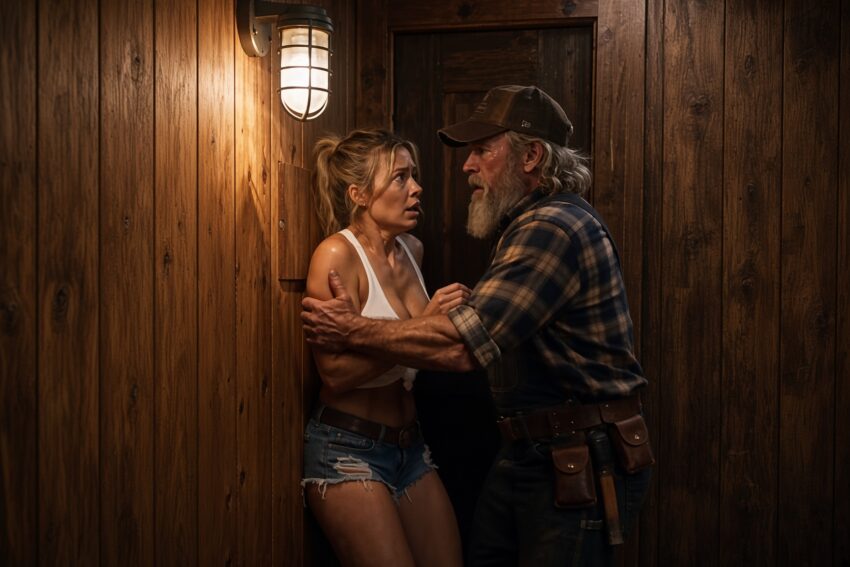
When three black bikes cut through Harlan’s sanctuary, pressing the hidden switch wasn’t just a defense—it was an eviction from the only peaceful life he had left.
THE CLICK
The red mushroom cap sank into the housing with a heavy hydraulic shudder.
Inside the wall, copper relays slammed shut like spring-loaded traps.
A low, resonant hum rose through the pine floorboards, vibrating straight into the soles of Maeve’s boots.
Outside, the porch groaned under running combat boots.
A shoulder hit the heavy timber door, rattling the iron deadbolts.
Harlan didn’t flinch.
“Keep your head down and stay against my back,” he whispered.
Above their heads, recessed steel plates slid horizontally across the window frames with a metallic screech, sealing the cabin in total darkness.
The only illumination left came from the caged bulkhead sconce and the angry red halo of the switch.
Heavy pneumatic latches engaged along the frame of the front door, locking three-inch hardened alloy pins into the surrounding spruce logs.
From the porch came a muffled oath, followed immediately by the dull thud of a breaching ram striking reinforced wood.
The door bowed an eighth of an inch, held, and held fast.
“Grandpa,” Maeve whispered, her knuckles white as she gripped his flannel sleeve. “Who are they?”
“Men who don’t leave witnesses,” Harlan said.
He reached beneath the wood panel, found a second, unlit mechanical lever, and yanked it down with the full weight of his shoulder.
THE DROP
The floor beneath their feet gave way without a warning click.
Maeve gasped as her stomach leapt into her chest.
A counterweighted trapdoor tilted on greased bearings, dumping them both into a slick, galvanized steel chute angled steep into the earth.
The fall was fast, rough, and smelled of cold galvanized zinc and old machine oil.
Harlan caught Maeve by the ribs, taking the brunt of the landing on his left shoulder as they spilled out onto a gravel pad ten feet beneath the cabin.
Above them, the steel hatch snapped shut with the finality of a bank vault.
Muffled concussive bangs echoed through the timber overhead—shaped breaching charges detonating against the front door upstairs.
“Up,” Harlan grunted, rolling to his knees and ignoring the sharp pain radiating down his collarbone. “They’ll realize the blast didn’t clear the frame in about twenty seconds.”
Maeve scrambled to her feet, brushing wet grit from her denim shorts.
Her hands were shaking, but her jaw had set into the stubborn line he’d known since she was six years old.
“Where does this go?” she asked, looking down a narrow, damp trench walled with treated railway ties.
“Down to the culvert under the logging road,” Harlan said, reaching into a recessed wooden cubby beside the gravel pile.
He pulled out two items: a canvas shoulder bag heavy with spare magazines and medical gauze, and a battered short-barreled pump twelve-gauge wrapped in oiled silicone cloth.
He racked the slide once, chambering a round with a clean, dry crack.
“Move fast, Maeve. Don’t look back, and watch your step on the timber.”
THE CULVERT
The trench led them sixty yards beneath the damp root systems of western hemlocks and Douglas firs.
The air grew icy, smelling of peat, iron deposits, and decaying leaves.
Maeve ran ahead, her boots splashing through three inches of standing run-off water that seeped through the culvert floor.
Behind them, a dull rumble rolled through the dirt—the roof of the cabin giving way as high-grade thermite or charges tore through the main structure above.
The attackers weren’t just searching; they were burning the evidence of their arrival.
“They’re burning it,” Maeve breathed, glancing over her shoulder at the faint orange flicker dancing in the chute’s exhaust pipe. “Everything we had.”
“Wood burns. Memories don’t,” Harlan muttered, shoving her forward gently. “Out the pipe, now.”
The culvert emptied out into a dense blackberry thicket on the blind side of the road embankment.
Fog hung thick between the mossy tree trunks, pearlescent and cold against Maeve’s bare shoulders.
The distant idle of high-displacement motorcycle engines hummed through the mist like angry hornets.
Two hundred yards up the trail, where Harlan had been driving a spike into the gate post only minutes earlier, two bikes remained idling while the third prowled the road line.
“They brought scout drones,” Harlan whispered, dropping flat into the wet ferns and pulling Maeve down beside him.
High in the dripping canopy, a high-pitched whine drifted through the pines—a six-rotor tactical surveillance drone sweeping the perimeter with thermal sensors.
“Cover yourself in the muck,” Harlan commanded quietly, smearing dark river silt over the exposed pale skin of his forearms and neck.
Maeve hesitated for only a second before digging her fingers into the black, cold mud, rubbing it across her shoulders and face until only her wide, cautious eyes showed.
Above them, the drone drifted through a break in the mist, its sensor pod panning slowly across the clearing before banking toward the smoking ruins of the house.
THE TIMBER TRACK
“River trail,” Harlan said, keeping his voice beneath the level of the dripping foliage. “Two miles south to the rail spur.”
“Who did this to us, Harlan?” Maeve asked, using his name for the first time instead of Grandpa.
It was the tone of someone realizing their childhood was built on top of a buried minefield.
Harlan didn’t answer right away. He kept his eyes fixed on the ridgeline, the twelve-gauge held low across his chest.
“A private security firm called Apex Vanguard,” he said finally, slipping through the sword ferns. “Ten years ago, they ran black recovery contracts along the northern pipelines. I was their master logistics surveyor.”
“You built cabins,” Maeve said, breathless as she matched his stride.
“I built holding sites,” Harlan corrected grimly. “Until I walked off with the ledger that proved where forty million dollars in public disaster relief actually went.”
A twig snapped thirty paces to their left.
Harlan froze, his boots sinking silent into the carpet of pine needles.
Through the grey vertical bars of the trees, a silhouette appeared—a man in full black tactical gear, helmeted, carrying a suppressed carbine at the low ready.
A patch on his right shoulder showed a silver raptor clutching a broken compass.
The scout paused, lifting a hand to his ear piece, listening to radio traffic.
“Sweeping quadrant three,” the scout spoke into his mic, his voice flat and synthetic through the comms grill. “Cabin is cleared. Secondary structure breached. Target unaccounted for. Suspect underground egress.”
Maeve held her breath, her chest pressed flat against a rotting cedar trunk.
The scout took two steps in their direction, his boots squelching softly in the wet moss.
Harlan waited until the man’s visor crossed behind a double birch trunk.
In one smooth, explosive motion born of decades of survival instinct, Harlan stepped around the flank, driving the steel butt of the shotgun upward into the scout’s jawline.
The impact sounded like a dropped melon.
The man’s knees folded instantly.
Before the body hit the ground, Harlan caught the carbine by its sling, stripped the spare magazines from the scout’s chest rig, and dragged him deep into the hollow of the windfall.
He took the scout’s tactical radio, unplugged the earpiece, and dropped the receiver into a pocket.
“He dead?” Maeve whispered, trembling violently.
“Concussed,” Harlan said, checking the carbine’s chamber. “He’ll wake up with a skull fracture in twenty minutes. That gives us fifteen to hit the tracks.”
THE BRIDGE AT BLACK FORK
Rain began to fall in earnest, heavy drops spattering against the fern fronds and washing the black mud from Maeve’s skin.
The cold was setting in, deep and biting.
They reached the rusted trestle bridge over Black Fork River just as the sky turned the color of bruised slate.
Below, the river raged white and brown with seasonal snowmelt, roaring loud enough to drown their footsteps on the creosote ties.
Harlan stopped at the bridgehead, his face pale beneath his gray beard.
He reached inside his flannel shirt, his fingers coming away slick with dark, arterial blood.
A piece of shrapnel from the breaching charge had punched clean through his left ribcage, masked until now by adrenaline and the sheer momentum of flight.
“Grandpa,” Maeve gasped, catching him as he staggered against a rail anchor.
“Keep walking,” Harlan wheezed, his breath coming in ragged, whistling gasps. “Silas has the shed at the switchyard. Half mile past the water tower.”
“You’re bleeding through your overalls!”
“Then walk faster so I don’t bleed out on the ballast,” he snapped, though his eyes were softening with an old, terrible exhaustion.
Suddenly, the roar of a two-stroke engine cut through the river noise from behind.
On the access road running parallel to the tracks, the headlight of a tactical motorcycle cut through the rain.
The rider saw them immediately.
He dropped the bike onto its side in a controlled skid, using the frame as cover, and brought an assault rifle to his shoulder.
Rounds cracked through the air above their heads, snapping wood splinters off the trestle ties like miniature whipcracks.
“Run!” Harlan roared, shoving Maeve behind the heavy iron girder of the bridge support.
He raised the captured carbine, braced his elbows on the rusted iron plate, and fired three controlled bursts down the road.
The muzzle flash lit the gray drizzle in sharp yellow strobes.
Two rounds sparked off the bike’s engine block; the third struck the rider’s shoulder, knocking him back into the ditch.
Harlan didn’t pause to admire the shot.
He grabbed Maeve’s hand, his grip slippery with blood and rain, and pulled her across the open spans of the bridge toward the darkened rail yard ahead.
THE SWITCHYARD
The yard was a graveyard of decommissioned boxcars, rusted tank cars, and overgrown spur tracks.
At the far end stood an old corrugated-iron machine shop, smoke curling thin and reluctant from an improvised stovepipe chimney.
Harlan pounded on the metal side door with a distinctive rhythm: three slow raps, two fast, one slow.
Inside, bolts slid back.
The heavy door creaked open an inch, revealing the barrel of a lever-action hunting rifle held at chest height.
Behind it stood Silas Drake—seventy years old, gaunt as a winter wolf, with one milky blind eye and hands blackened by thirty years of handling locomotive grease.
“You brought the whole county down on my head, Harlan,” Silas rasped, his voice sounding like two dry stones grinding together.
“They burned the cabin, Silas,” Harlan said, leaning his weight against the door jamb. “Maeve’s here.”
Silas lowered the rifle instantly, his good eye darting over Harlan’s bloody flank and Maeve’s shivering frame.
“Inside. Quick. Before the birds spot the heat signature.”
The shop smelled of kerosene, cutting oil, and cold coffee.
Silas barred the door with a length of four-inch steel pipe, then pointed Maeve toward a canvas cot near the cast-iron woodstove.
“Get her wrapped in those wool blankets,” Silas ordered. “And get that boy-scout look off your face, Harlan. You’re leaking like a blown gasket.”
THE SURGERY
Silas didn’t have morphine. He had raw grain alcohol and a pair of needle-nose pliers sterilized over an open propane torch.
Maeve held Harlan’s shoulders against the workbench while Silas cut away the flannel shirt.
The metal fragment had lodged between Harlan’s fourth and fifth ribs, three inches deep into the intercostal muscle.
“Bite this,” Silas said, thrusting a piece of hard cured leather between Harlan’s teeth.
Harlan bit down until his jaw joints popped.
The pain made his vision swim in blinding sheets of white light as Silas probed the wound, the steel pliers clicking against bone.
Maeve didn’t look away.
Tears cut clean tracks through the grime on her cheeks, but her hands never slipped from Harlan’s shoulders.
“Got the bastard,” Silas grunted, pulling a jagged two-inch sliver of case-hardened steel free and dropping it into a tin coffee can.
It hit the metal with a sharp clink.
Harlan spit out the leather, his forehead slick with cold sweat, his chest heaving.
“The ledger,” Harlan whispered, his voice barely audible over the drumming rain on the tin roof. “Silas… tell me you still have the backup drives in the grease pit.”
“I have them,” Silas said, washing the wound with alcohol while Harlan hissed through his teeth. “And I have the local circuit court clerk’s satellite uplink rigged to the ham antenna.”
“Apex has the county sheriff bought,” Maeve said, her voice steadying. “We saw the patch. They’re moving like they own the jurisdiction.”
“They don’t own the federal magistrate down in Olympia,” Silas said, stitching the torn muscle with heavy suture thread. “And they don’t own District Judge Miller. Miller lost a son in the same contractor scandal Harlan ran from.”
A dull click sounded from the shop’s perimeter alarm—a simple pressure-switch tripwire laid across the gravel road outside.
Silas paused, his needle halfway through a stitch.
“They’re here,” he said softly.
THE STAND
Through the high clerestory windows of the machine shop, sweeping beams of tactical searchlights painted lines across the steel rafters.
An amplified voice echoed from outside, flat and devoid of emotion.
“Harlan Cole. Maeve Cole. Exit the structure with hands raised. Silas Drake, you are harboring fugitives from a state security contractor. Stand down and you will not be prosecuted.”
“State contractor,” Silas spat on the floor. “Private mercs with a state-issued tax exemption. Disgusting.”
He tied off the suture with a quick jerk and walked over to an old steel lathe covered by an oilcloth tarp.
He pulled the tarp away.
Beneath sat a heavy, modified light machine gun mounted on a low bipod, fed from a twin-drum magazine.
“Silas, no,” Harlan said, trying to stand, but his legs folded beneath him. “You can’t hold them off. They’ll drop the roof on you.”
“I’m seventy-two years old, Harlan,” Silas said, adjusting the weapon’s iron sights with calm familiarity. “My lungs are half rust from coal dust, and my daughter died fifteen years ago in an underfunded municipal clinic while these bastards pocketed federal relief.”
He looked at Maeve, his single good eye clear and piercing.
“Under the grease pit. There’s a drainage tunnel that vents out behind the coal tipple. It connects to the abandoned timber spur where I parked my old diesel yard truck.”
He reached into his pocket and handed Maeve a ring with a single brass key and a ruggedized flash drive encased in rubber.
“Drive straight to the federal courthouse in Olympia,” Silas said. “Don’t stop for state troopers. Don’t stop for gas until you cross the county line.”
“Silas—” Maeve started.
“Run, girl,” the old man snapped. “Give an old machinist one good afternoon before the curtain drops.”
The front doors of the shop erupted inward under the blast of high-explosive breaching charges.
THE FIRE AT THE YARD
The shop filled instantly with gray smoke, the scent of cordite, and blinding muzzle flashes.
Silas opened fire before the dust settled.
The machine gun chattered with a deafening, rhythmic bark that shook the soot loose from the rafters.
Rounds tore through the corrugated metal walls, shredding the wooden crates near the breach and sending the lead mercenaries scrambling for the cover of the gravel berms.
“Down the pit!” Harlan roared, shoving Maeve toward the dark square opening in the concrete floor.
Maeve dropped into the grease pit, her boots landing on old rags and discarded oil cans.
She reached up, taking Harlan’s weight as he lowered himself painfully into the hole.
Above them, Silas stood his ground behind the lathe, his profile illuminated by the continuous strobe of his muzzle fire.
Two flashbang grenades detonated in quick succession inside the shop, followed by the high-volume cyclic fire of suppressed carbines.
Silas’s gun went silent.
A single, dry pistol shot echoed from above, followed by heavy boots advancing across the concrete.
Maeve clenched her teeth, pulling Harlan backward into the narrow brick drainage pipe beneath the yard.
Harlan didn’t look up.
He closed his eyes, his weathered jaw clenched so hard a muscle twitched in his cheek, honoring the old man’s sacrifice with the only thing that mattered: forward movement.
THE RUN TO THE TRUCK
The brick pipe was four feet high, slick with decades of engine sludge and coal runoff.
Harlan crawled on his hands and good knee, dragging his injured side while Maeve pushed him from behind.
Every yard was agony.
Behind them, the muffled sound of voices echoed down the shaft—mercenaries dropping into the grease pit to follow.
“They’re in the pipe,” Maeve whispered, hearing the splash of boots behind them.
“Twenty yards,” Harlan gasped, his voice ragged. “Light at the end.”
The pipe emptied into a weed-choked ravine beneath the massive timber beams of the old coal tipple.
Sitting beneath an overhang of rusted tin was Silas’s truck: a 1988 four-wheel-drive flatbed, painted matte green, its block heater plugged into a dying car battery.
Maeve hauled Harlan into the passenger seat, slammed the door, and dove behind the steering wheel.
She jammed the brass key into the ignition and turned it.
The heavy six-cylinder diesel engine turned over slowly—once, twice, then roared to life with a cloud of black exhaust that rattled the cab’s loose window glass.
Through the rear window, three black-clad figures scrambled out of the drainage culvert, raising their weapons.
“Floor it!” Harlan yelled, thumbing the safety off the carbine in his lap.
Maeve dropped the heavy floor-shifter into first, dumped the clutch, and hammered the throttle.
The dual rear tires broke traction on the wet shale, spinning mud fifteen feet into the air before biting into the hard dirt underneath.
Rounds starred the cab’s rear glass and punched ragged holes through the thin steel of the doors.
Maeve ducked low over the steering wheel, keeping her foot pinned to the firewall as the truck blasted through an old cedar gate and hurtled down the logging spur.
THE HIGHWAY PURSUIT
The logging road met State Route 9 at an unprotected grade crossing ten miles north of the county seat.
The rain was turning into a driving sleet that froze instantly on the windshield.
Behind them, two headlights appeared through the storm—not motorcycles this time, but a heavy black tactical SUV with a reinforced brush guard and high-intensity light bars.
The SUV gained on the lumbering farm truck with terrifying speed.
“They’re going to pit us,” Maeve said, her knuckles white on the vibrating plastic steering wheel.
“Not if you hold the centerline,” Harlan said, levering himself up against the dashboard despite the agonizing pain in his ribs.
He rolled down the passenger window, letting the freezing sleet blast into his face.
The SUV pulled up on their left flank, its steel bumper edging toward the truck’s rear wheel well to execute a spin-out maneuver.
Through the tinted glass of the SUV’s passenger window, Harlan saw the dark silhouette of a shooter raising a semi-automatic shotgun.
Harlan brought the carbine to his shoulder, leaned out into the freezing wind, and fired an entire twenty-round magazine directly into the SUV’s front left tire and steering assembly.
The high-velocity rounds shredded the run-flat tire and severed the tie rod.
The SUV’s front end dropped with a shower of orange sparks.
The heavy vehicle whipped violently to the left, caught the gravel shoulder at seventy miles per hour, flipped end-over-end three times, and disappeared into the ravine in an explosion of steam and shattered glass.
Maeve didn’t slow down.
She kept the throttle pegged until the highway widened into four paved lanes, the lights of the state capital glowing faint against the underbelly of the winter clouds thirty miles ahead.
THE MAGISTRATE’S DOOR
They did not go to the main entrance of the federal building.
They pulled into the underground service bay behind the Thurston County Courthouse at three in the morning, their headlights dead, the truck idling rough on five cylinders.
Harlan could barely walk.
Maeve supported his left side, her arm wrapped around his waist, the rubberized flash drive clenched tightly in her fist.
A lone security guard stepped out of the dispatch booth, his hand dropping to his sidearm at the sight of the blood-soaked old man and the mud-caked young woman.
“Stop right there! Put your hands where I can see them!”
“Call District Judge Miller’s personal chambers,” Harlan croaked, his eyes burning with fever. “Tell him Harlan Cole is downstairs with Silas Drake’s ledger. Tell him the people who killed his boy are twenty miles back on Route 9.”
The guard looked at Harlan’s face, then at the deep crimson stain covering his overalls, and picked up the direct wall phone.
Ten minutes later, the heavy security elevator doors slid open.
An older man in an unbuttoned overcoat and wire-rimmed glasses stepped out, flanked by four uniformed federal marshals carrying tactical shotguns.
Judge Miller looked at Harlan for a long, silent moment.
“I thought you died ten years ago in the Bitterroot range, Harlan,” the judge said softly.
“I tried to,” Harlan said, slipping down the wall until he was sitting on the cold concrete floor. “They didn’t let me.”
Maeve stepped forward, extending her hand, offering the black rubber drive.
“Silas Drake died so we could bring this to you,” she said, her voice trembling but clear. “It has the names, the bank transfers, and the coordinates of every holding site between here and the border.”
Judge Miller took the drive, his jaw tightening into iron.
He looked up at the marshals.
“Lock down this building. Get two trauma surgeons down here from St. Peter’s under armed escort. And notify the United States Attorney that court is in session tonight.”
THE HOSPITAL ROOM
The room smelled of antiseptic, sterile gauze, and filtered air.
Harlan woke up seventy-two hours later with three intravenous lines in his right forearm and a chest tube draining clear fluid from his pleura.
Maeve was asleep in the vinyl armchair beside the bed, wrapped in an oversized gray hospital blanket, her hair freshly washed and braided.
On the nightstand sat a television with the volume turned down low.
The news crawl along the bottom of the screen flickered continuously:
*FEDERAL WARRANTS ISSUED FOR APEX VANGUARD EXECUTIVES… THREE COUNTY OFFICIALS ARRESTED IN CORRUPTION PROBE… ARMED STANDOFF REPORTED AT NORTHERN TRAINING COMPOUND…*
Harlan watched the screen for a long time, feeling the slow, mechanical beat of his heart in his throat.
The bedroom door opened quietly.
Judge Miller stepped inside, carrying a manila folder under his arm.
He glanced at Maeve, then pulled a chair beside Harlan’s bed.
“The federal grand jury returned fifty-two sealed indictments this morning,” Miller said quietly. “Their executive staff is fleeing across the southern border, but we have their assets frozen. It’s over, Harlan.”
Harlan looked at the ceiling tiles, counting the little perforated dots.
“It’s never over, Arthur,” Harlan whispered. “You take the head off one snake, the corporate board just files for Chapter 11 reorganization and buys new stationery.”
Miller didn’t disagree. He set the manila folder on the edge of the mattress.
“Inside are two new identity packages. Passports, birth certificates, credit histories dating back fifteen years. Real files, sealed by federal court order. One for you. One for her.”
“Where?” Harlan asked.
“East coast,” Miller said. “Far from the timber. Far from anything that looks like a logging road.”
“She loves the timber,” Harlan said, his voice cracking.
“The timber isn’t safe for her anymore,” Miller replied softly. “And neither are you, old friend.”
THE PARKING LOT
Two weeks later, the discharge wheelchair rolled out into the damp, gray morning air of the medical center’s back exit.
Harlan stood up slowly, leaning heavily on a carved ash walking stick he’d fashioned himself from a branch Silas had kept in the machine shop.
Maeve stood beside him, dressed in clean jeans, a heavy woolen sweater, and new boots that didn’t have the mud of Black Fork on them.
A nondescript blue sedan sat waiting at the curb with the engine idling.
Behind the wheel was a young federal agent who looked straight ahead, ignoring them completely.
Harlan looked back at the city skyline—the gray buildings, the telephone wires, the crowded streets smelling of exhaust and wet asphalt.
“I hate the noise,” he murmured.
Maeve took his free arm, resting her head against his shoulder.
“We can plant a garden,” she said softly. “A small one. By a porch.”
Harlan looked down at her.
The fear that had haunted her eyes by the fence line was gone, replaced by something harder, colder, and far more durable.
She had survived the drop, the river, the machine shop, and the highway.
She was no longer the girl watching from the fence rail while he hammered nails into cedar posts.
“We won’t use red buttons this time,” Harlan said, a faint, wry smile touching his beard.
“No,” Maeve agreed, opening the sedan’s rear door for him. “Next time, we don’t run to the house.”
Harlan slid into the back seat, setting the walking stick across his knees.
As the car pulled away from the curb and merged into the gray stream of interstate traffic, he kept his hand inside his coat pocket, his weathered fingers wrapped firmly around the cold brass key to Silas’s truck.
The road ahead was paved, foreign, and long, but the horizon was still theirs to claim.
DISCLAIMER
This story is a work of fiction created solely for entertainment purposes. All characters, names, entities, incidents, and security organizations depicted are entirely products of the author’s imagination or used fictitiously. Any resemblance to actual persons, living or dead, or to real-world government agencies, private security firms, businesses, or historical events is purely coincidental. This text contains fictional depictions of tactical maneuvers and survival scenarios and is not intended to serve as instructional, legal, or tactical advice.