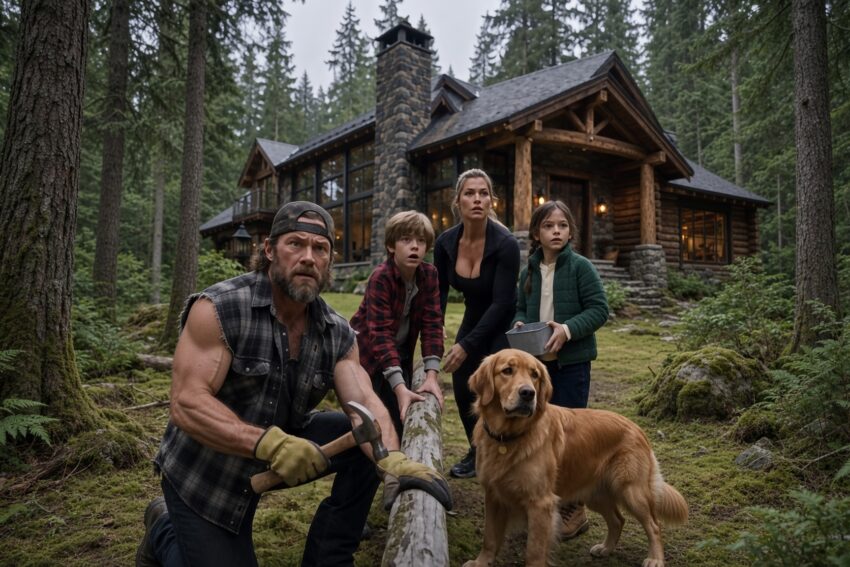
When the heavy blast shutters sealed his mountain sanctuary, Travis Mercer had six minutes to get his family underground before the strike team turned their haven into a tomb.

THE RED SWITCH
Travis Mercer’s thumb drove deep into the illuminated crimson paddle.
The click was not a soft mechanical snap.
It was a heavy, pneumatic thud that vibrated straight through the ancient river stones mortared into the hallway wall.
Behind the stone face, high-pressure nitrogen lines hissed through braided stainless steel.
Molly jumped, dropping the galvanized bucket she still clutched against her chest.
Three dozen flathead timber nails clattered across the flagstones, ringing like brass chimes against the rock.
Beth caught the girl by her trembling shoulders and pulled her back against her hips.
Cody didn’t look at the nails. His wide brown eyes stayed glued to his father’s pale, sweat-slicked jaw.
“Dad?” Cody’s voice broke into a raw, breathless squeak. “What was that?”
“Stay down,” Travis said, his voice flat, low, and stripped of everything except muscle memory. “Both of you. Sit on the stone. Hands over your ears.”
Rusty didn’t need an order.
The golden retriever dropped his belly directly onto Cody’s boots, his ears pinned back against his skull, a low, guttural vibration rumbling in his throat.
Above them, deep inside the tongue-and-groove cedar ceiling, the house began to groan.
THE IRON DROP
It started with a rhythmic, deafening clatter—four distinct impacts like train cars coupling at speed.
Four-inch solid steel storm shutters, hidden for five years inside the doubled exterior framing, dropped down the window tracks on counterweighted aircraft cable.
They hit the sill plates with the force of falling anvils.
*CLANG-THUD.*
The bright mountain light that poured into the great room died instantly.
The vast timber lodge plunged into absolute, pitch-black shadow, sliced open only by the amber glow of the hallway lantern and the blood-red square of the switch panel.
Outside, the heavy combat boots of the lead operators hit the stone porch steps.
Three paces from the threshold, they stopped.
A mechanical voice cut through the damp mountain air beyond the timber: “Breaching team up. Frame is reinforced timber. Set the linear charges on the hinges.”
Beth reached down with both hands, gripping the collars of Cody’s flannel shirt and Molly’s fleece vest.
Her knuckles were white. Her fingernails dug through the cloth.
“Travis,” she whispered. Her voice was steady, but her breath came fast and shallow through flared nostrils. “They aren’t local. Those aren’t county plates.”
“I know who they are,” Travis said.
He didn’t turn around. He reached into the dark alcove beside the switch box, found the recessed toggle, and flipped the breaker.
THE LOCKDOWN
Deep in the subterranean crawlspace, the diesel auxiliary generator kicked on with an oily cough and settled into a muffled, thumping roar.
Thin strip lights along the floorboards flared into a dim, tactical amber.
Through the six-inch solid cedar of the front doors, the team outside detonated their primary breaching charge.
The explosion sounded like a sledgehammer striking an iron safe.
Dust and dried moss exploded out of the ceiling beams, raining gray powder over Travis’s ball cap and shoulders.
The heavy double doors buckled inward half an inch, but the twelve-gauge manganese locking bars driven four inches deep into the granite doorframe held rigid.
A muffled curse came from the porch.
“Hydraulic deadbolts!” an operator barked outside. “They hardened the frame! Bring up the thermal lance from Truck Two!”
Travis stepped over the spilled nails, his work boots grinding iron against slate.
He dropped to one knee in front of his son and daughter, peeling off his sweat-stained leather work gloves with his teeth.
“Listen to me,” he said, looking straight into Molly’s tear-filled eyes, then Cody’s. “The house is doing what it was built to do. It’s buying us four minutes.”
Molly reached out with a small, dirt-caked hand and grabbed the frayed cuff of his sleeveless flannel.
“Are the bad men going to come through the window, Daddy?”
“No, baby,” Travis said gently, brushing a streak of sawdust from her cheek. “Those shutters are three-eighths rolled plate. They couldn’t get through them with an axe if they had an hour.”
He looked up at Beth.
The unspoken truth hung between them like heavy smoke: they didn’t have an hour. They had minutes before the operators brought cutting torches to the master anchors.
“The hearth,” Beth said simply.
“The hearth,” Travis agreed. “Move. Now.”
THE HEARTH BELOW
They moved through the darkened great room, navigating by the amber glow of the low-voltage baseboard strips.
The massive central fireplace dominated the room—twelve tons of river rock, granite boulders, and hand-chiseled slate rising twenty feet to the ridge beam.
Travis grabbed the heavy cast-iron poker hanging beside the firebox.
He jammed the hooked end into a narrow crevice between two split boulders four feet off the floor and hauled downward with his full body weight.
A counterweight dropped inside the masonry column with a heavy, hollow scrape.
The entire back wall of the firebox—a slab of refractory brick three feet wide and four feet tall—swung inward on an oil-packed pivot hinge.
A wave of cold, earthy air rolled out into the warm cabin, smelling of damp limestone, ancient shale, and cold groundwater.
“Cody first,” Travis commanded. “Slide down feet first. There’s a landing three yards down. Keep your hands on the guide rail.”
Cody hesitated for half a heartbeat, looking down into the black square.
“Go, buddy,” Beth urged, her palm firm against the boy’s back. “Mom is right behind you.”
Cody swung his legs over the cold brick lip and dropped into the darkness.
A split second later, his boots hit packed gravel with a firm scrape. “I’m down! I’m okay!”
“Molly, your turn,” Travis said, lifting the girl under her arms.
Molly didn’t make a sound. She clamped her teeth together, held her breath, and let her father lower her into the shaft until Cody’s hands caught her waist.
Rusty didn’t wait for an invitation.
The retriever crowded against Travis’s thigh, whined once, and scrambled down the slope, his claws scratching against the corrugated metal chute before landing beside the children.
Above them, the front porch erupted in a blistering shower of blue-white light.
Through the hairline seam around the front doors, the hissing hiss of an exothermic cutting torch began to chew through the outer steel skin.
The smell of vaporizing paint and scorched cedar filled the foyer.
“Beth, go,” Travis said.
Beth grabbed the edge of the brickwork, paused, and looked her husband dead in the eyes.
“You don’t fight them here, Travis. We leave together. You swore to me.”
“I’m on your heels,” Travis said. “Go.”
THE DESCENT
Beth vanished down the chute.
Travis reached behind the stone mantle, pulled down an olive-drab canvas pack he had kept staged behind the kindling box for four years, and slung it over his shoulder.
Inside were four sealed emergency rations, two water filters, three encrypted satellite radios, twenty thousand dollars in untraceable cash, and two Glock 17 pistols with six spare magazines.
He reached back to the release lever and shoved it upward, disengaging the counterweight.
As he slid down into the chute, the heavy refractory stone slab slammed shut behind him with a dull, final thud.
The latch clicked. From the inside, it was locked forever.
Travis hit the gravel landing, his boots absorbing the shock.
The air down here was eight degrees cooler than the cabin, dense with the smell of wet mountain soil and running water.
Ahead of them stretched a horizontal culvert four feet in diameter—galvanized corrugated drainage steel installed during the foundation pour, cutting straight under the lawn toward the timberline.
Beth had already switched on a red-lens headlamp, bathing the narrow ribbed walls in a soft, non-reflective crimson.
Cody was crouching low, holding Molly’s hand, leading Rusty by his fabric collar.
“Head down,” Travis whispered, his hand finding Cody’s shoulder. “Crawl fast. We’ve got two hundred yards before daylight.”
Behind them, muffled by twenty feet of earth and stone, a massive detonation shook the ground.
The sound vibrated through the steel pipe like a struck bass drum.
The strike team had blown the inner bolts. They were inside the lodge.
THE CULVERT
The crawl through the drainage pipe was brutal on knees and palms.
Water trickled along the bottom ribs of the pipe—cold snowmelt from the upper ridge, soaking through Travis’s jeans and numbing Cody’s sneakers.
Molly slipped once, her small knee banging against a steel bolt, but she didn’t cry out.
She merely sucked in a sharp hiss of air and kept crawling, driven by the steady patter of Rusty’s paws splashing ahead of her.
“Keep moving,” Travis urged from the rear. “Don’t stop for anything.”
He paused every twenty yards, turning his head backward into the dark pipe, listening.
For sixty seconds, there was only the sound of water and their own ragged breathing.
Then came the telltale clinking of metal against steel at the far entrance of the pipe.
They had found the hearth.
“They’re at the chute!” Travis whispered ahead. “Faster! Beth, push them!”
Beth surged forward, practically carrying Molly beneath her arm while crawling on one knee and one hand, her athletic frame maneuvering through the tight steel tube with desperate efficiency.
Ahead, the absolute darkness of the pipe gave way to a ragged disc of gray daylight.
The mouth of the culvert opened into a deep, brush-choked ravine three hundred yards south of the property line, buried beneath a tangle of wild blackberry canes and fallen hemlock logs.
Rusty reached the opening first, bursting through the brambles and shaking cold water from his golden coat with a vigorous rattle of his brass tags.
Travis lunged forward, grabbed the dog’s brass tags, and taped them tight with a strip of electrical tape pulled from his pack strap.
“Quiet, boy,” he breathed. “Not yet.”
THE RIDGE OVERLOOK
Beth pulled Molly and Cody out of the ditch, dragging them into the thick cover of a deadfall cedar.
Travis scrambled out last, turning immediately to shove an old piece of rusted corrugated sheet metal and dead hemlock branches across the pipe opening to break the unnatural circular outline.
He crawled on his belly up the rim of the ravine and parted the ferns.
Through the mist and light drizzle, the family cabin sat three hundred yards below them across the clearing.
The two matte-black armored trucks were parked at aggressive angles on the muddy grass where Travis had been splitting cedar fence rails ten minutes ago.
The driver’s side doors stood wide open.
Four masked men in heavy black plate carriers and high-cut ballistic helmets were sweeping the perimeter of the stone porch, carbines raised to their cheeks.
From the second-story master bedroom window, thick gray smoke began to billow outward into the pine canopy.
They were tossing incendiary grenades into the interior.
“They’re burning it,” Beth whispered, her voice tightening as she pulled Molly’s face into her chest so the child wouldn’t see. “Travis… they’re burning everything.”
Travis didn’t flinch.
His face was carved out of slate. His eyes tracked the trucks, counting the antennas on the roof racks.
“That’s standard sanitization,” he muttered, his jaw tight. “They don’t leave evidence of a breach. If they burn it to the foundation, the state police write it off as a remote chimney fire.”
“Who are they, Dad?” Cody whispered. His lower lip was trembling violently now that the immediate running had stopped. “You said we were safe here. You said nobody knew where this mountain was.”
Travis looked down at his son.
He unzipped the canvas pack, pulled out one of the Glocks, racked the slide with a crisp *clack-clack*, and tucked it firmly into the waistband of his jeans beneath his plaid overshirt.
“I was wrong, Cody,” Travis said quietly. “A man I used to work for made a deal. And we have to disappear before they realize we didn’t burn inside.”
A sudden high-pitched whine rose from the clearing below.
On the roof of the lead truck, a motorized gimbal rotated. A black quadcopter drone, eighteen inches across with shrouded rotors, launched into the damp mountain air.
THE CANOPY HUNT
“Drone’s up!” Travis snapped. “Under the hemlocks! Move, move, move!”
He grabbed Molly by her jacket and hoisted her into his arm, using his left hand to push Cody into the deepest shadows of the old-growth timber.
The dense forest canopy of Douglas fir and western hemlock formed a natural umbrella, but thermal imaging from a tactical drone could pick up body heat through wet pine needles if they broke into the open.
“Walk in the creek beds,” Travis instructed, leading them down the backside of the ridge away from the burning lodge. “Water masks our heat signatures from above. Don’t run across open clearings.”
They plunged into the bed of Cold Creek—a shallow, rocky runoff channel running southwest toward the logging districts.
The water was calf-deep and frigid, ice-melt straight from the upper cirques.
Molly gasped as the water filled her tan boots, but Beth gripped her hand tightly, moving with long, determined strides.
Above them, the muted buzz of the drone sounded like a hornet trapped in a glass jar, circling over the ridge where they had exited the culvert.
Travis stopped beneath the overhanging roots of a massive upturned spruce, pulling his family tight against the dirt bank.
Through the gaps in the spruce roots, he saw the drone hover fifty feet above the ravine.
It tilted, its optical sensor glinting silver in the gray light, sweeping the blackberry brambles.
Suddenly, a series of sharp, heavy pops echoed through the woods behind them—suppressed rifle fire.
The operators at the cabin were shooting down the mouth of the culvert from inside the basement, testing the exit point.
“They found the pipe,” Beth whispered, her breath fogging in the chill air.
“They know we’re out,” Travis said. “That drone will relay our heading within two minutes. We have two miles to the switchback road.”
“And what’s at the road?” Beth asked, looking him dead in the eyes. “Our truck is down in that driveway, Travis. We’re on foot in the middle of sixty square miles of timber.”
Travis reached into his pocket and pulled out an old brass barrel key.
“Silas Crane,” Travis said.
Beth’s eyes widened slightly. “Silas? You told me Silas died three years ago in Idaho.”
“I told everyone that,” Travis said grimly. “Including Silas.”
THE TRACKERS IN THE TREES
They moved southwest along the creek for twenty minutes, keeping beneath the thickest hemlock boughs.
The drizzle turned into a steady, soaking mountain rain that plastered Travis’s shirt to his shoulders and turned the forest floor into a slick slurry of rotten needles and black mud.
Rusty kept pace at Cody’s side, his coat soaked black, his head turning constantly toward the ridge behind them.
Travis stopped at a bend in the creek, dropping to one knee on a gravel bar.
He held up a clenched fist.
Beth froze instantly, dropping Cody and Molly behind a moss-covered boulder.
Through the rain, three hundred yards up the slope, two dark figures slipped between the trunks of the pines.
They moved in coordinated tactical bounding—one man covering with an elevated carbine while the second sprinted fifteen yards, dropped to a knee, and scanned the valley floor with a handheld optic.
They were wearing lightweight non-reflective rain shells over their black tactical gear, their faces hidden behind dark balaclavas and polarized ballistic eye protection.
On their right shoulders was a subdued rubber patch: a split shield with an inverted silver chevron.
“Vanguard,” Travis muttered beneath his breath.
“What is that?” Cody asked, shivering violently against the stone.
“A private logistics and recovery firm,” Travis said, his voice barely audible over the rush of the creek. “The kind the Department of Corrections hires when they don’t want a prisoner to ever see a courtroom.”
“Why are they hunting you?” Cody asked. His voice wasn’t frightened now; it was filled with an agonizing, bewildered confusion. “You build fences, Dad. You fix tractors.”
Travis kept his eyes fixed on the two operators moving along the ridge.
“Before I fixed tractors, Cody, I managed the bank accounts that paid men like that to do things nobody was allowed to talk about.”
He checked the magazine on his Glock, tapped the baseplate, and slid it back into his grip.
“When I left, I took the ledger. And they’ve spent eight years trying to find where I buried it.”
One of the operators on the ridge suddenly stopped.
He raised a gloved hand, signaling his partner, and pointed directly down toward the creek bed.
He had spotted their tracks in the wet mud where they had stepped out of the water to cross a gravel shelf.
THE DECOY TRIP
“They’ve got the trail,” Travis said calmly. “Beth, take the kids down the creek bed three hundred yards. There’s an old culvert under the deactivated logging spur. Climb inside and do not come out until I tap three times on the steel.”
“No,” Beth said, grabbing his forearm. “You can’t take two of them alone with a handgun.”
“I’m not taking them,” Travis said. “I’m turning them around.”
“Travis—”
“Beth. Trust me. Three hundred yards. Go.”
Beth swallowed hard, looked at the two armed men descending the ridge, and nodded once.
She took Molly’s hand and Cody’s collar, whispering sharply to Rusty, and slipped silently downstream around the gravel bend.
Travis didn’t run.
He moved twenty yards up the bank into the brush, pulled the canvas pack off his shoulder, and unbuckled the side pocket.
He pulled out a compact emergency flare—a high-output magnesium rod used for marine signaling.
He wedged the flare between two dry cedar roots beneath an overhanging rock ledge, looped a length of heavy fishing monofilament from his pocket kit around the pull-ring, and stretched the transparent line across the natural game trail the two operators were following down the slope.
Then he stepped back forty yards into the ferns, drew his sidearm, and leveled both hands against the rough trunk of a standing hemlock.
Through the drizzle, the lead operator emerged from the ferns.
He was moving with absolute tactical discipline, his rifle tucked tight against his shoulder pocket, his eyes sweeping the creek bed where Beth’s footprints were already filling with rainwater.
His boot caught the monofilament six inches off the ground.
The friction striker popped.
A blinding, hissing jet of brilliant white-hot magnesium fire erupted from the roots with a deafening roar of crackling sparks and billowing, sulfurous smoke.
The lead operator instinctively snapped his rifle toward the flash, diving sideways into the wet loam: “Contact! Tripwire! Take cover!”
His partner dropped behind a rotten cedar log, sweeping his weapon in an arc across the brush.
From his position forty yards behind them, Travis didn’t fire at their bodies.
He fired two rapid shots into the base of the rotten deadfall directly above the second operator’s head.
The 9mm hollow points shattered the dry, decayed wood with explosive cracks that sounded like high-caliber return fire echoing across the canyon walls.
“Sniper in the timber!” the second man shouted into his throat mic. “Ridge position! He’s dug in above us!”
The operators immediately laid down a heavy suppressive burst toward the high ridge—wasting fifty rounds of high-velocity ammunition into empty hemlock trunks, convinced they were pinned down from above.
By the time they realized the fire had come from their flank, Travis Mercer was already sixty yards downstream, running silently through the cold water of the creek.
THE LOGGING ROAD SPUR
Travis reached the deactivated logging culvert three minutes later.
He slid down the muddy embankment, ducked beneath the overhanging willow branches, and tapped three times on the rusty corrugated steel with the butt of his pistol: *rap, rap, rap.*
Beth’s face appeared from the shadows inside the pipe.
She reached out, grabbed his wet flannel shirt, and hauled him inside.
Cody and Molly were huddled together on an old dry tire someone had dumped in the culvert decades ago.
Rusty was lying across their feet, his head resting on Cody’s knees, whining softly.
“Did you hit them?” Cody asked, his eyes wide.
“Didn’t have to,” Travis said, catching his breath. “They think there’s a team on the high ridge. That’ll buy us twenty minutes while they set a perimeter and wait for backup from the trucks.”
He looked through the culvert to the other side of the dirt roadbed.
Beyond the old logging road lay an abandoned fire-watch compound built in the late 1960s—a rusted steel communications tower and a single-story cinderblock maintenance shack swallowed by wild blackberries.
“Silas is in there?” Beth asked, looking through the brush at the desolate concrete building.
“If he’s alive, he’s there,” Travis said. “And if he isn’t, his radio equipment is.”
Travis climbed out of the pipe first, checking the ridge line.
The rain was coming down harder now, a thick gray sheet that obscured the mountain peaks and muffled the sound of the world.
He waved them forward.
They sprinted across the overgrown gravel spur in a low crouch, Rusty darting between Cody and Molly, until they reached the heavy iron security door of the cinderblock shack.
The door was locked with a rusted three-pin deadbolt and secured with an industrial padlock that had turned orange with age.
Travis didn’t use a lockpick.
He took the brass barrel key from his pocket, inserted it into a tiny, almost invisible hole drilled into the mortar between two cinderblocks two feet to the left of the door, and turned it three clicks clockwise.
A heavy hydraulic latch inside the doorframe disengaged with a solid *clonk*.
Travis shoved the heavy steel door open.
“Inside,” he breathed. “Quick.”
THE COMPOUND IN THE GULCH
The air inside the maintenance shack was dry, warm, and smelled faintly of solder, pipe tobacco, and ozone.
Row upon row of military-surplus radio gear lined the concrete walls—old vacuum-tube transceivers, modern digital frequency scanners, banks of deep-cycle marine batteries, and cathode-ray monitors humming with faint green lines.
In the corner, sitting behind a scarred oak desk covered in circuit boards, sat an old man with a full white beard and a faded wool flannel shirt.
A heavy twelve-gauge pump shotgun lay across his lap, its muzzle pointed directly at Travis Mercer’s sternum.
The hammer was cocked.
“You took your sweet time, Mercer,” Silas Crane said, his voice like gravel grinding in a cement mixer.
Travis let out a long, ragged exhale and lowered his sidearm.
“The shutters bought us four minutes,” Travis said. “The chute gave us the rest.”
Silas slowly eased the hammer down on the shotgun with a scarred thumb and rested the barrel against the desk.
His sharp gray eyes flicked over Travis’s shoulder to Beth, then to the shivering children, and finally to the dripping golden retriever.
“You brought the whole house,” Silas muttered.
“They brought two armored trucks and an incendiary team, Silas,” Beth said, stepping forward, her voice trembling with exhaustion and fury. “They burned our home.”
Silas’s face darkened.
He stood up stiffly, leaning on a heavy ash-wood cane, and limped toward a cast-iron woodstove glowing cherry-red in the center of the room.
He pulled a stack of dry wool blankets from a shelf and tossed them to Cody and Molly.
“Wrap the kids,” Silas ordered. “There’s hot coffee on the kettle. Dry socks in the footlocker.”
Molly didn’t ask questions. She took the rough wool blanket, sat on the concrete floor beside the stove, and wrapped it around herself and Rusty, leaning her small head against the dog’s wet ribs.
Cody stood by his mother’s side, his eyes scanning the glowing screens on the desk.
“What is this place?” Cody asked.
“This,” Silas said, turning a rotary dial on an old tactical receiver, “is an ear that listens to the whole state, young man. And right now, it’s listening to four men who are very upset that your daddy isn’t a pile of ash in his own basement.”
THE SCANNER SPEAKS
Silas reached over and flipped a switch on an amplified speaker box.
A burst of static hissed into the warm shack, followed by a crisp, digitally compressed tactical voice:
*“…Echo-One to Control. Sweep team made contact on the creek spur. Target employed improvised explosive distraction. Believed armed with sidearm. No casualties, but target has broken visual contact.”*
A second voice, colder and higher in authority, answered through the speaker:
*“Control to Echo-One. The local authorities have been notified of a structure fire at the Mercer parcel. County units will arrive in forty-five minutes. You have thirty minutes to locate the target and recover the drive before this perimeter becomes untenable. Use secondary tracking.”*
*“Echo-One copies. Bringing up the hound.”*
Travis’s head snapped toward the speaker.
“They brought a dog,” Travis said.
Silas looked at him, his bushy white eyebrows knit together in grim realization.
“Bloodhound from the truck,” Silas said. “They’ll be at that culvert in ten minutes. From there, this concrete box is a straight line through the brush.”
Beth stepped between Travis and Silas, her hands trembling.
“Where is the ledger, Travis?” she demanded. “Tell me you have it. Tell me we didn’t lose everything we built for four years just to run until we run out of woods.”
Travis reached into his shirt collar, pulled out a thick stainless-steel dog tag hanging on a ball chain, and unscrewed the threaded barrel at the base.
Inside was a micro-solid-state memory card sealed in liquid silicone.
“It’s here,” Travis said.
“What’s on it?” Cody asked quietly from the stove. “Dad… what did you do?”
THE LEDGER
Travis knelt beside his son, looking at the boy’s pale, rain-streaked face.
“I worked for an investment corporation called the Vanguard Group, Cody,” Travis said, his voice quiet, steady, and clear. “They weren’t an investment company. They were a clearinghouse for private government contractors who did dirty work overseas and at home.”
“Illegal work,” Beth added softly.
“Contracts to fix bids, bribe port authorities, silence inspectors, and build private detention sites that didn’t exist on paper,” Travis continued. “I was their head accountant. I watched billions of dollars move through shadow companies into the pockets of men who wear suits in the capital.”
“And you stole their money?” Cody asked.
“No,” Travis said firmly. “I didn’t take a single dollar. But I took the records. Names, dates, bank routing numbers, audio recordings of procurement meetings, and the coordinates of six black sites operated on federal parkland.”
He looked up at Silas.
“I was an insurance policy,” Travis said. “As long as they thought I had the drive set to automatically upload to every federal judge in the Ninth Circuit if I died, they stayed away. But three days ago, the director of Vanguard was subpoenaed by a grand jury.”
Silas spat into a brass can beside the desk.
“And they figured if they’re going down,” Silas growled, “they’d better clean up the loose ends that can testify under oath.”
“They don’t want the drive,” Beth realized, her hand flying to her mouth. “They already know what’s on it. They just want you dead before Monday morning.”
“Monday morning is when the grand jury convenes in Helena,” Travis said.
He turned to Silas.
“Can you broadcast it from here?”
Silas looked at the high-gain transmission rack in the corner, then shook his head slowly.
“Not to the court,” Silas said. “My primary dish on the roof can push an emergency burst to the regional state patrol relay on Iron Mountain. But it’s encrypted with state frequencies. It’ll trigger an all-points bulletin across three counties, but it won’t go to a judge.”
“Then we push it to the state patrol,” Travis said. “We make it so big, so public, that they can’t make us disappear without every television station in the state filming the wreckage.”
Silas looked toward the heavy iron door.
“Then you’d better help me start the diesel pump on the roof,” the old man said, grabbing his shotgun. “Because that transmitter pulls forty amps, and we’ve got about eight minutes before their dog smells your boots.”
THE ROOF ARRAY
The wind howled across the steel roof of the maintenance shack.
Rain lashed against Travis’s face as he climbed the rusted steel ladder behind Silas, hauling the heavy waterproof cable up to the base of the antenna tower.
Below them, the logging gulch was shrouded in dense, swirling fog.
To the northeast, a faint orange glow flickered against the low-hanging clouds—the funeral pyre of the Mercer family home.
Travis connected the primary bus to the relay box, tightening the terminal nuts with his bare fingers until his skin pinched against the cold brass.
“Power’s green!” Silas yelled down the roof hatch.
Inside the shack below, the bank of tube transmitters hummed to life, a high-frequency whistle that made the hair on Travis’s forearms stand on end.
Suddenly, from the edge of the timber three hundred yards down the gulch, a deep, rhythmic baying shattered the rain.
The dog had found the culvert.
Travis looked over the lip of the cinderblock parapet.
Through the mist, a massive red-and-black hound burst from the brush, straining against a heavy leather tracking lead held by a handler in full tactical gear.
Behind the handler came four more operators, spread out in an assault wedge, moving fast across the wet gravel spur.
“Silas!” Travis barked down the hatch. “They’re on the gravel! How long on the upload?”
Silas’s voice came back through the opening, strained and hollow:
“The burst buffer takes ninety seconds to synchronize with the Iron Mountain repeater! You have to hold that door!”
Travis dropped through the roof hatch, sliding down the ladder rails to the concrete floor.
Beth was already standing by the reinforced entry door, a lever-action .30-30 hunting rifle from Silas’s gun rack held firmly against her shoulder, the hammer pulled back to full cock.
Her jaw was set like iron. Her fear had burned away, replaced by the lethal, cold instinct of a mother cornered with her children.
“Cody,” Travis commanded, pointing to a steel storage locker in the far corner. “Take Molly and Rusty inside that cabinet. Pull the door shut. Put your fingers in your ears. Don’t look out until Mom or I open it.”
Cody didn’t argue. He grabbed his sister’s hand, pulled the whimpering dog by his collar, and ducked into the locker, pulling the vented steel door shut until only a narrow dark slit showed his eyes.
THE BREACH AT THE SHACK
A heavy metallic crash slammed against the outside of the iron door.
“Occupants of the structure!” a voice bellowed through an amplified bullhorn outside. “This is a lawful federal recovery operation! Exit the building with hands on your heads or lethal force will be authorized!”
“Federal recovery?” Silas laughed bitterly from behind his console, his fingers flying across an old mechanical keyboard. “They don’t even have a badge between the five of them! Just a corporate credit card and a bag of plastic cuffs!”
“Thirty seconds, Silas!” Travis shouted, stepping to the hinge side of the door, his Glock leveled at waist height.
The door shook under a second massive impact—a mechanical ram hitting the center plate.
The concrete around the doorframe cracked, showering white dust over Beth’s boots.
“Beth,” Travis whispered. “On my mark. Low.”
The door frame groaned as a third hit drove the steel deadbolt through the crumbling mortar.
The door burst inward, swinging wildly on a bent top hinge.
The first operator stepped through the threshold, his carbine raised, the tactical light beneath the barrel blazing with a blinding twelve-hundred-lumen beam.
Beth fired.
The heavy lead-nosed .30-30 slug struck the operator directly in the center of his heavy ceramic plate carrier.
The kinetic energy hit him like a charging bull, lifting him off his feet and throwing him backward onto the wet gravel of the porch with a hollow, winded gasp.
Outside, the perimeter erupted in automatic gunfire.
Rounds ripped through the open doorway, chewing the cinderblock walls into flying chunks of gray aggregate and shattering the fluorescent tubes overhead into showers of green sparks.
Travis leaned around the jamb, firing three controlled shots into the mist, aiming low at the gravel to skip copper-jacketed slugs into the darkness.
An operator cried out in pain, dragging the downed man behind the cover of a rusted fuel tank.
Inside the shack, the high-frequency whistle of the transmitter reached a piercing crescendo.
On the console, a solid green indicator lamp flared to life.
*“DATA PACKET TRANSMITTED,”* a digitized synthetic voice announced from the speaker. *“RECEIPT CONFIRMED: STATE POLICE DISPATCH DISTRICT THREE.”*
Silas slammed his hand down on the power switch, killing the current.
“It’s out!” Silas roared. “The whole damn file is sitting on every patrol car terminal between here and the Canadian border!”
THE PRICE AT THE DOOR
The operators outside didn’t retreat.
Knowing their mission was blown, their objective shifted instantly from recovery to total annihilation.
A heavy black cylinder sailed through the shattered doorway, bouncing once across the concrete floor before coming to rest at Silas’s feet.
Not a flashbang.
A high-yield thermite charge.
“Out the back!” Silas screamed, lunging forward with his cane.
The old man didn’t look at Travis.
He didn’t look at Beth.
With a speed that defied his crippled hip, Silas kicked the hissing cylinder toward the open woodstove with the flat of his heavy boot, then threw his entire upper body against the firebox door to keep the blast contained.
The thermite detonated inside the iron stove.
A blinding pillar of white-hot fire exploded through the seams of the cast iron, shattering the stovepipe and blowing the heavy stove doors off their hinges with the force of an artillery shell.
The concussive shockwave hurled Travis and Beth across the floor, slamming them into the metal locker where the children were hidden.
The room filled instantly with an unbearable, suffocating heat that blistered the paint on the walls and turned the air into boiling sulfur.
“Silas!” Travis choked, scrambling through the blinding gray smoke on his hands and knees.
The old man lay on the floor ten feet from the shattered stove, his flannel shirt smoldering, his face blackened by soot, his eyes half-open.
Travis grabbed him by the shoulders, hauling him toward the rear emergency exit.
“Leave me, you damn fool,” Silas rasped, his voice bubbling with fluid. He shoved a heavy set of keys into Travis’s palm with trembling, scorched fingers. “The flatbed… behind the shop… it’s got half a tank of farm diesel…”
“Silas, come on, get up!” Travis shouted over the roaring flames.
“I’m done, Travis,” Silas whispered, a bloody cough racking his chest. “My tower’s down. My job’s done. Take your family… get to the highway before they bring the trucks around…”
Silas reached down, picked up his twelve-gauge shotgun from the rubble, and rolled onto his stomach, pointing the barrel toward the front door where boots were already crunching on the glass.
“Get them out,” Silas ordered, his voice suddenly steady, clear, and absolute. “Move, Mercer. Move!”
THE FLATBED
Travis choked back a scream of rage, turned, and ripped the doors of the steel storage locker open.
Cody and Molly fell out into his arms, coughing and retching from the smoke.
Rusty burst out behind them, sneezing violently, his tail tucked between his trembling legs.
Beth was already at the rear steel fire exit, kicking the panic bar open.
They burst out into the cold rain behind the maintenance building.
Parked beneath a rotting timber lean-to was Silas’s vehicle—a battered, rust-streaked 1988 four-wheel-drive flatbed truck with oversized mud tires and a welded steel pipe bumper.
Travis shoved Cody and Molly into the narrow bench seat of the regular cab.
Rusty scrambled in after them, wedging himself onto the floorboards between Cody’s knees.
Beth jumped into the passenger seat, levering another round into the hunting rifle and resting the barrel on the open window frame.
Travis jammed the heavy brass key into the ignition and twisted it.
The old six-cylinder diesel engine turned over with a painful, agonizing groan: *whir… whir… chug…*
Behind them, inside the burning cinderblock shack, Silas’s shotgun fired once.
Then twice.
Then a long, deafening burst of automatic fire answered, followed by absolute silence.
“Travis!” Beth screamed, pointing toward the corner of the building.
The lead armored truck had just rounded the cinderblock wall, its roof-mounted LED light bar blazing through the driving rain, blinding them in an icy white spotlight.
Travis mashed the starter again.
The diesel engine caught with a violent shudder, roaring to life in a cloud of black exhaust smoke that filled the lean-to.
THE LOGGING ROAD CHASE
Travis slammed the heavy floor shifter into reverse, dropped the clutch, and smashed the gas pedal to the floorboards.
The flatbed shot backward out of the lean-to, its heavy steel bumper tearing through the rotting cedar support posts.
The roof of the shed collapsed behind them in a tangle of corrugated tin and splintered beams, landing directly across the hood of the pursuing armored truck.
The impact smashed the armored truck’s LED light bar into a shower of plastic shards, momentarily blinding the driver.
Travis spun the heavy steering wheel, stomped the brake, slammed the shifter into second gear, and let the clutch bite.
The four massive mud tires dug into the wet clay of the logging spur, throwing rooster tails of mud thirty feet into the gray air as the truck lunged forward down the mountain.
“Hold on!” Travis roared over the deafening clatter of the diesel engine.
Molly buried her face in Cody’s lap, her hands clamped over her ears.
Cody gripped the cracked vinyl dashboard with one hand and wrapped his other arm tight around Rusty’s neck.
Through the rain-streaked rear window, the second armored truck appeared from the gulch, roaring onto the logging road behind them.
It was faster, heavier, and built for pursuit.
Its massive steel push bumper closed the distance on the narrow, winding dirt switchback, gaining fifty yards in three seconds.
Beth leaned out the passenger window into the whipping rain, resting the heavy rifle barrel on the side mirror.
“Keep it straight!” she screamed over the wind.
She squeezed the trigger.
The rifle bucked. The slug struck the armored truck’s bulletproof windshield, leaving a starburst crack in the heavy laminated glass directly in front of the driver’s face.
The armored truck swerved half an inch, but it didn’t slow down.
It surged forward, slamming its reinforced steel bumper into the rear overhang of Silas’s flatbed with a bone-jarring crash.
THE MOUNTAIN SWITCHBACKS
The impact threw Cody against the dashboard.
The rear end of the flatbed fishtailed violently across the slick mud, the tires skimming within six inches of a four-hundred-foot sheer drop into the rocky canyon below.
Travis fought the steering wheel, his forearms bulging against the manual steering, wrestling the sliding truck back onto the center of the roadbed.
“He’s going to pit us!” Beth shouted, working the rifle lever. “On the next curve, he’s going to push our rear out!”
Travis looked ahead through the thrashing windshield wipers.
Ahead lay the Iron Creek Trestle—an old, single-lane logging bridge made of creosoted timber beams laid across a fifty-foot rocky gorge.
The bridge was eighty years old, abandoned for two decades, its wood rotted by decades of mountain winter snows.
At the entrance to the bridge sat a rusted sign: *WEIGHT LIMIT 3 TONS. CLOSED.*
The flatbed weighed two and a half tons.
The black armored truck behind them, loaded with armor plate and five operators, weighed seven.
“Hang on to something!” Travis screamed.
He didn’t hit the brakes. He shoved the floor shifter into third gear and drove straight toward the rotten bridge deck.
THE ROTTEN TRESTLE
The flatbed hit the bridge timbers at forty-five miles per hour.
The sound was like an earthquake.
Rotten deck boards snapped like dry kindling under the oversized tires, shooting splintered fragments of timber down into the roaring creek below.
The truck bounced violently, its leaf springs groaning as it skipped across the sagging central span.
Behind them, the driver of the armored truck was blinded by the cracked windshield and the tunnel vision of the chase.
He followed the flatbed onto the bridge.
The armored vehicle’s massive seven-ton bulk hit the weakened center timbers with the force of a falling boulder.
The main support stringers—already split by twenty years of dry rot—shattered simultaneously with a series of explosive cracks that sounded like cannon fire.
The entire middle section of the wooden bridge collapsed inward.
Through the rear-view mirror, Travis watched the black armored truck plunge downward into the gap.
The front bumper caught the far abutment, but the weight of the rear axle dragged the vehicle backward, tumbling end-over-end down the rocky embankment before slamming upside down into the churning whitewater of the creek forty feet below.
A secondary explosion tore through the truck’s fuel cell, sending a ball of orange fire and black smoke rolling up through the gap in the bridge into the rain.
Silas’s flatbed cleared the far side of the gorge, its front tires hitting solid rock and gravel with a shuddering crash that knocked the driver’s side mirror clean off the door.
Travis didn’t stop.
He kept the accelerator pinned to the floorboards, speeding down the winding dirt grade toward the paved valley highway two miles below.
THE VALLEY ROAD
Ten minutes later, the muddy tires of the flatbed screamed as they crossed from slick dirt onto cracked black asphalt.
Route 12.
The two-lane state highway wound through the agricultural basin toward the county seat of Oakhaven.
It was mid-morning now.
Civilization returned with brutal, disorienting speed: barbed-wire cattle fences, metal grain silos, a battered yellow school bus waiting at a crossroads, and regular pickup trucks driving with their headlights on through the gloom.
Molly slowly lifted her head from Cody’s lap.
Her face was smudged with black soot from the woodstove, her eyes bloodshot and wide with exhaustion.
“Are they still behind us, Daddy?” she whispered.
Travis looked in the remaining rear-view mirror.
The empty asphalt stretched behind them into the misty foothills, gray and silent beneath the rain.
“No, baby,” Travis said, his voice cracking with a fatigue so deep it felt like lead in his bones. “Not right now.”
Cody looked down at Rusty.
The dog was licking a small cut on Cody’s wrist, his tail giving one slow, hesitant thump against the floorboard.
“Where are we going, Dad?” Cody asked. “Our house is gone. Everything’s gone.”
Travis reached out with his right hand, his thumb catching Cody’s chin, lifting the boy’s head until their eyes met.
“The house was just cedar and stone, Cody,” Travis said quietly. “This is the family. Right here in this cab. As long as we’re breathing, they didn’t win.”
Beth reached over and laid her hand on Travis’s knee.
Her fingers were stained with black powder residue, her knuckles raw where she had bumped the doorframe.
“Where do we go, Travis?” she asked softly. “The state police have the file. But Vanguard has money. They have lawyers. They have judges.”
“They don’t have enough lawyers to buy the whole town,” Travis said, looking toward the horizon.
Ahead of them, through the thinning mist, rose the brick clock tower of the Oakhaven County Courthouse.
THE TOWN SQUARE
The town of Oakhaven was not a remote mountain gulch where men in black masks could fire automatic weapons without consequence.
It was a working-class timber and farming town of twelve thousand people.
Main Street was lined with brick storefronts, a hardware store, a diner with neon signs in the window, and pickup trucks parked diagonally against the curbs.
Travis drove the battered flatbed straight down the center of Main Street.
The truck looked like an apparition from a war zone—bullet holes stitching the passenger door, the rear bumper torn away, the hood covered in mud and pine needles, and black smoke coughing from the broken tailpipe.
People on the sidewalks stopped.
A shopkeeper sweeping the porch of the feed store lowered his broom, staring in open-mouthed shock.
Ahead, parked in front of the county courthouse, sat four white-and-gold cruisers belonging to the County Sheriff’s Department, their blue-and-red light bars pulsing silently against the wet brick walls.
Beside them were two unmarked state patrol sedans.
Travis pulled the flatbed directly up to the courthouse steps, cut the ignition, and let the dying diesel engine shudder to a halt.
For a long moment, there was only the sound of rain drumming against the rusted cab roof.
“Travis,” Beth whispered, her hand tightening on his arm.
Six uniformed deputies stepped out of the courthouse double doors, their hands resting on their duty holsters, moving with cautious, measured steps down the granite stairs.
Behind them came a tall, gray-haired man in a brown uniform with the gold shield of the County Sheriff pinned to his pocket.
Beside the Sheriff walked an agent in a dark civilian suit, holding an open tough-book laptop that was still streaming green lines of data.
Travis took a slow, deep breath, reached up, and unclipped his seatbelt.
“Stay inside until I tell you,” he told Beth.
THE STEP OUT
Travis opened the battered driver’s door and stepped out into the rain.
He raised both hands into the air, fingers spread wide, palms open toward the deputies.
His clothes were soaked black with creek water.
His face was streaked with soot and blood from a shallow cut across his temple where the window glass had grazed him.
His boots were covered in mountain mud.
The Sheriff stopped at the bottom of the granite steps, ten paces away, his eyes sweeping Travis from his backward ball cap down to his mud-caked boots.
“Travis Mercer?” the Sheriff called out, his voice carrying over the quiet rain.
“I’m Travis Mercer,” he answered.
The Sheriff looked at the state agent beside him, who looked up from his laptop and gave a single, solemn nod.
“We received a transmission thirty minutes ago from an automated relay on Iron Mountain,” the Sheriff said. “Fifty gigabytes of financial ledgers, encrypted audio files, and sworn affidavits regarding an unregistered facility forty miles north of here.”
The Sheriff stepped forward, his eyes softening slightly as he looked through the truck’s windshield at Beth, the two huddled children, and the golden retriever looking over the dashboard.
“State police dispatch told us to expect an armed fugitive,” the Sheriff said slowly. “They said you were dangerous.”
“I’m not a fugitive, Sheriff,” Travis said, his voice steady, ringing clear across the quiet town square. “I’m a witness. And the men who burned my home are twenty miles back up that mountain in two unmarked armored vehicles.”
The Sheriff looked back at the town square, where dozens of citizens were now watching from the storefronts, cell phones raised, capturing the scene from every sidewalk corner.
The Sheriff turned back to Travis, reached to his belt, and unclipped his radio.
“Dispatch, this is Sheriff Miller,” he spoke into the mic. “Cancel the felony pursuit on the Mercer vehicle. Secure the perimeter around the courthouse. Bring emergency medical services to the front steps for a woman and two minors.”
He lowered the radio and looked Travis dead in the eye.
“And notify the United States Attorney’s office in Helena,” Miller added. “Tell them the key witness for the Vanguard grand jury just arrived on the morning docket.”
THE COST OF SURVIVAL
Two hours later, the rain had stopped, leaving the valley air crisp, clean, and smelling of wet asphalt and sweet clover.
Inside the small, wood-paneled office of the County Magistrate, Molly was wrapped in a dry wool emergency services blanket, sipping hot chocolate from a foam cup.
Rusty lay stretched out on the braided rug at her feet, his head resting heavily on Cody’s sneakers.
Cody sat in an oak armchair, holding a warm sandwich with both hands, staring out the window at the line of county cruisers parked outside.
In the corner of the room, a female deputy was gently applying an antiseptic strip to the scrape on Beth’s forehead.
Beth’s eyes were closed, her face pale, the tension of the last four hours finally releasing in long, silent shivers that shook her shoulders.
Travis stood by the magistrate’s desk, signing the final page of a twenty-page sworn deposition under the watchful eye of an assistant federal prosecutor who had flown in by helicopter from the state capital forty minutes ago.
Travis laid the pen down on the oak blotter.
“That’s everything,” Travis said. “Every account. Every name. Every drop point.”
The prosecutor—a tired-looking woman in her forties with graying hair—picked up the papers, tapped them square on the desk, and slid them into a leather briefcase.
“This will bring down three sitting directors, Mr. Mercer,” she said quietly. “And at least two dozen private contractors across four states.”
“I don’t care about the contractors,” Travis said, his voice hollow. “I want to know about Silas Crane.”
The prosecutor paused, her hand resting on the brass latch of her briefcase.
She looked down at the floor, then met his gaze with steady, sorrowful eyes.
“A county response team reached the logging shack twenty minutes ago,” she said softly. “The building was fully engulfed. They found him inside.”
Travis closed his eyes.
A heavy, suffocating weight settled onto his chest—the price of his survival, paid by an old man who had chosen to burn with his radio rather than let a family die in the timber.
“He held them,” Travis whispered.
“Yes,” the prosecutor said. “He held them. And two of the operators from the second vehicle were taken into custody near the bridge collapse. They’re in county lockup right now. They aren’t going anywhere.”
THE ROAD FORWARD
Beth stood up from the chair and walked over to Travis.
She didn’t say a word.
She reached out, took his calloused, cut hand in hers, and laced her fingers through his.
Her grip was tight, fierce, and unbreakable.
“We have a protective detail outside, Mr. Mercer,” the prosecutor said, stepping toward the door. “An unmarked van will transport you and your family to a secure federal installation outside Billings until the grand jury concludes on Thursday.”
Travis looked out the window at the black federal van parked beside the sheriff’s cruisers.
Another vehicle. Another secure perimeter. Another life behind locked doors and drawn curtains.
“And after Thursday?” Beth asked.
The prosecutor hesitated.
“After Thursday, you’ll have new names. A new parcel. Somewhere far from these mountains. Somewhere they will never find you.”
Travis looked back at his children.
Cody was showing Molly how to fold the wrapper of her straw into an accordion shape.
Molly laughed—a small, quiet sound, but bright and clear enough to pierce the gloom of the room.
Rusty raised his head, thumped his tail once against the braided rug, and closed his eyes to sleep.
Travis turned to the prosecutor, his face calm, his jaw set, the fear that had hunted him for eight years finally burned down to ash.
“They won’t have to look for me,” Travis said, his voice flat and hard as mountain granite. “Because after Thursday, there won’t be anyone left to send them.”
He reached down, picked up his daughter in his arms, and walked out the door into the sunlight.
DISCLAIMER
This story is a work of fiction intended strictly for entertainment purposes. All characters, names, entities, incidents, organizations, and tactical scenarios depicted are entirely the product of the author’s imagination or used fictitiously. Any resemblance to actual persons (living or deceased), real-world law enforcement agencies, private military corporations, legal proceedings, or actual events is purely coincidental. This text does not constitute, provide, or encourage technical instructions, tactical procedures, security configurations, or legal advice.