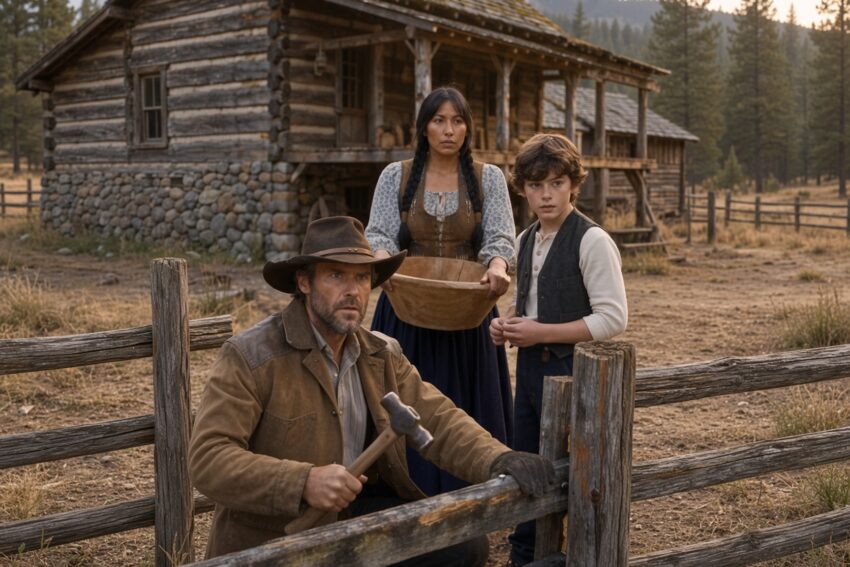
When Silas Harlan pulled the iron, the mountain did not save them. It only bought them a night, a wound, and a name the valley would not be able to bury.
THE LEVER
Silas’s palm closed on the cold knob.
It was brass gone dark, the size of a river stone, set in a black iron frame behind the hidden plank. Cables ran up into the wall like veins. The wood around the recess was worn smooth from years of him touching it and never pulling.
Winona held Eli against her skirt. The lantern on the peg threw a yellow oval across their faces. Outside, boots hit the porch. A rifle butt tested the bar.
“Father, what’s happening?” Eli had already asked it. His voice still lived in the room.
Silas did not look back.
“I have to pull the lever now.”
He did.
The knob came down with a sound like a bone breaking in a sack. Something deep in the sills answered. A chain ran. Dust smoked out of the ceiling cracks. The floor under the stove jumped once, hard.
Then the homestead changed its mind about being a house.
Iron rods dropped through the window frames with a series of hard clangs. The front shutters, hidden all this time as ordinary planks, slammed inward on spring hinges and locked. The bar on the door was no longer the only thing holding. A second bar, thicker, shot across from inside the jamb and seated itself with a noise that made Eli flinch.
Winona’s bowl was still outside in the dirt. She had dropped it when Silas shoved them.
A rifle cracked against the door. Splinters jumped inward but the new bar did not move.
Silas pulled Eli’s collar.
“Cellar. Now. Do not wait for me.”
THE LOCKDOWN
The hatch was under the rag rug by the stove. Silas had laid that rug himself the first winter. He kicked it aside. The ring came up. Cold air climbed out of the hole, wet stone and old flour.
Winona went first, skirt gathered, boots finding the ladder rungs in the dark. Eli followed, hands slipping on the wood. Silas took the lantern last, then dropped the hatch and threw the inner bolt.
Above them, men cursed.
Three of them. Silas had counted the horses on the trail. Three black coats. Three masks. Three rifles.
He knew the gait of the lead horse. He had heard it ten years ago in another county, on another kind of work.
The cellar was a room the cabin had never admitted to. Stone walls. A low timber ceiling. Shelves of jars and a crate of cartridges wrapped in oilcloth. A second door at the far end, iron-bound, leading into the hill.
Silas put the lantern on a hook.
“Listen to me,” he said. “The trail crib is cut. If the cables held, the cutbank comes down on the road. They will not ride back the way they came. They will come on foot. They will burn if they cannot break.”
Winona’s braids had come half undone in the run. Dust stuck to the sweat at her temple.
“You said we had years.”
“I said I hoped we had years.”
Eli stared at the iron door.
“What’s on the other side?”
“The mill race,” Silas said. “Then the trees. Then we see if Calder still lives on the north bench.”
A heavy weight hit the floor above. Someone was dragging the stove.
“They think the hatch is under the stove,” Silas said. “Good. Let them think.”
He took a short gun from the crate, checked the cylinder, and pushed it into Winona’s hands.
“You have shot tin. You can shoot a coat. Eli, you stay behind her. You do not pick anything up unless I say.”
Eli’s mouth was a thin line. He nodded once.
Another crash above. Glass. The lantern they had left on the peg, maybe, or the window.
Silas opened the iron door.
THE ROOM UNDER THE HOUSE
The passage sloped. It had been a spring tunnel before Silas widened it, timbered it, and lied to himself that he would never need it.
Water ticked somewhere ahead. The lantern made their shadows run long and then snap short at every beam.
Winona walked with the gun down by her thigh, finger off the trigger. Eli’s fingers hooked the back of her vest.
“Silas.”
“Say it.”
“If they are the same men—”
“They are.”
“Then they did not come for a conversation.”
“No.”
They reached a wider chamber where the hill opened into dressed stone. An old millstone leaned against the wall, cracked through the eye. Silas had hauled it here the year Eli turned four, not for grinding, for weight, for a door that needed a body behind it.
He put his shoulder to it and rolled it aside.
Beyond was the underside of the mill.
THE MILL
The wheel was still. The flume above them held a black pane of water that had not moved since autumn. Light came through the slats in dirty stripes. Grain dust hung in it like slow snow.
Silas killed the lantern.
They stood in the striped dark and listened.
From the cabin, a hundred and forty paces upslope, came a sound Silas had built the crib to make. A long wooden scream. Then a roar of earth. Then horses. One of them shrieked in a way that was not a horse anymore.
Winona shut her eyes.
Eli whispered, “Did you kill them?”
“I killed the road,” Silas said. “If they were on it, that is on them.”
They were not all on it.
Boots found the mill porch. Two pair, not three. Careful. The third man was either under the cutbank or circling.
Silas pointed at the grain bin, then at the wheel pit.
Winona understood. She lifted Eli over the bin wall into the empty oak. She climbed after him and pulled the lid until only a finger of air remained.
Silas dropped into the wheel pit, water to his calves, and put his back to the slime-slick stone.
The mill door opened.
A man in a black duster stepped in. The mask was cloth, not leather, tied behind the hat. Rifle first. He let his eyes adjust.
A second man followed. Shorter. He had a bandolier that clicked when he breathed.
“Check the pit,” the first one said.
The short one walked to the edge and looked down.
Silas was there.
He came up with the hammer he had not dropped at the fence. The same hammer. He had shoved Winona and Eli and somehow the hammer had stayed in his belt like a habit.
It took the short man across the knee.
The man folded without a shot. The rifle clattered into the water.
The first man fired into the pit. The muzzle flash painted the wheel orange. Stone chips cut Silas’s cheek. He was already moving up the spokes, out of the water, into the man’s legs.
They went down together on the mill floor.
Silas did not try for the rifle. He tried for the throat. The mask slipped. A mouth full of broken teeth and a scar through the upper lip.
Silas knew the scar.
“Rourke,” he said, and the name came out like spit.
Rourke tried to bring the rifle barrel around as a club. Silas put the hammer on the man’s wrist. Something gave. The rifle spun away.
Winona’s lid banged open.
She did not shoot Rourke. She shot the doorway, where the third man had appeared with the sunset behind him, rifle already up.
The doorway shot and her shot met in the same instant.
The third man jerked, hit the jamb, and went to one knee. His round tore a groove in the bin lid and showered Eli with oak splinters.
Winona fired again. The third man rolled off the porch and was gone into the weeds.
Rourke drove his good elbow into Silas’s mouth.
Silas tasted iron. He hit Rourke once more, not to finish him, to make him stay down long enough.
“Winona. Out the flume side. Now.”
She dragged Eli from the bin. The boy had a thin line of blood on his temple from the splinters. He did not cry. That frightened Silas more than crying would have.
They ran the narrow board along the flume. Water slapped under the boards. Behind them Rourke was shouting a name that was not any of theirs.
THE TREES
Pine closed over them. The ground here was needles and old cones, not the packed dirt of the yard. Their breath tore. Eli fell once and Winona hauled him up by the vest without slowing.
Silas looked back only when the mill roof cleared the branches.
Smoke was already coming from the cabin eaves. They had put fire to the place the moment they understood the door would not open.
Ten years of a table. Eli’s first shoes. The bowl Winona had been holding.
Gone in the time it took pitch to catch.
“Don’t,” Winona said, not looking at him. “Not yet.”
They climbed the north bench. The light was failing into that long gray that makes every trunk look like a man.
Calder Voss’s place was a single-room timber hut and a lean-to for goats. Calder had been sixty when Silas met him. He would be seventy now if the winters had been kind.
The hut was dark.
Silas raised a hand. Winona stopped Eli with a palm on his chest.
The door opened before Silas knocked.
Calder stood there with a lamp and a scattergun older than the state line. His beard had gone the color of dirty snow. He looked at Silas, at the blood on Silas’s mouth, at the woman and the boy.
“You pulled it,” Calder said.
“I pulled it.”
“I told you the crib would only buy the afternoon.”
“It bought the mill. That is more than I paid for.”
Calder stepped aside.
“Get in. Leave the name of who followed you outside. I don’t want it in the house.”
THE ALLY
Calder had stew that was mostly root and goat. He made Eli eat first. He wrapped the cut on the boy’s temple with a strip of boiled cloth. He did not ask questions until the boy’s eyes started to close on the bunk.
Then he looked at Silas.
“Rourke,” Silas said.
Calder’s mouth tightened.
“I heard he took the Thorn charter after you walked. I heard he has been buying maps of this range for two summers.”
“He has three men. Had. One is in the mill water. One is bleeding in the weeds. Rourke is still standing.”
“Thorn never sent three if they meant to talk,” Calder said. “They sent three if they already knew where the book was.”
Winona sat at the table with the gun still near her hand.
“What book.”
Silas had not said the word in front of her in five years. He had said other words. Past. Debt. Men who do not forget. He had never said ledger.
He said it now.
“When I rode for them I did not just burn fences. I wrote what they did. Names. Payments. Which judge took the envelope. Which sheriff rode the other way. I wrote it because I thought if I ever wanted out I would need a spine to hold the door open.”
“And you kept it,” Winona said.
“Under the millstone. In the room under the house.”
The room they had just left. The room now sitting under a cabin that was burning.
Winona’s face did not change for a long time.
“You brought my son to a mountain to hide a book.”
“I brought my wife and my son to a mountain to hide from the men who want the book and the man who wrote it.”
“That is the same sentence with better clothes.”
Calder tapped the table.
“Fight after the boy is asleep. Rourke will not sit on a broken wrist and wait for morning. He will send for more coats. The nearest Thorn camp is two valleys west if they still use the old line shack.”
“How many,” Silas said.
“If the charter is fat, a dozen. If it is lean, six. Either number is enough.”
Eli made a small sound on the bunk, not a word, a breath that had a question in it.
Winona went to him. She put her hand on his hair and stayed there.
Silas looked at the dark window.
“I have to go back,” he said.
Winona did not turn.
“For a book.”
“For the only thing that makes them afraid of something other than their own rifles.”
Calder took a key from a nail and tossed it. It was iron, heavy, for a padlock on a shed.
“Mule in the lean-to. She hates strangers. She hates fire more. Take the north cut to the mill if the smoke has pulled their eyes upslope. I will keep the woman and the boy. If you are not back by first light I am moving them to the river caves and you can find us or you can not.”
Winona did turn then.
“He does not go alone.”
“He does,” Calder said. “You have a child with a hole in his head that is still deciding how deep it is. You stay.”
Silas stood.
Winona caught his sleeve.
“If you die for paper I will not forgive the paper.”
“I am not dying for paper,” Silas said. “I am dying, if I die, so Eli does not spend the rest of his life answering the same men at a different door.”
He kissed her hair, once, where the braid had come loose. He touched Eli’s shoulder without waking him.
Then he went out into the cold.
THE BOOK
The cabin was a standing coal.
Silas came in from the spring side, low, the mule tied two bends back. Heat pushed against his face from fifty paces. The porch had fallen in. The fence he had been nailing that afternoon was a black comb.
He did not look at it long.
The hatch from above was cooked shut. He went through the mill again.
The short man was still in the wheel pit, half in the water. Silas did not check if he was breathing. The doorway where Winona had shot the third man was empty except for a dark smear on the jamb.
Rourke was not there.
The millstone chamber was hot as an oven. Smoke had found the passage and hung in it like wool. Silas wrapped his shirt over his mouth and rolled the stone.
The floor under where the stone had sat was a flat slate. He pried it with the hammer.
The book was there. Oilskin. Twine. Ten years dry.
He put it inside his jacket and rolled the stone back because some habits are not about sense.
When he came out of the mill the third man was waiting in the flume shadow with a knife, not a rifle, because a rifle would have spoken too early.
They went into each other without words.
The knife opened Silas along the left side, under the ribs, not deep enough to end it and deep enough to make the rest of the night expensive. Silas put the hammer on the man’s temple and the man stopped being a problem.
Silas sat in the needles and pressed his hand to his side. The blood was hot and then immediately cold in the air.
He got on the mule because standing still was a way of dying that Rourke would enjoy too much.
THE COST
First light was a gray knife on the ridge when Silas saw Calder’s hut again.
He saw the door open.
He saw Winona in the yard with the scattergun.
He did not see Calder.
Eli was behind her, holding a goat by a rope like the goat mattered.
Silas slid off the mule and his knees tried to stay down. Winona reached him and her hand found the wet in his jacket and her face did a thing he had only seen once, the night Eli was born and the midwife said the cord was wrong.
“Where is Calder,” Silas said.
“They came from the west cut an hour after you left,” Winona said. “Not Rourke. Four new ones. Calder fired from the lean-to and took one off a horse. The others took him instead of the hut. They wanted you. They took the man who had fed us.”
Eli’s voice was very small.
“He told me to hold the goat. He said if I held the goat I was doing the job.”
Silas looked at the trees west.
A man like Calder Voss did not get taken to be questioned kindly. A man like Calder got taken to be walked until he pointed, and then he got left on the walk.
Winona saw the oilskin in Silas’s jacket.
“You have it.”
“I have it.”
“Then we use it before they use him.”
“They may already have.”
“Then we use it anyway.”
She bound his side with a strip of Calder’s spare shirt. She did not ask if he could ride. She put Eli on the mule in front of her and gave Silas Calder’s scattergun and the last of the cartridges.
They left the hut as it was. The door open. The stew on the hearth gone cold. The goat still on the rope in Eli’s hand until Winona gently took the rope away and tied the animal to the rail with enough slack to reach water.
“Someone will find her,” she said.
Eli did not answer.
THE VALLEY ROAD
The town was called Hollow Pine because the first men there had cut a tree that was empty in the heart and took it for a sign. It had a meeting house, a dry goods porch, a smith, and a man who wore a star because someone had to.
Silas had not walked its street in nine years.
They came in at midday. Smoke from other people’s cookfires. A dog barking at the mule. Faces turning.
A wounded man, a woman with braids and a gun, a boy with a cloth on his temple—Hollow Pine had seen poorer sights. It had not seen them coming off the north bench with that particular dust on their boots.
Silas tied the mule at the meeting house rail.
The man with the star came out of the dry goods with a heel of bread in his hand. His name was Duff. Silas remembered him as a boy who had wanted to be taller.
“Harlan,” Duff said. “You were dead.”
“Not yet.”
“There are men in black coats asking the west farms about a cabin and a mill.”
“I know.”
Silas took the oilskin out and set it on the meeting house step where anyone could see the twine.
“This is a ledger of the Thorn charter. Payments. Names. The year they burned the Cole place. The year they bought the survey on the south fork. The envelope that went to Judge Pell. The envelope that went to a man who used to wear the star before you.”
Duff stopped chewing.
People had begun to gather because people do.
Winona stood with Eli against her and did not smile at anyone.
Silas opened the book to a page he had marked with a pine needle years ago.
He read.
He read in a voice that was not a speech. It was an inventory. Dates. Sums. A woman’s name that made someone in the back of the porch put a hand over their mouth. A boy’s name that had been a boy when the page was written and would be a man now if the fire had missed him.
Duff said, “You cannot stand on this step and hang men with paper.”
“I can stand on this step and make the paper public,” Silas said. “What you do after that is what you have always done. Ride the other way, or do not.”
Rourke rode into the far end of the street while Silas was still on the third page.
His wrist was bound. His mask was off. The scar was plain. Behind him were six coats, not three. One of the horses had Calder’s old blanket rolled behind the saddle, the blue one with the mend in the corner.
Eli saw the blanket. His hand tightened on Winona’s skirt.
Rourke did not raise a rifle in the street. He was not that kind of stupid in front of a porch full of witnesses. He stopped his horse and looked at the book like it was a snake that had learned to sit.
“That is stolen property,” Rourke said. “And that man is a thief who rode with us and ran.”
“I rode with you,” Silas said. “I wrote what we did while we did it. If it is stolen, it was stolen from a fire you set.”
A woman on the porch, older, with flour on her wrists, said, “Read the Cole year again.”
Silas read the Cole year again.
Duff’s hand was on his holster and also not doing anything with it.
Rourke smiled with the broken teeth.
“You want a trial, Harlan, you can have one. In the county seat. Under a judge. You remember judges.”
“I remember Judge Pell,” Silas said. “He is in the book.”
The street held still in the way a street holds still when it is deciding whether it is a town or a corridor.
Winona spoke, not loud.
“They took Calder Voss off his own step this morning. If any of you bought meat from him you know his face. If he is alive you will bring him in with these men. If he is not, you will remember who rode in with his blanket.”
Rourke’s eyes moved to her, then to Eli, then back to Silas.
“You hid behind a woman and a child. That is new for you.”
“I hid with them,” Silas said. “That is new.”
Duff stepped down into the street at last.
“Rourke. You and your coats stay at the west end until I say. Harlan. You and that book stay on this porch. Anybody fires and I will not sort out who had the better reason.”
It was not courage. It was a man trying to keep a street from becoming a graveyard on a weekday.
It was enough for an hour.
THE TURN
The hour became a meeting.
The meeting house filled because fear fills rooms faster than faith. Silas laid the ledger on the table. Pages were turned by hands that had not written them. Some names were of men who still lived in Hollow Pine. Those men left by the side door. Some names were of men who were already buried. Those names sat in the air and did not leave.
Duff sent two riders for the county seat. Whether they would reach a clean court or a bought one was a question Silas did not dress up.
At dusk a boy from the west farms came in on a lathered pony and said there was a body in the cut below Calder’s bench. Old man. Shot once. No coat.
Winona sat down on the meeting house bench as if someone had cut the strings in her legs.
Eli put his face against her shoulder.
Silas went outside and stood in the street and did not speak.
Rourke, from the west end, watched him do it.
That was the cost that would not come out of a wound in the side. Calder had kept a lamp in a window for a man who might never come. He had given stew to a boy. He had fired from a lean-to so a woman would have time to pick up a scattergun.
The town buried him two days later in the small plot behind the meeting house because the north bench was no longer a place you left a friend.
Silas stood at the grave with his hat in his hands. The hatband’s brass studs were dull. Winona stood on one side. Eli stood on the other and did not ask what was happening. He had already asked that in a lantern room and the answer had been a lever.
Duff nailed copies of three pages to the meeting house door. Not the whole book. Enough. The smith made more copies because the smith had had a brother on the Cole list.
Rourke did not ride in again that week. He also did not leave the range. Smoke showed now and then on the western ridges. Men in black were still a fact, like weather.
THE HOUSE THAT WAS
They did not go back to live in the burn.
Silas walked there once with Duff and two others, to show where the crib cables ran and where the passage opened, so the story of the mountain eating a road would not turn into a story of ghosts.
The cabin was a chimney and a suggestion. The fence was charcoal. Winona’s bowl was still in the yard, black inside, the wood cracked from heat.
Eli asked if they could keep the bowl.
Winona said yes.
She carried it in a sack. It was useless. She carried it anyway.
THE AFTERMATH
Hollow Pine gave them a back room behind the smith for the month. It smelled of iron and damp coal. Silas’s side closed slowly. He walked like a man who had been opened and sewn with the same needle.
At night Eli woke and said, “Get inside,” in his sleep, in Silas’s voice, and Winona put her hand on his chest until the dream let go.
They spoke, when they spoke, in the short way people speak after a fire.
“We can go north,” Winona said one evening. “Farther than a map Rourke can buy.”
“We can stay and finish the reading,” Silas said. “If we run every time the page is mid-sentence they learn that paper is only loud in a room they do not enter.”
“You want to make this town your lever.”
“I want Eli to see that a door can open both ways.”
Winona looked at the boy on the cot, the cloth gone from his temple, a small pink line left like a misplaced thread.
“He saw a man die for us. He saw you pull a secret out of a wall. He saw riders. Do not dress that as a lesson yet.”
Silas nodded.
“Then we do both. We stay through the county hearing. If the hearing is a lie, we go north. If it is not a lie, we still go north. This range knows our names now. Knowing is a kind of road.”
She did not argue that. She was tired of winning arguments that did not keep anyone warm.
THE HEARING THAT WAS NOT A FINISH
The county seat sent a magistrate who was not Judge Pell. Pell had resigned the week the pages went up. That was a kind of justice so small you could lose it in a pocket.
The magistrate took statements. He took the ledger into a back room. He came out and said there would be warrants for some names and inquiries for others and patience for the rest.
Warrants for some. Patience for the rest.
Rourke’s name was on the inquiry list, not the warrant list, because no one in the room had seen him put a bullet in Calder except the trees.
Silas sat with his hat on his knee and felt the old familiar shape of almost.
Outside the courthouse a man in an ordinary coat watched from a rail. He was not Rourke. He wrote something in a small book of his own. When he left, he left toward the west road.
Winona saw it too.
“They will print a different ledger,” she said. “One that starts with you.”
“Then we keep moving.”
“And the book?”
“Copies in the meeting house. Copies with the smith. One copy in the river caves Calder told you about. If they burn one, they do not burn all.”
Eli, sitting on the courthouse step, said, “Are we going home?”
Silas looked at him.
“Home is not the cabin anymore.”
“I know,” Eli said. “I meant us.”
“Yes,” Winona said. “Us. That part we still have.”
WHAT THE LEVER DID
On the mountain the crib stayed down. The trail would take years to be a trail again. Brush would eat the mill. The wheel would freeze and split. The secret room would fill with silt from the spring.
The lever itself, in the burned wall, was a black shape in a black box. No one pulled it again. There was nothing left for it to hold.
What it had done was not magic. It had dropped iron across windows. It had dumped a hillside on a road. It had opened a hole into a hill. It had given three people a chance to be alive in a smith’s back room instead of on a cabin floor.
That was all a lever ever does. It moves a weight from one place to another. The weight does not disappear.
THE NORTH CUT
They left Hollow Pine on a morning with cloud on the peaks.
Duff came to the rail and did not ask where they were going. He gave Silas a packet of the copied pages and a letter that said the man Harlan had stood on a step and read, which was not a pardon and not a rope.
“If Rourke comes through here I will send word upriver,” Duff said. “If I am still the man with the star. If I am not, the smith will.”
Silas shook his hand.
Winona did not. She nodded, which in her language that week meant the same amount.
Eli looked back once at the meeting house door where the pages were still nailed, the edges already soft from night weather.
The mule carried the sack with the burned bowl and a blanket that was not Calder’s.
They took the river trail, not the ridge. Water makes less noise about who passed.
On the second day they found the caves Calder had meant. Dry sand in the back. Old smoke on the ceiling. A tin cup someone had left as if they might return.
Winona set the cup upright.
Silas sat and took the pressure off his side.
Eli asked, “Will they find us again?”
Silas could have said no. He had said softer things for years and the horses had still come down the pine road.
“They may,” he said. “If they do, we will not be standing at a fence with a hammer, pretending the afternoon is ours. We will already be moving. That is the difference I can give you. Not safety. A head start.”
Eli thought about that. He picked up a flat stone and put it in his pocket for no reason that needed saying.
Winona stood at the cave mouth and watched the river.
“I want a garden again,” she said. “Not this year. A year that is quieter than this one.”
“You will have it,” Silas said.
He did not say where. He did not know where. He knew she needed the sentence anyway.
Far downriver a column of smoke stood up and then bent with the wind. Could have been a slash pile. Could have been a cabin. Could have been a signal.
Silas watched it until it thinned.
He did not reach for a lever. There was no lever here. There was a river, a boy with a stone in his pocket, a woman with flour still somewhere in the memory of her hands, and a packet of pages that had already cost a good man his last morning.
Rourke was still on the range.
The Thorn charter was wounded and not dead.
The family was together and not safe.
That was the truth the iron knob had purchased.
Silas Harlan put his hat back on. The band sat in its old crease.
“We sleep here tonight,” he said. “Before first light we follow the water until the water finds a town that has never heard of a mill.”
Winona came in from the mouth of the cave.
“And if they have heard?”
“Then we read to them too,” Silas said. “And we keep walking.”
Eli lay down on the sand with his vest folded under his head.
Outside, the river went on talking over stones, which is what rivers do whether men pull levers or not.
In the dark, before sleep, Silas felt Winona’s fingers find the scar coming in his side, gently, as if counting that he was still there.
“Do not pull another secret without me in the room,” she said.
“I will not.”
“Say it like you mean the next ten years.”
“I mean the next ten years.”
She was quiet long enough that he thought she had gone under.
Then she said, “He asked you what was happening. You should have a better answer ready than a piece of iron.”
“I will work on the answer,” Silas said.
He lay awake after they slept, listening for hooves that did not come that night.
They would come some other night. He knew that the way he knew weather.
When they did, there would be no hidden panel in a pretty wall. There would be a family that had already run once, and buried a friend, and nailed pages to a door, and learned the size of a head start.
Silas closed his eyes on that, which was not peace.
It was the only kind of ending the lever allowed.
CONTINUATION
In Hollow Pine the smith kept copying until the paper ran out.
On the west ridge a man with a scarred lip hired two new coats and bought a map that had the river caves marked in a hand that was not Calder’s. Someone always talks. Someone always sells a line on a page.
Upriver, a garden had not been planted yet.
The burned bowl sat on a rock inside the cave, ugly and kept.
Eli turned the stone in his pocket until the edges went smooth.
And somewhere behind them, in the charcoal of a homestead, an iron knob hung in a melted frame, useless, honest, finished with its one true job.
They were not done.
The road was.
DISCLAIMER
This is a work of fiction written for entertainment only. All characters, groups, places, ledgers, charters, and events are invented. Any resemblance to real persons, living or dead, or to real organizations, agencies, companies, or cases is coincidental. This story is not a report, not an accusation, and not a guide to any real-world act.