PART 2: – SARAH PROMISED HER SON THEY WERE FINALLY SAFE—THEN TWO BLACK TRUCKS TORE DOWN THE DRIVEWAY.
Sarah’s thumb found the switch before her mind caught up.
The panel was smaller than she remembered.
The wood around it had swollen with three winters of damp.
The red toggle sat in a shallow steel cup, the same color as old blood.
Toby’s breath hitched against her hip.
Cooper stood between them and the door, hackles up, a low sound rolling in his chest.
Boots hit the stone steps outside.
Someone tried the latch.
Then they stopped trying and started hitting.
Sarah pressed the switch.
Nothing exploded.
Nothing flashed.
A single click traveled through the wall like a bone settling.
Then the cottage changed its mind about being a house.
Shutters dropped over the two front windows.
Not wood.
Steel.
They came down in paired slams that made the floor jump.
Dust shook out of the ceiling beams.
Toby clapped his hands over his ears.
“Mom—”
“Stay on me,” Sarah said.
She pulled him off the wall and toward the hearth.
The old iron grate had always been too heavy for the size of the firebox.
She had installed it that way on purpose.
She hooked two fingers under the left andiron and twisted.
The grate swung inward on a silent pin.
Cold air rose from a square of darkness the size of a cellar door.
Cooper did not wait for a command.
He dropped into the hole.
Sarah pushed Toby after him.
The boy’s sneakers slipped on the first stone tread.
She caught his wrist, then followed, pulling the grate shut above them as the first rifle stock smashed through a shutter slat.
The lock bar dropped into place with a sound like a coffin lid.
They were in a throat of limestone.
Sarah had cut it by hand over fourteen months, nights only, after Toby was asleep.
The walls still showed the marks of the chisel.
A weak strip of emergency light woke along the left side, the color of old mustard.
It ran for thirty steps and died at a bend.
Above them, men shouted.
Something heavy hit the cottage floor.
Glass.
Then a second shutter.
Sarah put her mouth against Toby’s hair.
“Do not talk until I say.”
He nodded.
His face was wet.
She wiped it once with her sleeve and started down.
The tunnel sloped under the well.
She had built the first chamber around the well shaft so the cottage would still look ordinary from the road.
A person with a map would see a stone house, a trough, a fence, a dog.
A person with the right map would see a lid.
The second chamber opened after the bend.
It was no larger than a pantry.
Three packs hung on pegs.
A metal box sat on a shelf cut into the rock.
Sarah took the smallest pack and shoved it at Toby.
“Arms through. Both straps.”
He obeyed.
She took the middle pack for herself.
The third she left.
Cooper drank from a tin pan she kept filled from a drip in the ceiling.
The drip had never stopped, even in drought.
That was why she had chosen the ridge.
Sarah opened the metal box.
Inside: a short carbine, four magazines, a folding knife, a coil of cord, a paper map sealed in wax, and a black key the length of her thumb.
She loaded the carbine in the dark by feel.
The motion was older than the cottage.
Older than Toby.
Her hands remembered a life she had tried to bury under fence rails and ordinary afternoons.
Above, the shouting changed pitch.
They had found the grate.
A man called her name.
Not Sarah.
The other name.
The one she had signed on the last set of drawings.
“Mara.”
Toby looked at her.
She did not look back.
“Ignore it,” she said.
The voice came again, closer, filtered through stone.
“Mara, you built this. You know how long the bar lasts. Open it and the boy walks.”
Sarah slung the carbine.
She took the black key and the map.
She knelt so her eyes were level with Toby’s.
“They are going to lie,” she said. “Every sentence. If I fall, you keep walking toward water. Cooper will know. You do not wait for me. Say it.”
“I don’t wait.”
“Again.”
“I don’t wait.”
She kissed the top of his head and stood.
The third passage left the pantry at a crawl.
Sarah went first on her elbows.
Cooper belly-crawled behind Toby, his tags taped silent with cloth she had wrapped that morning for no reason she could have named then.
She had woken with the taste of copper in her mouth.
She had told herself it was the weather.
The crawl ended in a cistern room.
Rain from three seasons sat black and still in a square cut basin.
A ladder of iron staples climbed the far wall to a hatch the size of a wagon lid.
Sarah did not take the hatch.
The hatch opened in the tool shed, and the tool shed sat in line with the driveway.
The trucks would see it.
She took the low door instead, a slot she had hidden behind a hanging canvas.
It led under the north fence, under the dry creek, and out into the scrub oak.
They moved.
Time in the tunnel had no clocks.
It had dripping and the sound of Toby’s pack scraping stone.
When the air changed, Sarah smelled dust and crushed sage.
She put a hand back and stopped them.
The exit was a badger-sized hole under a fallen juniper.
She listened.
Wind.
A hawk.
Far off, a truck engine idling.
No voices.
She pushed the juniper aside an inch.
Late sun. Long shadows. The cottage a hundred and forty yards behind them, already vomiting men from its broken door.
Two black trucks in the yard, noses pointed at the porch like dogs on a scent.
A third vehicle she had not seen from the fence line sat on the ridge road.
A low command carrier, matte, no plates.
Sarah counted eleven figures.
Then twelve, when one came out of the well house.
They had found the dummy cellar.
Good.
It would cost them minutes.
She eased Toby out, then Cooper, then herself.
They stayed on their bellies until the juniper closed behind them.
The scrub oak took them in.
Sarah had walked this line in her head every night for two years.
Left of the lightning-killed pine.
Right of the stone that looked like a sleeping goat.
Down the cut where runoff had carved a path deep enough to hide a crouching woman and a boy.
Cooper ranged three steps ahead, then three back, never farther.
He had learned the rule the first month they arrived.
The first month they had still believed the valley was empty.
Sarah had bought the cottage under a name that belonged to a woman who died in a river town in another century.
She had paid in stacked paper from a box she kept under a floorboard in a rented room two states away.
She had taught Toby a new last name.
She had taught him not to wave at passing trucks.
She had taught him that if Cooper ever stood up from a nap and stared at the road, they were already late.
They reached the cut.
Sarah rolled in and pulled Toby after her.
The earth was cool.
Roots hung like veins.
She unfolded the waxed map.
The map showed three exits from the valley.
The ridge road was dead.
The south track ran past the neighbor’s empty winter cabin, and the neighbor was a man who asked too many questions about why a woman hammered fence rails at midnight.
The third line was the river.
Not a true river this late in the year.
A green thread in a white bed of stones, then a stand of cottonwoods, then the old rail spur that the maps still printed and the trains no longer used.
If they made the spur by dark, they could walk the ties north until the country changed its name.
Sarah put the map away.
“Water,” she whispered.
Toby nodded.
They moved along the cut.
Behind them a shot cracked.
Not at them.
A warning into the air, or a lock blown, or a man discharging a round because the empty house had made him angry.
Sarah did not look back.
She had looked back once in her life.
That was how they had found the first house.
The first house had been white.
A porch.
A swing.
Toby had been four.
She had told him they were visiting a cousin.
There had been no cousin.
There had been a man in a kitchen who owed her a night’s sleep and a set of new papers.
The Compact had burned the white house to the foundation.
Sarah had carried Toby through a cornfield with his face pressed to her throat so he would not see the color of the sky.
She had promised him, in a voice that did not sound like hers, that they were done running.
She had promised it again in a motel.
She had promised it at the stone cottage, with her palm on the warm crown of his head, the day the last box came off the truck.
Promises were a kind of architecture.
They stood until the ground under them moved.
The cut emptied into a bowl of dry grass.
Sarah scanned.
The ridge road was a dark stitch on the high ground.
The command carrier had not moved.
Men were spreading from the cottage in a widening fan.
Professional.
Not hurried.
They had done this to other houses.
Sarah knew the pattern because she had drawn the pattern.
She had sat in a windowless room with a roll of thin paper and marked approach lines for teams that did not officially exist.
She had told herself the work was for people who needed to vanish from worse people.
That had been true for a year.
Then the lists changed.
The names on the lists stopped being witnesses and started being inconvenient.
Sarah had asked a question in a hallway.
The man she asked had smiled with only the lower half of his face.
A week later her access codes failed.
A week after that a woman who shared Sarah’s floor in the old building failed to arrive at her desk.
Sarah had taken Toby out of school at noon and they had not gone back.
The grass bowl was a risk.
She took it at a crouch, Toby’s sleeve in her fist, Cooper a gold shape low against the stems.
Halfway across, Cooper stopped.
He did not bark.
He only turned his head toward the east fold of the bowl.
Sarah dropped.
She pulled Toby down so hard the boy’s chin hit dirt.
A man in a long black coat came over the fold with a rifle already at his shoulder.
He was looking the wrong way.
Toward the cottage.
Toward the noise.
Sarah could have left him.
She almost did.
Then the man turned, as men do when the skin on the neck knows before the mind.
Their eyes met across thirty yards of dead grass.
Sarah shot him in the hip.
The carbine made a flat sound, smaller than the valley.
The man folded around the hit and went into the grass without a shout.
His rifle clattered.
Sarah was already moving.
She did not check if he was finished.
Finished men still had radios.
They reached the far scrub as a second figure appeared on the fold.
This one did shout.
The shout pulled the fan of searchers off the cottage like iron filings toward a magnet.
Sarah ran.
Running with a boy and a pack and a dog is not running.
It is a series of decisions that look like panic from a distance.
She chose the rocks.
The rocks took ankles and time, but they took bullets worse.
Chips burst off a boulder to her left.
Toby made a noise that was not a word.
Cooper cut right, then left, confusing the line of fire by being a moving color that was not a woman and not a child.
They dropped into the dry creek.
Water had been here in April.
Now it was white stones and a ribbon of green scum.
Sarah shoved Toby under the undercut bank.
She knelt over him and listened to her own pulse try to leave her body.
Boots on stone, up-creek.
Two pairs.
Maybe three.
She lifted two fingers.
Toby saw them and shut his mouth.
Cooper flattened until he was only a suggestion of fur.
The first man came along the opposite bank.
Young.
His mask was pushed up on his forehead because the heat had won.
He had a boy’s throat.
Sarah waited until his boot was on the loose plate of shale she had noticed on the way in.
When the shale moved, his eyes dropped.
She rose and fired twice.
He went backward into the stones.
The second man was smarter.
He did not show himself.
He put rounds into the undercut, stitching left to right.
Dirt rained on Toby’s hair.
Sarah rolled, came up behind a root ball, and emptied the rest of the magazine at the sound.
Silence.
Then a wet cough.
Then nothing.
She reloaded with hands that wanted to shake and refused.
“Now,” she told Toby.
They went down-creek, staying in the shadow of the bank.
The cottonwoods showed as a dark seam ahead.
Beyond them the land fell toward the old spur.
Sarah’s lungs burned.
She had not run like this in three years.
The body keeps a ledger even when the mind files for peace.
At the first cottonwood she stopped them.
The tree was split from an old strike.
She had cached a second tin under the split, wrapped in oilcloth.
Inside: water, dried fruit, a small first kit, and a photograph she should have burned.
She gave Toby the water first.
He drank too fast.
She made him stop, wait, drink again.
Cooper lapped from her cupped palm.
Sarah did not look at the photograph.
She knew it.
A man on a porch.
Not smiling.
His hand on the rail as if the rail might try to leave.
Toby’s father, if names still meant anything.
He had not died in the white house.
He had died before the white house, in a parking structure under a building with no directory.
Sarah had been told it was an accident.
She had believed it for eleven days.
Then she had found the copy of his last drawing in a place his last drawing should not have been.
He had designed doors.
Not house doors.
The other kind.
The kind that close on people and do not open from the inside.
Sarah had finished two of those doors before she understood what they were.
She had walked out of the third.
That was the version she would tell Toby when he was older.
If there was an older.
“Mom,” Toby said.
His voice was a scraped thing.
“Who is Mara?”
Sarah capped the water.
“A woman who drew houses that were not houses.”
“Are you her?”
“I was.”
“Are they going to take me?”
“No.”
“You said we were safe.”
Sarah looked at the boy’s face.
The sun had put a white line of salt at his temple.
His eyes were her eyes, darker only by a year of being hunted.
“I was wrong,” she said. “I will not be wrong twice.”
They moved again.
The cottonwoods held the last of the day’s heat.
Leaves clicked.
A crow argued with another crow.
The world insisted on being a world.
Sarah smelled the river before she saw it.
Minerals. Wet stone. A sweetness that meant cottonwood roots had found a seep.
The bed was wider than last spring.
The water was not.
It braided in three thin cords between white plates of rock.
They could cross it in twenty steps if no one was watching the far bank.
Someone was watching the far bank.
Cooper’s head snapped up.
Sarah pulled Toby behind a trunk.
A figure stood in the willows across the water.
Long coat.
Rifle hanging easy.
Not searching.
Waiting.
Sarah knew the stance.
Hale.
He had run the floor that issued her drawings.
He had brought her coffee in paper cups and talked about weather as if weather were the only system that failed.
He had signed the order that moved her husband’s file from active to closed.
He raised one hand.
Not a wave.
A courtesy.
“Mara,” he called.
The name carried cleanly over the thin water.
“You pressed Ash. You always said you wouldn’t. I’m almost proud.”
Sarah did not answer.
Ash Protocol was not a lock.
It was a clock.
Twelve minutes after the switch, the cottage’s main beam charges would fire.
Not enough to flatten the valley.
Enough to drop the roof, collapse the well, and cook the dummy cellar into a story that would take a week to untangle.
It would not stop Hale.
It would only make him hurry.
Hale stepped to the edge of the water.
He had aged in the way men age when they sleep in vehicles.
The black coat hung correctly.
The mask was off.
He wanted her to see his face.
“The boy is not on the list,” Hale said. “You are. The core is. You bring me the key and he grows up in a town with a school. You run again and I stop being polite about terrain.”
Toby whispered, “What key?”
Sarah’s fist closed around the black key in her pocket until the edges bit.
The key was not metal in the way people meant metal.
It was a signed root, a physical token that woke the archive she had buried under a different ridge in a different year.
The archive held names.
Not the public names.
The ones that showed which quiet houses had been used as doors.
Which families had gone in and had not come out.
Hale wanted the archive because the Compact was splitting.
Factions.
A man with the list could sell the list, or burn the list, or wear the list like a crown.
Sarah had built the archive as insurance.
Insurance had a way of becoming the thing that got you killed.
“You have eight minutes,” Hale said, as if he could see her thoughts. “Ash will take the house. My people will take the tunnel. You can stand in a riverbed and teach your son what stubborn looks like, or you can end this.”
Sarah looked at the water.
Then at the willows.
Then at the low sun.
She put her mouth to Toby’s ear.
“When I stand up, you go left along this bank until the trees end. There is a culvert under the spur. Wait inside. If Cooper comes without me, you go with him. North. Do not come back to the water.”
“Mom—”
“Say it.”
“Culvert. North. Don’t come back.”
Sarah stood.
She left the pack.
She kept the carbine and the key.
Cooper started to follow.
She pointed at Toby without looking.
Cooper sat, trembling, torn down the middle of his training.
Sarah walked into the open.
Hale did not raise the rifle.
That was the insult.
He still thought he knew her limits.
“The key,” he said.
Sarah stopped at the first braid of water.
“You killed him,” she said.
“I closed a file. He was building exits for people who were not supposed to have exits. You knew. You finished two of his doors.”
“I finished them before I knew what they opened onto.”
“Everyone says that after.”
Sarah let the carbine hang.
The river made a small sound against her boots.
Ash would go soon.
She could feel the minutes in her teeth.
“Let the boy walk,” she said. “Then we talk about keys.”
Hale smiled with the lower half of his face.
The same smile from the hallway.
“The boy already walked,” he said.
Sarah turned.
The bank behind her was empty.
Toby was gone.
Cooper was gone.
For one bright, stupid second she believed her own order had been followed that fast.
Then a man in a black coat stepped from the cottonwoods holding Toby off the ground with an arm around the boy’s middle.
Toby kicked.
The man did not mind.
Cooper was on the ground three yards away, a looped cord around his neck, another man holding the end.
The dog’s legs scrabbled.
No sound came out of him.
Sarah’s body went very still.
Hale spoke as if they were still discussing weather.
“Ash in six. Key on the stone at your feet. Then the boy goes in the carrier and you come with us to open the rest. That is the whole deal. It has always been the whole deal.”
Sarah looked at Toby.
The boy’s mouth was open.
He was trying not to cry because she had told him crying made men patient.
She had taught him that.
She had taught him too many things that were true in the wrong rooms.
Sarah took the black key from her pocket.
She held it up so Hale could see the tooth-pattern catch the sun.
Then she dropped it into the deepest braid of the river.
The key hit water and vanished.
Hale’s face changed.
Not much.
Enough.
“That was a copy,” Sarah said. “The root is in the well. Ash will take it. You can dig glass for a year.”
It was a lie.
The root was in the key.
The river was cold and fast in that braid, and the braid ran under a shelf of rock and came up a quarter mile down in a churn that had swallowed fence posts.
Hale would not believe her.
He would have to.
He would also have to choose, in the next five minutes, between a collapsing house and a woman in a river.
He chose the woman.
“Take her,” Hale said.
The man with Toby tightened his arm.
Sarah lifted the carbine.
She did not aim at Hale.
She aimed at the man holding Cooper’s cord and shot him through the hand.
The cord jumped.
Cooper came off the ground like something poured from a cup.
He hit the man holding Toby at the knee.
The man dropped the boy to deal with sixty pounds of teeth.
Sarah was already in the water.
She fired again, missed Hale, blew bark off a willow.
Hale’s rifle came up.
The round snapped past her ear so close it felt like a door slammed beside her head.
She grabbed Toby by the pack and hauled.
The boy’s weight was all panic.
Cooper broke off and came with them because the boy was moving and the boy was the rule.
They splashed through the second braid.
Rounds stitched the water into white flowers.
Sarah felt a hit in the pack, not in meat.
They fell into the far willows.
Thorns opened her cheek.
She did not stop.
The culvert was real.
She had not lied about the culvert.
It was a concrete throat under the railbed, dry as a bone, smelling of old animals.
She shoved Toby in.
Cooper followed.
Sarah turned, knelt, and put three rounds back through the leaves to buy a breath.
Then she crawled in after them.
The culvert ran thirty yards.
Light at both ends.
A trap if a man stood at either mouth.
Sarah crawled anyway.
Halfway through, Ash arrived.
They felt it before they heard it.
A pressure in the chest.
Then a sound like a library falling down a stair.
Then a second sound, deeper, the well giving up.
Dust came down the culvert in a cough.
Toby said something Sarah did not catch.
She kept crawling.
They came out on the far side of the spur into a ditch of cheatgrass.
The sky over the valley had a brown tooth in it.
The cottage was a shape that no longer made sense.
Men would be running toward the smoke.
Some would run toward the river.
Hale would do both by splitting his people, because Hale did not love any one outcome enough to bet the whole team.
Sarah pulled Toby up the ditch to the ties.
The rails were rust.
The ties were gray and cracked.
They walked north between the rails because the center line was the least likely place for a man to aim from a distance.
Toby’s hand stayed in hers.
It was slick.
She did not let go.
The sun went down without asking.
Color left the hills in a single long pull.
Coyotes started up somewhere east, a sound like laughter that had learned to hunt.
Sarah did not use a light.
The rails held a faint leftover shine.
They walked until Toby’s legs folded.
She sat him on a tie and checked him with her hands.
No holes.
A scrape on the chin.
The pack had a neat slot where a round had gone through a bag of rice.
Cooper lay down with his head on Toby’s shoe.
The cord had burned a ring in the fur of his neck.
Sarah cut the rest of it away with the folding knife.
“I dropped the key,” she said, because the boy deserved a piece of the truth while his body was still shaking.
“Was it the real one?”
“Yes.”
“Then they can’t open the doors.”
“They can build new doors. They cannot open the old list. That is different. It is not nothing.”
Toby stared at the dark between the rails.
“Is Dad in the list?”
Sarah closed her eyes.
The night pressed on her lids.
“His name is,” she said. “Not his body. His body is in a place I cannot take you.”
Toby nodded once, the way he nodded when he understood a fence needed another rail.
He did not ask if they were safe.
Sarah loved him for that and hated the world for teaching him.
They slept in pieces.
Sarah took first watch sitting against the rail, carbine across her thighs.
Stars came out in the hard way they come out over dry country.
A satellite slid through them, stupid and bright.
She thought of the archive under the other ridge.
Without the key it was a sealed box in limestone.
In ten years the box would still be there.
In ten years Hale might still be a man who signed files.
Or he might be a story someone told about a fire in a valley.
Sarah did not pray.
She counted the ways the spur could kill them and crossed two off.
At some hour she woke Toby and they walked again.
The boy did not complain.
Complaint was a luxury for houses with doors that locked from the inside.
Dawn found them at a water tank that had once served cattle.
The tank was dry.
The windmill above it turned on a bearing that screamed every third rotation.
Sarah climbed the ladder and looked back.
The valley was a pale bowl.
Smoke still stood where the cottage had been, thinner now, a pencil mark.
No trucks on the spur.
A dust thread on the ridge road, moving south, not north.
Hale going toward the wreckage to confirm the lie about the well.
Or Hale setting a wider net.
Both could be true.
Sarah climbed down.
They drank the last of the bottled water.
She portioned the fruit.
Cooper ate what she put in her palm and then sat facing the road because he had decided the road was the problem.
Sarah took out the waxed map and tore it along a fold.
She kept the northern half.
The southern half she buried under a stone.
Maps were a kind of confession.
By midmorning they reached a crossing where a gravel county track cut the spur.
A mailbox stood there with no house in sight.
The flag was down.
Sarah opened the box.
Inside: a yellowed circular, a spider, and a stub of pencil.
She did not leave a note.
Notes were how the first house had ended.
They followed the gravel because gravel meant people, and people meant a chance to steal a ride or a chance to be seen.
Sarah chose the chance.
At a bend, an old farm truck sat in the weeds with its hood up.
No one in it.
The engine well was full of nests.
Sarah kept walking.
Toby’s voice came from behind her, small.
“If they find us again, will you press another button?”
“There is no other button.”
“Then what do we do?”
Sarah stopped.
The road went on without them, white and indifferent.
She turned around.
The boy looked like a boy.
That was the miracle and the problem.
“We become boring,” she said. “We find a place with no ridge and no well and no clever walls. We use our real names in rooms that do not matter. We do not hammer at midnight. If a dog stands up, we leave the same hour. That is the whole plan.”
“That’s not a plan.”
“It is the only one that has ever worked for more than a year.”
Toby thought about that.
Then he reached down and put his hand on Cooper’s head.
“He’s hungry.”
“I know.”
They found a creek at noon that still had a moving thread.
Sarah let them drink after she watched the water for a long time, which was not science and was all she had.
She washed the blood off her cheek.
The cut was shallow.
It would scar.
She had others.
In the afternoon a pickup came toward them from the north.
Sarah moved Toby and Cooper into the ditch and put the carbine under her coat, which was not a coat that hid carbines well.
The pickup slowed.
An old man in a straw hat looked at them the way country men look at people who do not belong to a mailbox.
He did not stop.
Sarah waited until the dust settled and they walked on.
Near evening they came to a crossroads store that had not decided whether it was open.
A bell hung on a string.
The windows held faded bread ads and a handwritten note about worms.
Sarah left Toby and Cooper behind the rain barrel and went in alone.
A woman at the counter looked at Sarah’s cheek and did not ask.
Sarah bought water, jerky, a loaf that was more memory than bread, and a cheap cap for Toby.
She paid with bills from the pack.
The woman made change as if change were a truce.
“Storm on the scanner,” the woman said. “Not weather. Some fire west. You coming from west?”
“South,” Sarah said.
The woman nodded at the lie without believing it.
“There’s a church annex two miles up that takes night people if they sweep the floor. I didn’t say that.”
“You didn’t.”
Sarah left.
They ate behind the store among crates that smelled of apples from a year that had apples.
Toby fell asleep sitting up.
Sarah watched the road.
No black trucks.
A bird with a rusty voice went on and on in a tree that had no right to be that alive.
When the boy woke they walked to the annex.
It was a low building with a door that stuck.
Inside: stacked chairs, a smell of wax, a sink that worked.
Sarah locked the door with a chair under the knob, which would not stop Hale and would stop a drunk.
She let Toby lie on a pile of choir robes.
Cooper curled against his back.
Sarah sat on the floor with her spine to the wall and the carbine across her knees.
She did not sleep so much as drop into brief black wells.
In one of them she saw the white house.
In another she saw Hale’s smile.
In another she saw the key turning in water, flashing once like a fish.
Morning came in through a colored window and laid a red bar across the floor.
Sarah stared at the bar for a long time.
Red had meant override.
Red had meant the last thing.
Now it was only light through cheap glass.
They left before anyone arrived to open the annex.
The country flattened as they went north.
Fewer ridges.
More fields that had given up.
A town appeared the way towns appear when you are too tired to be glad.
Sarah did not enter it.
She skirted the grain elevators and found a motor court with half its letters burned out.
She paid for a room at the end in cash.
The clerk wanted a name.
She gave him the one on the last remaining paper in the pack.
It would last a week if no one ran it.
The room had two beds that had known better decades.
A window that looked at a blank wall.
A bathroom where the tap shuddered.
Sarah ran water until it went from rust to clear.
She washed Toby’s face.
He let her.
Cooper drank from the toilet before she could stop him, then looked proud.
Sarah sat on the edge of the bed.
The carbine went under it.
The pack went against the door.
For a few minutes the only sound was the ice machine down the walk, which was a sound from a life in which people stayed in rooms like this on purpose.
Toby said, “Are we there?”
“No.”
“Is there a there?”
Sarah looked at her son.
The salt line was gone from his temple.
A new one would come.
“There is a river town I saw on a map that was not mine,” she said. “People fish. Nobody asks why a woman and a boy and a dog arrived on a Thursday. We will try that. If it fails, we try the next one. That is how this ends. Not with a switch. With a string of ordinary days we refuse to decorate.”
Toby lay back.
He stared at the ceiling’s water stain, which looked a little like a goat.
“I held the post,” he said.
It took her a second.
The fence.
The last ordinary afternoon.
“You did,” she said.
“I can hold other things.”
“I know.”
He slept.
Sarah stood at the window and watched the blank wall as if it might develop a driveway.
It did not.
Night came.
A couple argued two rooms down and then laughed, which was a kind of weather.
Sarah cleaned the carbine by feel.
She counted magazines.
Two and a half.
Not enough for a war.
Enough for a door.
She thought of Hale in the valley, standing in ash, sending men into a well that held nothing but brick and her first set of lies.
He would not stop.
Men like Hale did not stop because a house fell down.
They stopped when the cost of the next house got higher than the value of the name on the file.
Sarah intended to become expensive.
Not by building another quiet house.
By leaving no house at all.
Just a boy, a dog, a woman with a scar on her cheek, and a habit of walking when the air changed.
Before dawn she woke Toby.
They left the key to the room on the dresser.
They left no note.
The motor court sign buzzed behind them, one letter still trying.
They walked until a bus came.
The bus was not going to the river town.
It was going toward a larger road that would, if they transferred twice and did not fall asleep in the wrong station, put them in a place with a river.
Sarah paid.
The driver looked at Cooper.
Sarah said he was a working dog.
It was not entirely a lie.
They sat in the back.
Toby leaned on her shoulder.
The window showed fields, then a yard of rusted implements, then a stretch of highway that had no opinion.
Sarah watched the mirrors.
No black trucks.
A cattle hauler.
A sedan with a cracked windshield.
The ordinary traffic of a country that did not know it contained ledgers and quiet houses and women who had drawn doors.
Cooper put his chin on Toby’s knee and closed his eyes.
Sarah did not close hers.
The bus crossed a bridge.
Water moved under it, brown and wide, nothing like the braided creek.
Sarah watched the water until the bridge ended.
She did not drop anything in.
She had already given the river what it would keep.
At the first transfer station she bought Toby a sandwich that was mostly bread.
He ate it like a person who had decided to live through lunch.
That, more than the button, more than the fire, more than Hale’s voice over the water, was the thing she filed away as the start of the end.
Not safety.
Refusal.
They boarded the second bus.
The seats were hotter.
A woman in front knitted something the color of a bruise.
A man slept with his mouth open.
Sarah counted exits.
Two.
The story of their lives would be exits for a while yet.
She could live with that.
She had lived with worse.
Near dusk the second bus let them out in a town that smelled of fried batter and river mud.
Sarah stood on the curb with Toby’s hand in hers and Cooper’s leash, which was a length of cord from the pack, looped around her wrist.
Lights came on in a cafe.
Someone laughed behind glass.
A church bell tried a single note and thought better of it.
Sarah picked a direction that was away from the highway and toward the sound of water.
They walked.
No one followed.
That would not last forever.
It lasted the length of the street, and then the length of the next, and then the length of a dock where an old man fed bread to fish that may or may not have been there.
Sarah rented a room over a bait shop with the last of the clean bills.
The owner wanted a week up front.
She gave him five days and a look that ended the math.
The room had a window that looked at the water.
Real water.
Moving.
Sarah stood at that window after Toby was asleep and let herself shake once, quietly, the way a house shakes when a truck goes by and then remembers its job.
She took the folding knife and cut the last Compact mark out of the lining of the pack.
A small stitched notch she had never told anyone about.
She dropped the thread in the toilet and flushed.
Then she sat on the floor with her back to Toby’s bed and listened to Cooper’s paws twitch through a dream.
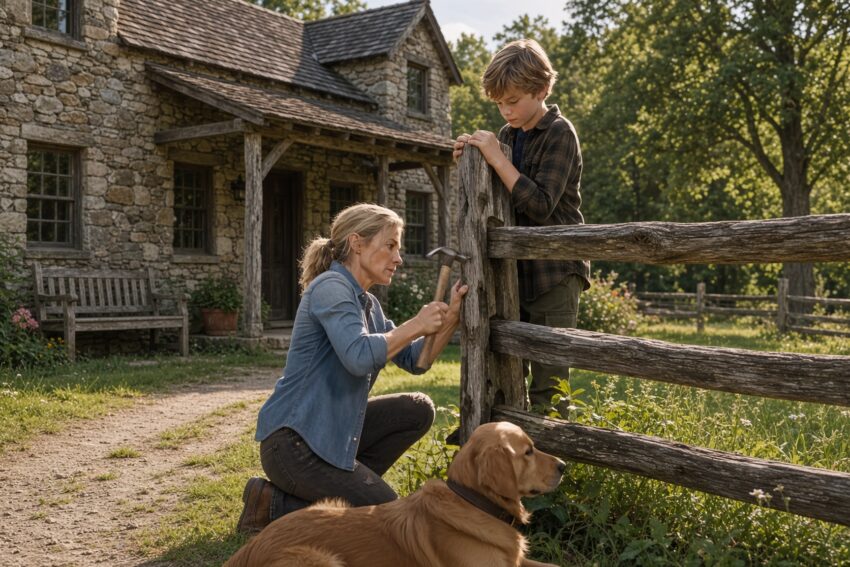
In the dream, perhaps, the dog was still in the grass by the stone cottage, and the hammer was still rising, and the trucks had not yet turned down the driveway.
Sarah did not allow herself that dream.
She allowed herself the next morning.
And the morning after that.
And a boy who would ask fewer questions when the days stayed dull.
That was the ending she could keep.
Not a last shot.
Not a last switch.
A string of unremarkable hours, guarded by a woman who had already pressed the only button that mattered, and who would not build another one, even if the dark came down the driveway again.
If it did, she would take the boy and the dog and the river would still be there, and the river did not keep lists.
Sarah turned off the lamp.
The room became a simple dark.
Outside, water hit the pilings in a rhythm that needed no architect.
She kept the carbine close without touching it.
She kept her eyes on the window until the window was only a paler rectangle.
Then she slept, and for the first time in three years the sleep did not begin with a well.
It began with a fence rail.
Toby’s hands on the post.
Cooper in the grass.
The hammer rising.
This time, in the dream, when the dog stood up, they were already gone.
The driveway stayed empty.
The trucks never arrived.
The red switch stayed behind a panel in a house that no longer existed, and the only thing it unlocked, in the end, was a road that ran north until the names on the mailboxes stopped meaning anything at all.
DISCLAIMER
This is original fiction written as a continuation of a short reel. It is not an official Part 2 and is not affiliated with the original clip or page.
Names, places, the Compact, and later events were invented. Not based on real people, families, companies, agencies, or events. Any resemblance is coincidental.
Contains fictional violence and pursuit. For entertainment only.