THE RED SWITCH IN THE LOG WALL
He promised his grandkids they were safe out here.
Then three black SUVs tore through the trees.
PART 2
———————————————————————
THE FENCE LINE
———————————————————————
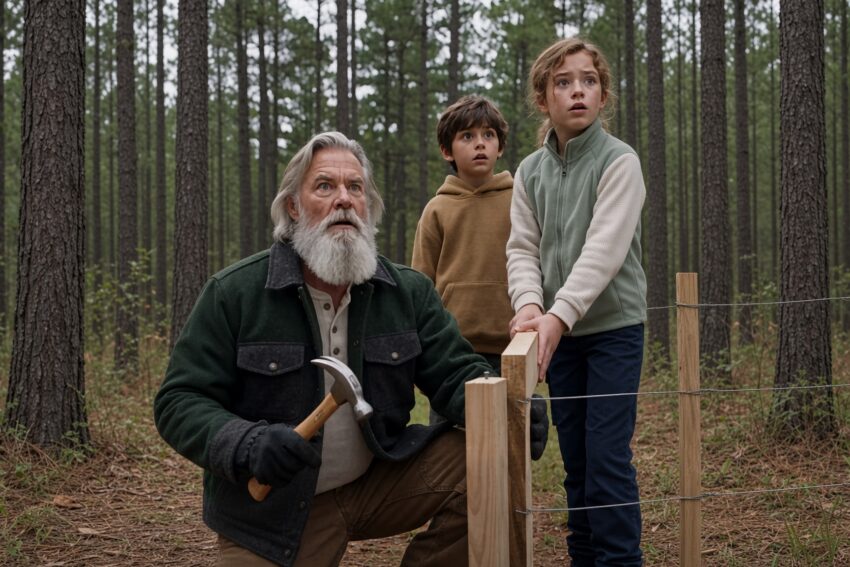
August Reed felt the trucks in the ground before he heard them.
The hammer was still up.
The nail was still waiting.
Eli stood close in the tan hoodie, watching the strike the way boys watch men they trust.
Willa held the timber steady in both hands, sage vest over cream sleeves, hair coming loose, taking the job seriously because that was how she loved people.
Pine needles under their boots.
Tall timber all around.
A log house behind them with a stone chimney and a metal roof and porch lights already burning though the afternoon was not gone.
It was supposed to be an ordinary day on a fence that did not need to keep anyone out.
Then the lane spoke.
Three black SUVs came through the trees in a wall of dust and did not slow for the open gate.
Headlights.
Brush guards.
Gravel screaming.
August’s mouth went dry.
“Oh shit,” he said. “They found me.”
Eli’s eyes went wide.
Willa did not let go of the post until August’s glove hit her shoulder.
He dropped the hammer.
“Run. Get to the house.”
He shoved both of them.
They ran.
The lawn was longer than it had ever been.
Behind them doors flew.
Masked men in black kit hit the dirt running.
Boots.
Rifles.
No badges that wanted to be read.
“Run to the house!”
Willa’s braid bounced.
Eli’s hoodie flapped.
August’s beard split in the wind.
“Almost there!”
“Get inside!”
They hit the porch boards.
They hit the door.
August threw the bolt.
The house went from gray daylight to warm log dark in one breath.
A wall lamp burned gold over the hall.
Boots hit the porch.
Eli looked up first.
Then Willa.
Tears already on her face.
“Grandpa, what’s happening?”
August did not answer the question.
He answered the clock.
Sweat ran into the white of his beard.
“I have to press the button now.”
He found the hidden cedar disc in the log wall with a hand that had practiced the motion for years and hoped it would stay practice.
The panel swung.
Inside a steel plate a red switch glowed like a coal.
He pressed it.
———————————————————————
THE CLICK
———————————————————————
The click was small.
Everything after it was not.
Steel slats dropped inside the window frames with a sound like a freight door slamming.
Dust jumped off the sills.
The porch lantern died.
Under the floor a generator coughed once and caught.
A low animal hum climbed the logs and settled in the beams.
Willa flinched into him.
Eli backed into the wall.
“Grandpa—”
“Listen first,” August said. “Then you can be scared. You get ten seconds of being scared. After that we move.”
The front door took the first hit.
Not a knock.
A ram.
The oak jumped in its frame.
The iron latch screamed.
August pulled them down the hall, one child in each hand.
The second hit came harder.
A seam in the floor that had looked like ordinary pine for eight years split along a cut he had made himself with a handsaw in the second winter.
Hydraulics hissed.
A rectangle of darkness opened at their feet.
Stairs went down into cold air that smelled of oil, concrete, and old paper.
“Eli first. Hand on the rail. Willa, you follow him. Do not let go of his hoodie. I’m right behind you.”
Eli went.
Willa went.
August followed and yanked the hatch.
It sealed with a rubber thump that killed the sound of the ram for half a second.
Then the house above them became a drum.
———————————————————————
THE ROOM UNDER THE HOUSE
———————————————————————
They were in a short concrete throat painted the color of wet stone.
Motion lights woke in sequence, pale and mean.
At the bottom the space opened into a room the size of a two-car garage that no inspector had ever been invited to measure.
Gun metal.
Gray lockers.
A steel table bolted to the floor.
A radio wall.
Two cots that had never been slept on.
A map of the county with pins that had not moved in eight years.
On the far wall, behind a grate, a second hatch stenciled:
CRAWL / WEST
Eli stood on the last stair with both hands on the rail.
“What is this?”
“The part of the house that isn’t a house,” August said.
Willa’s voice was smaller.
“Did you always have this?”
“Yes.”
“Under our kitchen?”
“Under everything.”
He crossed to a locker, spun a combination he had not spoken aloud since Willa’s ninth birthday, and opened it.
Three plate carriers in coyote tan.
A short rifle.
A pistol in a holster.
Ear protection.
A go-bag packed years ago, because the man who packs a bag after the knocking starts is already dead.
He did not put the rifle in their hands.
He put the smallest carrier over Willa’s vest and yanked the straps until they bit.
Then the middle one over Eli’s hoodie.
“Too tight,” Eli said.
“Good.”
Another crash upstairs.
Then a sound August hated more than the ram.
A saw.
They were cutting the door.
August keyed a panel.
Cameras he had buried in birdhouses and knotholes and the underside of the eave blinked onto a split screen.
Three black SUVs in the yard.
Nine masked men visible.
Two still in the trees on the east line.
One on the porch with a bar.
One kneeling at the south window with a charge.
Not a welfare visit.
Not anyone who wanted to be seen.
The patches on their shoulders were a gray thorn wreath on black.
He had burned that wreath in a barrel eight years ago and watched the nylon melt.
“They found the county,” he said.
Eli’s voice went thin.
“Who are they?”
“Masked men who think I stole something from them.”
“Did you?”
August looked at both of them.
Eli’s stubborn chin.
Willa’s too-careful eyes.
The same mouth their mother had.
“Yes,” he said. “I stole you.”
The charge on the south window went off.
The camera there turned white and died.
Dust rained from the bunker ceiling.
The generator did not even stutter.
He had overbuilt it on purpose, the way a guilty man overbuilds a coffin.
He slung the rifle, checked the chamber, and put his palm on the west hatch.
“We’re not staying to win the house,” he said. “The house is bait now. We take the crawl. It runs under the ridge to the old equipment shed. From there we have a truck that doesn’t look like a truck.”
He held both their faces.
“If we make the tree line before they map the heat, we get a head start. If we don’t, you do exactly what I say and you don’t look back at me. Say it. Both of you.”
Eli: “We do what you say. We don’t look back.”
Willa, after a beat: “We do what you say. We don’t look back.”
“Again.”
They said it again.
He opened the west hatch.
———————————————————————
THE TUBE
———————————————————————
The crawl was a corrugated tube barely wider than his shoulders.
He had laid it the year he poured the slab, graded so water would run out and not in.
He had dragged the sections himself at night with a come-along and a mule he later sold so no one would ask why an old man needed a mule.
Eli went first because he was longer in the limb and could pull Willa if she froze.
Willa went second.
August came last with the rifle across his forearms.
Dirt whispered against the metal.
Roots had found hairline seams and made pale fingers.
Behind them, through the sealed bunker, came boots in the hall.
Then a muffled shout when they found the floor hatch and discovered it did not open from their side without a code he had not written down anywhere a living person could find.
Two minutes in the tube.
Two and a half.
Willa’s breathing got loud.
“Keep going,” August said. “You’re doing it.”
Eli: “There’s a light.”
“That’s the shed. Don’t stand up until I say. Willa, stay on his heels.”
They came out into a space that had been a tractor shed on every form and a second skin on every night August could not sleep.
A dirty window.
A workbench.
Under a canvas tarp: a twenty-year-old farm truck with mud in the wheel wells and a cracked windshield that made it look honest.
Under the bench, in a crate marked FEED, was not feed.
August pulled the tarp.
“Eli, passenger floor. Willa, you get small behind the seat. Both of you stay down until I say up.”
They climbed in.
He dropped the seat-back just enough to hide the shape of two children from a casual sweep and not enough to suffocate them.
Then he did the thing that cost him four seconds he did not have.
He put one hand on Eli’s hair and one on the crown of Willa’s head, once, hard, like a blessing that had no religion left in it.
“I am going to start this truck loud,” he said. “When I do, they will hear it. That is the point. They will come to the noise. The noise is not where we stay.”
He did not start the truck.
He opened the crate, took a can, walked to the far corner where he had stacked old diesel jugs for a winter that never came, and laid a line that would look, in five minutes, like a farmer’s accident.
Then he lit a road flare from the glove box, tossed it onto the line, and only then turned the key.
The truck caught with a wet roar.
The shed began to think about burning.
August rolled out the back with the lights off, down a two-track that was not on any map, because he had planted pine over the first forty yards the spring after he bought the land.
Branches slapped the hood.
Willa made a sound in her throat and swallowed it.
Eli whispered a word that was almost a prayer and then shut up.
Behind them the shed went up with a sound like a chest opening.
On the ridge, the masked men would be turning, pointing, splitting.
Some toward fire.
Some toward the house they still believed held an old man and two kids.
That split was the only math August trusted.
———————————————————————
THE ROAD WITH NO STRIPE
———————————————————————
He drove without headlights until the two-track hit the old timber road.
Then he risked one running light and more speed than the ruts wanted to give.
Eli’s voice came from the floor.
“You said you stole us.”
“I did.”
“From who?”
“From the men in those trucks. And from a version of me I don’t get to be anymore.”
Silence.
The kind children make when they are deciding whether the truth is safer than the lie they have been living inside.
Willa, very small: “Are Mom and Dad dead because of you?”
The road tried to take the wheel.
He took it back.
“They died because they found the same thing I found,” he said. “I got there first. I lived. That is not the same as innocent.”
Eli sat up an inch before August’s hand pushed him down again.
“You told us it was a wreck. Weather. A wet road.”
“I told you a story a six-year-old and a five-year-old could sleep inside. You’re not those kids tonight.”
The timber road spat them onto a county two-lane with no stripe.
He turned south, because north was the gate and the gate was a mouth.
A black SUV would be on that mouth in minutes, if it was not already.
He needed distance.
He needed a phone that was not a phone.
He needed the one person left who still owed him a debt large enough to move at night.
Her name was Mara Ellison.
She had been his second in a life that used different last names.
She ran a diner now on a frontage road with a back room that was not a back room, and a boy who thought she had always fried eggs.
August had not spoken to her in seven years and eleven months.
That was the deal.
You do not call the dead unless the dead are the only ones who can still hear you.
He drove until the fuel light was a rumor and the fire behind them was just a color on the underside of the clouds.
Then he pulled into a closed gravel pit, killed the engine, and let the tick of cooling metal fill the cab.
“You can sit up.”
They climbed onto the seat.
Soot on Willa’s cheek.
The carriers still too tight.
They looked like children who had been dressed for someone else’s war.
Eli wiped his mouth with the back of his hand.
“The button. What did it really do?”
“Three things.”
August rubbed his face with a gloved hand and then realized the glove still had pine pitch on it from a life that had ended forty minutes ago.
“It locked the house so they would waste time. It armed a beacon I buried in the foundation. And it started a clock on a box that does not live in this county.”
He watched the pit entrance.
“If I don’t enter a code every six hours, that box sends everything I took to people who still believe in justice, and to papers that still print names. The masked men know that. That’s why they came with a ram instead of a knock.”
Willa: “So if they kill you—”
“The send still happens. That’s the only reason you’re still breathing in this truck. They need me alive long enough to turn the clock off. Or they need you, because they think I will turn it off for you.”
Eli stared at the dark windshield.
“Will you?”
August watched a moth beat itself against the glass.
“No,” he said. “And that is the ugliest sentence I have ever said to either of you. I will spend the rest of whatever night this is trying to make it untrue. But if it comes down to the send or you in a room with them, I press nothing. The send is how your mother still gets to win.”
Willa cried then, finally, without performance.
Eli put his arm around her like a boy who had practiced being older than he was.
August let them.
He did not pet their hair.
He kept his eyes on the pit entrance, because grief is how men like him get a bullet in the ear.
When they quieted, he started the truck again.
———————————————————————
THE PIE SIGN
———————————————————————
The diner was two hours if the roads stayed empty and forever if they did not.
They did not stay empty.
A pair of headlights far back on the two-lane held a distance that was too polite to be ordinary.
August took a farm spur, killed his own lights, and cut across a hayfield that punished the oil pan.
The polite headlights hesitated.
Then they followed the spur.
Then they stopped when the field had no road left in it.
He did not celebrate.
The masked men had machines in the air now.
They had money that bought patience.
Patience is just absence with a plan.
“Down,” he said.
Both kids went back to the floor without being told twice.
The diner sat on a frontage road with a neon pie that had been missing the P for years.
PIE, the sign said, like a dare.
August parked behind the dumpsters and sat for a full minute with the rifle across his knees.
“If I tell you to run to the kitchen, you run to the kitchen. There is a freezer with a false back. You get in and you stay in until a woman with a scar through her left eyebrow says the word threshold. Not before. Not another word. Threshold. Say it.”
Eli: “Threshold.”
Willa: “Threshold.”
He got out.
The back door opened before he knocked.
Mara Ellison filled it with a skillet in one hand and a compact pistol in the other, because some people retire the way snakes shed and keep the same teeth.
She looked at his face.
Then at the truck.
Then at the two shapes in the passenger well.
“You brought the clock to my pie sign,” she said.
“I brought the kids.”
Mara’s mouth flattened.
She had known their mother.
She had held Willa as a baby in a rented room that smelled like bleach and instant coffee.
She had taught Eli to shuffle cards when he was seven and the world still had a kitchen table in it.
She had also been the one who told August to disappear so completely that even she would have to wonder if the woods had eaten him.
“Inside,” she said. “All of you. The skillet is not a metaphor.”
They went through the kitchen.
The diner out front was dark, chairs up, a radio talking to no one about wheat prices.
Mara locked three locks that did not match and led them into the storeroom, then through the false wall into a space with no windows and a table that had seen better nights than dinners.
The kids stood close to August’s hips, one on each side.
Mara crouched so she was eye-level with both of them.
“You’re Eli. You’re Willa. You probably don’t remember me right. That’s a gift. Are you hurt?”
Two head shakes.
“Hungry?”
Two tiny nods.
Mara looked at August like she might hit him for the nods alone, then went back out and returned with a plate of cold roast and bread that was not a last meal if she could help it.
They ate standing up.
Children in flight eat like that.
“Talk,” Mara said.
August talked.
He told her about the fence.
The wreath patch.
The saw in the door.
The button.
The six-hour clock.
He told her the masked men had found the county, which meant someone had sold a record or a picture or a memory.
He told her the log house was gone as a home even if the walls were still standing.
Mara listened the way she used to listen in vans.
Without her face.
“Who led the stack?” she asked.
“Didn’t see a face. Movement said money. Not local boys playing dress-up. Their spacing was schoolhouse.”
“Merrick,” Mara said.
The name landed in the room like a tool falling off a bench.
Merrick had been the interior knife when the wreath still pretended it was only a company that guarded warehouses.
He had sat across from August once and smiled with only the bottom half of his face.
When the work went rotten — when the vans stopped moving witnesses and started moving inventory — Merrick did not get out.
He got the night shift with no witnesses.
“If Merrick is on the ground, this isn’t a pickup,” Mara said. “It’s erasure with a spare key. He’ll want the box, the codes, and two children he can sit in a room until an old man becomes reasonable.”
“I don’t have the box on me.”
“Where is it?”
August glanced at Eli and Willa, then away.
“Split. Three pieces. One in the bunker they are currently failing to open. One in a tin at a little bank under a name that died in ’98. One in a place I am not saying in a room with a radio.”
Mara almost smiled.
It did not improve her face.
“You still think like a man who expects to be put in a chair.”
“I think like a man who brought two children to a diner at one in the morning.”
Eli had stopped eating.
“I’m twelve.”
Willa: “I’m ten.”
“Even worse,” Mara said, and the gentleness in it was accidental and therefore real.
———————————————————————
THE PLAN
———————————————————————
They made a plan because plans are how fear is given a job.
Mara would move them before dawn in a bread truck that made legitimate drops.
August would not go to the little bank.
Merrick would have the obvious boxes watched.
The piece in the bunker was already a magnet.
The third piece was the one that mattered.
Reaching it meant going back toward the hills, not away — toward a fire lookout on forest land that had been shut down on paper and kept alive in secret by a man named Peck, who owed August a quieter debt than Mara’s.
Peck was seventy-six and half deaf and kept a dog that hated everyone equally.
The lookout had a line-of-sight radio and a hole under the floorboards that held the last third of what the masked men wanted buried.
Names.
Routes.
The rooms they called clinics in their own papers.
The money.
The men who had taken the silence and called it work.
If that third piece reached the box before the six-hour clocks ran out of mercy, the send would not be a rumor.
It would be a door kicked in by justice, slow and ugly and public enough that the next ram would cost someone a name.
If Merrick reached it first, there would be no August and no Eli and no Willa and no Mara.
And the diner would burn, because men like that do not leave witnesses with pie signs.
Eli listened to all of it with his jaw locked.
“I can help,” he said.
“You can do what you’re told,” August said.
“That’s not help.”
“Tonight it is the only help that keeps your sister breathing.”
Willa looked at her brother.
“Please just do it.”
Eli’s mouth worked.
Then he nodded once, sharp, like a door closing.
They left at 4:10 in a truck that smelled like yeast and diesel.
The kids slept against a rack of trays, Willa’s head on Eli’s shoulder, the carriers still on because August had not yet found a minute that felt like safety.
Mara drove.
August rode the passenger seat with the rifle under a delivery blanket and his eyes on every side road.
Dawn came up gray, the color of galvanized steel.
———————————————————————
THE LOOKOUT
———————————————————————
They were on a forest track west of the big reservoir when Mara said, “Company.”
Not headlights.
A sound.
Blades, far but not far enough, beating the canopy in a search pattern.
“Kids in the back. Stay flat. If they mark the truck I will ditch on the switchback and you take the drainage. Peck’s tower is six miles as the miserable walk. You remember the cairns?”
“I built two of them.”
“Then don’t get sentimental and die on the third.”
The machine in the air did not see them.
It saw a heat shimmer two ridges over that might have been a deer and might have been a flare Merrick’s people had dropped to see who ran.
August did not run.
Running is a language masked men speak fluently.
They dumped the bread truck in a turnout used by hunters and went the rest of the way on foot.
Off-trail.
Kids between the adults.
August counting their steps, because a twelve-year-old and a ten-year-old do not do six miles of deadfall after a night like that without a bill coming due.
Willa fell twice.
Eli picked her up once before August could.
August picked her up the second time.
He did not say they were brave.
Brave is a word adults use to make children carry more.
The lookout stood on a knuckle of rock above a sea of pine.
Peck was on the catwalk with a mug and a shotgun, as if the last twenty years had been a single afternoon.
He looked at August.
He looked at the boy.
He looked at the girl.
He looked at Mara.
“You were supposed to be a rumor,” Peck said.
“Merrick is on the county,” August said. “We need the hole.”
Peck spat off the catwalk.
“Then you better come up before the rumor grows rotors.”
The third piece was in a steel can wrapped in oilcloth, buried under a floorboard Peck had worn smooth by standing on his own secret for a decade.
August opened it with hands that were suddenly old.
Inside: drives in a sleeve that ate signals.
A paper key written in a cipher their mother had invented as a joke when she was still alive and mean enough to laugh at powerful men.
And a photograph August had not known Peck kept.
Four people on a porch that was not yet a fortress.
August.
A woman with Willa’s mouth.
A man with Eli’s stubborn chin.
The two kids smaller.
The dead, smiling like the future was a road and not a cliff.
Willa saw the photograph before he could turn it.
Eli saw it a half-second later.
Neither asked if that was them.
They already knew.
Willa took the photo with two fingers and put it in the zip pocket of her vest.
Eli did not try to take it from her.
He just looked at August like a boy measuring a man.
August sat on the floor of the lookout and worked.
———————————————————————
FOURTEEN MINUTES
———————————————————————
The cipher.
The radio.
The window of clean sky that would only last fourteen minutes.
Mara watched the trees.
Peck watched the air.
Eli stood at the south window like he wanted a job.
Willa sat with her back against the wall and the photograph and did not pretend to be useful, which was a mercy.
The first drive woke.
The second.
Names unspooled.
Routes.
Rooms.
Transfer pages.
A file August did not open, because there are things you do not put in a ten-year-old’s air, and only a few more you put in a twelve-year-old’s.
He sent.
Packet by packet, into the dark, toward the box that would either wake justice or die in a locked room depending on who had been paid more this year.
The six-hour clock in the cabin foundation was someone else’s problem now.
This was the real clock.
Fourteen minutes.
Thirteen.
Twelve.
At nine minutes the dog started barking.
Peck moved to the south window.
“Two trucks on the service ribbon. One bird coming around the east saddle. They found my road, August. They found it because you found me.”
“I know.”
“You going to finish or you going to shoot?”
“Both.”
He sent the last brick at minute six.
The bar crawled like a coward.
Mara took the south stairs down to the first landing with Peck’s shotgun, because a pistol is a conversation and a shotgun is a period.
Eli said, “Grandpa.”
“I hear you.”
“If they get in—”
“They won’t.”
Willa: “If they do. The word was threshold. Is there a word here?”
August looked at both of them and felt the eight years collapse into a single cheap second.
“The word here is porch,” he said. “Like the one in the picture. You hear me say porch, you go through the floor hatch behind the stove and you crawl until the rock tells you to stop. You do not come out for my voice. Only for porch. Only from me. Understand?”
Eli: “Porch.”
Willa: “Porch.”
The bar hit complete.
A tone.
Ugly.
Beautiful.
Done.
August had just enough time to shut the sleeve and kick the can back into the hole before the first round hit the lookout’s tin roof and made it sound like hail with a purpose.
“Down.”
They went behind the stove.
———————————————————————
THE TOWER
———————————————————————
Mara fired from the landing.
Someone in the trees fired back.
The round punched a hole in the map on the wall, right through a county August had circled in red eight years earlier, as if the future had been waiting for the paper to catch up.
Peck laughed once, a dry stick breaking.
“Forgot how much I hate this part.”
They held the tower for eleven minutes.
That is a long time when the walls are glass and wood and memory.
The masked men stacked the east slope the way they had stacked the cabin yard.
Patient.
Sure.
Merrick’s voice came up from the trees on a loudhailer, smooth as a closing argument.
“Reed. You sent it. I know you sent it. That was the noble version of you. Come down and we only need the children to check a few keys. They will be treated gentle. You have my word.”
August did not answer a loudhailer.
He had learned that in a different county with a different name.
Merrick tried again.
“You press nothing now, old man. The send is already a problem for people above me. Do not make it a corpse problem. Send the kids out. Keep your stand. I can sell that.”
Willa, from behind the stove, whispered, “Don’t.”
Eli: “Grandpa. Don’t.”
“I wasn’t going to.”
A flash can clacked against the catwalk and cooked off.
Light like a nail in the eye.
August’s ears rang in the old familiar key.
When he could see again, two masked men were on the stairs.
Mara had already shot the first one through the thigh and the second one through the place where the plate does not cover if you raise your arm wrong.
The first one still tried to climb.
Peck put the shotgun over the sill and ended the trying.
Eli made a sound and bit it off.
Willa had her face in her brother’s sleeve.
“Tower’s done,” Peck said, almost kindly. “You take the hole. I’ll keep the door company.”
“Peck—”
“I am seventy-six years old and my dog is meaner than my kids. Go.”
August grabbed both children from behind the stove.
He did not say thank you, because Peck would have hated it.
He went through the floor hatch into a space that was less a tunnel than a wound in the rock, a miner’s mistake from a century ago that Peck had kept open with timber and spite.
They crawled.
Eli first.
Willa second.
August last.
Above them the lookout became a different kind of thunder.
Shotgun.
Rifle.
A man shouting a name that was not Peck’s.
Then a sound August recognized from too many roofs.
A charge placed by someone who had decided the building was no longer useful.
The blast traveled through stone as a dull shove.
Dust.
Willa coughed and kept crawling, because the only other option was the option she had promised not to take.
Eli reached back once without looking and found her wrist.
They came out in a notch above a drainage that ran toward a logging road older than the wreath, older than August, older than the idea that secrets stay buried if you put enough pine on them.
Mara was already there, bleeding from the hairline, shotgun gone, pistol up.
“Peck?” August asked.
Mara shook her head once.
Eli looked at the trees like he wanted to go back.
August put a hand on his chest.
“No.”
That was the whole speech.
———————————————————————
THE MARKET
———————————————————————
They moved.
The logging road.
A second stolen truck, a forest beater Peck had kept for parts.
The long ugly hour toward a highway.
The knowledge that sending the files is not the same as surviving the files.
The masked men would be sloppy now.
Sloppy is how more people die, including the people who thought a diner and a lookout were enough.
They made a motel outside a lake town, because motels are where the country hides its unfinished business.
August paid cash.
Mara taped her head.
The kids sat on the bed with the photograph between them and did not turn on the television, because the television would eventually say a name and they were not ready for the world to know their mother’s face as a story.
At 2:14 in the afternoon Mara’s other phone — the one that was not a phone — buzzed.
A contact who still sat close enough to a justice desk.
Confirmation.
Packets received.
Partial proof.
A paper already moving a name.
A man in a suit already calling for a car.
Merrick had not called for a car.
Merrick was still in the county, which meant Merrick was not finished.
August stood at the window with the curtain in his fist.
“He will come for them until the story is too loud to bury,” he said. “So we make it louder.”
“How?” Mara asked.
“We don’t hide them. We put them where cameras already live. Not a stage. A market. A crowd that isn’t ours. We make the next grab a public mistake. Police hate a mess they didn’t plan. Justice hates a film of children being taken in daylight.”
“That’s using them.”
“Yes,” August said, and the word sat in the room like a fourth person. “I have been using their lives as a reason to stay human for eight years. Today I use their faces as a shield. If you have a cleaner idea that keeps them breathing, put it on the table.”
Mara had no cleaner idea.
Eli listened to all of it with his fists on his knees.
“I’ll do it,” he said.
Willa looked at him, then at August.
“Me too.”
August turned.
“You don’t know what you’re agreeing to.”
Eli: “I know they killed Mom and Dad. I know they wrecked the house. I know Peck is dead because we went to his tower. I can stand in a crowd.”
Willa: “I’m not little.”
They were little.
That was the whole wound.
They chose a Saturday market in town because Saturday markets have phones and mothers and men who film everything that is not their business.
August hated it.
He did it anyway.
They walked the kids through the stalls with Mara twenty yards off and August closer, no rifle, just the pistol and the look of a grandfather buying cider.
Eli stayed half a step in front of Willa without being asked.
For twelve minutes it was almost a life.
Then Merrick tried it anyway, because arrogance is a kind of faith.
A van on the cross street.
Two men in clothes that were trying to be local and failing in the shoulders.
They came at the kids between the honey stall and the kettle corn like they had practiced on different children.
August did not draw first.
A woman with a stroller screamed first, which was better than a gun.
Phones came up.
The market became a throat.
The two men understood the new math a half-second late.
Mara was already on the near one with the compact pistol under her jacket, not firing, just present, a fact.
August put his body in front of both kids and looked at the second man until the second man remembered that some old men are not old in the way that matters.
Eli had grabbed Willa’s sleeve hard enough to leave a mark.
A market cop in a short-sleeve shirt pushed through the crush late and loud, which was still useful.
The van left without its passengers’ dignity.
No shots.
Better.
By evening the phones had done what the box had started.
Not the whole truth.
Enough of a shape.
Two kids.
A market.
Masked work in daylight clothes.
A cabin county.
A company name that leaked from a clerk who wanted to sleep at night.
Merrick went dark.
A statement went out about unauthorized men.
The statement was a lie in a nice font.
———————————————————————
WHAT WAS LEFT
———————————————————————
August did not get to go back to the log house.
The house was tape and questions and a box of lumber that had once been a life.
Police walked the yard and photographed the posts he had been nailing when the gate broke.
They bagged the hammer in the grass.
They found the panel and the glowing red switch and did not understand it yet, which was fine.
Understanding would come the slow way, through paper and stubborn people.
He stood in the motel parking lot that night after the kids finally slept and let the fact of it hit him in order.
The fence.
The hammer.
The red button behind the cedar.
The promise he had kept and the ones he had burned to keep it.
Mara came out with two paper cups of bad coffee.
“They’ll ask again tomorrow,” Mara said. “What you were. Why they wanted you. Whether you’re good.”
“I’m not.”
“I know. Tell them the true version anyway. Kids can smell the other kind. Especially that boy.”
He told them the true version in the morning, in short pieces, because that is the only way a story like that can be carried.
He had run a quiet crew that moved people who knew too much and plugged leaks that would have gotten those people killed.
The wreath had been a vendor, then a partner, then a parasite.
When the vans started disappearing the wrong witnesses — when the clinic memos crossed his desk — he had tried to cut them out from inside.
Their mother and father had been the ones who found the rooms first, independently, with a camera and a stubbornness he had given them by accident.
The masked work killed them on a coastal road and made it weather.
August got to the wreck.
He got to the two children in the back seat who were still buckled and still alive, because some mercies are stupid and random.
He took them.
He took the files.
He buried both in pine and fence-line and waited for the world to either forget him or come through a gate.
The world had come through the gate.
“I should have told you when you were old enough to hate me for it,” he said.
Eli sat with his knees up on the motel bed.
Willa sat against the headboard with the photograph in both hands.
Eli: “I don’t hate you.”
Willa: “Me neither.”
“You can later. I’ll still be here.”
Eli: “Are they going to keep coming?”
“Some of them. Not like before. Light is a kind of weapon. Not a perfect one. We will move. We will use other names for a while. You will go to a school that doesn’t know this story until you decide it can. I will not nail fence posts in a yard that can be seen from a road.”
Willa: “Will you still teach us how to build?”
August looked at his hands.
Pitch.
Blood that was not his.
The shake that arrives when the shooting stops and the bill comes.
“Yes,” he said. “On a different piece of ground. With a door that is only a door.”
———————————————————————
CONTINUATION
———————————————————————
They did not get a clean ending.
Clean endings are for people who never pressed the button.
What they got was a week of motels, then names that were almost true, then a rented place near a town too boring for machines in the air.
What they got was justice moving the way justice moves — late, partial, loud in the wrong rooms and quiet in the right ones.
Some of the masked men got picked up on the county road with guns that did not match their stories.
Some vanished into other work and other patches.
A paper ran a piece with no photographs of the kids.
A police captain in a small office drank bad coffee and decided he believed the old man just enough to keep a car on the lake road for a month.
Merrick’s name surfaced once in a file and then sank again, which is how knives like him survive.
August did not hunt him.
Hunting would have made Eli and Willa orphans of a different kind.
He had already been that man.
He was trying, clumsily, to be the other one.
On a wet Thursday they came in from the new school with questions they had saved all day.
Eli went first, because he always did now.
“If the button was still there,” he said, “and they came again, would you press it?”
August stood at the sink with a plate in his hand and the rain stitching the window.
“Yes.”
Willa: “Even knowing Peck. And the diner. And the market.”
“Yes.”
They nodded, as if they had needed the ugly answer more than the soft one.
Eli: “Then I want my own button. Not a real one. A plan. So I’m not just the kid who gets told to crawl.”
Willa: “Me too.”
He dried his hands.
They sat at the table that was only a table, and he gave them the first honest lessons of his second life.
How to leave a house.
How to tell a lie that keeps you alive without poisoning you.
How to find the person in a room who will help because they remember being small.
How to keep a photograph without letting it become a cage.
How to walk toward police when police are the lesser danger, and how to know the difference.
How a brother watches a sister in a crowd.
How a sister watches a brother when he wants to be a weapon too early.
He did not give them a gun.
He gave them a language for fear that was not silence.
Outside, the alder moved in the rain.
The road stayed empty.
Far away, in a county of pine and ruined fence, a red switch sat behind a panel in a log house that no longer belonged to anyone, waiting for a thumb that would not come back.
The thing under the floor had already woken.
It had a name now, and two faces, and two children who knew the words threshold and porch and yes.
Spring came late.
They planted two posts in the new yard.
Eli held the rail.
Willa held the first nail.
August remembered how to miss a strike on purpose so they could laugh at him.
No gate at the end of the drive.
Just a grate and a stretch of road that went to a town where people still waved.
Sometimes a black SUV passed and all three of them went still in the old way.
Sometimes it was only a black SUV.
Mara sent a postcard with no return address and a single word — threshold — which meant she was alive and the skillet was still a skillet.
Willa kept the photograph in a drawer, then on a shelf, then back in the drawer when the shelf felt like a shrine.
Eli asked, once, if their mother had been brave or just angry.
“Both,” August said. “That’s the only combination that ever changes anything.”
And late, when the kids were asleep and the rented house made rented-house sounds, August sat at a table that was only a table and wrote down the rest so that if the next gate broke and he was not fast enough, they would have the story in his actual sentences, not in a feed.
He wrote about the hammer.
He wrote about the dust on the road.
He wrote about the red switch and the way a small click can be the loudest sound a life makes.
He wrote that he had spent eight years trying to be a grandfather instead of a weapon, and that the world had asked him to be both in the same afternoon, and that he had chosen the kids every time it was a real choice, including the times it did not look like it.
He wrote that Peck had been seventy-six and had laughed.
He wrote that Eli had wanted to go back for him.
He wrote that Willa had kept crawling with dust in her mouth.
He wrote that love, in the end, is not the cabin.
It is the running toward the cabin with a grandson’s hoodie in one hand and a granddaughter’s vest in the other, and the decision, when the door slams, to press the thing you swore you would never press.
Not because you want the war.
Because the war already knows your name.
Then he turned off the light.
In the dark, the rented house was just a house.
For one night, that was enough.
That was the rest of the story.
Not victory.
Continuation.
The only ending a man like August Reed was ever going to earn.
———————————————————————
DISCLAIMER
———————————————————————
This is a work of fiction written for entertainment. It is an original continuation inspired by a short internet video and a public story prompt. The characters, groups, places, and events are invented. Any resemblance to real people, living or dead, real organizations, real towns, or real incidents is coincidental. Nothing here is a report, an accusation, or a set of instructions. It is a made-up thriller meant to be read as a story, nothing more.